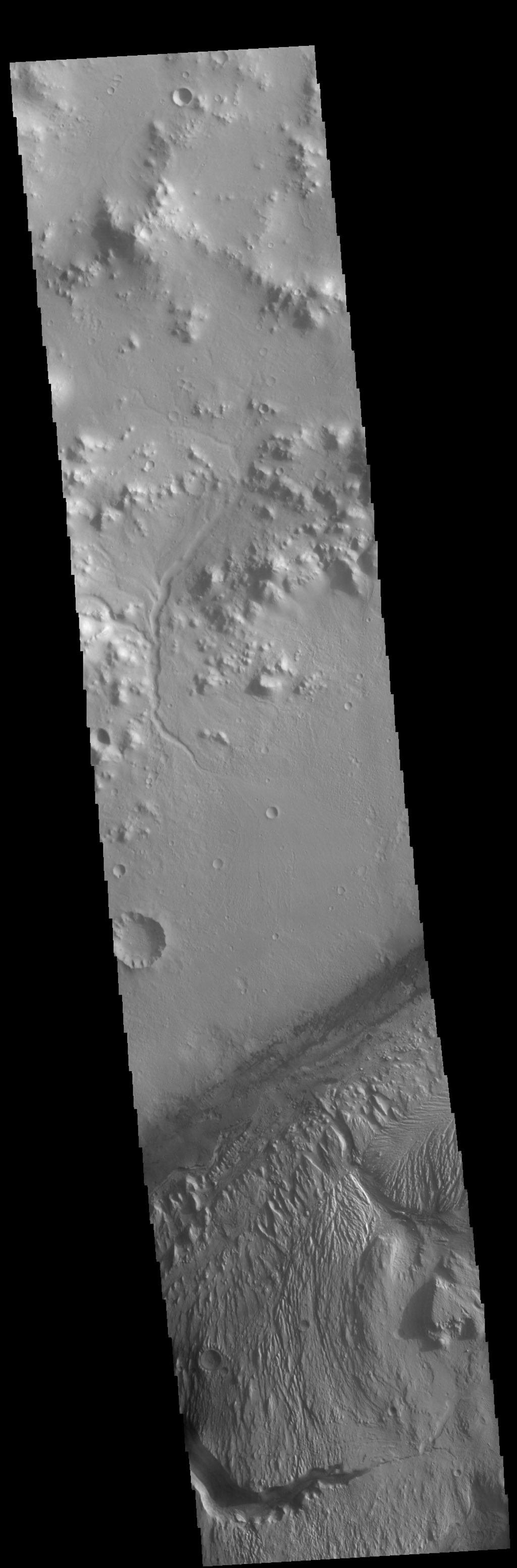
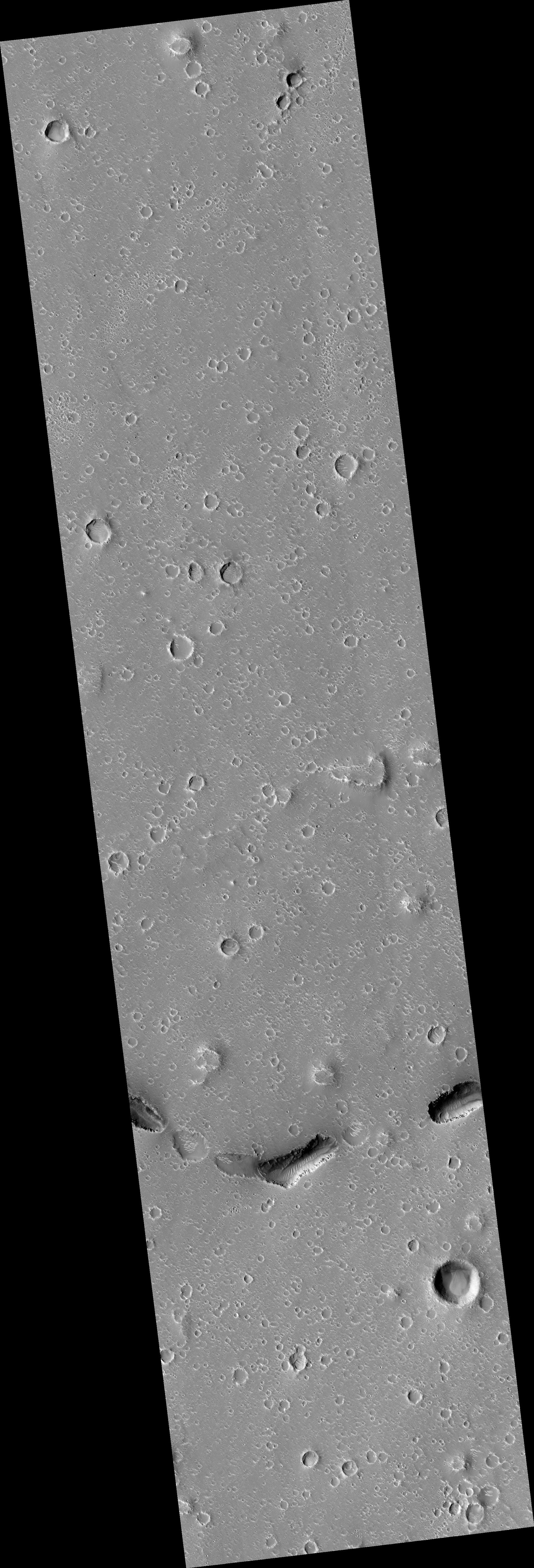
The nearest hill to China’s Zhurong

Pitted cone near Zhurong
Click for full image.

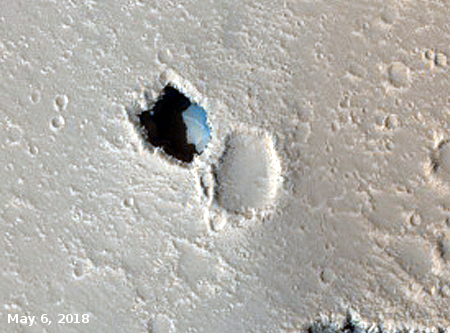
Cool image time! The science team for the high resolution camera on Mars Reconnaissance Orbiter (MRO) today released a pair of images the camera took on June 28, 2021 of the nearest pitted cone to China’s Zhurong rover.

The stereo anaglyph to the right, cropped and reduced to post here, allows you, with blue-red 3D glasses, to see the cone in three dimensions. Quite impressive. As noted by Alfred McEwen of the Lunar & Planetary Laboratory in Arizona in his caption,

This image completed a stereo pair of a region just west of where the Zhurong rover landed in southern Utopia Planitia.

The cutout is from a portion of the stereo anaglyph, showing an enigmatic pitted cone. Is this cone composed of sediments or volcanic materials? The sharp bright features surrounding the cone are aeolian (wind-blown) landforms.

According to McEwan, the hill itself is about 200 to 220 feet high, with the pit at its top about 60-65 feet deep.

While McEwan has told me this cone would be his primary target if he was running Zhurong, it appears the Chinese are instead heading south toward the largest nearby crater, and on the way inspecting the parachute, fairing, and heat shield discarded just prior to landing.

The mosaic below from three MRO context camera images provides a wider overview.
» Read more

4 comments

Fractured crater close to the Phoenix lander on Mars

Fractured crater on Mars
Click for full image.

Cool image time! The photo to the right, cropped to post here, was taken on May 3, 2021 by the high resolution camera on Mars Reconnaissance Orbiter (MRO). It shows a remarkably fractured crater that lies only a few miles to the southeast of where the now-inactive Phoenix lander put down back in 2008, at the very high latitude of 69 degrees north.

Phoenix was purposely sent to this high latitude to find out what the ground and atmosphere was like there. It found the following:

Phoenix’s preliminary science accomplishments advance the goal of studying whether the Martian arctic environment has ever been favorable for microbes. Additional findings include documenting a mildly alkaline soil environment unlike any found by earlier Mars missions; finding small concentrations of salts that could be nutrients for life; discovering perchlorate salt, which has implications for ice and soil properties; and finding calcium carbonate, a marker of effects of liquid water.

Phoenix findings also support the goal of learning the history of water on Mars. These findings include excavating soil above the ice table, revealing at least two distinct types of ice deposits; observing snow descending from clouds; providing a mission-long weather record, with data on temperature, pressure, humidity and wind; observations of haze, clouds, frost and whirlwinds; and coordinating with NASA’s Mars Reconnaissance Orbiter to perform simultaneous ground and orbital observations of Martian weather.

Below is an overview map showing the location of both this crater and the Phoenix lander.
» Read more

0 comments

A hiker’s view from Mount Sharp

A hiker's view of Gale Crater, taken by Curiosity
Click for full image.

A quick cool image! The photo to the right, reduced to post here, was taken yesterday by Curiosity’s left navigation camera. It looks west across the floor of Gale Crater, at the base of a nearby butte.

The crater rim, as seen by the distant mountains, is about 25 miles away. The butte that towers above Curiosity is probably no more than 50 feet high.

Below is a panorama showing the full view to the west, with Navarro Mountain (the nearby 450-foot-high foothill at the base of Mount Sharp) on the left edge. Based on the rover’s planned route, it will travel to the right of the butte rather than climbing up onto the saddle on the left. This will take it to the western side of Navarro Mt, where it will eventually head south into the canyon Gediz Vallis.
» Read more

4 comments

Update on Ingenuity’s 10th flight and Perseverance’s first sample drilling

Ingenuity landing at end of 10th flight

The news coming from the Perseverance and Ingeniuty science teams has been sparse this past weekend, even though Perseverance had begun drilling its first core sample that it will stored for pickup by a later unmanned robot, and Ingenuity had attempted its 10th and most challenging flight yet.

We do have images however, and the two to the right give us hints about what has happened.

First, the top picture on the right was taken by Ingenuity’s navigation camera just prior to landing. The camera looks straight down and is used by the helicopter to adjust its flight. The dark area is the helicopter’s shadow. Based on this picture and the four preceding images (taken over an eleven second period), it appears the helicopter was landing safely. No other images have yet been downloaded, nor has the Ingenuity team announced any results, so we do not yet know if the flight proceeded as planned.

UPDATE: The flight was a success, as per this JPL announcement:

With the #MarsHelicopter’s #flight success today, we crossed its 1-mile total distance flown to date. It targeted an area called “Raised Ridges,” named for its #geographic features. Flight 10 is #Ingenuity’s most complex flight profile yet, with 10 distinct waypoints and a new #record height of 40 feet (12 meters).

Drill and core sample in the ground

The second image, taken by Perseverance’s left navigation camera and cropped and reduced to post here, is more puzzling. It shows what appears to be the core sample still in the ground after drilling. While this could be entirely as planned, it seems very surprising. Most of what I can find online describing the operation for obtaining these samples implies that the robot arm would drill the hole, and then retract the sample immediately to place it in storage. Nothing suggests the arm would be retracted with the sample still in the ground.

I think however the odds of this picture revealing a problem are low. This JPL press release from February 2021 implies vaguely that the core sample will be released in this manner before retraction. After the core sample, with bit, is separated from the arm, the release suggests they will lift the arm away to inspect the drilling process, then return the arm to retract the core sample for storage. This does make some sense, though grabbing that sample again will be quite challenging.

If this was not supposed to happen as described, then there is a problem that must be resolved. I expect more details in the next day or so to clarify this situation.

5 comments

Ingenuity’s next flight set for today

Flight plan for Ingenuity's 10th flight
Click for full image.

Though circumstances can obviously change, the Ingenuity/Perseverance science teams have scheduled Ingenuity’s 10th Martian flight for sometime later today, with a flight plan, shown to the right, that is even more ambitious.

Flight 10 will allow us to reap the benefits of our previous flight. Scheduled for no earlier than this Saturday (July 24), Flight 10 will target an area called the “Raised Ridges” (RR), named for the geographic features that start approximately 164 feet (50 meters) south-by-southwest of our current location. We will be imaging Raised Ridges because it’s an area that Perseverance scientists find intriguing and are considering visiting sometime in the future.

From navigation and performance perspectives, Flight 10 will be our most complex flight to date, with 10 distinct waypoints and a nominal altitude of 40 feet (12 meters). It begins with Ingenuity taking off from its sixth airfield and climbing to the new record height. It will then head south-by-southwest about 165 feet (50 meters), where upon hitting our second waypoint, take our first Return to Earth (RTE) camera image of the Raised Ridges, looking south. Next, we’ll translate sideways to waypoint 3 and take our next RTE image – again looking south at Raised Ridges.

Imagery experts at JPL hope to combine the overlapping data from these two images to generate one stereo image. Flying farther to the west, we’ll try for another stereo pair of images (waypoints 4 and 5), then head northwest for two more sets of stereo pairs at waypoints 6 and 7 as well as 8 and 9. Then, Ingenuity will turn northeast, landing at its seventh airfield – about 310 feet (95 meters) west of airfield 6. Total time in the air is expected to be about 165 second.

Unlike the previous flights, this one will involve several turns while in the air. The engineers are definitely pushing the envelope with each flight, thus not only gathering scientific data about Jezero Crater but also advancing their engineering knowledge on the art of robotic flying on Mars.

3 comments

Ice, lava, quakes, and faults, all in one Martian image

A lot of geology in one picture
Click for full image.

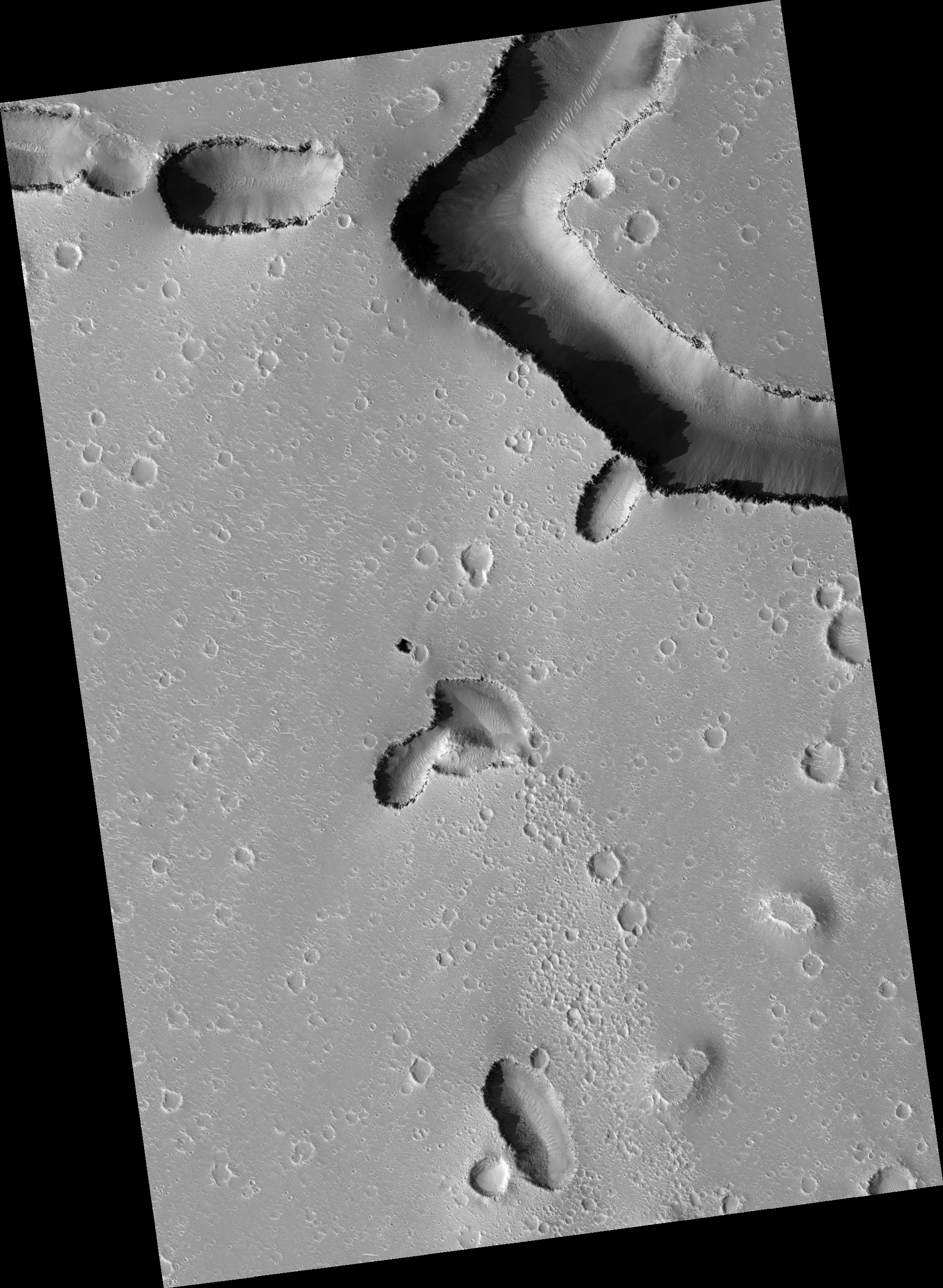
Cool image time! The photo to the right, rotated, cropped, and reduced to post here, was taken by the high resolution camera on Mars Reconnaissance Orbiter (MRO) on April 25, 2021. It grabbed my attention because it possibly captures a whole range of Martian geological processes, all in one place, including evidence of quakes, of lava, of faults, and possibly of glaciers.

First, ignore the black rectangle, which is merely a small section of lost data.

The picture itself shows a wide north-south fissure, as indicated by the distinct western cliff and the fainter and less pronounced eastern cliff. This fissure, likely formed along a fault, was created when the crust was pushed and stretched upward by the pressure of underground volcanic magma, part of the long series of eruptions that formed the many similar and parallel north-south fissures south of the shield volcano Alba Mons.

The overview map below illustrates this fissure’s relationship with Alba Mons.
» Read more

0 comments

Global dust storm on Mars brought on an early spring in southern hemisphere

Scientists analyzing the climate effects from the 2018 global dust storm on Mars have found that while it did little to change the seasons in the northern hemisphere, it caused winter to end early in southern hemisphere.

The team found that the 2018 storm had profoundly different effects in each hemisphere. At the south pole, where the vortex was almost destroyed, temperatures rose and wind speeds fell dramatically. While the vortex may have already been starting to decay due to the onset of spring, the dust storm appears to have had a decisive effect in ending winter early.

The northern polar vortex, by contrast, remained stable and the onset of autumn followed its usual pattern. However, the normally elliptical northern vortex was changed by the storm to become more symmetrical. The researchers link this to the high dust content in the atmosphere suppressing atmospheric waves caused by the extreme topography in the northern hemisphere, which has volcanoes over twice as tall as Mount Everest and craters as deep as terrestrial mountains.

These differences are likely also related to the eccentricity in the Martian orbit around the Sun, which is greater than that of Earth and actually has a direct effect on its seasons. As noted in this recently published paper about the activity scientists have now documented on the Martian surface in the past decade,

Because perihelion (the closest approach to the Sun) currently occurs [during summer in the south], southern hemisphere seasons are more extreme, with a longer winter and shorter, warmer summer

This difference is probably a major factor explaining the different effects of the global dust storm. It also is probably why the Red Planet’s two polar ice caps are so different.

This difference between the two hemispheres will also likely help drive the intitial human settlement on Mars to the north. Not only does the northern hemisphere have the flat lowland plains, making those first difficult landings easier and safer, it has a more benign climate year round.

1 comment

Scientists refine Martian interior based on quakes detected by InSight

Martian quake map as seen by InSight

Scientists today published three studies in the journal Science outlining their conclusions about the interior of Mars, based on the quakes that have been detected by InSight since it arrived on Mars in November 2018.

Reporting in a trio of studies published in the July 23rd Science, the Insight science team has now analyzed about 10 marsquakes to make the first direct observations of the structure within another rocky planet. The results — a surprisingly thin crust, an undifferentiated mantle, and a larger-than-expected core — will help determine how Mars formed and evolved.

There results are essentially what was described in April by the InSight science team at the annual 52nd Lunar and Planetary Science Conference (and reported here but no where else), though now more carefully and thoroughly described.

The discovery that the Martian crust is much thinner than expected, either 12 or 24 miles thick, with a core that is still liquid, has ramifications that might help explain both the planet’s formation and its volcanic history and giant volcanoes.

One piece of good engineering news in connection with the lander InSight:

Despite a dust-fueled energy crisis earlier this year, the solar-powered lander has since regained some power-generating capacity. “We are at least safe for this season’s winter and probably far into 2022,” Stähler says.

0 comments

The wind-swept volcanic ash plains of Mars

Overview map

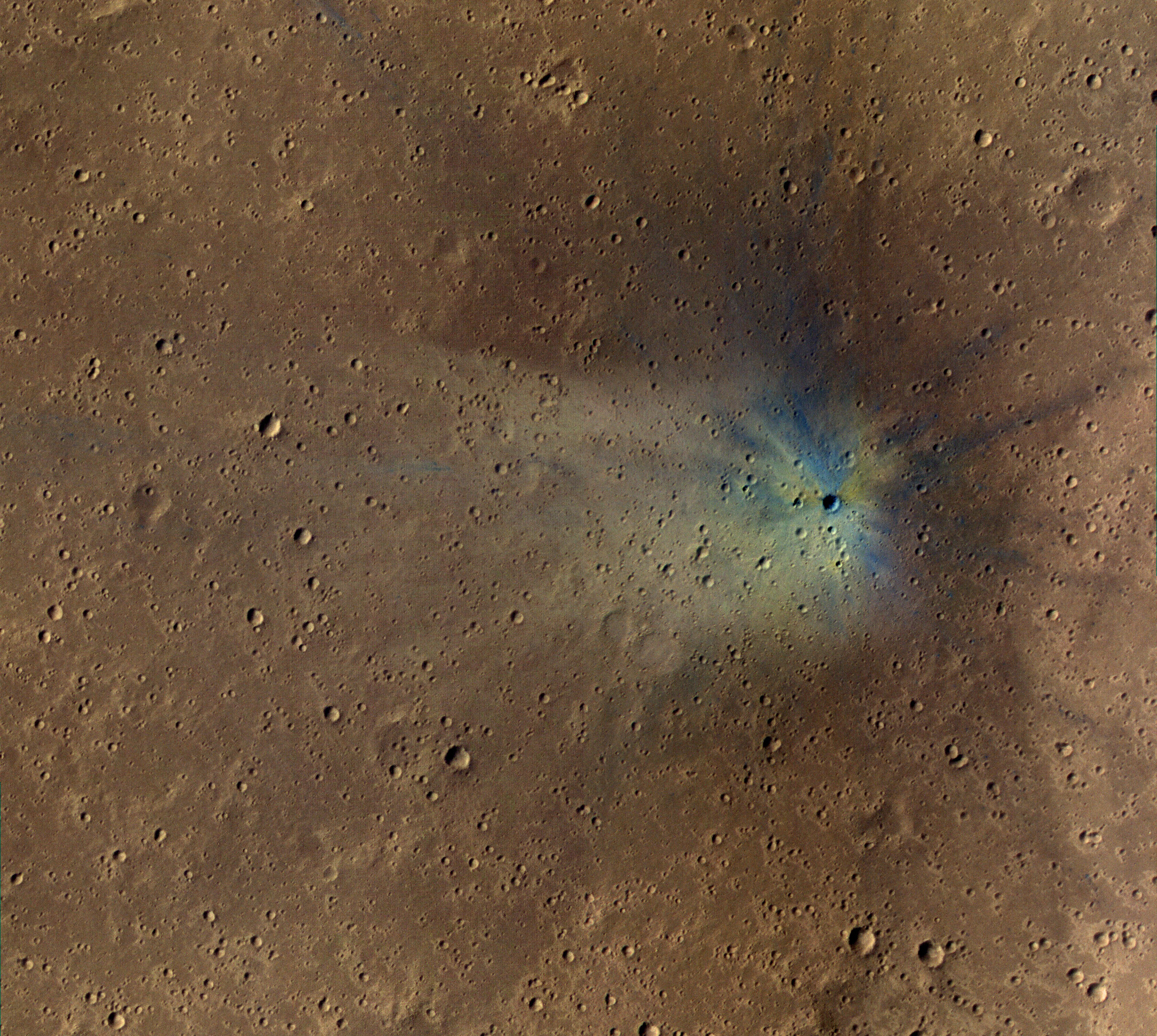
Cool image time! In Mars’ volcano country lies the planet’s largest ash deposit, dubbed the Medusae Fossae Formation. Scientists believe that this gigantic deposit, with a size comparable to the nation of India, was laid down by muliple volcanic eruptions over several billion years and is the source of most of the dust seen on the Red Planet.

The overview map on the right shows the location of this ash deposit on Mars. The white cross indicates the location of today’s cool image, found below.
» Read more

1 comment

It’s drill time for Perseverance!

The Perservance science team is preparing the rover for its first drill hole and the first collection of a sample to cache so that a future spacecraft can return it to Earth.

They are presently at the general location where they wish to drill, and are looking for the exact right spot.

The sampling sequence begins with the rover placing everything necessary for sampling within reach of its 7-foot (2-meter) long robotic arm. It will then perform an imagery survey, so NASA’s science team can determine the exact location for taking the first sample, and a separate target site in the same area for “proximity science.”

“The idea is to get valuable data on the rock we are about to sample by finding its geologic twin and performing detailed in-situ analysis,” said science campaign co-lead Vivian Sun, from NASA’s Jet Propulsion Laboratory in Southern California. “On the geologic double, first we use an abrading bit to scrape off the top layers of rock and dust to expose fresh, unweathered surfaces, blow it clean with our Gas Dust Removal Tool, and then get up close and personal with our turret-mounted proximity science instruments SHERLOC, PIXL, and WATSON.”

“After our pre-coring science is complete, we will limit rover tasks for a sol, or a Martian day,” said Sun. “This will allow the rover to fully charge its battery for the events of the following day.”

Sampling day kicks off with the sample-handling arm within the Adaptive Caching Assembly retrieving a sample tube, heating it, and then inserting it into a coring bit. A device called the bit carousel transports the tube and bit to a rotary-percussive drill on Perseverance’s robotic arm, which will then drill the untouched geologic “twin” of the rock studied the previous sol, filling the tube with a core sample roughly the size of a piece of chalk.

Perseverance’s arm will then move the bit-and-tube combination back into bit carousel, which will transfer it back into the Adaptive Caching Assembly, where the sample will be measured for volume, photographed, hermetically sealed, and stored. The next time the sample tube contents are seen, they will be in a clean room facility on Earth, for analysis using scientific instruments much too large to send to Mars.

Not all drill samples will be cached in this manner.

With this press release and press conference NASA continued to push the fiction to the press that Perservance’s prime mission is to search for life. That is a lie designed to catch the interest of ignorant journalists who don’t know anything. The rover’s real mission is to study the overall Martian geology in Jezero Crater in order to better under the planet’s present geology as well as the geological history that made it look like it does today.

If the scientists using Perseverance find evidence of life, wonderful, but that is not their prime goal.

6 comments

Another “What the heck?” photo from Mars

Isolated clump of mounds on Mars
Click for full image.

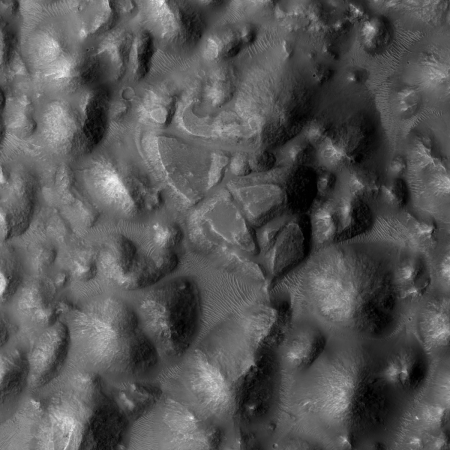
The cool image to the right, cropped and reduced to post here, was taken a decade ago, on August 25, 2011, by the context camera on Mars Reconnaissance Orbiter (MRO), It shows a flat plain with a sudden clump of mounds or hills at the center.

This is one of those pictures from Mars which I like to call a “What the heck?” image. What caused the mounds, and why are they found only in this concentrated clump, with the rest of the terrain around them generally flat?

Though the context image was taken a decade ago, no follow-up high resolution images were taken of this area until very recently.

Below is the one recent high resolution image taken by MRO on May 12, 2021, cropped and reduced to show the bottom half of the mound clump as shown by the white box. It makes the mystery even more puzzling.
» Read more

4 comments

Ice-filled craters in Mars’ glacier country?

Craters in Protonilus Mensae
Click for full image.

Today’s cool image returns us to the chaos region dubbed Protonilus Mensae, the middle of three adjacent mensae regions in the northern hemisphere that I like to dub Mars’ glacier country because there is so much evidence of buried ice there.

The photo to the right, cropped to post here, was taken on May 31, 2021 by the high resolution camera of Mars Reconnaissance Orbiter (MRO). Titled “Layered Feature in Crater in Protonilus Mensae,” the section I have posted focuses on several craters, with the one with the central mesa likely the picture’s target. Based on many similar features found in craters in this region, it is somewhat safe to assume that this mesa is made of buried ice.

The overview map below as always provides the context.
» Read more

0 comments
1 92 93 94 95 96 212