Ingenuity successfully completes 11th flight

Ingenuity about to land
Click for full image.

Ingenuity has successfully completed its 11th flight, safely touching down at approximately its planned landing spot. From the science team’s tweet:

[Ingenuity] has safely flown to a new location! Ingenuity flew for 130.9 seconds and traveled about 380 meters before landing.

The image to the right, reduced to post here, was taken mere seconds before landing, and shows the helicopter’s shadow directly below it on the ground.

This particular flight was the first that did not push Ingenuity’s abilities, merely flying in a straight line to put it in a good position for later flights and to keep it ahead of Perseverance.

So far they have only released five images from the flight. Expect the rest to be downloaded from Perseverance in the next few days.

1 comment

Curiosity: Nine years since landing on Mars and the way forward

The way forward for Curiosity
Click for full image.

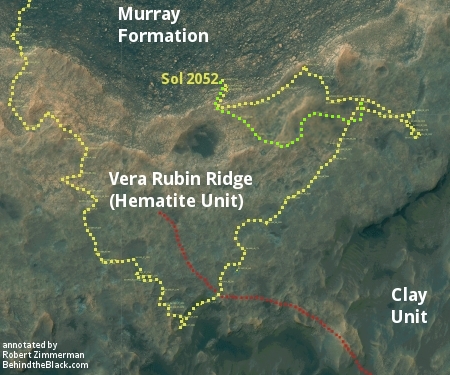
In today’s Curiosity update written by planetary geologist Abigail Fraeman, she noted this significant fact:

Project scientist Ashwin Vasavada pointed out a great fact at the beginning of planning today: At around 4 o’clock in the afternoon on Sol 3199 (the first sol in the plan we are creating today), Curiosity will begin its 10th Earth year on Mars. In the last nine years, the rover has traveled 26.3 km [16.3 miles], climbed over 460 m [1,509 feet] in elevation, and collected 32 drilled samples of rock.

Her update includes the first image taken by Curiosity upon landing, a view of Mount Sharp using the rover’s front hazard camera. In that picture, the mountain is far away, as the rover was sitting on the flat floor of Gale Crater.

The photo above, cropped and enhanced to post here, was taken yesterday by one of Curiosity’s navigation cameras, and looks out across the rocky mountainous terrain the rover is soon to travel. As Fraeman also notes,
» Read more

9 comments

White blobs on Mars

White blobs on Mars
Click for full image.

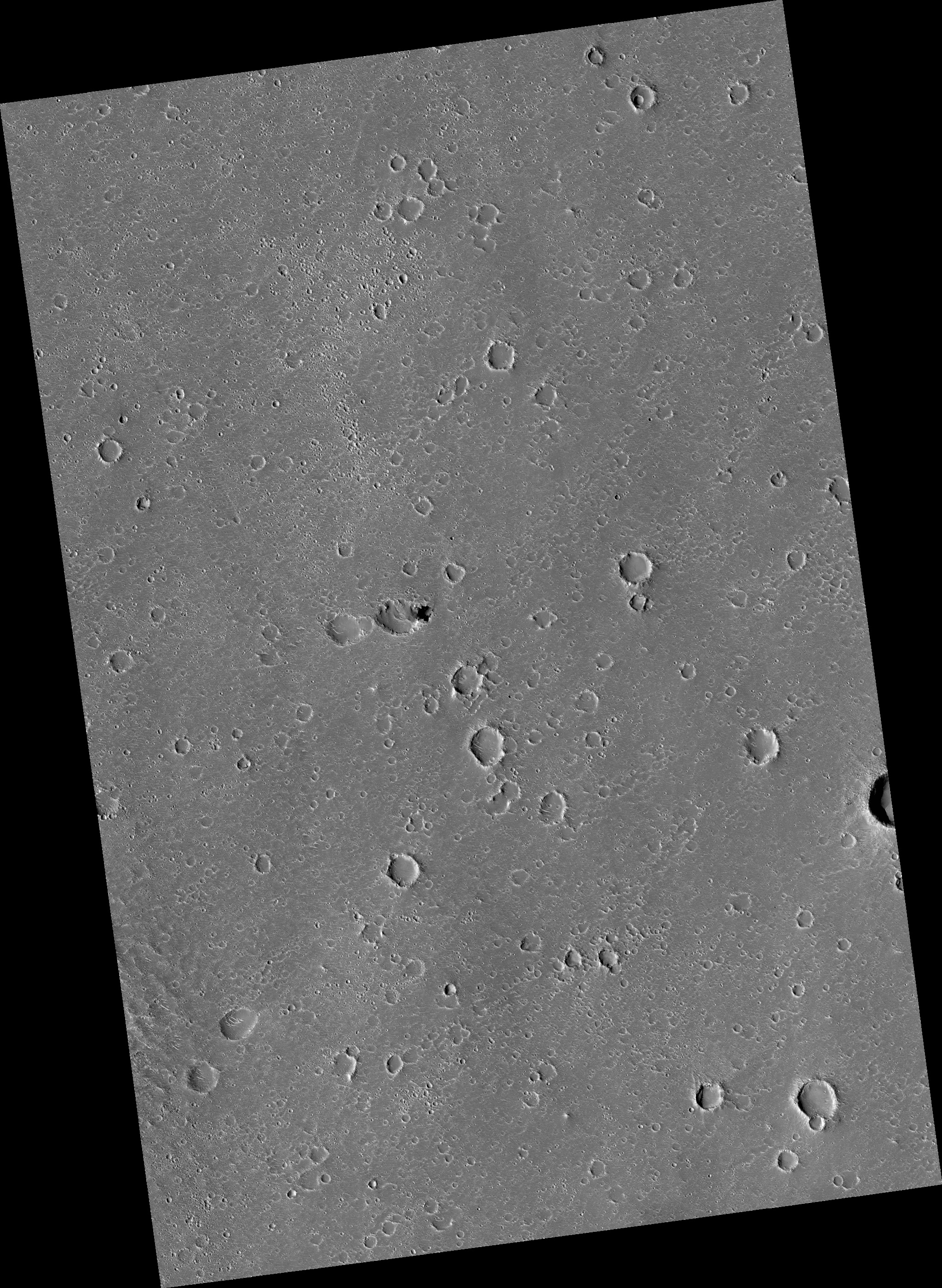
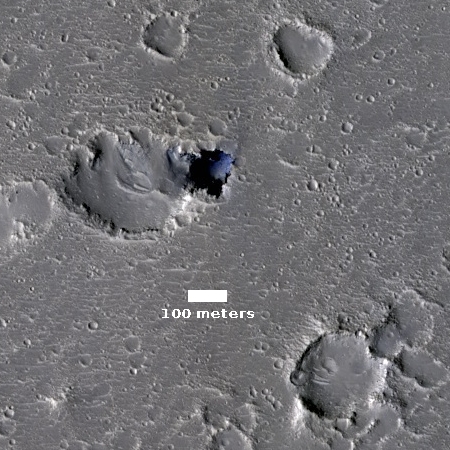
Time for another “What the heck?” image. The photo to the right, cropped to post here, was taken on May 18, 2021 by the high resolution camera on Mars Reconnaissance Orbiter (MRO). It shows what appears to be a series of white circular features aligned with a ridge line.

Are these eroded craters? Maybe, but their alignment with those ridges suggests otherwise. If you look at the full image, you will see further parallel ridges to the north and south, also with similar circular blobs lined along them. Furthermore, the flat surrounding terrain, part of the northern lowland plains north of the resurgences from Valles Marineris, has a scattering of very normal looking craters, with distinct rims and even some glacial material within. As this is at 44 degrees north latitude, the presence of glacial material inside craters is not surprising.

Thus, the white blobs are likely not craters, but some form of eruptive material from below, coming up along those ridges which are probably faultlines. The whiteness suggests that material is water ice, but this of course is unconfirmed.

The question is of course, why? What would cause water ice to erupt along these faultlines? And why are such features not seen elsewhere? Faults and underground ice are common on Mars. Yet, I don’t remember seeing features such as this in any other Martian images.

2 comments

Ingenuity’s 11th flight scheduled for tonight

Ingenuity's 11th flight plan
Click for interactive map.

The next flight of Ingenuity on Mars is now scheduled for this evening, and will be a much simpler flight than the helicopter’s previous trip.

The map to the right shows the route in blue. The flight is mainly a transfer flight, intended to keep the copter ahead of the rover as they leapfrog from point to point in Jezero Crater. It will actually be the first flight by Ingenuity that does not push its engineering in any major way.

This map, the most up-to-date available, is at this moment about five sols out of date. Perseverance is likely slightly south and to the west of the location shown.

The present plan is for Perseverance to travel to the northwest along the dark ridgeline that Ingenuity will land next to. The rover will then retreat, returning more or less to its landing area and then north to circle around the largest crater on the map and then to head west to the base of the delta to the area labeled “Three Forks”, which is their entrance to the delta’s geology.

0 comments

Gil Levin passes away

Gil Levin, a instrument project scientist for one of the science experiments on the Mars Viking landers in the 1970s, has passed away at 97.

Levin deserves special mention because he believed for years that his experiment, called “labeled release,” had possibly found evidence of life.

Dr. Levin’s experiment employed a nine-foot arm to scoop Martian soil into a container, where it was treated with a solution containing radioactive carbon nutrients. Monitors detected the release of radioactive gas, which Dr. Levin interpreted as evidence of metabolism.

“Gil, that’s life,” Straat said when they saw the results.

The findings held true for both Viking 1 and Viking 2, which took samples from different regions of the planet. Other experiments aboard the Viking, however, used different methods to conclude that Martian soil did not contain carbon, an element found in all living things.

Dr. Levin stood by his findings, but top NASA scientists disagreed, saying that the response he observed was the result of inorganic chemical responses, not biological processes. “Soon thereafter,” Dr. Levin told the Johns Hopkins University School of Engineering Magazine last year, “I gave a talk at the National Academy of Sciences saying we detected life, and there was an uproar. Attendees shouted invectives at me. They were ready to throw shrimp at me from the shrimp bowl. One former adviser said, ‘You’ve disgraced yourself, and you’ve disgraced science.’”

I met Levin once and interviewed him several times. With amazing grace and cheerfulness he always emphasized that his results needed to be confirmed, and there was certainly room for skepticism, but to reject them outright was not how the scientific method worked.

Levin however was never awarded another NASA project, essentially blackballed because of his 1970s claims, even though later research hinted at the possibility that he may have been right.

R.I.P. Gil Levin. Though the overall data we have gotten from Mars in the half century since still favors a non-life explanation for his experiment, the uncertainty remains quite large. He could have been right.

More important than his uncertain result, however, was his dedication to the proper scientific method, where you let the data speak for itself and never dismiss any possibility if that is what the data shows you.

3 comments

Curiosity’s wheels: a good news update

Curiosity's wheels
Click here and here for the original images.

For the past few weeks Curiosity has been traveling across some of the roughest terrain it has seen on Mars, since landing in Gale Crater in August 2012. The rover is now roving among the high cliffs and foothills at the very base of Mt Sharp, with the ground covered with rocks, boulders, plates of bedrock, and all sorts of protrusions.

On August 1st the rover team used its cameras to do another survey of the rover’s wheels to see how they fared during that journey. The two images to the right compare the same area on the same wheel after the most recent 16 sols of travel. This is the same wheel I have focused on since 2017. Overall, the damage in the most recent picture seems almost identical to the previous picture. In fact, if you compare today’s image with the annotated version of the 2017 photo, found here, you can see how little things have changed since then.

From this one wheel it appears that the wheels are continuing to hold up quite well. The Curiosity team of course needs to review all the images of all the wheels, but based on this one comparison, it looks like their long term strategies for mitigating damage to the wheels is working, even in the rough terrain the rover is presently traversing.

1 comment

Martian lava flooded crater?

lava flooded crater?
Click for full image.

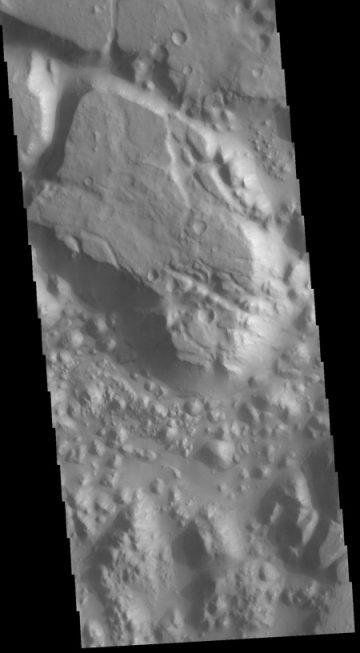
A quick cool image! The photo to the right, rotated, cropped and reduced to post here, was taken by the high resolution camera on Mars Reconnaissance Orbiter (MRO) more than a decade ago, on June 1, 2010. I post it now because it is today’s MRO picture of the day, and is definitely cool. The caption:

One of a few “scaly-looking” inselbergs within regional platy-ridged flows in Elysium Planitia. This inselberg has a broken and blocky appearance with some of the blocks being tilted. Could this be the remnant of a once extensive mantling deposit? An inselberg is an isolated hill or mountain rising abruptly from a plain.

The wider image by MRO’s context camera below, also rotated, cropped and reduced to post here, illustrates even more forcefully how isolated this circular set of blocks is.
» Read more

0 comments

The sublimating surface of Mars’ northern plains?

Sublimating patches on Mars?
Click for full image.

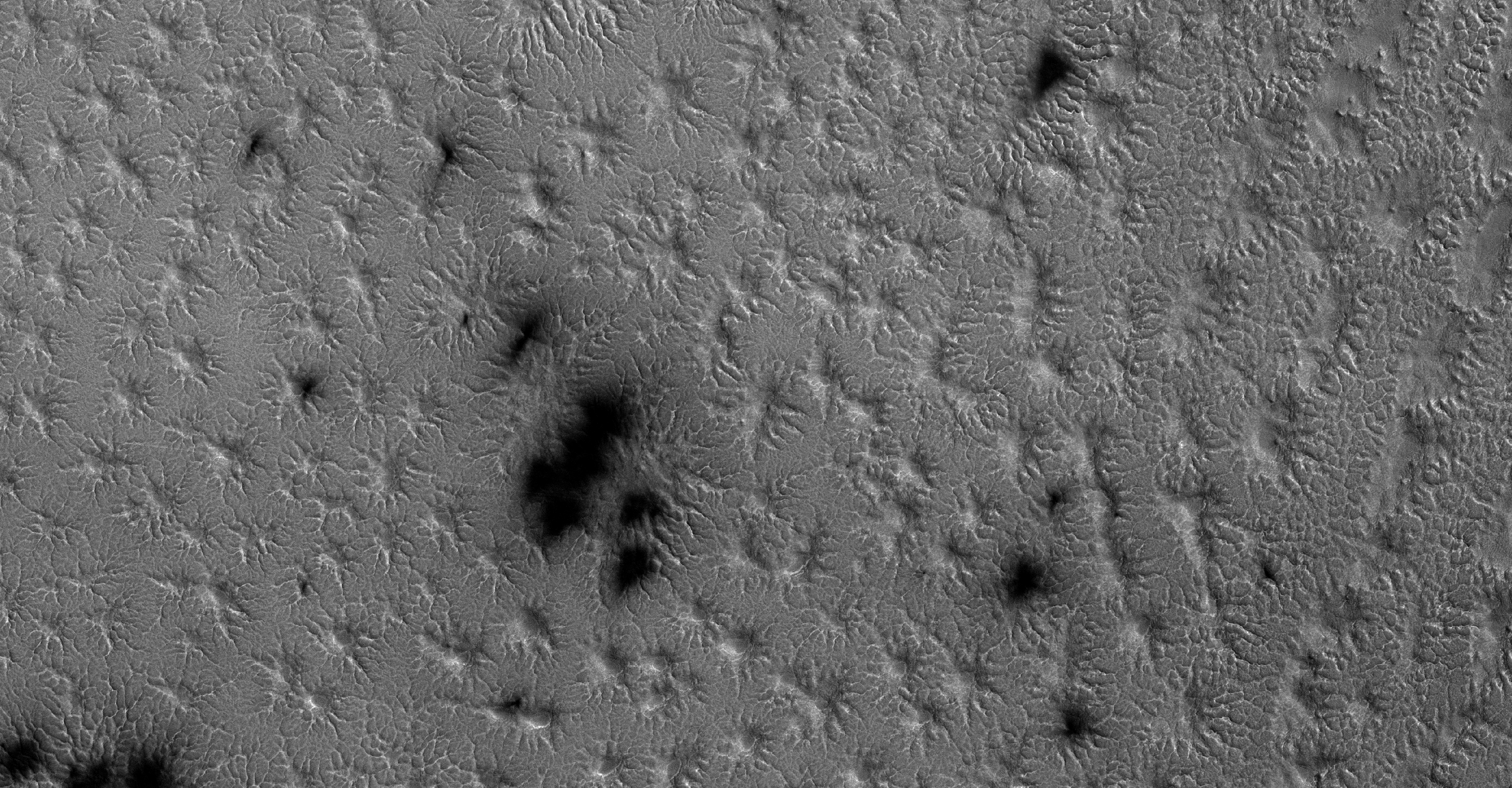
Cool image time! The photograph to the right, cropped and reduced to post here, was taken by the high resolution camera on Mars Reconnaissance Orbiter on May 27, 2021. A sample image, likely taken not as part of any specific scientist’s research but by the camera team in order to maintain the camera’s temperature, shows an area of the Martian northern plains that appears filled with rough scattered depressions, possibly caused by sublimation of buried ice.

The location, at 54 degrees north latitude, is far enough north to easily have a lot of buried ice. It is also only about 40 miles to the east of Milankovič Crater, where scientists have found many scarps that appear to have exposed layers of ice in their cliff faces.

However, the location has other components that must raise questions about this sublimating ice hypothesis.
» Read more

0 comments

Zhurong continues south, inspecting dunes

Zhurong's travels as of July 31, 2021

The Chinese science team for their Zhurong Mars rover released new images yesterday, including a map showing the rover’s present position.

The new images and location has confirmed that the white streaks seen in orbital pictures are small dunes of sand blown by the thin Martian wind.

The map to the right, created using their map but annotated and providing a wider context, shows their present location relative to the lander and surrounding terrain. So far the rover has traveled about 1,900 feet, about 1,000 feet per month. Since it seems to be operating as planned, I expect China will extend the mission once it completes its nominal three-month tour in about two weeks.

At that travel pace there is much of interest that is within the rover’s range. I expect they are heading south partly because this brings them closer to their original landing site, which is an area they probably studied at length before landing. Whether they head to the largest crater, visible only partly on the image’s south edge, remains unclear.

0 comments

The view of Jezero Crater, from both Ingenuity and Perseverance

The view from Ingenuity during 10th flight
Click for full image.

Cool image time! Today the Perseverance science team released the 200 images that Ingeniuty took during its 10th flight on July 24, 2021.

The photo to the right was taken about 25 seconds before the helicopter landed, and looks to the southwest. In the foreground can be seen the ridge of rocks and pebbles that the scientists sent Ingeniuty to photograph. In the distance can be seen the rim of Jezero Crater, about 7.5 miles away, with some rounded hills that sit in the crater floor about 5.5 miles away.

The white box indicates the area covered by two high resolution images taken by Perseverance on July 28th that I have combined into the panorama below.
» Read more

15 comments

Atomic oxygen in Mars’ atmosphere, as seen by Al-Amal

Oxygen distribution on Mars

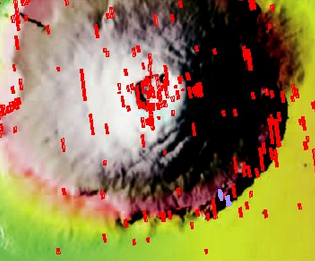
The UAE’s Al-Amal Mars orbiter on July 19, 2021 released a new spectroscopic image, showing the global distribution of atomic oxygen in the Martian upper atmosphere.

The Emirates Ultraviolet Spectrometer (EMUS) mapped the distribution of atomic oxygen in the planet’s upper atmosphere, showing a dense patch emerging from the nightside into the new day.

The photo to the right, cropped and reduced to post here, shows this.

Over the next two years, covering one single Martian year, Al-Amal will monitor the distribution of this oxygen to see how it fluctuations from season to season, as well as from day to day. Gather this information will help the theorists untangle the past atmospheric history of Mars.

3 comments

Scientists: Clay, not liquid water, explains radar data under Martian south icecap

The uncertainty of science: In a new paper scientists claim that clay materials, not liquid water, better explain the radar data obtained by orbital satellites, initially hypothesized to be liquid water lakes under Mars’ south polar icecap.

Sub-glacial lakes were first reported in 2018 and caused a big stir because of the potential for habitability on Mars. Astrobiologists and non-scientists were equally attracted to the exciting news. Now, the solution to this question, with great import to the planetary science community, may be much more mundane than bodies of water on Mars.

The strength of this new study is the diversity of techniques employed. “Our study combined theoretical modeling with laboratory measurements and remote sensing observations from The Compact Reconnaissance Imaging Spectrometer for Mars (CRISM) instrument on NASA’s Mars Reconnaissance Orbiter. All three agreed that smectites can make the reflections and that smectites are present at the south pole of Mars. It’s the trifecta: measure the material properties, show that the material properties can explain the observation, and demonstrate that the materials are present at the site of the observation,” Smith said.

This paper is only one of several recently that has popped the balloon on the liquid lake theory. Nothing is actually proven, but the weight of evidence is definitely moving away from underground liquid water under the south pole icecap.

1 comment
1 91 92 93 94 95 212