Mini-volcanoes (mud or lava?) near Zhurong’s Mars landing site

Mosaic of features near Zhurong's planned landing site on Mars
Click here, here, and here for full images.

Cool image time! Though we still do not know exactly where the Chinese Mars rover Zhurong landed on Mars, we have a rough idea based on the latitude and longitude numbers leaked to the Chinese press in October 2020 and were apparently confirmed by photos taken by the Tianwen-1 orbiter soon after reaching Mars. We also know Zhurong’s engineers wanted to land in the northern lowland plains dubbed Utopia Planitia, a region that is relatively flat and thus makes a safe landing spot for their first attempt to reach the surface of Mars.

The mosaic to the right, rotated and reduced to post here, is made from three context camera images taken by Mars Reconnaissance Orbiter (MRO). The white cross on the right edge is essentially Zhurong’s leaked landing spot. The red box indicates the area covered by one of only two photos that China has released that were taken by its Tianwen-1 orbiter.

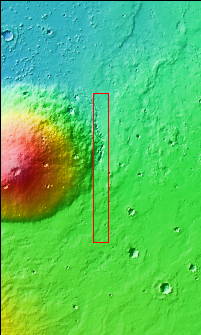
The white box in the upper left shows the area covered by today’s cool image, shown below.
» Read more

0 comments

Curiosity’s dramatic path forward

Curiosity's future travels
Click for full image.

Cool image time! In the coming weeks and months the view from Curiosity is going to give us the most spectacular views of another world since the Apollo astronauts walked on the Moon.

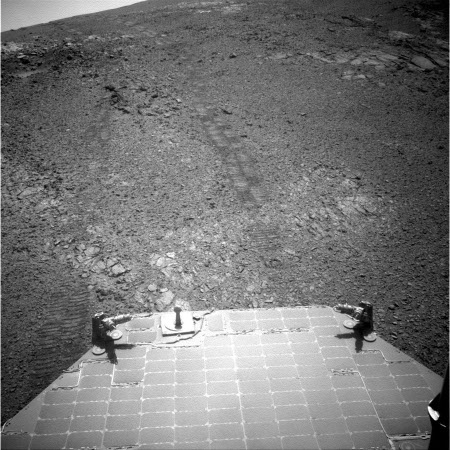
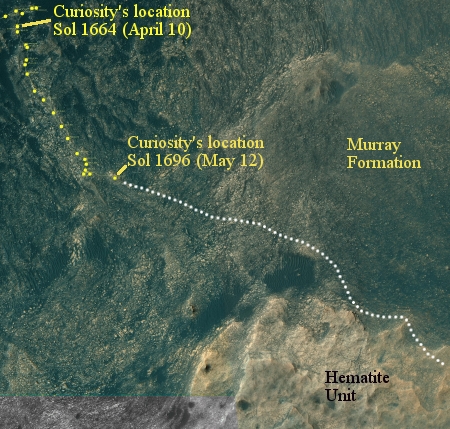
In today’s download of new images from the Mars rover Curiosity was the photo above, reduced to post here. Taken by rover’s right navigation camera, it looks west directly in line with Curiosity’s future travels, and shows that it is now finally entering mountain country.

The overview map below provides the context.
» Read more

3 comments

Inexplicable ridges north of China’s Mars rover

Wrinkle ridges in Utopia Planitia?
Click for full image.

Cool image time! The photo to the right, rotated, cropped, and reduced to post here, shows some unusual geology about 450 miles north of the approximate area where China’s Zhurong rover landed in the northern lowlands of Mars. It was taken on April 14, 2021 by the high resolution camera on Mars Reconnaissance Orbiter (MRO).

These scattered ridges remind me of wrinkle ridges, formed when the surface of a place shrinks. With less surface area, the extra material needs somewhere to go, and so ridges are forced up at weak points to release the pressure.

Assuming this hand-waving explanation is true, the next question would be: What causes the shrinking? The overview map below might help provide an answer.
» Read more

1 comment

A visit to a crater near the non-face on Mars

Glacial erosion features inside crater
Click for full image.

Cool image time! The photo to the right, rotated, cropped, and reduced to post here, was taken on March 12, 2021 by the high resolution camera on Mars Reconnaissance Orbiter (MRO). It looks down at small six-mile-wide Apt crater in the northern lowland plains of Mars located at about 40 degrees north latitude. The image’s focus were the layers on the crater interior rim as well as the eroded glacial features on the crater’s floor. The color strip suggests [pdf] that the bluish material on the north-facing south interior rim and floor are likely icy, while the tan-colored material seen in the crater’s north half are likely dusty.

While the suggestion of glacial material on the crater’s interior is very typical for many craters in the mid-latitudes, what makes this crater of interest is its location, only a short few miles south of that mesa on Mars that for decades the shallow-minded insisted was a face and proof of an alien Martian civilization.
» Read more

4 comments

Ingenuity has issues on sixth flight

On its sixth flight and first intended as an operational scouting mission for Perseverance, the Mars helicopter Ingenuity had problems, requiring an emergency landing.

The trouble cropped up about a minute into the helicopter’s sixth test flight last Saturday at an altitude of 33 feet (10 meters). One of the numerous pictures taken by an on-board camera did not register in the navigation system, throwing the entire timing sequence off and confusing the craft about its location.

Ingenuity began tilting back and forth as much as 20 degrees and suffered power consumption spikes, according to Havard Grip, the helicopter’s chief pilot.

A built-in system to provide extra margin for stability “came to the rescue,” he wrote in an online status update. The helicopter landed within 16 feet (5 meters) of its intended touchdown site.

Engineers are presently trouble-shooting the issue, which they suspect was a “navigation timing error.”

1 comment

The strange flows in Shalbatana Vallis on Mars

Strange flows in Shalbaltana Vallis
Click for full image.

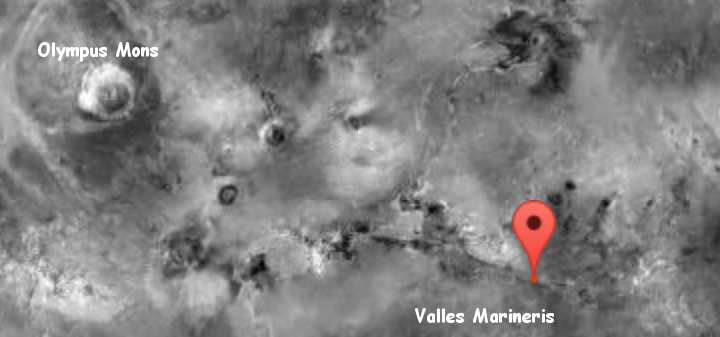
Cool image time! The photo to the right, rotated, cropped, and reduced to post here, was taken by the high resolution camera on Mars Reconnaissance Orbiter (MRO) on March 31, 2021, and shows a series of very distinct arrowhead-shaped sloping ridges interspersed with hollows flowing down from the southern cliff face of Shalbatana Vallis, one of the larger long meandering drainages flowing into the northern lowlands of Chryse Planitia and north of Valles Marineris.

This location is at 5 degrees north latitude, so nothing we see in the picture is likely glacial or evidence of ice.

So what are we looking at? My guess is that the parallel ridges show us a hint of the original slope of alluvial fill. In the past canyon’s south rim or cliff either did not exist, or was much smaller. Instead the ground mostly sloped gently downhill from the plateau to the canyon floor.

Scientists believe that in the far past catastrophic floods of water flowed through Shalbatana. If a massive flood of water off that rim came down that slope of alluvial fill, it could have pushed into that fill and created the hollows, washing the fill down into the canyon floor and leaving behind the ridges in between.

The overview maps below provide the geographical context.
» Read more

1 comment

Glacial flows covering a crater on Mars?

Partially covered crater by glacial flows?

Cool image time! The photo to the right, cropped and reduced to post here, was taken on March 4, 2021 by the high resolution camera on Mars Reconnaissance Orbiter (MRO). It shows an eroded mound that appears to have flows coming off its north and south slopes that fill the surrounding low spots, including half-covering a nearby crater.

The science team for MRO’s high resolution camera chose this picture as their April 28th picture of the day, noting the following:

The objective of this observation is to examine a crater which seems to be in the process of getting covered by flow from a mound. This image, in Protonilus Mensae, may show us characteristics of the covering material: could it be debris-covered glaciers?

Below is a global map of Mars, with this mound’s location in Protonilus Mensae in the northern mid-latitudes indicated by a black cross.
» Read more

0 comments

The big cliffs of Gediz Vallis on Mars

The Big Cliffs of Mt Sharp
Click for full image.

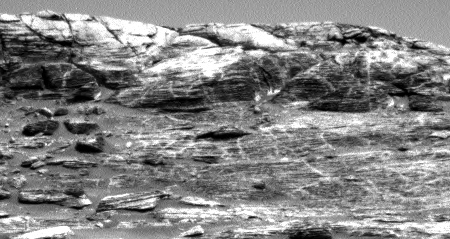
Cool image time! The photo to the right, cropped and reduced to post here, was taken on May 21, 2021 by Curiosity’s chemistry camera (ChemCam), normally designed to look at high resolution close-up imagery of nearby objects.

However, it can also be used as what the science team call “a long distance spyglass.” The image to the right is an example, looking at what I think are the distant but steadily approaching big cliffs on the western wall of the canyon Gediz Vallis. Make sure you look close at the shadowed cliff-face, probably several hundred feet high. It is filled with huge rock faces reminiscent of the most stark rock cliffs on the mountains of Earth.

The two images below provide the context, which makes the image even more quite breath-taking.
» Read more

3 comments

Zhurong rolls onto Martian surface

Zhurong's view of lander after deployment onto Martian surface

The new colonial movement: According to China’s state-run press, the Zhurong rover has successfully rolled off its lander and reached the Martian surface.

The image to the right was taken by the rover’s rear hazard avoidance camera, and shows the lander and the deployment ramps behind Zhurong.

At this moment China has released no other images of the Martian surface, nor have they revealed if they have a precise idea of where the lander actually put down on Mars. This latter information is essential for them to plan the rover’s travels over its 90-day nominal mission.

Nonetheless, it appears Zhurong is functioning perfectly. If all goes right, it will not only complete that 90-day mission but continue on for considerably longer, as have other similar small rovers on both Mars and the Moon.

39 comments

Curiosity climbing Mount Sharp

Curiosity as seen by MRO from orbit
Click for full image.

Today’s cool image, to the right and cropped to post here, was taken on April 18, 2021 by the high resolution camera on Mars Reconnaissance Orbiter (MRO). Released today by MRO’s science team, it shows the rover Curiosity sitting on top of the 20-foot high rock outcrop the scientists have dubbed Mt. Mercou. The 16,400 foot high Mt. Sharp is to the south, with the rim of Gale Crater about 30 miles to the north.

I have annotated the image to show the rover’s route both before and after the moment when this picture was taken. As the caption at the link notes, the rover is currently working its way up Mt. Mercou, a route that was not initially in their plans, as shown by the wider MRO view below.
» Read more

0 comments

The steep sudden foothill of Olympus Mons

Olympus Mons on Mars

Today’s cool image starts from afar and zooms inward. The elevation map to the right shows Olympus Mons, the largest volcano on Mars and in fact the entire solar system. About 600 miles across, from the edge to its peak this volcano rises about 54,000 feet, with an actual height relative to Mars’ “sea level” of just under 70,000 feet, more than twice as high as Mount Everest on Earth.

The cross-section of this volcano is so large it would cover almost all of France if placed on Earth. As a shield volcano, it was formed by many many volcano flows that laid down many layers of lava, with some in its northwest quadrant thought to be as recent as 2 to 115 million years ago.

Our cool image today is located at the white rectangle at the southeast edge of this volcano, and illustrates how those many lava flows could create such a large shield volcano with such a large cross section.
» Read more

9 comments

Ingenuity to make sixth flight next week

Future travels for Perseverance and Ingenuity

The Ingenuity engineering team announced today that the Mars helicopter will make its sixth flight next week, flying to a new landing spot while taking images for the Perseverance science team.

Ingenuity’s flight plan begins with the helicopter ascending to 33 feet (10 meters), then heading southwest for about 492 feet (150 meters). When it achieves that distance, the rotorcraft will begin acquiring color imagery of an area of interest as it translates to the south about 50-66 feet (15-20 meters). Stereo imagery of the sand ripples and outcrops of bright rocks at the site will help demonstrate the value of an aerial perspective for future missions. After completing its image collection, Ingenuity will fly about 164 feet (50 meters) northeast where it will touch down at its new base of operations (known as “Field C”).

The flight will attempt a new speed record of 9 mph, and will also land for the first time in a spot that the helicopter has not scouted beforehand. It will instead be using data from high resolution images from Mars Reconnaissance Orbiter (MRO) combined with its own hazard avoidance system.

Ingenuity will essentially place itself over and in an area where Perseverance plans to go, leapfrogging ahead flight by flight, as shown by the map above (annotated by me from the map available here). The green dot numbered 5 shows the helicopter’s present position, while #6 shows its approximate landing spot after its sixth flight. Perseverance, whose present location is indicated by the blue marker, is generally heading south within the area outlined by the red line, as described during the science team’s an April 30th press conference. The goal in exploring this region is to gain a very robust geological baseline of the floor of Jezero Crater, which scientists believe will be the oldest material the rover should see in its travels.

2 comments
1 96 97 98 99 100 212