Has Yutu-2 found something unusual?

According to Chinese sources, China’s lunar rover Yutu-2 has spotted something unexpected and unusual on the surface of the far side of the Moon.

On July 28, the Chang’e-4 team was preparing to power Yutu-2 down for its usual midday ‘nap’ to protect the rover from high temperatures and radiation from the sun high in the sky. A team member checking images from the rover’s main camera spotted a small crater that seemed to contain material with a color and luster unlike that of the surrounding lunar surface.

The drive team, excited by the discovery, called in their lunar scientists. Together, the teams decided to postpone Yutu-2’s plans to continue west and instead ordered the rover to check out the strange material. With the help of obstacle-avoidance cameras, Yutu-2 carefully approached the crater and then targeted the unusually colored material and its surroundings. The rover examined both areas with its Visible and Near-Infrared Spectrometer (VNIS), which detects light that is scattered or reflected off materials to reveal their makeup.

VNIS is the same instrument that detected tantalizing evidence of material originating from the lunar mantle in the regolith of Von Kármán crater, a discovery Chinese scientists announced in May.

So far, mission scientists haven’t offered any indication as to the nature of the colored substance and have said only that it is “gel-like” and has an “unusual color.” One possible explanation, outside researchers suggested, is that the substance is melt glass created from meteorites striking the surface of the moon.

The report is at present too vague to really tell us anything. What I predict is that this discovery will almost certainly not be as strange or alien as this report makes it sound.

15 comments

ISS partners okay Trump changes to Gateway

The various international nations that partner on ISS and wish to partner on NASA’s Gateway project issued a statement this week saying that they approve the changes imposed on that lunar space station by the Trump administration, all of which significantly delay their participation.

In an Aug. 28 statement, members of the station’s Multilateral Coordination Board (MCB), which includes the five space agencies involved in the ISS, said the Gateway is “a critical next step” in human space exploration and that they plan to contribute modules or other elements for the facility in lunar orbit.

“Looking to exploration activities beyond LEO, the MCB members reaffirmed their continued intention to cooperate on a human outpost in the lunar vicinity – Gateway,” the document, a summary of the board’s Aug. 6 meeting, stated. “Within a broader open architecture for human exploration, the MCB acknowledged the Gateway as a critical next step.”

The board offered a similar endorsement of the Gateway at a March 5 meeting. The statement from that meeting included a diagram of one Gateway configuration, with contributions from Canada, Europe, Japan and Russia, as well as the United States, identified.

Three weeks after that meeting, though, Vice President Mike Pence announced at a meeting of the National Space Council that the U.S. would speed up its lunar exploration timeline, seeking to land astronauts on the moon by 2024, rather than prior plans for a 2028 landing. NASA subsequently said that it would initially pursue a minimal Gateway needed for that 2024 landing, deferring full-fledged development of the Gateway for a second phase intended to enable “sustainable” lunar exploration in the second half of the 2020s. [emphasis mine]

The “minimal Gateway” that the Trump administration is presently pursuing is structured to shift focus from a space station in lunar orbit to landing on the Moon. This means that many of the later components of Gateway, to be built or used by these international partners, will be significantly delayed, or even made unnecessary.

So, why did these space agencies all endorse the new plan that circumscribed their participation? They have no choice. Without NASA’s SLS, they have no way to get to the Moon. And without Gateway, SLS has no reason to exist. These government space agencies need SLS (as ephemeral as SLS might be) because it is the only free government launch option available to them. They hope, by endorsing what the Trump administration has done, to convince it to go along with the complete Gateway project, including the continued funding of SLS, thus creating a gigantic international boondoggle (paid for mostly by the U.S.) that will justify all their manned space programs.

This is another reason to dump SLS. Wouldn’t it be better for the U.S. to have its private commercial space launch industry sell its goods to these leeches, rather than have them living off our taxpayers’ dime? We will gain nothing from them with Gateway, as it is presently structured, while they feed off of us. If instead they needed to buy launch services from private rockets, the profits would accrue to U.S. companies and citizens, and help encourage competition and more innovation.

If we instead buy into this international boondoggle, we will spend a lot of money for very little space exploration, even as we make the bureaucrats at six government space agencies (including NASA) very happy.

2 comments

More images from Chandrayaan-2

Moon image from Chandrayaan-2
Click for full image.

The Chandrayaan-2 engineering team has released more lunar images from Chandrayaan-2, this time from its higher resolution Terrain Mapping Camera 2.

One example is to the right, reduced to post here. It was taken from about 2,700 miles altitude, and shows a section of the northern hemisphere on the Moon’s heavily cratered far side. There are other images at the link.

The goal of these images is to demonstrate that the camera and spacecraft pointing systems are working. It appears they have done so successfully.

0 comments

ISRO releases Chandrayaan-2’s first Moon image from lunar orbit

The Moon as seen by Chandrayaan-2

India’s space agency ISRO has released the first image taken by Chandrayaan-2 after entering orbit around the Moon.

That image is to the right, reduced to post here. It was taken from about 1,600 miles elevation, and shows mostly the far side of the Moon. The dark mare in the upper right is the Sea of Moscow, which is the only large mare on the far side.

This image once again proves the camera and the spacecraft’s ability to point it accurately are both functioning.

0 comments

ULA wins private lunar launch contract

Capitalism in space: Astrobotic, the private company building a lunar lander for NASA, has chosen ULA’s Vulcan rocket for its launch vehicle.

Astrobotic announced today that it selected United Launch Alliance’s (ULA) Vulcan Centaur rocket in a competitive commercial procurement to launch its Peregrine lunar lander to the Moon in 2021.

“We are so excited to sign with ULA and fly Peregrine on Vulcan Centaur. This contract with ULA was the result of a highly competitive commercial process, and we are grateful to everyone involved in helping us make low-cost lunar transportation possible. When we launch the first lunar lander from American soil since Apollo, onboard the first Vulcan Centaur rocket, it will be a historic day for the country and commercial enterprise,” said Astrobotic CEO, John Thornton.

This is the second contract announcement for ULA’s Vulcan rocket, with the first being Sierra Nevada’s announcement that it would use Vulcan for Dream Chaser’s first six flights.

Isn’t competition wonderful? It appears to me that ULA must be offering very cut-rate deals to get these contracts, since the rocket has not yet flown while SpaceX’s already operational Falcon Heavy (with three successful launches) could easily do the job and is a very inexpensive rocket to fly. These lower prices, instigated by competition and freedom, will mean that funding missions to the Moon will continue to become more likely, even if NASA and the federal government fail to get their act together.

2 comments

Chandrayaan-2 successfully enters lunar orbit

The head of ISRO today announced that, after completed a 29 minute engine burn, India’s Chandrayaan-2 orbiter/lander/rover has successfully entered the correct orbit around the Moon.

In his briefing, Dr. Sivan announced that “The LOI maneuver was performed successfully today morning using the onboard propulsion system for a firing duration of about 29 minutes. This maneuver precisely injected Chandrayaan-2 into an orbit around the Moon.” He emphasised the unique requirement of 90 degree orbital inclination of Chandrayaan-2 and said that it was achieved by the precise execution of both the Trans Lunar Injection (performed on August 14, 2019) and today’s LOI maneuver.

“The satellite is currently located in a lunar orbit with a distance of about 114 km at perilune (nearest point to the Moon) and 18,072 km at apolune (farthest point to the Moon)”, he added.

Over the next four lunar orbits they will execute four more engine burns to lower the spacecraft to the orbit needed to send the lander/rover to the surface on September 7 in the south polar region of the Moon between the craters Manzinus C and Simpelius N at about 71 degrees latitude.

4 comments

Protest filed against NASA contract awards for unmanned lunar landers

Deep Space Systems, one of the private companies that bid for a NASA contract to build a private lunar lander to carry NASA instruments to the moon, and did not get the contract, has filed a protest against that decision.

I found out about this through my industry sources. I have no further information about the protest itself.

The timeline however is intriguing. The contracts were awarded to three different companies on May 31, 2019. Deep Space Systems’ protest was filed on June 24, 2019.

On July 30, 2019 one of contract winners, Orbit Beyond, backed out of the deal. Whether the protest or Orbit Beyond’s exit are related is at present unknown, though I wonder if they might be connected.

Either way, the question now arises: Who will replace Orbit Beyond? I also wonder if this protest gives Deep Space Systems an advantage for getting that replacement contract. This last thought is pure speculation and very unlikely. There are several other companies that are more well known and might be better qualified, and it would be inappropriate for NASA to allow its decision-making process to be pressured because of this protest.

Regardless, stay tuned for more information. This story is going to get more interesting.

0 comments

Chandrayaan-2 successfully puts itself in route to the Moon

Chandrayaan-2 today successfully completed its last Earth perigee burn, raising its orbital apogee so that it will enter the Moon’s gravitational sphere of influence on August 20th.

Chandrayaan-2 will approach Moon on August 20, 2019 and the spacecraft’s liquid engine will be fired again to insert the spacecraft into a lunar orbit. Following this, there will be further four orbit maneuvers to make the spacecraft enter into its final orbit passing over the lunar poles at a distance of about 100 km from the Moon’s surface.

…Subsequently, Vikram lander will separate from the orbiter on September 02, 2019. Two orbit maneuvers will be performed on the lander before the initiation of powered descent to make a soft landing on the lunar surface on September 07, 2019.

Vikram will be doing the hardest part, the landing.

0 comments

Yutu-2 and Chang’e-4 go to sleep again

Yutu-2's travels

Both Yutu-2 and Chang’e-4 have been put in dormant mode after completing their eighth lunar day on the far side of the Moon.

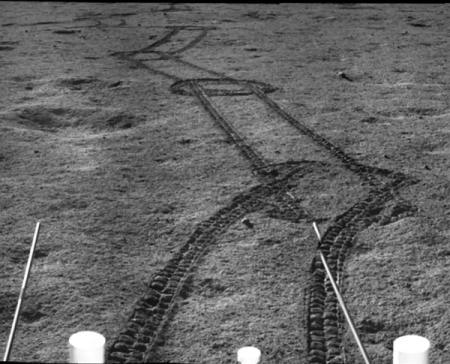
The article at the link provides a lot of new details about what both spacecraft have learned and done since they landed, including a nice detailed map showing Yutu-2’s exact path during those eight lunar days. The image to the right, reduced to post here, was taken by Yutu-2, and shows the rover’s tracks during what appears to be its seventh lunar day. It appears that the rover periodically stopped and did a pirouette, probably to obtain a 360 degree mosaic of the surrounding terrain.

Yutu-2’s travels have tended west from Chang’e-4, and on its eighth lunar day it continues that route, traveling 271 meters. After a period of short traveling days, they have now upped the distance traversed by a considerable amount. Since the planned nominal mission for both spacecraft had been three lunar days, both are demonstrating that the Chinese have figured out how to do this, and are now pushing Yutu-2 hard as a result.

The article vaguely describes some of the science obtained so far, but in general the Chinese remain tight-lipped about most of their discoveries.

0 comments

Water bears on the Moon!

A digital library carried by the Israeli lunar lander, Beresheet, that crashed on the Moon in April also carried with it dehydrated tardigrades, also called water bears.

Spivack had planned to send DNA samples to the moon in future versions of the lunar library, not on this mission. But a few weeks before Spivack had to deliver the lunar library to the Israelis, however, he decided to include some DNA in the payload anyway. Ha and an engineer on Spivack’s team added a thin layer of epoxy resin between each layer of nickel, a synthetic equivalent of the fossilized tree resin that preserves ancient insects. Into the resin they tucked hair follicles and blood samples from Spivack and 24 others that he says represent a diverse genetic cross-section of human ancestry, in addition to some dehydrated tardigrades and samples from major holy sites, like the Bodhi tree in India. A few thousand extra dehydrated tardigrades were sprinkled onto the tape used to secure the lunar library to the Beresheet lander.

The promising thing about the tardigrades, says Spivack, is that they could hypothetically be revived in the future. Tardigrades are known to enter dormant states in which all metabolic processes stop and the water in their cells is replaced by a protein that effectively turns the cells into glass. Scientists have revived tardigrades that have spent up to 10 years in this dehydrated state, although in some cases they may be able to survive much longer without water. Although the lunar library is designed to last for millions of years, scientists are just beginning to understand how tardigrades manage to survive in so many unforgiving environments. It’s conceivable that as we learn more about tardigrades, we’ll discover ways to rehydrate them after much longer periods of dormancy.

They suspect that the digital library probably survived the crash, which means the dehydrated water bears did also.

Don’t expect the Moon to be overrun by tardigrades. However, it will be a very interesting discovery if we find, years hence when explorers finally can recover that digital library, that the tardigrades can be re-hydrated and come back to life.

1 comment

First images from Chandrayaan-2

Earth from Chandrayaan-2

India yesterday released the first images taken by its lunar orbiter/lander/rover Chandrayaan-2, taken from Earth orbit of the Earth.

The image on the right is one example, and was taken mostly for engineering purposes. All the images (available here) demonstrates that the spacecraft’s camera is working properly, and it can orient itself accurately.

They now hope to put the spacecraft into lunar orbit on August 20th, with the landing attempt set for September 7th, after they have lowered that lunar orbit sufficiently.

0 comments

Chinese test microsat deorbits and crashes into Moon

The new colonial movement: A Chinese tiny smallsat, sent to lunar orbit to test the technology of such microsats, has been deorbited and allowed to crash into the far side of the Moon.

The micro satellite crashed into a predetermined area on the far side of the Moon at 10:20 p.m. on July 31 (Beijing Time), the center said Friday.

Weighing 47 kg, Longjiang-2 was sent into space on May 21, 2018, together with the Chang’e-4 lunar probe’s relay satellite “Queqiao,” and entered the lunar orbit four days later. It operated in orbit for 437 days, exceeding its one-year designed lifespan.

The development of the micro lunar orbiter explores a new low-cost mode of deep space exploration, said the center. The micro satellite carried an ultra-long-wave detector, developed by the National Space Science Center of the Chinese Academy of Sciences, aiming to conduct radio astronomical observation and study solar radiation.

China might be stealing a lot of the space technology it is using to make it a major space power, but it is also doing a fine job of refining and improving that technology. Its capability to do practically anything in space as well if not better than anyone else continues to grow.

And with their government using its space effort as a management test for determining the best individuals to promote into the government’s power structure, do not expect their space effort to wane anytime in the near future.

0 comments

Chandrayaan-2 successfully completes 4th orbit burn

The new colonial movement: India’s lunar orbiter/lander/rover Chandrayaan-2 today successfully completed its fourth engine burn, this time raising its orbital apogee to 89,472 kilometers (55,595 miles).

The next burn is scheduled for August 6, when the spacecraft’s orbit brings it back down to its perigee.

By September they expect to raise that apogee high enough so that it is within the Moon’s gravitational sphere of influence, when they will be able to put it the spacecraft into lunar orbit.

0 comments

Private lunar landing company backs out of NASA contract

Capitalism in space: The commercial lunar landing company, OrbitBeyond, has told NASA that it cannot fulfill its $97 million contract, only two months after that contract was announced.

NASA announced July 29 that OrbitBeyond informed the agency that “internal corporate challenges” will prevent it from carrying out a task order that NASA awarded the company May 31 as part of its Commercial Lunar Payload Services (CLPS) program. The company asked to be released from that contract, and NASA agreed.

NASA didn’t elaborate on what specific issues caused OrbitBeyond to scrap its contract with NASA, and the company didn’t immediately respond to a request for comment. At the May 31 event where NASA announced the contracts, Siba Padhi, chief executive of OrbitBeyond, said the company was still in the process of closing a round of funding. The company has not subsequently announced a funding round.

Considering its receipt of a $97 million NASA contract, it would be very puzzlingly for the company to be unable to obtain further investment capital. If anything, that contract should have encouraged funding. If the lack of funding is the cause of this termination then it also suggests the company had other problems.

This leaves NASA with two private lunar lander companies. I expect NASA will look to award the contract to a third company. The company Firefly and its team of Israeli Beresheet engineers comes immediately to mind.

1 comment

Chandrayaan-2 completes third orbit maneuver

Chandrayaan-2 has completed its third engine burn to raise the apogee of its orbit to 71K.

The next burn is set for August 2, when the spacecraft returns to its orbital low point, the perigee. As it raises its orbit each time the time between burns gets extended because the orbit gets longer. By September however the apogee will put the spacecraft in the Moon’s gravitational field of influence, and when Chandrayaan-2 reaches that apogee engineers will then fire its engines again to slow it down and enter lunar orbit.

0 comments
1 33 34 35 36 37 58