LRO to image Vikram landing site next week

The Lunar Reconnaissance Orbiter (LRO) science team plans to take high resolution images of the Vikram landing site when the orbiter flies over that site on September 17, thus allowing them to release before and after images.

Noah Petro, LRO’s project scientist at NASA’s Goddard Space Flight Center, said that the orbiter is due to fly over the Vikram landing site Tuesday, Sept. 17. “Per NASA policy, all LRO data are publicly available,” Petro wrote in an email. “NASA will share any before and after flyover imagery of the area around the targeted Chandrayaan 2 Vikram lander landing site to support analysis by the Indian Space Research Organization.”

Officials with India’s space agency ISRO have said they have photographed Vikram with their orbiter, Chandrayaan-2, but they have not released these images as yet. Their have also been reports from India stating that their images suggest the lander is still in one piece, but these reports are not confirmed.

LRO’s images should clarify the situation. The images should also help tell us what exactly happened after Indian engineers lost contact with Vikram shortly before landing.

1 comment

More delays for China’s Long March 5

Chinese officials have now admitted that the next launch of China’s biggest but troubled rocket, the Long March 5, will not occur until December 2019 at the earliest.

Moreover, the first launch of Long March 5B, the new version of the rocket developed following the Long March 5 failure on its second launch in 2017, won’t happen until 2020. This is the version they plan to use to launch their space station modules, and these delays probably thus delay start of the in-orbit assembly of their space station by two years, to 2022.

These rocket delays also threaten the launch of China’s Chang’e-5 lunar sample return mission and their first Mars orbiting mission, which has a firm summer 2020 launch window which if missed will delay the mission’s launch for two years.

These reports also for the first time officially explain the engine trouble that caused the Long March failure on its second launch in July 2017.

Addressing the causes of the failure has required a lengthy process of redesign and testing of the YF-77 liquid hydrogen-liquid oxygen propellant engines. Two YF-77 engines power the rocket’s first stage, with an oxidizer turbopump isolated as the fault behind the 2017 launch failure.

The Space News article very strangely headlines the completion of the core module for China’s space station, when the real story here is the continuing delays in getting Long March 5 off the ground. Without that rocket none of China’s big space plans can proceed. Yet the article buries this scoop many paragraphs down. I wonder why.

0 comments

Yutu-2 travels almost 300 meters on ninth lunar day

According to a story today in official Chinese state-run media, Yutu-2 traveled another 284.99 meters during its ninth lunar day on the surface of the Moon, and has now been placed in hibernation in order to survive the long lunar night.

The story provides no further information, including saying nothing about the strange and unusual material the rover supposedly spotted during this time period.

4 comments

Chandrayaan-2 locates Vikram

According to K. Sivan, the head of ISRO, India’s space agency, their Chandrayaan-2 orbiter has captured a thermal image of Vikram on the lunar surface, pinpointing the lander’s location.

They have not released the image. According to reports today, they do not yet know the lander’s condition, and have not regained communications. Reports late yesterday had quoted K.Sivan as saying “It must have been a hard-landing.” That quote is not in today’s reports.

In watching the landing and the subsequent reports out of India, it appears that India is having trouble dealing with this failure. To give the worst example, I watched a television anchor fantasize, twenty minutes after contact had been lost, that the lander must merely be hovering above the surface looking for a nice place to land. Most of the reports are not as bad, but all seem to want to minimize the failure, to an extreme extent.

Their grief is understandable, because their hopes were so high. At the same time, you can’t succeed in this kind of challenging endeavor without an uncompromising intellectual honesty, which means you admit failure as quickly as possible, look hard at the failure to figure out why it happened, and then fix the problem. If India can get to that place it will be a sign that they are maturing as a nation. At the moment it appears they are not quite there.

4 comments

Vikram fails to land on Moon

Vikram, India’s first attempt to soft land on the Moon, apparently has failed, with something apparently going wrong in the very last seconds before landing.

As I write this they have not officially announced anything, but the live feed shows a room of very unhappy people.

It is possible the lander made it and has not yet sent back word, but such a confirmation should not take this long.

India’s prime minister, Narendra Modi, was given a very short briefing by K. Sivan, head of ISRO, and then apparently left without comment. This I found an interesting contrast to the actions of Israel’s prime minister Benjamin Netanyahu when its lunar lander Beresheet failed in landing earlier this year. Netanyahu came out to comfort the workers in mission control, congratulating them for getting as far as they had. Modi apparently simply left. UPDATE: Modi has reappeared to talk to the children who had won a contest to see the landing as well as people in mission control. After making a public statement he has now left.

They are now confirming that communications was lost at 2.1 kilometers altitude, which was just before landing. They are analyzing the data right now to figure out what went wrong.

11 comments

Watch Vikram landing on Moon

Vikram's primary landing site

The new colonial movement: I have embedded below the live stream of India’s attempt today to land its Vikram lander on the Moon, broadcast by one of their national television networks.

The landing window is from 4:30 to 5:30 pm Eastern. This live stream is set to begin about 3 pm Eastern.

If you want to watch ISRO’s official live stream you can access it here.

Some interesting details: Vikram is named after Vikram A. Sarabhai, who many consider the founder of India’s space program. The lunar rover that will roll off of Vikram once landing is achieved is dubbed Pragyan, which means “wisdom” in Sanskrit. Both are designed to operate on the Moon for one lunar day.

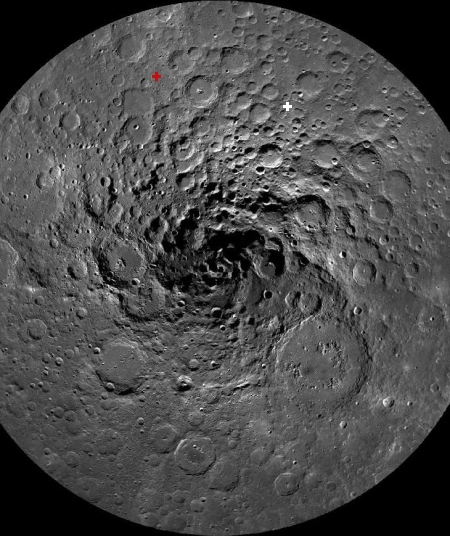
The landing site will be about 375 miles from the south pole.

That spot is a highland that rises between two craters dubbed Manzinus C and Simpelius N. On a grid of the moon’s surface, it would fall at 70.9 degrees south latitude and 22.7 degrees east longitude.

The white cross on the image to the right is where I think this site is. The secondary landing site is indicated by the red cross.

1 comment

Vikram makes second and last lunar orbital change

The new colonial movement: India’s Vikram lunar lander today made its second and last orbital change, preparing itself for landing on the Moon on September 7.

The orbit of Vikram Lander is 35 km x 101 km. Chandrayaan-2 Orbiter continues to orbit the Moon in an orbit of 96 km x 125 km and both the Orbiter and Lander are healthy.

With this maneuver the required orbit for the Vikram Lander to commence it descent towards the surface of the Moon is achieved. The Lander is scheduled to powered descent between 0100 – 0200 hrs IST on September 07, 2019, which is then followed by touch down of Lander between 0130 – 0230 hrs IST

They plan to roll the rover Pragyan off of Vikram about two hours after landing.

This article provides a nice overview of the mission.

0 comments

Vikram completes first de-orbit burn

The new colonial movement: India’s Vikram lunar lander has successfully completed its first de-orbit engine burn, lasting 4 seconds, adjusting its orbit slightly in preparation for landing on the Moon on September 7.

They will do a second burn tomorrow, further adjusting the orbit.

Note that the update says that this burn was by Chandrayaan-2, but this must be a mistake. The Vikram lander separated from the Chandrayaan-2 orbiter yesterday, and it is Vikram that is doing the orbital changes and will land on the Moon.

0 comments

Vikram has successfully separated from Chandrayaan-2

The new colonial movement: India’s lunar lander, Vikram, has successfully separated from Chandrayaan-2, and is functioning nominally in lunar orbit.

The update describing this is the second update at the link, with the first detailing the arrangements for the press to cover the landing on September 7.

The lander carries the rover, dubbed Pragyan, which will roll off Vikram only a few hours after landing.

2 comments

Chandrayaan-2 now in proper lunar orbit for release of lander/rover

India’s Chandrayaan-2 spacecraft today completed its fifth engine burn in lunar orbit, placing it in the correct orbit for releasing its lander/rover.

The next operation is the separation of Vikram Lander from Chandrayaan-2 Orbiter, which is scheduled on September 02, 2019, between 1245 – 1345 hrs (IST). Following this, there will be two deorbit maneuvers of Vikram Lander to prepare for its landing in the south polar region of the moon.

The landing itself is scheduled for September 7.

0 comments

Has Yutu-2 found something unusual?

According to Chinese sources, China’s lunar rover Yutu-2 has spotted something unexpected and unusual on the surface of the far side of the Moon.

On July 28, the Chang’e-4 team was preparing to power Yutu-2 down for its usual midday ‘nap’ to protect the rover from high temperatures and radiation from the sun high in the sky. A team member checking images from the rover’s main camera spotted a small crater that seemed to contain material with a color and luster unlike that of the surrounding lunar surface.

The drive team, excited by the discovery, called in their lunar scientists. Together, the teams decided to postpone Yutu-2’s plans to continue west and instead ordered the rover to check out the strange material. With the help of obstacle-avoidance cameras, Yutu-2 carefully approached the crater and then targeted the unusually colored material and its surroundings. The rover examined both areas with its Visible and Near-Infrared Spectrometer (VNIS), which detects light that is scattered or reflected off materials to reveal their makeup.

VNIS is the same instrument that detected tantalizing evidence of material originating from the lunar mantle in the regolith of Von Kármán crater, a discovery Chinese scientists announced in May.

So far, mission scientists haven’t offered any indication as to the nature of the colored substance and have said only that it is “gel-like” and has an “unusual color.” One possible explanation, outside researchers suggested, is that the substance is melt glass created from meteorites striking the surface of the moon.

The report is at present too vague to really tell us anything. What I predict is that this discovery will almost certainly not be as strange or alien as this report makes it sound.

15 comments

ISS partners okay Trump changes to Gateway

The various international nations that partner on ISS and wish to partner on NASA’s Gateway project issued a statement this week saying that they approve the changes imposed on that lunar space station by the Trump administration, all of which significantly delay their participation.

In an Aug. 28 statement, members of the station’s Multilateral Coordination Board (MCB), which includes the five space agencies involved in the ISS, said the Gateway is “a critical next step” in human space exploration and that they plan to contribute modules or other elements for the facility in lunar orbit.

“Looking to exploration activities beyond LEO, the MCB members reaffirmed their continued intention to cooperate on a human outpost in the lunar vicinity – Gateway,” the document, a summary of the board’s Aug. 6 meeting, stated. “Within a broader open architecture for human exploration, the MCB acknowledged the Gateway as a critical next step.”

The board offered a similar endorsement of the Gateway at a March 5 meeting. The statement from that meeting included a diagram of one Gateway configuration, with contributions from Canada, Europe, Japan and Russia, as well as the United States, identified.

Three weeks after that meeting, though, Vice President Mike Pence announced at a meeting of the National Space Council that the U.S. would speed up its lunar exploration timeline, seeking to land astronauts on the moon by 2024, rather than prior plans for a 2028 landing. NASA subsequently said that it would initially pursue a minimal Gateway needed for that 2024 landing, deferring full-fledged development of the Gateway for a second phase intended to enable “sustainable” lunar exploration in the second half of the 2020s. [emphasis mine]

The “minimal Gateway” that the Trump administration is presently pursuing is structured to shift focus from a space station in lunar orbit to landing on the Moon. This means that many of the later components of Gateway, to be built or used by these international partners, will be significantly delayed, or even made unnecessary.

So, why did these space agencies all endorse the new plan that circumscribed their participation? They have no choice. Without NASA’s SLS, they have no way to get to the Moon. And without Gateway, SLS has no reason to exist. These government space agencies need SLS (as ephemeral as SLS might be) because it is the only free government launch option available to them. They hope, by endorsing what the Trump administration has done, to convince it to go along with the complete Gateway project, including the continued funding of SLS, thus creating a gigantic international boondoggle (paid for mostly by the U.S.) that will justify all their manned space programs.

This is another reason to dump SLS. Wouldn’t it be better for the U.S. to have its private commercial space launch industry sell its goods to these leeches, rather than have them living off our taxpayers’ dime? We will gain nothing from them with Gateway, as it is presently structured, while they feed off of us. If instead they needed to buy launch services from private rockets, the profits would accrue to U.S. companies and citizens, and help encourage competition and more innovation.

If we instead buy into this international boondoggle, we will spend a lot of money for very little space exploration, even as we make the bureaucrats at six government space agencies (including NASA) very happy.

2 comments

More images from Chandrayaan-2

Moon image from Chandrayaan-2
Click for full image.

The Chandrayaan-2 engineering team has released more lunar images from Chandrayaan-2, this time from its higher resolution Terrain Mapping Camera 2.

One example is to the right, reduced to post here. It was taken from about 2,700 miles altitude, and shows a section of the northern hemisphere on the Moon’s heavily cratered far side. There are other images at the link.

The goal of these images is to demonstrate that the camera and spacecraft pointing systems are working. It appears they have done so successfully.

0 comments

ISRO releases Chandrayaan-2’s first Moon image from lunar orbit

The Moon as seen by Chandrayaan-2

India’s space agency ISRO has released the first image taken by Chandrayaan-2 after entering orbit around the Moon.

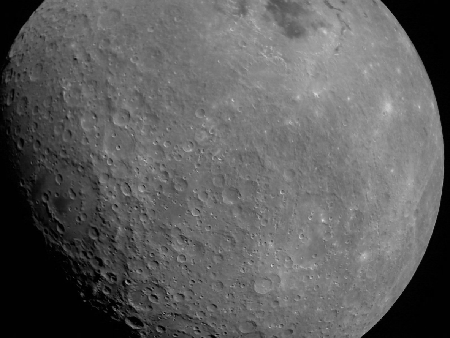
That image is to the right, reduced to post here. It was taken from about 1,600 miles elevation, and shows mostly the far side of the Moon. The dark mare in the upper right is the Sea of Moscow, which is the only large mare on the far side.

This image once again proves the camera and the spacecraft’s ability to point it accurately are both functioning.

0 comments

ULA wins private lunar launch contract

Capitalism in space: Astrobotic, the private company building a lunar lander for NASA, has chosen ULA’s Vulcan rocket for its launch vehicle.

Astrobotic announced today that it selected United Launch Alliance’s (ULA) Vulcan Centaur rocket in a competitive commercial procurement to launch its Peregrine lunar lander to the Moon in 2021.

“We are so excited to sign with ULA and fly Peregrine on Vulcan Centaur. This contract with ULA was the result of a highly competitive commercial process, and we are grateful to everyone involved in helping us make low-cost lunar transportation possible. When we launch the first lunar lander from American soil since Apollo, onboard the first Vulcan Centaur rocket, it will be a historic day for the country and commercial enterprise,” said Astrobotic CEO, John Thornton.

This is the second contract announcement for ULA’s Vulcan rocket, with the first being Sierra Nevada’s announcement that it would use Vulcan for Dream Chaser’s first six flights.

Isn’t competition wonderful? It appears to me that ULA must be offering very cut-rate deals to get these contracts, since the rocket has not yet flown while SpaceX’s already operational Falcon Heavy (with three successful launches) could easily do the job and is a very inexpensive rocket to fly. These lower prices, instigated by competition and freedom, will mean that funding missions to the Moon will continue to become more likely, even if NASA and the federal government fail to get their act together.

2 comments

Chandrayaan-2 successfully enters lunar orbit

The head of ISRO today announced that, after completed a 29 minute engine burn, India’s Chandrayaan-2 orbiter/lander/rover has successfully entered the correct orbit around the Moon.

In his briefing, Dr. Sivan announced that “The LOI maneuver was performed successfully today morning using the onboard propulsion system for a firing duration of about 29 minutes. This maneuver precisely injected Chandrayaan-2 into an orbit around the Moon.” He emphasised the unique requirement of 90 degree orbital inclination of Chandrayaan-2 and said that it was achieved by the precise execution of both the Trans Lunar Injection (performed on August 14, 2019) and today’s LOI maneuver.

“The satellite is currently located in a lunar orbit with a distance of about 114 km at perilune (nearest point to the Moon) and 18,072 km at apolune (farthest point to the Moon)”, he added.

Over the next four lunar orbits they will execute four more engine burns to lower the spacecraft to the orbit needed to send the lander/rover to the surface on September 7 in the south polar region of the Moon between the craters Manzinus C and Simpelius N at about 71 degrees latitude.

4 comments
1 32 33 34 35 36 57