New serious damage to Curiosity’s wheels?

New damage to Curiosity's wheels?
Click for original image.

I must start this post with a strong caveat. The serious damage, as posted to the right, of the zig-zag growser treads on one of Curiosity’s wheels that was photographed by one of the rover’s cameras yesterday and downloaded today, could very well not be new damage. As noted in a report in June:

The team discovered that the left middle wheel had damaged one of its grousers, the zig-zagging treads along Curiosity’s wheels. This particular wheel already had four broken grousers, so now five of its 19 grousers are broken.

The damaged wheel to the right appears to be that left middle wheel. This photo thus might simply be documenting the damage noted in June, and not new damage. Since Curiosity has six wheels (three on each side), the middle wheels like this one are likely slightly less critical and can be worked around should it no longer function well.

Nonetheless, the damage to these growsers is of concern. Previously, the wheel damage has consistently involved breakage in the metal plates between the growsers. Though the science team noted in that June report that it has “proven through ground testing that we can safely drive on the wheel rims if necessary”, the team also said that it did not think that was going to happen soon.

Based on this image, however, it is happening, at least on one wheel. Fortunately, a review of all the images downloaded yesterday does not show any other broken growsers on any other wheel, though the image survey is not thorough and does not cover the entire surface of every wheel. For example, I could not identify any images of the damaged sections of the wheel that I have been tracking since 2017. It could be that the photo’s orientation this time was significantly different, making it difficult to find a match. It could also be that the damage had increased so much that no match with an earlier photo was easily possible. Or it could simply be that the same section on the wheel was not photographed this time.

Either way, the damage on this middle wheel foreshadows the rover’s eventual future, a future that is likely getting closer because of the roughness of the mountain and rocky terrain that Curiosity is presently traveling, and appears to have no end as it now climbs Mount Sharp.

8 comments

Orion successfully enters its preliminary lunar orbit

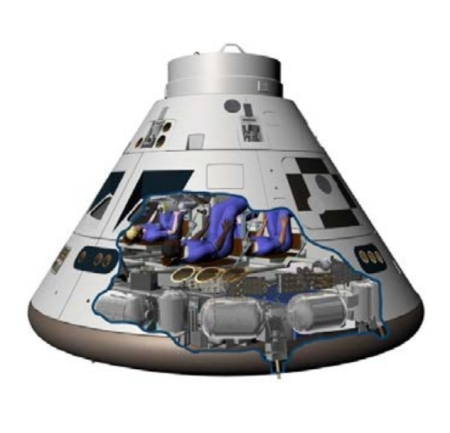
NASA’s Orion capsule today successfully completed a 2.5 minute engine burn this morning to put it in its preliminary lunar orbit around the Moon.

At the time of the burn, Orion was 328 miles above the Moon, travelling at 5,023 mph. Shortly after the burn, Orion passed 81 miles above the Moon, travelling at 5,102 mph. At the time of the lunar flyby, Orion was more than 230,000 miles from Earth.

The outbound powered flyby burn is the first of two maneuvers required to enter the distant retrograde orbit around the Moon. The spacecraft will perform the distant retrograde orbit insertion burn Friday, Nov. 25, using the European Service Module. Orion will remain in this orbit for about a week to test spacecraft systems.

NASA has been bragging that when this orbit sends Orion 40,000 miles past the Moon, it will be the farthest a man-rated spacecraft has flown from Earth since Apollo. Though true, this fact is somewhat trivial. First, SpaceX could have easily put a Dragon capsule on its first Falcon Heavy launch, instead of a Tesla, and sent that capsule into interplanetary space beyond Mars. Second, Orion is not capable of taking any astronauts farther than lunar orbit. Thus, NASA’s achievement here is somewhat overblown. Orion is not an interplanetary spaceship. It remains nothing more than an overpriced, overweight, and over-designed ascent-descent manned capsule.

12 comments

NASA awards Starship a second manned lunar landing contract

Capitalism in space: NASA yesterday modified its manned lunar lander contract with SpaceX to award Starship a second manned lunar landing for $1.15 billion.

Known as Option B, the modification follows an award to SpaceX in July 2021 under the Next Space Technologies for Exploration Partnerships-2 (NextSTEP-2) Appendix H Option A contract. NASA previously announced plans to pursue this Option B with SpaceX. The contract modification has a value of about $1.15 billion.

…The aim of this new work under Option B is to develop and demonstrate a Starship lunar lander that meets NASA’s sustaining requirements for missions beyond Artemis III, including docking with Gateway, accommodating four crew members, and delivering more mass to the surface.

NASA is also accepting bids for a competitive second manned lunar lander, but has awarded nothing as yet.

Combined with earlier investments and contracts, SpaceX now had garnered about $13 billion for developing Starship and Starlink, about $9 billion from private investment capital and about $4 billion from NASA, with most of the cash used for Starship. In addition, the company plans another investment funding round that will raise its valuation to $150 billion.

SLS might have flown once, but it appears both NASA and the investment community is increasingly putting its eggs in the Starship basket.

1 comment

NASA’s SLS rocket successfully launches Orion toward the Moon

After almost eighteen years of development and almost sixty billion dollars, NASA tonight finally completed the first unmanned test launch of its Space Launch System (SLS) rocket, lifting off at 1:41 am (Eastern).

The two solid rocket boosters functioned as planned, separating from the core stage with no problem. Then core stage and its four former shuttle engines completed its burn, putting the capsule and its upper stage into Earth orbit, and then separated cleanly. At about 30 minutes after launch the service module’s solar arrays completed their deployment. At 53 minutes after launch a 30 second burn circularized the orbit in preparation for the trans-lunar-injection (TLI) burn that will send Orion to the Moon. TLI occurred about 90 minutes after launch, after a period of check-out in orbit.

Orion will spend 26 days in space, about a week of which will be in a wide lunar orbit, testing its systems. If all goes right it will splashdown on around December 11th.

As this was the first U.S. government launch in more than a decade, since 2011 when the space shuttle was retired, the leader board for the 2022 launch race remains unchanged:

The leaders in the 2022 launch race:

52 SpaceX
51 China
19 Russia
9 Rocket Lab
8 ULA

The U.S. now leads China 76 to 51 in the national rankings, and trails the rest of the world combined 79 to 76.

20 comments

Martian helicopters of the future

Today Bob Balaram, the chief engineer for the Mars helicopter Ingenuity, wrote up a short essay summarizing the helicopter’s successes on Mars.

This aircraft, very much also a spacecraft, has been on its own on the surface of Mars, detached from its traveling companion Perseverance, for over 500 Martian days or sols. It has operated way beyond its original planned mission of 30 sols, including surviving a brutal winter that it was not designed for. With 33 flights, almost an hour of flight time, over 7 km of travel in Jezero crater, takeoffs and landings from 25 airfields, almost 4000 navigation camera images, and 200 high-resolution color images, it has proven its worth as a scout for both scientists and rover planners. Currently, it is getting ready to use its fourth software update – this one with advanced navigation capabilities that will allow it to safely fly up the steep terrain of the Jezero river delta, scouting ahead of the rover Perseverance as it searches for signs of past life on Mars. [emphasis mine]

I have highlighted the number of flights above because Ingenuity was supposed to do a very short 34th flight on November 10th that would only have the helicopter go straight up 16 feet, hover, and then come straight back down. Yet, I have seen no postflight reports, and Ingenuity’s flight log still does not include it as of today. One image from Ingenuity that was taken on November 9th has been released, and shows the ground directly below it. No other recent images of this 34th flight however have been released.

The flight could still have happened, or was scrubbed for a later time. What is important however is all those other 33 flights, and what Ingenuity’s overall success has meant for future Martian exploration. As Balaram writes,
» Read more

5 comments

Watching the first SLS launch tonight

At this moment, with weather 90% favorable and the countdown underway, the first launch of NASA’s SLS rocket appears go for a 1:04 AM (Eastern) launch tonight.

You can watch the live stream on NASA TV here, which will begin at 3:30 pm today and mostly be NASA propaganda intermixed with descriptions of the rocket, its payloads, its full mission, and updates on the launch countdown.

NASA’s live stream is now embedded below, beginning at 10:30 PM (Eastern) when actual coverage of the final countdown begins. I would still suggest that you wait until at least 12:30 AM (Eastern) before watching, as those first two hours will still be filled with a lot of NASA propaganda blather.
» Read more

13 comments

NASA managers okay SLS launch attempt November 16th

NASA managers have given the go-ahead to the scheduled launch of the agency’s SLS rocket for 1:04 am (Eastern) on November 16, 2022, despite the existence of some detached caulking that Hurricane Nicole had pulled free.

Engineers examined detailed analysis of caulk on a seam between an ogive on Orion’s launch abort system and the crew module adapter and potential risks if it were to detach during launch. The mission management team determined there is a low likelihood that if additional material tears off it would pose a critical risk to the flight.

Technicians also completed replacing a component of an electrical connector on the hydrogen tail service mast umbilical. While swapping the component did not fully fix the issue, engineers have redundant sources of information supplied through the connector.

The launch window is two hours long. As this is a night launch, it will be quite spectacular, no matter what happens. I will embed the live stream tomorrow in the early evening, for those who wish to watch NASA’s multi-hour propaganda stream. My suggestion would be to find a better use of your time until around 12:50 am (Eastern). Then would be a good time to tune in.

3 comments

SLS launch early on November 16th remains uncertain

Despite repeated assurances that the November 16, 2022 1:04 am (Eastern) launch of NASA’s SLS rocket remains on target, managers have also noted that damage to a small piece of caulking at the base of the shroud protecting the Orion capsule remains an issue that could cause a scrub.

But high winds from Nicole caused a thin strip of caulk-like material known as RTV to delaminate and pull away from the base of the Orion crew capsule’s protective nose cone at the top of the rocket. The material is used to fill in a slight indentation where the fairing attaches to the capsule, minimizing aerodynamic heating during ascent. The fairing fits over the Orion capsule and is jettisoned once the rocket is out of the dense lower atmosphere. “It was an area that was about 10 feet in length (on the) windward side where the storm blew through,” said mission manager Mike Sarafin. “It is a very, very thin layer of RTV, it’s about .2 inches or less … in thickness.”

Engineers do not have access for repairs at the pad and must develop “flight rationale,” that is, a justification for flying despite the delaminated RTV, in order to proceed with the launch. Managers want to make sure any additional material that pulls away in flight will not impact and damage downstream components.

In plain language, NASA managers would either have to issue a waiver that says this small piece of caulking poses no risk, or scrub and roll the rocket back to the assembly building to fix it. The second option would delay the launch another month, at a minimum.

A waiver however would continue NASA’s pattern with the shuttle (and continuing with SLS) to dismiss potential engineering problems simply to avoid schedule delays. With the shuttle, this pattern twice caused the loss of a shuttle and crew. With SLS, NASA has already waived by more than a year its rules concerning the stacked life of the rocket’s solid-fueled boosters. Agency managers have also waived the full test requirements from the dress rehearsal countdown, so that this test did not test everything it should.

It is expected that NASA managers will announce the waiver today on this problem. Whether it matters when the rocket goes through maximum dynamic pressure shortly after lift-off will likely determine the future of SLS.

6 comments

CAPSTONE successfully enters lunar orbit

CAPSTONE successfully entered orbit around the Moon today, putting it into the planned Lunar Gateway halo orbit to test operations in that location.

CAPSTONE is now in a near-rectilinear halo orbit, or NRHO. This particular NRHO is the same orbit that will be used by Gateway, the Moon-orbiting space station that will support NASA’s Artemis missions. CAPSTONE is the first spacecraft to fly an NRHO, and the first CubeSat to operate at the Moon.

Mission engineers plan two more engine burns over the next five days to refine the orbit more precisely.

0 comments

SLS rides out hurricane; engineers now assessing damage

NASA’s SLS rocket has apparently successfully survived on the launchpad the hurricane-force winds from Nicole, though engineers will need to inspect the rocket to see if there is any less obvious damage that might delay the now scheduled November 16th launch.

With blastoff on a long-delayed maiden flight on tap next week, sensors at pad 39B recorded gusts as high as 100 mph atop a 467-foot-tall lightning tower near the rocket. But winds at the 60-foot-level, which are part of the booster’s structural certification, peaked at 82 mph, just below the 85 mph limit.

The observed winds were “within the rocket’s capability,” said Jim Free, manager of exploration systems at NASA headquarters. “We anticipate clearing the vehicle for those conditions shortly.”

“Our team is conducting initial visual check outs of the rocket, spacecraft and ground system equipment with the cameras at the launch pad,” he tweeted. “Camera inspections show very minor damage such as loose caulk and tears in weather coverings. The team will conduct additional on-site walk down inspections of the vehicle soon.”

If no issues are found, the countdown will begin on November 14th.

8 comments

Rocket Lab leases engine test facility at Stennis

Rocket Lab has finalized a 10-year lease for using one of the engine test facilities at NASA’s Stennis Space Center in Mississippi for developing the Archimedes rocket engine for its new Neutron rocket.

With the new agreement, the A-3 Test Stand and about 24 surrounding acres at Stennis will be incorporated into the Archimedes Test Complex. Archimedes is Rocket Lab’s new liquid oxygen and liquid methane rocket engine that will power its large, reusable Neutron rocket.

Rocket Lab will have exclusive access to use and develop the A-3 Test Stand area, including associated propellant barge docks and buildings. The initial 10-year agreement includes an option to extend an additional 10 years.

The Mississippi Development Authority is providing assistance for Rocket Lab to develop the new site and to relocate and install needed equipment.

With this agreement Rocket Lab is clearly moving forward aggressively in its project to build a new rocket that can complete head-to-head with SpaceX’s Falcon 9.

0 comments

Cygnus successfully berthed at ISS

Cygnus approaching ISS on November 9, 2022

Despite on of its two solar panels only partly deployed, astronaut Nicole Mann was able to use the robot arm on ISS to grab Northrop Grumman’s Cygnus freighter and bring it into its port, where ground engineers successfully berthed it.

The image to the right is a screen capture from NASA TV as Cygnus approached. You can see the problematic panel at the bottom. Though it has folded out from its initial stored position, it has not opened up fully.

The freighter will stay docked to ISS until late January, during which the crew will unload about four tons of cargo and then fill it with garbage before sending it to burn up over the ocean. We should expect NASA and Northrop Grumman to also plan a spacewalk to not only inspect the panel to figure out what failed, but to see if it can still be deployed.

6 comments
1 49 50 51 52 53 192