Curiosity climbing Mount Sharp

Curiosity as seen by MRO from orbit
Click for full image.

Today’s cool image, to the right and cropped to post here, was taken on April 18, 2021 by the high resolution camera on Mars Reconnaissance Orbiter (MRO). Released today by MRO’s science team, it shows the rover Curiosity sitting on top of the 20-foot high rock outcrop the scientists have dubbed Mt. Mercou. The 16,400 foot high Mt. Sharp is to the south, with the rim of Gale Crater about 30 miles to the north.

I have annotated the image to show the rover’s route both before and after the moment when this picture was taken. As the caption at the link notes, the rover is currently working its way up Mt. Mercou, a route that was not initially in their plans, as shown by the wider MRO view below.
» Read more

0 comments

ESA proposes constellation of lunar communications and navigation satellites

The European Space Agency is proposing in this decade to build a constellation of communications and GPS-type satellites, dubbed Moonlight, to orbit the Moon.

ESA is asking two industrial consortia in Europe to define what an integrated sat-nav and telecoms system at the Moon would look like.

It’ll include a constellation of at least three, but probably more, positioning-and-relay satellites to give global coverage, and will likely include some surface beacons, too, to augment the accuracy of the navigation signals.

“The target we have at the moment is that the constellation would be able to allow for an accuracy of 100m and probably better. We think we are able to get to 30m in the first instance,” explained Paul Verhoef, the director of ESA’s navigation department.

The two consortiums are the UK’s Surrey Satellite and Italy’s Telespazio.

It also appears the ESA is proposing making this system available to all lunar exploration missions, whether they be part of the U.S.’s Artemis program or China’s lunar plans. If so, it is commercially smart, as they will have plenty of customers to buy their services.

9 comments

Delays force ULA to replace Vulcan rocket with Atlas 5 on military launch

Because the development of ULA’s new Vulcan rocket is behind schedule, the Space Force has agreed to allow the company to replace it with an Atlas 5 rocket on a ’22 launch.

That mission, known as USSF-51, was awarded to ULA in August 2020 and is scheduled to launch in late 2022. The company had bid its newly developed Vulcan to fly that mission but the vehicle is not going to be ready on time. As a result, the Space Force agreed to allow ULA to launch USSF-51 on the company’s legacy vehicle the Atlas 5.

…Switching vehicles financially penalizes ULA. According to the company, the Atlas 5 is more expensive than Vulcan. Phase 2 provisions allow ULA to change vehicles but at no cost penalty to the government.

This story however is important because of what it tells us about the state of Blue Origin’s BE-4 rocket engine, required by both Vulcan and Blue Origin’s New Glenn rocket.

At this moment ULA is saying that the first launch of Vulcan is still scheduled for late this year, launching Astrobotic’s Peregrine lander to the Moon. However, for that launch to happen the rocket requires working BE-4 rocket engines for its first stage. In January Blue Origin announced it had finally completed a full throttle test of that engine after problems lasting several years, and would soon be delivering flight-worthy engines to ULA.

It is now late May, and the article at the link revealed this very significant and somewhat shocking detail buried in the text:

Blue Origin in 2020 delivered pathfinder engines for ground tests but has yet to provide a flight-qualified engine for Vulcan’s first flight. A spokeswoman for Blue Origin said May 20 the company is “on track to deliver BE-4 engines this year.” [emphasis mine]

It seems completely impossible for ULA to launch that lunar lander on Vulcan this year if it does not yet have any flight-worthy engines on hand to incorporate and test in the rocket. Worse, it appears that Blue Origin might not deliver those engines for months yet.

This story thus suggests that we will not see launches of either ULA’s new Vulcan rocket or Blue Origin’s New Glenn rocket for a considerable time.


6 comments

SpaceX grabbing 90% of the launch contracts to the Moon

Capitalism in space: The announcement yesterday by Firefly that it has awarded SpaceX the launch contract for its Blue Ghost lunar lander mission (scheduled for launch in ’23) is significant because it continues a remarkable pattern of dominance by SpaceX of the lunar launch market.

Right now, of the seven scheduled robot missions to the Moon, SpaceX will launch all but one. The full list, in no particular order:

In addition, SpaceX launched Israel’s Beresheet lander in 2019 on a Falcon 9.

Furthermore, SpaceX has won the contract from NASA for the agency’s first manned lunar lander, using Starship. It has also won the contract to launch the initial components of NASA’s Lunar Gateway space station on a Falcon Heavy.

There are other lunar missions in the works (by Russia, China, and others), but these are all the launches awarded as commercial contracts to private rocket companies in recent years. Thus, of these ten lunar missions, SpaceX has launched or is launching nine. That’s a 90% market share!
» Read more

11 comments

The steep sudden foothill of Olympus Mons

Olympus Mons on Mars

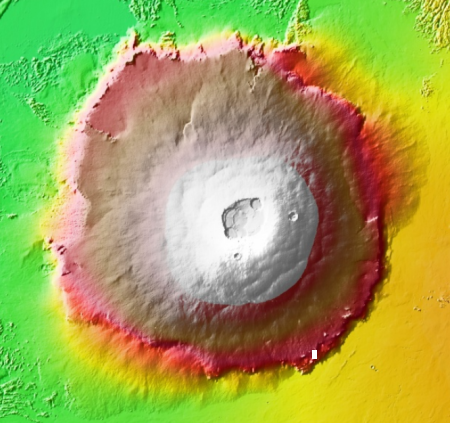
Today’s cool image starts from afar and zooms inward. The elevation map to the right shows Olympus Mons, the largest volcano on Mars and in fact the entire solar system. About 600 miles across, from the edge to its peak this volcano rises about 54,000 feet, with an actual height relative to Mars’ “sea level” of just under 70,000 feet, more than twice as high as Mount Everest on Earth.

The cross-section of this volcano is so large it would cover almost all of France if placed on Earth. As a shield volcano, it was formed by many many volcano flows that laid down many layers of lava, with some in its northwest quadrant thought to be as recent as 2 to 115 million years ago.

Our cool image today is located at the white rectangle at the southeast edge of this volcano, and illustrates how those many lava flows could create such a large shield volcano with such a large cross section.
» Read more

9 comments

SpaceX begins stacking Superheavy prototype for flight

Capitalism in space: It appears that the third Superheavy prototype, BN3 (Booster #3), is now being stacked and prepared for the first near-orbital flight of Starship, which SpaceX is still hoping to launch before the end of this year.

SpaceX has at least six BN3 sections – amounting to 22 rings and two of three tank domes – either completed or awaiting integration. The process of stacking BN3 began sometime in the last 7-10 days when SpaceX joined two four-ring sections – including the booster’s common dome, likely pictured above.

SpaceX has mostly completed BN3’s engine section, including a thrust dome with plumbing cutouts for a full 28 Raptor engines. Most recently, what looks like a Super Heavy fuel manifold appeared in Boca Chica. That manifold will attach to the end of a supersized Super Heavy transfer tube – also spotted in work – used to route methane through the liquid oxygen tank to fuel its Raptor engines. Fueling 28 large, high-performance Raptors is no mean feat and requires a rat’s nest of plumbing to feed them more than 15 metric tons (~30,000 lb) of propellant every second at full throttle.

Put simply, a majority of Super Heavy booster BN3’s hardware appears to be ready or almost ready for integration. The eight rings now stacked represent approximately 20% of the rocket’s full height, leaving another 30 or so rings – 54m (~180 ft) – to go.

That flight, the flight plan of which has already been submitted to the FCC, would take off from Boca Chica, circle about three-quarters of the globe, and land in the Pacific to the northwest of Hawaii. While not a full orbit, this flight would demonstrate an orbital capability while allowing for a controlled safe re-entry at a planned location, a wise approach for that first orbital attempt.

4 comments

Ingenuity to make sixth flight next week

Future travels for Perseverance and Ingenuity

The Ingenuity engineering team announced today that the Mars helicopter will make its sixth flight next week, flying to a new landing spot while taking images for the Perseverance science team.

Ingenuity’s flight plan begins with the helicopter ascending to 33 feet (10 meters), then heading southwest for about 492 feet (150 meters). When it achieves that distance, the rotorcraft will begin acquiring color imagery of an area of interest as it translates to the south about 50-66 feet (15-20 meters). Stereo imagery of the sand ripples and outcrops of bright rocks at the site will help demonstrate the value of an aerial perspective for future missions. After completing its image collection, Ingenuity will fly about 164 feet (50 meters) northeast where it will touch down at its new base of operations (known as “Field C”).

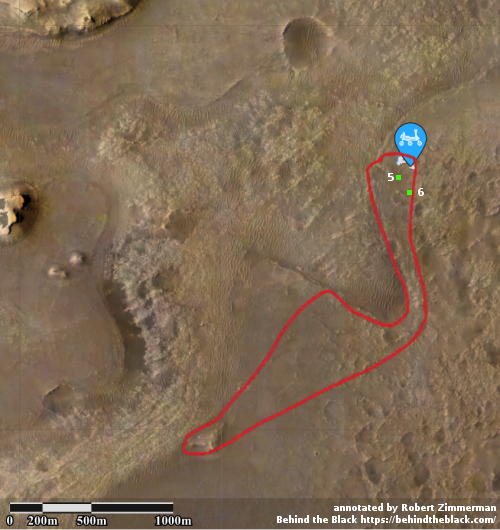
The flight will attempt a new speed record of 9 mph, and will also land for the first time in a spot that the helicopter has not scouted beforehand. It will instead be using data from high resolution images from Mars Reconnaissance Orbiter (MRO) combined with its own hazard avoidance system.

Ingenuity will essentially place itself over and in an area where Perseverance plans to go, leapfrogging ahead flight by flight, as shown by the map above (annotated by me from the map available here). The green dot numbered 5 shows the helicopter’s present position, while #6 shows its approximate landing spot after its sixth flight. Perseverance, whose present location is indicated by the blue marker, is generally heading south within the area outlined by the red line, as described during the science team’s an April 30th press conference. The goal in exploring this region is to gain a very robust geological baseline of the floor of Jezero Crater, which scientists believe will be the oldest material the rover should see in its travels.

2 comments

Bidding for ticket on first New Shepard manned suborbital flight reaches $2.8 million

Capitalism in space: The first phase in Blue Origin’s auction for the purchase of the first seat on its New Shepard suborbital spacecraft in July has closed, with the high bid now $2.8 million.

Amazon CEO Jeff Bezos’ Blue Origin space venture has begun unsealing the bids for an open seat on its New Shepard suborbital spaceship, and the high bid hit the $2.8 million mark with more than three weeks to go in the online auction.

Blue Origin says the auction has drawn out more than 5,200 bidders from 136 countries. … Bidding started on May 5 and will conclude with a live auction on June 12. Proceeds from the sale will be donated to Blue Origin’s educational foundation, the Club for the Future.

The first phrase involved sealed secret bids, and ended with the high bid at $1.4 million. The second phase, on-going now with bidding quite brisk, makes the high bid visible to all bidders.

The $2.8 million bid is far higher than the estimated price point predicted for this suborbital flight, which had been in the range of several hundred thousand dollars. The high price is likely because this will be the first flight, and people with cash are willing to spend it to get bragging rights to that seat. At the same time, the high bidding suggests that the previous estimated ticket price might have been low, at least for the first flights.

With three weeks left before the final live auction on June 12th, there is a chance the winning bid could get even higher.

7 comments

Typical but still mysterious gullies in a crater on Mars

Gullies on crater interior wall

Today’s cool image to the right, cropped and reduced to post here, is of a crater in the mid-latitudes of Mars’s cratered southern highlands. The picture was taken on January 4, 2021 by the high resolution camera on Mars Reconnaissance Orbiter (MRO), and is actually the only high resolution image ever taken of this crater.

The gullies in the north interior wall of this crater are the reason why this picture was snapped. These gullies are very typical on the pole-facing slopes of mid-latitude Martian craters, and have puzzled scientists since they were first discovered in the late 1990s in images taken by Mars Global Surveyor. Since then, thousands have been found, almost all of which in the 30 to 60 degree mid-latitude bands where glacial features are also found. Most occur on the more shadowed pole-facing interior slopes of the craters, though at higher latitudes they are also found facing the equator.

Since their discovery scientists have puzzled over their cause, which because of their locations favoring colder temperatures suggest some form of seasonal weather factor. The most preferred hypotheses propose some interaction with water ice or dry ice, or are simply dry flows of rocky granular material. None of these hypotheses have been confirmed. Some evidence suggests they are dry flows, no water involved. Other evidence points to the influence of an underground layer of water ice.

The mystery of these gullies is enhanced by by the wider view from MRO’s context camera below, rotated and cropped to post here.
» Read more

1 comment

Discovery channel to launch contest to fly winner to space

Capitalism in space: The Discovery channel today announced that it is planning a contest where the winner will win an eight-day flight to ISS in partnership with the space tourism company Axiom.

The casting call on Discovery’s website says that eligibility is limited to U.S. residents or citizens, with additional requirements to be disclosed. For now, there are few other details about eligibility for hopeful astronauts applying to the Discovery show, the expected challenges entrants will face and who will serve as judges for the competition, as the series isn’t expected to start filming until next year.

It is so far unclear whether or not eligibility may include people with physical disabilities, but the casting call does include questions about your degree of impairment with physical activities. (The European Space Agency’s current astronaut process is open to candidates with physical disabilities, and the forthcoming Inspiration4 mission includes Hayley Arceneaux, who has a prosthetic limb after childhood bone cancer.)

Discovery said the series will be in eight parts and will chronicle a “grueling” process. “The series will follow each of the contestants competing for the opportunity in a variety of extreme challenges designed to test them on the attributes real astronauts need most, and as they undergo the training necessary to qualify for space flight and life on board the space station,” the channel said in a statement.

It is unclear exactly when this mission will fly, but based on its description and timing I suspect it will not be for several years, and might actually take place after Axiom installs its own module to ISS in ’24.

0 comments

1st pictures from Zhurong finally released

Zhurong's front view
Click for full image.

Zhurong's rear view
Click for full image.

China today finally released the first images from its Mars rover Zhurong, proving that the rover landed successfully and is operating as planned. The link takes you to the website of the Chinese space agency, in Chinese. This link provides some details in English.

The two images to the right show the front and rear views from Zhurong, sitting on top of its landing. The black & white front view shows the deployed ramps that the rover will roll down when it begins it operational phase. It shows, as expected, the generally flat terrain of the northern lowlands plains of Utopia Planitia. In the distance however there appears to be distinct features, possibly the rim of a small crater. At the moment the exact location of the rover is not known, so no precise map yet exists of its surrounding terrain. This will change in the coming days as both Chinese and American scientists hone in on the rover using orbital images.

The color rear view shows that the rover’s solar panels and high gain antenna have properly deployed. While the design of Zhurong in many ways imitates the two American rovers Spirit and Opportunity (probably because China hacked into the JPL website for several years and downloaded their blueprints), it also includes several upgrades. For example, Zhurong’s solar panels unfold, providing a significantly larger surface area to gather sunlight. Both Spirit and Opportunity were somewhat hampered by the power they could obtain by their smaller solar panels. Both also experienced times when Martian dust on the panels reduced that power. Zhurong’s much larger panels will protect it better from these issues, and could allow it to survive longer on Mars.

2 comments

China’s Long March 4B rocket launches oceanography satellite

China tonight successfully launched a new oceanography satellite using its Long March 4B rocket, completing a three satellite constellation.

No word on whether the rocket’s first stage landed on any villages in the interior of China.

The leaders in the 2021 launch race:

15 SpaceX
13 China
7 Russia
2 Rocket Lab
2 ULA

The U.S. still leads China 21 to 13 in the national rankings.

0 comments
1 76 77 78 79 80 126