Petrified dunes on Mars?

Petrified dunes on Mars?
Click for original image.

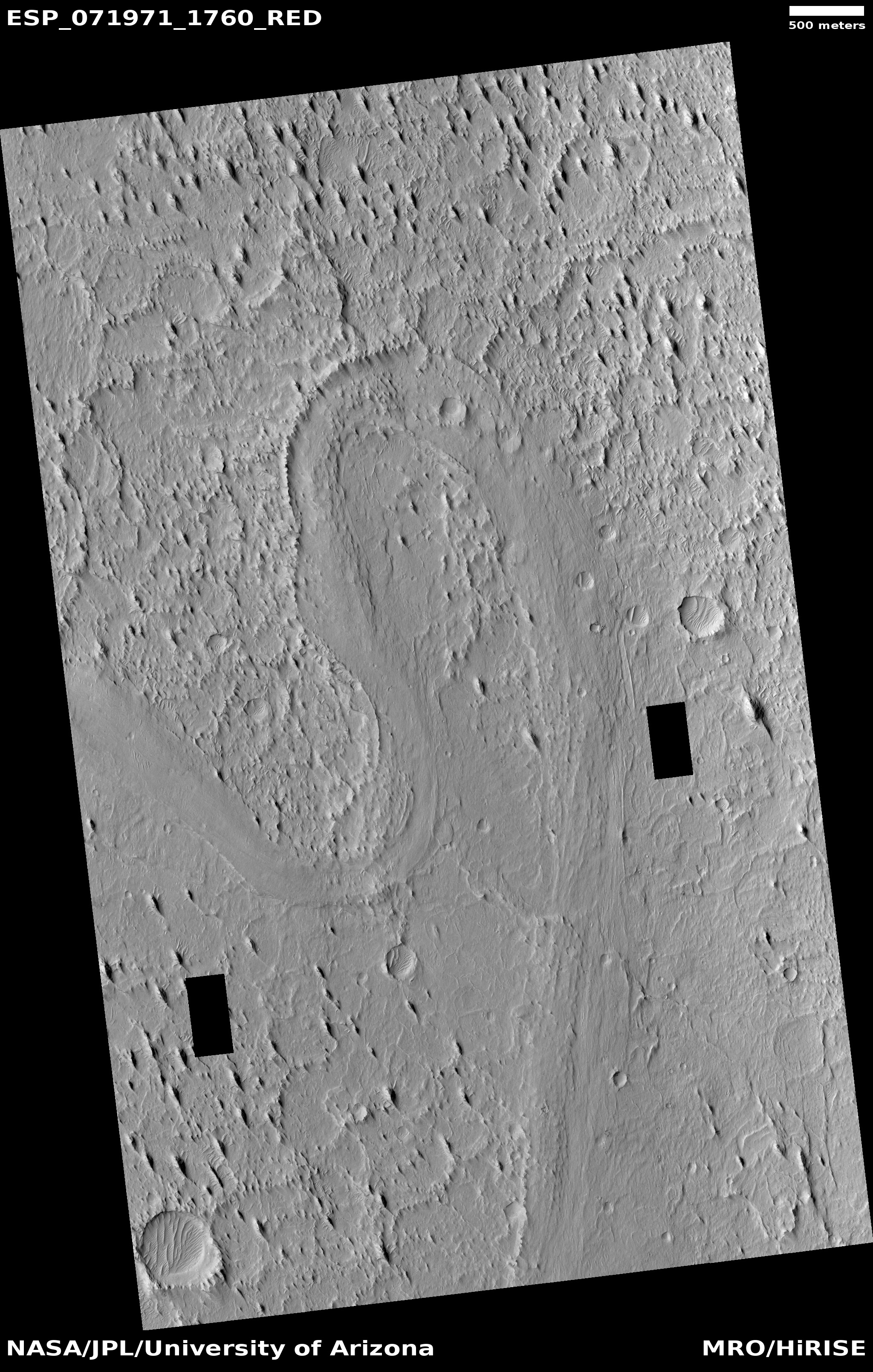
Cool image time! The picture to the right, cropped, reduced, and sharpened to post here, was taken on May 31, 2023 by the high resolution camera on Mars Reconnaissance Orbiter (MRO).

I think the many parallel ridges are likely hardened and petrified dunes of sand because of their craggy nature. Dunes of sand would have a smoother, softer look, and in fact, if you look at some of the dunes inside the depression at the bottom-right of the picture you will see ridges with exactly that look, smooth and curved.

Nor is it unreasonable to believe these ridges are petrified dunes, as orbital data over time has found that many of the dunes on Mars, even those that look active, are not and have likely been hardened for centuries.

As for the ridges running at right angles to each other in the picture’s middle left, I have no idea. Possible we are looking at ancient dykes of lava that pushed up through cracks and faults, but this is pure guess.
» Read more

0 comments

Ingenuity completes 56th flight on Mars

Overview map
Click for interactive map.

According to a tweet yesterday by the Ingenuity engineering team, the helicopter successfully completed its 56th flight on Mars on August 25, 2023, flying 1,345 feet to the northwest at a height of 39 feet for 141 seconds, or two minutes and twenty-one seconds. The distance traveled and the flight time were slightly longer than planned, but that likely was because the helicopter used that extra time to determine a safe landing site.

The green line on the map above shows the approximate new position of Ingenuity, positioned close to the planned route of Perseverance as indicated by the red dotted line. Perseverance’s present location is marked by the blue dot.

Neretva Vallis is the gap in the western rim of Jezero crater through which the delta had flowed eons before, and is the rover’s eventual target in order to begin exploring the terrain beyond, known to be very rich in mineral content.

Meanwhile, the Ingenuity engineering team has already released its flight plan for the 57th flight, heading north about 670 feet and targeting tomorrow for flight.

2 comments

Amazon investors sue company for not considering SpaceX as potential launch provider

In a lawsuit filed by Amazon investors, they claim that the company’s decision to give major and expensive launch contracts to Arianespace, ULA, and Blue Origin to put its planned 3,200 Kuiper satellite constellation into orbit but never even consider using SpaceX indicates a failure at due diligence for the shareholders as well as a possible conflict of interest.

The plaintiff’s biggest concern was the decision to give Blue Origin the contract.

The suit, filed by Amazon shareholders the Cleveland Bakers and Teamsters Pension Fund, alleges that the board spent less than 40 minutes approving the launch agreements for Amazon’s Project Kuiper mega-constellation, while not even considering leading launch company (and Blue Origin rival) SpaceX. “Amazon’s directors likely devoted barely an hour before blindly signing off on funneling […] Amazon’s money to Bezos’ unproven, struggling rocket company,” the suit says. The plaintiffs say the board failed to protect the negotiation process “from Bezos’ glaring conflict of interest.”

It appears these investors might have a point, as so far Amazon has paid these launch companies about $1.7 billion, with Blue Origin getting $585 million, though not one satellite has yet launched. Moreover, it appears from all counts that it will be very difficult for these companies — especially Blue Origin — to complete the required missions necessary to get into orbit half of Amazon’s constellation by 2026, as required by its FCC license.

6 comments

SpaceX successfully launches 22 more Starlink satellites

SpaceX tonight successfully launched another 22 Starlink satellites, its Falcon 9 rocket lifting off from Cape Canaveral.

The first stage successfully completed its seventh flight, landing on a drone ship in the Atlantic. Note too the speed in which SpaceX was able to resume launches after Hurricane Idalia plowed across Florida. ULA’s canceled a launch earlier in the week, but it can’t move as fast to resume launches.

The leaders in the 2023 launch race:

60 SpaceX
38 China
12 Russia
7 Rocket Lab

In the national rankings, American private enterprise now leads China in successful launches 69 to 38. It also leads the entire world combined, 69 to 61, while SpaceX by itself now trails the rest of the world (excluding American companies) only 60 to 61 in successful launches.

6 comments

The splatter surrounding a mid-latitude Martian crater

A channel in the splatter of a Martian crater
Click for original image.

Cool image time! The picture to the right, cropped, reduced, and sharpened to post here, was taken on April 12, 2023 by the high resolution camera on Mars Reconnaissance Orbiter (MRO). It shows what the scientists simply label as “Northern Mid-latitude Terrain”.

I have focused in on that meandering channel and the landscape around it. On Earth we would assume that channel marks the drainage of a river or stream, possibly also shaped by a glacier at some point because of its U-shaped profile. This guess is strengthened by the elevation data from MRO, which shows the channel descending to the southwest about 440 feet along its 2.2 mile length.

The channel and the eroded look of the surrounding terrain suggests strongly the presence of near-surface ice at this location, which is not unreasonable based on its 32 degree north latitude. The wider look below only adds further strength to this hypothesis, but also adds a lot more details explaining the genesis of this strange landscape.
» Read more

0 comments

Webb takes infrared image of Supernova SN1987A

Annotated infrared image from Webb
Click for original image.

The Webb Space Telescope has taken its first infrared image of Supernova SN1987A, the closest supernova to Earth in five centuries at a distance of 168,000 light years away in the nearby Large Magellanic Cloud.

The annotated image to the right, cropped, reduced, and sharpened to post here, shows that supernova remnant as Webb sees it. Most of the structures identified here have been observed now for decades as the material from the explosion has been expanding outward. However,

While these structures have been observed to varying degrees
by NASA’s Hubble and Spitzer Space Telescopes and Chandra X-ray Observatory, the unparalleled sensitivity and spatial resolution of Webb revealed a new feature in this supernova remnant – small crescent-like structures. These crescents are thought to be a part of the outer layers of gas shot out from the supernova explosion. Their brightness may be an indication of limb brightening, an optical phenomenon that results from viewing the expanding material in three dimensions. In other words, our viewing angle makes it appear that there is more material in these two crescents than there actually may be. [emphasis mine]

I highlight that one word because it is unnecessary, and is only inserted to punch up Webb’s abilities for public relations purposes. Moreover, the rest of the text of the full press release at the link is even worse. It provides little information about the evolution of this supernova since its discovery more than three decades ago, but instead waxes poetic again and again about how wonderful Webb is.

Though Webb certainly has much higher resolution than the earlier infrared space telescope Spitzer and can do far more, this tendency of NASA press releases to use these superlatives only devalues Webb. The images themselves sell the telescope. No need to oversell it in the text.

Meanwhile, the significance of SN 1987A is not explained. Since the development of the telescope by Galileo in the early 1600s, there has been no supernova inside the Milky Way. SN 1987A has been the closest, so it has been photographed repeatedly in multiple wavelengths to track the evolution of the explosion’s ejecta. Webb now gives us a better look in the infrared, though in truth the small amount of new details is actually somewhat disappointing.

3 comments

Firefly notifies Space Force that it is ready to launch military payload at a moment’s notice

As part of a military program to improve the speed of launching payloads, Firefly and its payload provider Millennium have now notified the Space Force that both are ready to launch a satellite any time in the next six months, and do so fast.

Although this mission has been promoted as a 24-hour call-up, it is being planned in multiple stages and the companies have spent months rehearsing and preparing. The intent of the demonstration is to help the Space Force and the space industry contractors figure out processes to accelerate the planning and execution of national security missions.

Firefly and Millennium are now officially in a six-month “hot standby phase.” At any point during that time the Space Force will give the companies an alert notification, kicking off a 60-hour window to transport the payload to Firefly’s launch site at Vandenberg Space Force Base, California. conduct fueling operations and integrate it with the Alpha rocket’s payload adapter.

Space Force officials will then issue Firefly a launch notice with the final orbit requirements. Firefly will then have 24 hours to update the trajectory and guidance software, encapsulate the payload, transport it to the pad, mate to Alpha, and stand ready to launch at the first available window.

It appears that SpaceX has already done a similar thing with a fast classified launch several years ago, announcing the contract award and launching a classified payload within weeks. This new test is likely to show Firefly’s ability to do the same.

3 comments

Vikram takes movie of Pragyan rover as it roves

Pragyan as seen by Vikram
Click for movie.

Using one of Vikram’s lander cameras, engineers have produced a short movie of India’s Pragyan rover as it rotated to avoid a small crater about ten feet ahead.

The picture to the right is from that 16-second movie, near its end. It appears that the engineers operating Pragyan were unhappy with almost any route ahead from its present position, as they rotated Pragyan almost 360 degrees, and even attempted forward motion at one point and then resumed rotation.

It is not clear if any of the craters visible in this picture are the crater that caused the detour. The movie however does provide a sense of scale. Pragyan is small, but it is able to maneuver easily using its six wheels.

5 comments

China’s Long March 2D launches 3 satellites

China today successfully placed three “remote sensing” satellites into orbit, using its Long March 2D rocket lifting off from its Xichang spaceport in south China.

The state-run press provided no other information, including whether the rocket’s lower stages crashed near habitable areas. According to the flight path, the crash zones were near major population centers, including one city with a population of nine million.

SpaceX meanwhile scrubbed a Falcon 9 launch this morning at Vandenberg due to an issue with one first stage engine, but it is still scheduled to launch 22 Starlink satellites this afternoon from Cape Canaveral. The live stream is here.

The leaders in the 2023 launch race:

59 SpaceX
38 China
12 Russia
7 Rocket Lab

In the national rankings, American private enterprise still leads China in successful launches 68 to 38. It also leads the entire world combined, 68 to 61, while SpaceX by itself now trails the rest of the world (excluding American companies) 59 to 61 in successful launches.

1 comment

Buried ridges at the bottom of a Martian abyss

Buried ridges in a Martian abyss
Click for full image.

Today’s cool image could be labeled a “What the heck?!” photo, as the origin of its most distinct feature is utterly baffling. The picture to the right, cropped, reduced, and sharpened to post here, was taken on June 18, 2023 by the high resolution camera on Mars Reconnaissance Orbiter (MRO), and shows what look like a collection of meandering ridges peeking out from a terrain covered by thick dust.

The scientists label this dust-covered ground, as well as the ripple dunes to the south in the full image, “sand sheets.” Without question, the ground here seems to resemble a Sahara-like terrain. It is utterly featureless, other than the few bedrock features that poke up out of that sand. In the full image some peaks stick out, but it the meandering ridges in this section that are most intriguing. They are reminiscent of rimstone dams in caves, but what formed them remains baffling, since cave rimstone dams are formed by the interaction of limestone and water, and there is absolutely no evidence of any near surface ice at this location in the dry equatorial regions of Mars.

All the ridges signify is a buried terrain formed in some inexplicable way.
» Read more

4 comments

Starlink makes deal with Japanese cell phone company

SpaceX has now partnered with the Japanese cell phone company KDDI to provide satellite-to-cellular service in remote areas of Japan that do not have good cell tower service.

The companies plan to start with SMS text services as early as 2024 and will eventually provide voice and data services. Almost all existing smartphones on KDDI network will be compatible with this new service as it employs the device’s existing radio services.

Since Starlink now has more than 5,000 satellites in orbit, it can offer its services to a wider ranger of customers worldwide, and has been slowly signing them up, from country to country.

0 comments

Pragyan snaps first pictures of Vikram sitting on the Moon

Vikram as seen by Pragyan
Click for original image.

India’s space agency ISRO has released the first two pictures from the Pragyan rover showing the Vikram lander that bought both to the Moon safely.

The picture to the right is the close-up image, which shows two of Vikram’s science instruments. CHASTE is a probe that has been measuring the temperature of the Moon’s regolith at this spot, while ILSA is a seismometer for measuring the seismicity around the landing site.

Both spacecraft have been on the lunar surface now for one week, which means they are both halfway through their nominal two-week mission that lasts until lunar sunset, occurring on September 4th. Neither were designed to survive the 14-day-long lunar night, though engineers will attempt to kept both alive.

4 comments
1 317 318 319 320 321 1,327