Astronomers discover an exoplanet with the density of a marshmallow

Using ground-based telescopes to gather more data about an exoplanet discovered by the orbiting TESS telescope, astronomers have found that it has the density of a marshmallow.

The planet orbits a red dwarf star, the most common star in the universe, and is the “fluffiest” yet seen around this type of star.

Red dwarf stars are the smallest and dimmest members of so-called main-sequence stars — stars that convert hydrogen into helium in their cores at a steady rate. Though “cool” compared to stars like our Sun, red dwarf stars can be extremely active and erupt with powerful flares capable of stripping a planet of its atmosphere, making this star system a seemingly inhospitable location to form such a gossamer planet.

Astronomers remain puzzled how such a large fluffy planet could have formed around such a dim small star.

3 comments

Rate of micrometeorite impacts on Webb holding as expected

According to this Space.com article, the rate and size of micrometeorite impacts on the main mirror of the Webb Space Telescope has held steady at the rate and size expected, since the first surprisingly large micrometeorite impact in May that slightly dinged one mirror segment.

At this point, JWST has experienced a total of 33 micrometeoroid events, according to Smith’s slides. But the most damaging one came before JWST began science observations; in late May, a particularly large micrometeoroid struck the observatory’s mirror, leaving its mark on one golden hexagon. The team estimates that a strike of that size should occur about once a year, Smith said.

“So we got that at month five,” he said. “We haven’t seen another one yet, so it’s still consistent with the statistics that we expected.”

Smith noted that, at the current impact rate, Webb will still be meeting its five-year performance requirement 10 years into the mission. Scientists estimate that the observatory has enough fuel to operate for 20 years.

Meanwhile, one of Webb’s infrared cameras is not doing spectroscopy as engineers analyze the high levels of friction in a “grating wheel.” At this point it appears they still do not understand the cause of the friction, and thus have not come up with a plan for mitigating it.

0 comments

Chandrayaan-3 now scheduled for summer 2023

India’s second attempt to put a rover on the surface of the Moon, Chandrayaan-3, has now been tentatively scheduled for launch in the summer of 2023.

The launch had originally been scheduled for launch in the fall of 2020, but was delayed when India shut down due to the Wuhan panic. Official at ISRO, India’s space agency, had hoped to launch by the summer of 2022, but that proved impossible. They have now delayed the mission a full year.

In fact, all earlier reports had indicated the rover was almost ready. This new delay of a full year suggests that some new issues might have been identified.

The news article at the link also notes that ISRO is now planning two unmanned orbital missions plus four launch abort tests before launching its first manned mission, dubbed Gaganyaan, not two abort tests as previously planned. They are still targeting ’24 for the manned mission.

0 comments

InSight status: Barely hanging on

InSight's power status as of October 19, 2022

The science team for the InSight lander on Mars today posted an update on the power the spacecraft’s dust covered solar panels are producing. I have added that data to my on-going graph of these power levels, to the right. From the update:

On October 19, 2022, InSight was generating an average between 275 and 285 watt-hours of energy per Martian day, or sol. The tau, or level of dust cover in the atmosphere, was estimated at 1.5 (typical tau levels outside of dust season range from 0.6-0.7).

The jump in tau level is due to a large dust storm that developed in September more than two thousand miles away in the southern hemisphere. Though it is so far away, that storm put a lot more dust in the atmosphere above InSight, and forced engineers to shut down all but its most essential functions.

That storm is apparently continuing, and might even be growing. If so, the future of InSight is dim indeed. Any further drop in the amount of power it generates daily will likely make it unable to operate at all, and the mission will end.

0 comments

Frozen lava flows around Martian hills

Martian lava flowing around hills
Click for full image.

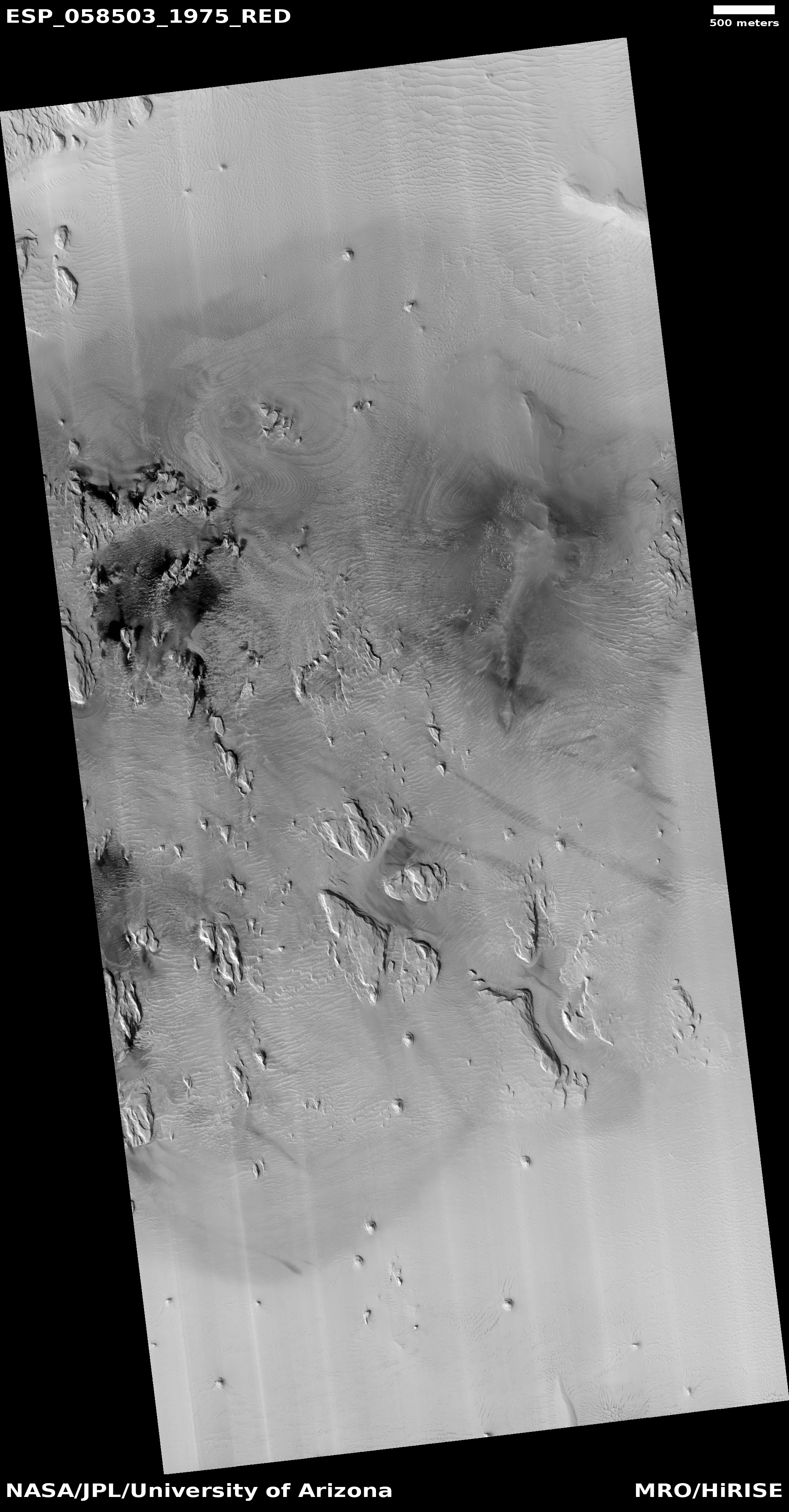
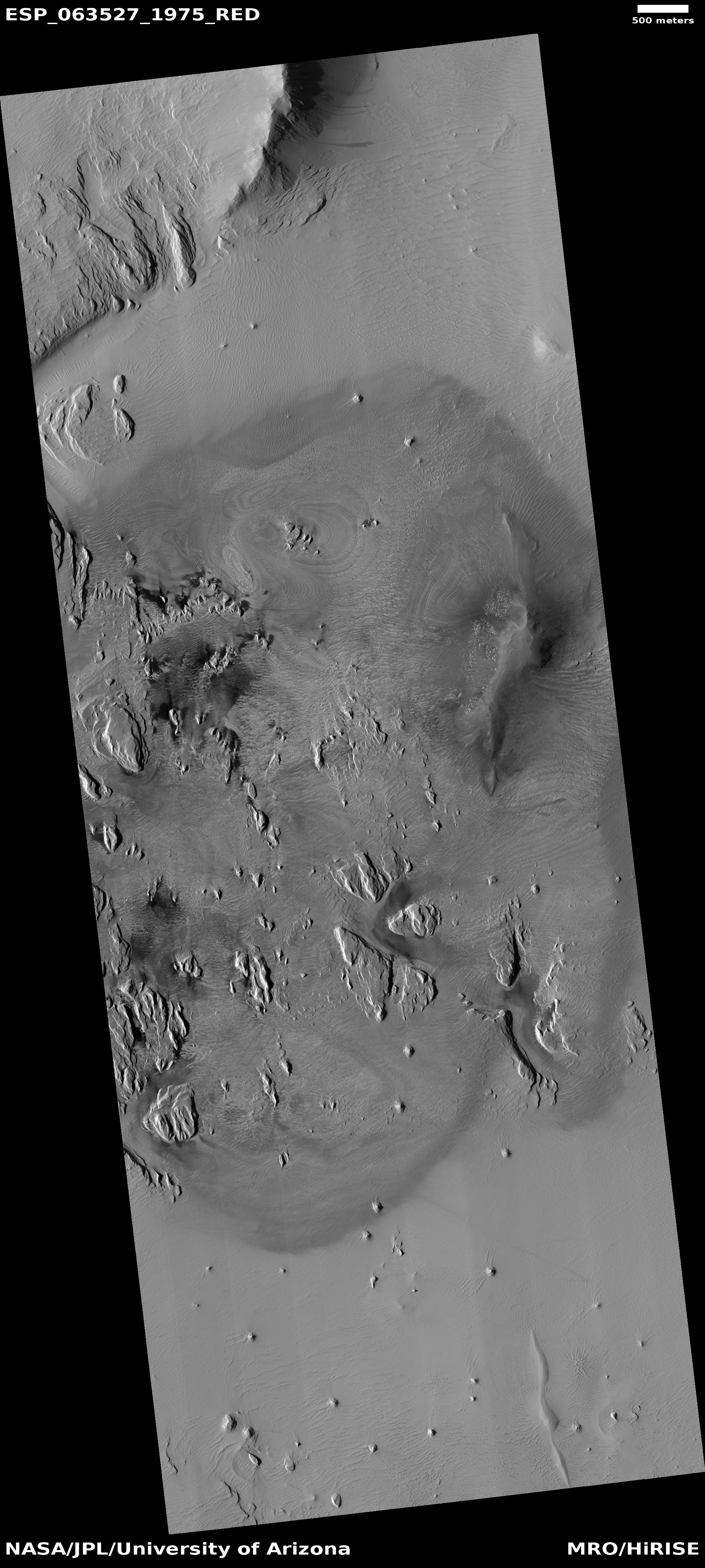
Cool image time! The photo to the right, rotated, cropped, reduced, and enhanced to post here, was taken on August 24, 2022 by the high resolution camera on Mars Reconnaissance Orbiter (MRO). It shows the westernmost edge of the Athabasca flood lava plain, thought to be the youngest lava flow on Mars, having covered the area of Great Britain in a matter of weeks 600 million years ago.

This image was a captioned feature yesterday by the MRO science team. As they note:

Although you can’t sail a boat on a sea of lava, hills and craters that stick up higher than the lava flow act like barriers. When a boat is driven through the water, there is a bow wave at the front of the boat, and a wake that trails off behind that indicates which way the boat is moving. In a lava flow, when a hill sticks up, the lava piles up on the upstream side (just like a bow wave) and can leave a wake on the downstream side, so we can tell which way the lava was moving against the stationary hill.

As you can see, every hill has a pile of lava on its northeast slopes, and a wake to its southeast. As the main vent of the Athabasca eruption is to the northeast, about 500 miles away (as shown on the overview map below), the flow direction suggested by the wakes fit the general geography.
» Read more

2 comments

Hubble spots double tail of debris from DART impact of Dimorphus

Dimorphus double tail
Click for original image.

A series of images taken by the Hubble Space Telescope of the ejecta released when DART crashed into the small 525-foot-wide asteroid Dimorphus has found that debris forming a double tail trailing away from the Sun.

The picture to the right, cropped, reduced, and enhanced to post here, was taken on October 11, 2022 by Hubble, and shows those two tails as close parallel debris trails.

Repeated observations from Hubble over the last several weeks have allowed scientists to present a more complete picture of how the system’s debris cloud has evolved over time. The observations show that the ejected material, or “ejecta,” has expanded and faded in brightness as time went on after impact, largely as expected. The twin tail is an unexpected development, although similar behavior is commonly seen in comets and active asteroids. The Hubble observations provide the best-quality image of the double-tail to date.

Following impact, Hubble made 18 observations of the system. Imagery indicates the second tail formed between 2-8 October 2022.

Though observations by telescope will continue for the years to follow, the real punchline to this event will be when the European probe Hera rendezvouses with the Didymous-Dimorphus pair in 2026 to perform several years of very close observations.

0 comments

NASA approves use of American spacesuits for spacewalks after investigation

NASA this week gave approval to the resumption of spacewalks on ISS, using its American spacesuits, following its investigation into a March incident where one astronaut’s spacesuit became somewhat water-logged.

The agency has now completed a review of the incident, finding that it was not a leak caused by hardware issues. Instead, the water was condensation caused by high levels of astronaut exertion and the cooling setting on Maurer’s extravehicular mobility unit (EMU) spacesuit, NASA officials said.

Though NASA was somewhat vague about the solution, it appears it has simply told astronauts to adjust the cooling setting of their suits to prevent condensation within the suits.

These American suits are very complicated to use, and very expensive. The agency has contracted out for new suits from private companies, but it will be very instructive to see what SpaceX comes up with for the spacewalk suits it is making for the private commercial manned Polaris Dawn mission in the spring of 2023.

1 comment

ESA delays first Ariane-6 launch to late in 2023

The European Space Agency has once again delayed the first Ariane-6 launch, shifting it to the fourth quarter of 2023.

Even so, officials warned that this is merely “a planned date,” and that static fire tests of both the first stage and second stage must first be completed before the launch can go forward.

Ariane-6 was initially supposed to begin launching in 2020, putting it three years behind schedule. Furthermore, it has struggled to obtain customers, as it is entirely expendable and thus expensive and not competitive with SpaceX’s Falcon 9.

Since Ariane-6 is delayed and the Ariane-5 rocket’s has only a few launches left before retirement, ESA officials also noted that it has now been forced to buy two launches from SpaceX.

The launches include the Euclid space telescope and the Hera probe, a follow-up mission to NASA’s DART spacecraft which last month succeeded in altering the path of a moonlet in the first test of a future planetary defence system. “The member states have decided that Euclid and Hera are proposed to be launched on Falcon 9,” ESA Director General Josef Aschbacher told reporters after a meeting of the 22-nation agency’s ministerial council.

The launches will take place in 2023 and 2024 respectively.

The irony is that ESA is probably going to save a lot of money launching with the Falcon 9, rather than its own Ariane-6. In fact, I would not be surprised if the total SpaceX price for both launches equals one Ariane-6 launch. Furthermore, SpaceX gets this business because its own American competitors, ULA and Blue Origin, have also failed to get their new rockets flying on time.

6 comments

SpaceX launches 54 Starlink satellites

SpaceX today successfully used its Falcon 9 rocket to launch 54 Starlink satellites.

The first stage completed its 10th flight, landing on its drone ship in the Atlantic.

The leaders in the 2022 launch race:

48 SpaceX
45 China
15 Russia
8 Rocket Lab
7 ULA

American private enterprise now leads China 68 to 45, and is tied with the entire world combined 68 each. Note that SpaceX’s 48 launches so far this year matches the entire total for the U.S. last year.

5 comments

A pseudo-oblique view of Jupiter’s cloud-tops

A pseudo-oblique view of Jupiter's cloud-tops
Click for original image.

Cool image time! The image to the right, cropped, reduced, and annotated to post here, was created on October 18, 2022 by citizen scientist Thomas Thomopoulos from one of the photos taken by Juno during its close fly-by of Jupiter in May 2018.

He created this three dimensional relief by assigning different elevation values across the image’s greyscale, with white having the highest elevation. This relief is thus not based on actual topography, but it provides a nice way to illustrate the cloud structures of Jupiter’s cloud tops. It also, as Thomopoulos notes, provide a good way to possibly “see a representation in relief of surface movements.” Nor is his topography based on greyscale far wrong, since in many Jupiter images the lighter colored clouds are generally higher because the darker ones are in shadow.

The map below provides the context and scale of this image.
» Read more

6 comments

Twelve years of data from WISE

The Wide Field Infrared Survey Explorer (WISE) was launched in 2009 with an intended mission of two years, during which it would map the sky looking for asteroids. In 2011 NASA extended the mission, renaming the telescope for inexplicable reasons to NEOWISE (adding “Near-Earth Object” to the beginning).

In the more than a decade since, the telescope has been able to get eighteen repeated scans of the entire sky, allowing scientists to track many changes in a variety of stellar objects over time.

Yesterday NASA issued a press release celebrating this long achievement.

Every six months, NASA’s Near-Earth Object Wide Field Infrared Survey Explorer, or NEOWISE, spacecraft completes one trip halfway around the Sun, taking images in all directions. Stitched together, those images form an “all-sky” map showing the location and brightness of hundreds of millions of objects. Using 18 all-sky maps produced by the spacecraft (with the 19th and 20th to be released in March 2023), scientists have created what is essentially a time-lapse movie of the sky, revealing changes that span a decade.

There is a bit of hype in this claim. The data isn’t really useful when looked at across the entire sky. One has to zoom into particular objects to see them evolve over time. Also, many of these changes, such as with variable stars, are well known and tracked by many other telescopes.

Nonetheless, this infrared database is very valuable. It can be used for example by astronomers to identify objects that should be viewed with high resolution in the infrared, by Webb.

0 comments

Webb takes infrared image of Hubble’s Pillars of Creation

The Pillars of Creation, as seen by Hubble and Webb
Click for original image.

Not unexpectedly, astronomers have quickly begun aiming the Webb Space Telescope’s infrared eye at some of the most famous targets previously imaged in optical wavelengths by the Hubble Space Telescope.

The newest example is shown to the right and reduced and labeled to post here. It shows what NASA officials dubbed “The Pillars of Creation” when Hubble first photographed this nebula in 1995, with a later 2014 Hubble optical image at the top and the new 2022 Webb infrared image on the bottom. From this image’s caption:

A new, near-infrared-light view from NASA’s James Webb Space Telescope, at [bottom], helps us peer through more of the dust in this star-forming region. The thick, dusty brown pillars are no longer as opaque and many more red stars that are still forming come into view.

While the pillars of gas and dust seem darker and less penetrable in Hubble’s view [top], they appear more diaphanous in Webb’s. The background of this Hubble image is like a sunrise, beginning in yellows at the bottom, before transitioning to light green and deeper blues at the top. These colors highlight the thickness of the dust all around the pillars, which obscures many more stars in the overall region.

In contrast, the background light in Webb’s image appears in blue hues, which highlights the hydrogen atoms, and reveals an abundance of stars spread across the scene. By penetrating the dusty pillars, Webb also allows us to identify stars that have recently – or are about to – burst free. Near-infrared light can penetrate thick dust clouds, allowing us to learn so much more about this incredible scene.

While the Hubble colors attempt to mimic the colors seen by the human eye, the colors in the Webb image are all false colors, chosen by the scientists to distinguish the different infrared wavelengths produced by different features in the picture.

2 comments
1 423 424 425 426 427 1,327