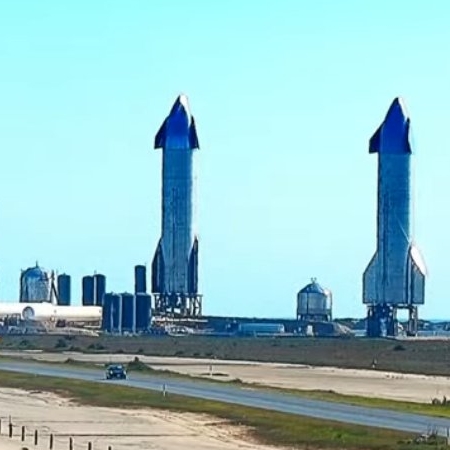
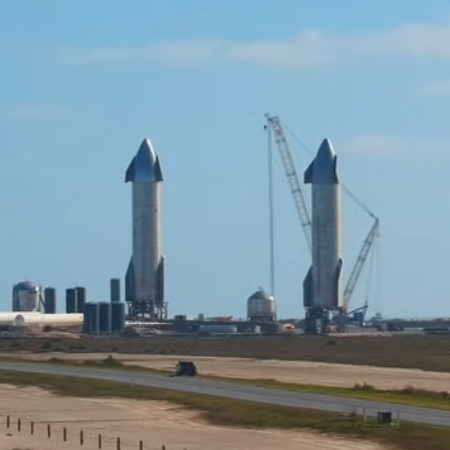
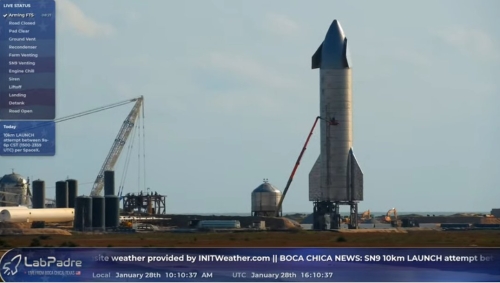
Starship 50,000 ft hop now scheduled for Nov 30th

Capitalism in space: Having completed all preliminary static fire tests, SpaceX has now set November 30th as the target date for 50,000 foot high hop for its eighth Starship prototype.

SpaceX is understood to be conducting a Flight Readiness Review (FRR) for the test flight, with this final Static Fire test providing key data to the final go to proceed towards SN8’s big day.

Elon Musk has already calibrated public expectations on the expected outcome of SN8’s test, noting that “understanding exactly how the body flaps control pitch, yaw & roll during descent, such that the ship is positioned well to relight, flip & land, would be a big win.” As opposed to expecting SN8 to land feet first on the landing pad.

Musk’s point is important. The primary engineering goal for this first hop will be to find out whether they truly understand how to control and fly Starship. Their knowledge in this area is only computer based, and thus is very incomplete, and could very well be wrong, resulting in a failure that prevents a proper clean landing.

Such as failure however would actually be an engineering success, as it would give them the data needed to make later prototypes work. As for landing, they know how to do that already. Once they get the flying right, the landing should follow.

SpaceX has said it will live stream that hop. Should be a thrill to watch.

9 comments

SpaceX sets numerous launch records in placing 60 more Starlink satellites in orbit

Falcon 9 booster landing for a record 7th time

Capitalism in space: SpaceX tonight broke a whole bunch of new launch records in launching another sixty Starlink satellites into orbit using its Falcon 9 rocket.

First, the leaders in the 2020 launch race:

31 China
22 SpaceX
12 Russia
5 ULA
5 Rocket Lab

The US now leads China 35 to 31 in the national rankings.

For SpaceX, this launch established the following landmarks for the company:
» Read more

9 comments

Regulators coming after SpaceX’s Boca Chica facility and Starship

Capitalism in space? New FAA documents suggest that government regulators are not happy with the rapid and spectacular development by SpaceX of its Super Heavy/Starship rocket at Boca Chica, Texas, and are eager to impose restrictions and delays.

The issue revolves around revisions to SpaceX’s original FAA approval for its work at Boca Chica because the company has switched from flying Falcon 9 and Falcon Heavy rockets to developing and flying Starship and Super Heavy. While the FAA has been cooperative in issuing the necessary revisions, other agencies have raised red flags.

But the most important document of the bunch is the written reevaluation signed by the FAA on May 22. The file spans 26 pages, was required for SpaceX to receive its suborbital launch license from the FAA on May 28, and incorporates concerns from state and federal environmental agencies.

In the reevaluation, the Texas Parks and Wildlife Department and the US Fish and Wildlife Service took issue with several aspects of SpaceX’s plans and ongoing activities. Those criticisms targeted the “fluid nature” of the company’s construction projects, excessive road closures to Boca Chica Beach (which Brownsville locals prize), around-the-clock work that may affect nocturnal threatened or endangered species, prototype explosions, and sprawling wildfires the company has triggered.

The FAA responded to each concern in the document, ultimately determining “there are no significant environmental changes, and that all pertinent conditions and requirements of the prior approval have been met or will be met” with SpaceX’s suborbital test-flight plans.

However, SpaceX does not yet have the FAA’s go-ahead to launch any Starships to orbit from Boca Chica.

In its replies to concerns noted by other agencies — some of which call for a new EIS [environmental impact statement], which could take years to complete (an eternity in Musk time) — the agency repeatedly noted it is working with SpaceX to draft an “environmental review” of those plans.

Should Joe Biden and the power-hungry and controlling Democrats take control of the executive branch of the federal government, expect the FAA’s desire to help SpaceX to quickly end.

27 comments

SpaceX launches oceanography satellite

Capitalism in space: SpaceX today successfully launched an oceanography satellite using its Falcon 9 rocket from the company’s California launch site at Vandenberg Air Force Base..

The first stage, making its first flight, successfully landed back on land near the launch site.

This was also SpaceX’s 21st successful launch in 2020, tying their record from 2018 for the most launches in a single year by a private company, ever. That record should be broken tomorrow, with their next Starlink launch.

The leaders in the 2020 launch race:

30 China
21 SpaceX
12 Russia
5 ULA
5 Rocket Lab

The U.S. now leads China 34 to 30 in the national rankings.

9 comments

The SpaceX fleet of Dragons

The first manned Dragon capsule on the launchpad
The first manned Dragon capsule, on the launchpad

Capitalism in space: During the post-launch press briefing after launch of its second manned Dragon mission on November 15, SpaceX CEO Gwynne Shotwell revealed the company’s plans to build and fly a fleet of Dragon cargo and crew capsules, and reuse them repeatedly over the coming years..

Specifically, Shotwell revealed that SpaceX intends to build three reusable Cargo Dragon 2 capsules, one of which is already completed and in Florida preparing for its December 2nd CRS-21 launch debut. On the crew side of things, SpaceX will build “three more” Crew Dragon capsules on top of the flight-proven Demo-2 and currently orbital Crew-1 capsules. It’s unclear if this means that the new Crew Dragon capsule flown on SpaceX’s January 2020 In-Flight Abort (IFA) test will be refurbished for additional flights.

Excluding IFA Crew Dragon capsule C205, SpaceX thus intends to operate a fleet of at least three Cargo Dragon 2 and five Crew Dragon capsules, representing eight reusable spacecraft each capable of at least five orbital missions.

She also hinted that the company has plans to fly its own missions, using these spacecraft, in addition to its contracted flights for NASA and the private company Axiom.

This private capability, which far exceeds anything ever built by NASA or any government worldwide, is entirely because Elon Musk had the freedom and the will to push for his particular vision. He had a bold idea, and with courage he pursued it.
» Read more

16 comments

Israeli fighter pilot to fly on Axiom’s first private Dragon launch in ’21

Capitalism in space: Axiom has revealed that an Israeli fighter pilot, Eytan Stibbe, will be the second passenger on on its first private Dragon launch to ISS in the fall of 2021.

Stibbe will be the second Israeli to fly in space, following Ilan Ramon, who died when the space shuttle Columbia broke up in 2003 during its return to Earth.

The Axiom AX-1 mission is scheduled to launch in the second half of 2021, which the company unveiled in a deal with SpaceX earlier this year. Astronaut Michael Lopez-Alegria, who previously worked for NASA and flew to space four times, will be the AX-1 mission commander, with Stibbe set to serve as a mission specialist.

AX-1 would be the first fully private mission to the International Space Station, with Lopez-Alegria and Stibbe flying with two other yet-to-be-named people.

The consistent rumors are that actor Tom Cruise and a movie director will be those other two passengers, but this is not confirmed.

It is important to emphasize that this space mission will be entirely private, with almost no involvement of the U.S. government other than providing coordination, the training of the astronauts, and the use of ISS. The rocket and spacecraft are SpaceX’s, purchased by the customer Axiom. Moreover, Axiom has plans to add its own private modules to ISS where future private space passengers will be housed, which will then reduce the government’s role and contribution even more.

And since this will be a private mission, it means the funds to fly it will come from its passengers, not the government. This also means that as long as there are customers, there will be no slow-down in future flights.

2 comments

Resilience has docked with ISS

SpaceX’s Resilience Dragon capsule successfully docked with ISS tonight.

They are in the process of checking the seal of the docking, and the opening of the hatch.

As much as I have been critical of Boeing in recent years, I truly hope they can get their management and engineering problems worked out so they can accomplish the same thing with their Starliner capsule. The competition with SpaceX will be healthy for both companies, the nation, and the future of the human race.

13 comments

SpaceX successfully launches four astronauts to ISS

Falcon 9 launch on November 15, 2020 with four astronauts

Capitalism in space: SpaceX tonight successfully launched four astronauts to ISS on its Dragon capsule Resilience, using its Falcon 9 rocket.

They also recovered the first stage, landing it on its drone ship in the Atlantic. The routine manner in which SpaceX ran this launch is truly admirable. They make landing and reuse of the first stage so expected it is hard to believe that for fifty years rocket managers and engineers insisted it wasn’t doable.

They had one issue today, a failure of the capsule hatch to hold air pressure after closure. They calmly reopened the hatch, cleared the issue, added some lubricant, and closed the hatch, all in less than ten minutes.

Resilience will dock with ISS tomorrow evening.

The leaders in the 2020 launch race:

30 China
20 SpaceX
5 ULA
4 Europe (Arianespace)
4 Rocket Lab

The U.S. now leads China 32 to 30 in the national rankings.

6 comments

Watch today’s launch of SpaceX’s Resilience manned capsule

According to a NASA report yesterday, the weather then stood at 50% for allowing a launch of four astronauts to ISS on SpaceX’s Resilience capsule tonight at 7:27 pm (Eastern).

That percentage was still reported this morning. Part of the issue is that SpaceX wants to recover the first stage, and the weather therefore not only has to be good in Florida, it has to be good in the Atlantic where the stage will come down.

NASA’s live coverage begins at 3:15 pm (Eastern). The link to that live stream is below the fold. As I write this at around noon (Eastern) it is simply NASA TV’s normal feed, which is essentially full time propaganda for NASA. After 3:15 pm it will switch to live coverage, which unfortunately will still be packed with pro-NASA propaganda, even though this launch is entirely being run by the private company SpaceX. NASA’s only part is that of a customer, with the ability to say “no” at any point. The rocket, the capsule, the launchpad, and the countdown, is operated completely by SpaceX and its employees.

I have also added the clean feed from NASA, which appears to carry little commentary or narration.

» Read more

4 comments

Most recent engine test on eighth Starship prototype had issues

Capitalism in space: The most recent engine test on November 12th of SpaceX’s eighth Starship prototype had a problem that will delay its planned 50,000 foot test hop.

The Starship SN8 vehicle performed its third brief “static fire” — a test in which engines are ignited while a rocket remains tethered to the ground — at SpaceX’s South Texas facility on Thursday, near the village of Boca Chica.

Shortly after the test, which several outside organizations webcast live, material could be seen apparently dripping from SN8’s base. This looked odd, and SpaceX founder and CEO Elon Musk soon confirmed that something off-nominal had happened. “We lost vehicle pneumatics. Reason unknown at present. Liquid oxygen header tank pressure is rising. Hopefully triggers burst disk to relieve pressure, otherwise it’s going to pop the cork,” Musk said via Twitter on Thursday night. (Burst disks are single-use devices that, like valves, seal off different sections or systems of a vehicle. They relieve pressure when they open, as Musk noted.)

The cause of the problem is unknown at the moment, Musk said in another Thursday tweet: “Maybe melted an engine preburner or fuel hot gas manifold. Whatever it is caused pneumatics loss. We need to design out this problem.”

The decision to pin down the cause and redesign things so it won’t happen again makes perfect sense, but it also means that the hop will not occur in the next week or so, as hoped for by the company. Expect a delay. Based on the pace that SpaceX works, that delay however should not be longer than one or two months.

5 comments

Elon Musk gets contradictory COVID-19 test results

The uncertainty of science: Because SpaceX’s founder Elon Musk had had some minor cold-like symptoms, he decided to get tested for COVID-19, and discovered that after four tests, he still had no idea whether he had it or not.

The Tesla boss and fifth-richest man in the world had initially tweeted Thursday night that “Something extremely bogus is going on” regarding COVID-19 testing. “Two tests came back negative, two came back positive. Same machine, same test, same nurse.”

…Though Musk had initially tweeted that his symptoms were “nothing unusual” and those “of a typical cold,” he gave more detail Friday morning. “Mild sniffles & cough & slight fever past few days,” he told one Twitter user who asked how he was feeling. “Right now, no symptoms, although I did take NyQuil.”

First, the results tell us that the so-called surge going on in new coronavirus cases that is panicking our Democratic Party lords and masters might very well be bogus. At a minimum we should all be more skeptical of the numbers.

Second, assuming Musk does have COVID-19, his symptoms illustrate once again how relatively harmless the virus is to healthy people. In fact, no one seems to notice that of the numbers of people diagnosed with COVID-19 in the general populace, no one seems ever to die from it. Like the flu, they are sick for a week or so, and then recover.

12 comments

Weather forces one day delay in launch of Resilience with four astronauts

Because of high winds and ocean weather interfering with the recovery of the first stage, NASA and SpaceX today decided to delay the launch of SpaceX’s second manned Dragon mission, the capsule Resilience carrying four astronauts, to Sunday, November 15.

NASA and SpaceX are now targeting 7:27 p.m. EST Sunday, Nov. 15, for liftoff of the agency’s SpaceX Crew-1 mission to fly astronauts from Launch Complex 39A at NASA’s Kennedy Space Center in Florida to the International Space Station.

Teams moved the launch by one day because of onshore winds and to enable recovery of the first stage booster, which is planned to be reused to launch the Crew-2 mission next year. The booster is expected to land on the recovery ship about nine minutes after launch.

They now plan to dock with ISS at 11 am (eastern) on November 16th.

1 comment

Update on continuing engine testing of Starship prototype #8

Link here. The article provides details on the on-going engine tests of SpaceX’s eighth prototype of its Starship reusuable upper stage.

As should be expected, the testing has not gone exactly as planned, though clear progress is being made, especially in the testing of the header tanks in the nosecone..

After several days of test windows come and gone and an aborted attempt on November 9th, Starship SN8 finally ignited one of its three Raptor engines, feeding the engine with liquid methane and oxygen stored in two separate header tanks. Oddly, a second or two after startup and ignition, Raptor’s usual exhaust plume was joined by a burst of shiny firework-like debris. A relatively normal five seconds later, the Raptor cut off, though the engine appeared to remain partially on fire for another ten or so seconds – also somewhat unusual.

It appears that fire was from nearby debris, not the engine itself.

Another engine test is likely later this week. The actual 50,000 foot hop will not happen until they have completed all these engine tests.

2 comments

NASA officially approves operational Dragon manned missions

Capitalism in space: NASA yesterday officially certified SpaceX’s Dragon capsule for future operational manned missions to ISS.

NASA officials gave approval Tuesday for SpaceX to begin regular crew rotation flights to the International Space Station with the launch of four astronauts set for Saturday from the Kennedy Space Center in Florida, signaling a transition from development to operations for the human-rated Dragon spacecraft.

Mission managers completed a two-day Flight Readiness Review Tuesday and issued a preliminary go-ahead for the launch of SpaceX’s Crew Dragon “Resilience” spacecraft Saturday at 7:49 p.m. EST (0049 GMT Sunday) with NASA commander Mike Hopkins, pilot Victor Glover, and mission specialists Shannon Walker and Soichi Noguchi, a veteran Japanese space flier.

The decision means that SpaceX will now be rotating crews for NASA at ISS every six months. It will also be reusing both the first stages and the capsules. Endeavour, the capsule used on the demo flight earlier this year, will be reused in the spring. Resilience, the capsule scheduled for launch on November 14th, will be reused next fall.

Since SpaceX also has a commercial manned flight planned for next fall, that will probably require a third capsule. With those three capsules they will have at least for the next few years a fleet will cover all their initial needs. Don’t be surprised if however the introduce an upgraded capsule or two along the way, based on what they learn on these initial flights.

The article had one other piece of new news concerning Boeing’s Starliner capsule. The second unmanned demo flight has now officially been delayed into the first quarter of next year, rather than late this year.

0 comments

Canada’s government approves Starlink service

Capitalism in space: Canada’s government yesterday announced that it has given final approval to SpaceX’s Starlink internet service to offer those services in that country.

More here.

This final approval came from the Innovation, Science and Economic Development Canada (ISED) agency, which appears designed to protect Canadian businesses from foreign competition. It had appeared initially that they had been stalling giving their approval (maybe for political reasons). The delay however could simply have been the slowness of operation which is typical of such government bureaucracies. As noted at the first link above, however “Clearly, the government heard the demand from consumers to get this service approved.” And since there are no Canadian companies that can offer this service, it was absurd not to okay SpaceX’s operation.

This approval means that Starlink is now posed to begin commercial operations, actually selling its internet service to the public, and doing it ahead of its primary competitor, OneWeb. Considering that OneWeb had started development and satellite launching first, this achievement illustrates again SpaceX’s nimble and fast approach to business. The company does not waste time in anything it does. It might not meet all of its scheduling goals, but not for want of trying.

SpaceX has already been offering the service in its test market in the northern U.S. for the price of $99 per month plus an initial fee of $499 for equipment, with the initial user reports very positive.

6 comments

NASA offers public chance to experience next manned mission virtually

NASA is now offering the general public the opportunity to virtually experience the next manned Dragon flight to ISS, set to launch on November 14th.

“Members of the public can attend the launch virtually, receiving mission updates and opportunities normally reserved for on-site guests,” NASA officials wrote in a statement on Tuesday (Nov. 3). “NASA’s virtual launch experience for Crew-1 includes curated launch resources, a digital boarding pass, notifications about NASA social interactions and the opportunity for a virtual launch passport stamp following a successful launch,” the agency added.

While much of this will be fun to do, much of it is also pure hype, designed to sell NASA to the public, even though the mission is being launched and run almost entirely by the private commercial company SpaceX, not NASA.

5 comments

SpaceX launches Space Force GPS satellite

Capitalism in space: SpaceX tonight successfully launched the GPS satellite that on a previous launch had experienced a launch abort at T-2.

This was a completely new Falcon 9 rocket, with two of its original engines replaced after the company had traced the issue that caused the launch abort. The first stage successfully landed on the drone ship in the Atlantic Ocean, and will fly again on the next GPS launch by SpaceX for the Space Force.

The satellite has been deployed successfully, completing the launch.

The leaders in the 2020 launch race:

27 China
19 SpaceX
12 Russia
4 ULA
4 Europe (Arianespace)
4 Rocket Lab

The U.S. now leads China 30 to 27 in the national rankings.

3 comments

Starship hop tentatively set for Nov 9-11

Capitalism in space: Based on SpaceX’s road closure requests, it now appears that the 50,000 foot hop by the eighth Starship prototype will occur sometime between November 9th and November 11th.

This schedule remains very uncertain, as the company needs to do other tests before the hop. Depending on when these tests happen and what they learn after each, the overall schedule might change.

0 comments

SpaceX to live stream 50,000 foot hop of Starship

Capitalism in space: Elon Musk yesterday announced that SpaceX will publicly live stream the 50,000-foot hop of Starship prototype #8, expected sometime in the next two weeks. His tweet:

Sure, although it might be quite a short livestream! Lot can go wrong, but we’ll provide video, warts & all. You will see every frame that we do.

Up until now the public has had to depend on the independent live streams being put out by local residents still living in Boca Chica, Texas, which did not know SpaceX’s exact schedule. When SpaceX does it they will likely provide more specific launch times. They will also probably provide detailed accurate commentary.

Also, this update on the status of Starship development notes that the primary goal of that hop is testing the ability of the ship’s fins and systems to control the ship’s initial descent on its return to Earth, flying on its side like the Space Shuttle. If they have problems getting the ship upright for a vertical landing and it ends up in the ocean that will not surprise them. A successful vertical landing would be icing on the cake.

7 comments
1 76 77 78 79 80 141