The world’s two biggest rockets move to their launchpads!
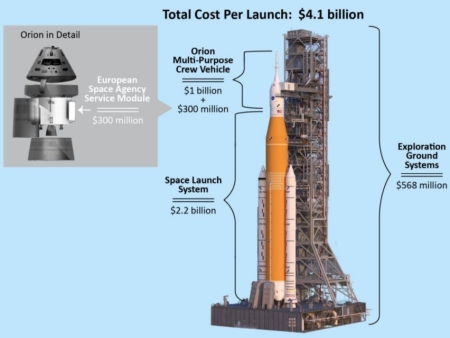
The real cost of SLS and Orion
The expected real per launch cost of SLS and Orion

The big news in the mainstream press today is the planned rollout from the Vehicle Assembly Building (VAB) of NASA’s SLS rocket this evening in preparation for its dress rehearsal fueling and countdown planned for April 3rd.

This article by Newsweek is very typical. It glows with facts lauding SLS’s gigantic size and the monumental systems designed to slowly transport it the four miles from the VAB to the launchsite.

At a height of 322 feet (ft), making it taller than the 305ft Statue of Liberty, the SLS will be the largest rocket to move to a launchpad since the Saturn V launched on its last mission in 1973, when it carried the Skylab space station into orbit around Earth. Its size has seen NASA dub it a Mega-Moon rocket.

NASA says that the four-mile journey from the Vehicle Assembly Building to the launch pad at NASA’s Kennedy Space Center in Florida, where the SLS was recently adorned with the NASA logo, will take between 6 and 12 hours. It will be carried on the back of NASA’s 6.6-million-pound crawler vehicle. [emphasis mine]

If that April 3rd countdown dress rehearsal goes well, SLS will be rolled back to the VAB and then prepped for its first launch, presently scheduled tentatively for May ’22, though more likely in June or July.

For NASA the rollout today is somewhat of a relief. SLS was originally supposed to launch in 2015, making it seven years behind schedule. It has also been enormously expensive, costing close to $30 billion to build, if one does not count the $20 billion cost of the Orion capsule it carries. That the agency finally has this rocket assembled and almost ready to launch, after so many delays and cost overruns, means that NASA might finally be able to prove it is a reality, not simply a boondoggle designed by Congress to funnel cash through NASA to their constituents.

The Newsweek article however strangely ignores the launchpad stacking of another equally gigantic rocket that occurred yesterday. » Read more
10 comments

FAA administrator, a Trump holdover, announces resignation

FAA administrator Steve Dickson yesterday announced that he will officially resign from the agency on March 31, 2022.

Dickson was appointed by President Trump in 2019 to a five year term, so his resignation now cuts his term short by two years.

Dickson gave as his reason for resigning a desire to spend more time with his family, the go-to explanation for every Washington official’s resignation. While this may be true, I can’t help wondering if friction and pressure from the Biden administration contributed to his decision.

For example, though Dickson’s record with private enterprise has been mixed, his record in connection with commercial space was mostly good, working to help the new launch industry prosper by keeping out its way as much as possible. This record was especially obvious with SpaceX’s operations in Boca Chica, where there was little regulatory effort to slow that work until Biden became president, and even then relatively little. It could be the Biden administration was unhappy with this approach, and was trying to force Dickson to regulate SpaceX more.

A new administrator, appointed by Biden, will certainly be less friendly. Based on most Biden appointees in the past year, the administration will likely want to put someone in place who is hostile to capitalism, favors a communist agenda, and wants to impose strong government control. Thus, this resignation almost certainly puts another nail in the coffin of SpaceX’s desire to launch Starship test flights from Boca Chica.

Then again, that new administrator would have to be approved by the Senate, and right now, based on the Senate’s 50-50 split between Democrats and Republicans, it will be difficult for the Biden administration to get a radical leftist approved. This difficulty will be further magnified by Biden’s horrible poll numbers as well as similar polls suggesting a bloodbath for Democrats in the mid-term November elections. For them to force through an extremist in this position now will not help those poll numbers.

I therefore predict the nominee put forth by Biden will likely mouth empty support for private enterprise during the confirmation hearings. If the Senate Republicans are fooled by this disingenuousness (something that has happened frequently), when confirmed that person will immediately act to impose the government’s will on most commercial operations, especially those by SpaceX.

10 comments

SpaceX begins filling methane tanks at Starship launchsite in Texas

Capitalism in space: SpaceX has begun the slow process of filling the storage tanks at its launchpad in Boca Chica with the methane that will be used by its Starship and Superheavy rocket once launched.

To fill the two existing tanks, which may store enough methane to fuel a stacked Starship and Super Heavy about 4/5ths of the way, SpaceX will need around 40-50 more tanker deliveries. Since last November, SpaceX has completed more than 320 liquid nitrogen and 200 liquid oxygen deliveries โ€“ equivalent to about 6700 tons (~14.8M lb) of LN2 [liquid nitrogen] and 4200 tons (~9.3M lb) of LOx [liquid oxygen]. If SpaceX maintains that average and focuses entirely on LCH4 [methane], the two horizontal tanks could be filled to the brim before the end of February.

Having a substantial amount of [methane] stored at the orbital tank farm will finally allow SpaceX to attempt the first major wet dress rehearsals (WDRs) and, more importantly, the first full static fires with flightworthy Super Heavy booster prototypes. Of course, a tank farm with full supplies of LOx, LCH4, LN2, and their gaseous equivalents is also a necessity for the first orbital Starship launch attempt, which has most recently slipped from a target of mid-2021 to no earlier than (NET) Q2 2022, pending regulatory approval.

The article also notes that the way SpaceX built two vertical methane tanks at the launchpad appears in violation of Texas regulations, and might either need a waiver from the state or be rebuilt in order to be used. Subsequently the company has added two horizontal tanks that conform to regulations, and it is these tanks it is now filling. More tanks however will have to be added to give it the fuel needed for launch.

1 comment

FAA delays Starship approval again

Death by a thousand cuts: The FAA today announced that it is once again delaying the release of the final version of its environmental reassessment of SpaceX’s Boca Chica facility, the PEA, that will allow Starship orbital launches to occur there.

The FAA intended to release the Final PEA on February 28, 2022. The FAA now plans to release the Final PEA on March 28, 2022 to account for further comment review and ongoing interagency consultations.

Though the draft PEA had approved SpaceX future Starship operations at Boca Chica, all signs continue to point to heavy resistance to making that approval official both within the Biden administration as well as those other “interagency consultations.”

I predict that the FAA will delay again, and it will delay repeatedly month by month as agencies like Fish & Wildlife and NOAA refuse to go along. The only one who could break this deadlock would be President Biden, and the only chance he or any of the people running his administration will do so is if they decide to reject the FAA’s reassessment to instead demand a new and full environmental impact statement, which would likely take years to complete.

Texas politicians might want to wake up. If SpaceX fails to get this approval it will shift its Starship operations almost entirely to Florida. I must also add that politicians across the nation should wake up as well, because if the Biden administration blocks SpaceX, the many year delay for the launch of Starship will likely impact many many businesses nationwide. It will also negatively impact NASA’s effort to land humans on the Moon this decade.

11 comments

Musk: “We need to seize the opportunity and do it as quickly as possible.”

Raptor engine
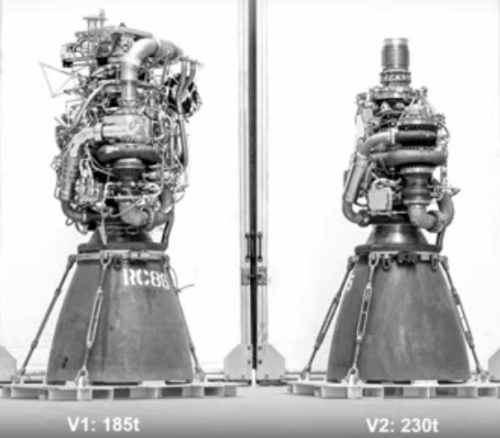
Raptor-1 on the left, Raptor-2 on the right

The headline quote above encapsulates the main philosophical point of Elon Musk’s presentation tonight in Boca Chica, Texas. Musk’s presentation was focused mostly at outlining the status of SpaceX’s Starship/Superheavy reusable heavy-lift rocket, but he started his talk stating his philosophical reasons for doing what he is doing.

It is his strong belief that in order to guarantee the survival of all life on Earth, we must colonize as many planets as possible. Musk’s quote above indicated his sense that this effort must be done now. As he had noted,

The window of opportunity [to build human settlements on other worlds] may be open for a long time, and I hope it is, but it may also be open for a short time. And this is the first point in the four and half billion history of Earth that it is possible.

He added, “To be frank, civilization is feeling a little fragile these days,” which makes achieving his goal quickly even more urgent.

After making this point, Musk then proceeded to outline what they’ve accomplished so far in building Starship/Superheavy, and what they hope to do in the coming years. Much of what Musk said was largely known, such as the size and power of Starship and its design. He did underline these important details:
» Read more

97 comments

Watching Elon Musk’s update on Starship tonight

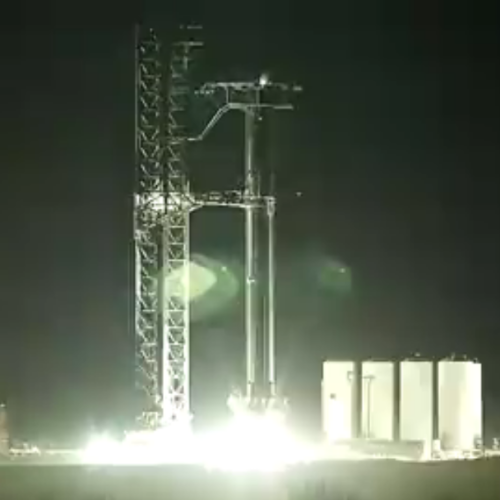
Starship mounted by tower on Superheavy

Tonight at 8 pm (central) Elon Musk is going to give a presentation updating the world on the status of SpaceX’s Starship project, with the fully stacked Starship/Superheavy as his backdrop. The photo to the right is a screen capture showing that stacking.

I have embedded the live stream below. Or you can watch it on SpaceX’s website or on its youtube channel.

The biggest question is the regulatory situation for Boca Chica. Will Musk report progress in getting operations approved there by the federal government, or will he outline how the federal government is acting as a barrier to progress? Or will he sidestep the issue (for diplomatic reasons) and focus his talk entirely on technical issues?

We can only wait and see.

3 comments

SpaceX stacks Starship on Superheavy on orbital launchpad

Starship mounted by tower on Superheavy

Capitalism in space: SpaceX for the first time used the giant arms on the launch tower at its Boca Chica orbital launchpad to stack Starship on top of Superheavy, with the fully stacked giant rocket to act as a backdrop to Elon Musk’s update on the project scheduled for airing tonight at 8 pm (Central).

You can see a time lapse of the several hour process here.

The use of a launch tower to stack a rocket is apparently a first, and provides solid evidence that SpaceX’s plan to catch Superheavy with that tower and put it on the ground has a chance of success.

SpaceX has not yet announced how Musk’s presentation will be aired, but when this information is available I will embed it on Behind the Black.

8 comments

SpaceX’s failure to win space station NASA contract reveals where the company is weak

Jeff Foust of Space News today has a detailed article detailing NASA’s decision-making process that led to its awarding Blue Origin, Northrop Grummann, and Nanoracks development contracts for their proposed commercial and private space station.

The article not only describes NASA’s analysis of each winning bid, it also describes the analysis of some of the eight bids that lost. Most interesting were the strengths and weaknesses NASA saw from SpaceX’s bid.

The company won strengths based on its technical maturity linked to HLS proposal (the Starship lunar lander) and a โ€œstrong approachโ€ to communications that appeared to be associated with SpaceXโ€™s Starlink constellation. However, NASA assessed several weaknesses because of a lack of details about its concept, including how it will accommodate payloads and scale up an environmental control system for long-duration missions. [emphasis mine]

While SpaceX so far has proven itself to be a brilliant rocket and engineering company — achieving things that everyone else said couldn’t be done and doing so so quickly it takes your breath away — the company has so far appeared to have little understanding or knowledge about the complexities of building an interplanetary manned vessel. This NASA analysis, as noted by the highlighted phrases in the quote above, underlines that impression.

None of this precludes SpaceX from gaining that knowledge and applying it to the engineering of future Starship designs. This information however shows that the company still lacks this knowledge. It apparently has still not tackled the job of designing the insides of Starship, only its rocketry for getting into orbit.

10 comments

SpaceX aiming to launch 52 times in 2022

According to NASA officials, SpaceX is hoping to complete as many as 52 launches in 2022, a pace of one launch per week.

The impressive figure was given during a virtual meeting of NASAโ€™s Aerospace Safety Advisory Panel, or ASAP, which gives guidance to the space agency on how to maintain safety within its biggest programs. โ€œNASA and SpaceX will have to be watchful during 2022 that theyโ€™re not victims of their success,โ€ Sandy Magnus, a former NASA astronaut and member of the panel, said during the meeting. โ€œThereโ€™s an ambitious 52-launch manifest for SpaceX over the course of the year. And thatโ€™s an incredible pace.โ€

Based on other sources, I had previously estimated a SpaceX manifest for ’22 to be 40 launches. That this new higher number comes from NASA’s corrupt safety panel, and was touted as a reason to raise questions about SpaceX, makes me suspicious of it.

Still, a launch pace by SpaceX of one launch per week is wholly possible. For one thing, the company needs to get a lot of Starlink satellites into orbit as quickly as possible. With its development of Starship blocked by government interference, it might have decided to up the pace of launches using Falcon 9.

Furthermore, because most of the rocket is reused, SpaceX has a far greater launch capacity. For every Falcon 9 it builds it gets ten or more launches from its first stage. This means SpaceX does not have to build as much to maintain a high launch pace.

As for the safety panel’s fears about such a pace, who cares? That safety panel has been consistently wrong about everything it has said about SpaceX and commercial space now for almost a decade. It is very likely wrong now. In a more rational world, NASA would have shut it down two years ago for doing such a bad job. Sadly, we no longer live in a rational world.

2 comments

NASA: No further Artemis Moon landings for at least two years after first in 2025

The tortoise appears to be dying: NASA today announced that there will be a two-plus year pause of Artemis missions to the lunar surface after it completes its hoped-for first manned Moon landing in 2025.

In presentations at a two-day meeting of the NASA Advisory Councilโ€™s Human Exploration and Operations Committee Jan. 18 and 19, agency officials said the Artemis 4 mission, the first after the Artemis 3 mission lands astronauts on the moon, will not attempt a landing itself.

Instead, Artemis 4 will be devoted to assembly of the lunar Gateway. The mission will deliver the I-Hab habitat module, developed by the European Space Agency and the Japanese space agency JAXA, to the Gateway. It will be docked with the first Gateway elements, the Power and Propulsion Element and Habitation and Logistics Outpost, which will launch together on a Falcon Heavy in late 2024 and spend a year spiraling out to the near-rectilinear halo orbit around the moon.

Essentially, the Biden administration appears to be switching back to NASA’s original plans, to require use of the Lunar Gateway station for any future lunar exploration, thus delaying that exploration considerably. Do not expect any of this schedule to take place as promised. The 2025 lunar landing will be delayed, as will all subsequent SLS launches for Artemis. The rocket is simply too complicated and cumbersome to even maintain one launch per year, while inserting Gateway into the mix only slows down lunar exploration even more.

NASA officials also revealed that they are limiting their lunar landing Starship contract with SpaceX to only that single planned ’25 Moon mission. For future manned missions to the Moon the agency will request new bids from the entire industry.

NASAโ€™s Human Landing System (HLS) Option A award to SpaceX last year covers only development of a lander and a single crewed flight on Artemis 3. NASA will acquire future landings through a separate effort, called Lunar Exploration Transportation Services (LETS). The goal of LETS is to select one, and possibly more, companies to provide โ€œsustainableโ€ landing services.

The timing of LETS โ€” a draft request for proposals is scheduled for release this spring โ€” means there will be a gap of a couple years before the first landing service acquired through that program would be ready. โ€œItโ€™ll be about two years from the Option A award to the LETS award before weโ€™ll have this sustainable lander,โ€ Kirasich said. โ€œItโ€™s a different lander with more aggressive requirements than Option A.โ€

It appears that Jeff Bezos’ political lobbying efforts have paid off, and that NASA is now reopening bidding so that his consortium, led by Blue Origin, can once again compete for that lunar lander contract. Whether the Bezos’ team will be able to propose anything comparable to Starship is however very questionable.

None of this really hurts SpaceX. Its contract with NASA helps them develop a Starship lunar lander. Then, while NASA twiddles its thumbs building Gateway, it will be free to fly its own lunar missions, selling tickets on the open market. I suspect that — should NASA succeed in landing humans in ’25 — the next American manned landing on the Moon will be a bunch of SpaceX customers, not that second Artemis mission sometime in the late 2020s.

SpaceX of course will also be able to bid on that second lunar landing competition. And it will be hard for NASA not to award Starship a further contract, even if others are competing against it. Starship will be operational. The others will merely be proposed.

32 comments

SpaceX’s Starship gets Air Force point-to-point cargo study contract

Capitalism in space: The Air Force Research Laboratory (AFRL) has signed a $102 million five year contract with SpaceX to study the practicality of using its Starship spacecraft as a method for transporting large cargo point-to-point on Earth.

[Program manager Greg] Spanjers said the SpaceX work is focused in four areas: collecting data from commercial orbital launches and landings; exploring cargo bay designs compatible with U.S. Transportation Command containers [TRANSCOM] and support rapid loading and unloading; researching landing systems that can operate on a variety of terrain; and demonstrating the heavy cargo launch and landing process.

The emphasis on landing options and interoperability with TRANSCOM containers and loading processes is an important element of the project, Spanjers noted, because the departmentโ€™s vision for how the point-to-point capability could be used is broader than just the commercial business case. While companies are primarily interested in delivering cargo to and from established sites, the military wants to deliver supplies and humanitarian aid to locations that may not have spaceports.

This contract is in many ways similar to NASA’s manned Starship lunar lander contract. Both provide SpaceX some cash for developing a different version of Starship, even as the bulk of development money for building Starship comes from the private investment community.

22 comments

Update on Starship/Superheavy development

Link here.

The article first provides a detailed review of the past year’s effort, which leads to laying out the possibilities for 2022. Key quote:

With the FAA citing its plans to issue the Final Programmatic Environmental Assessment (PEA) for the SpaceX Starship / Super Heavy project no earlier than the end of February, SpaceX can claim the review process is the schedule driver. However, [Superheavy] Booster 4 [intended for Starship’s first orbital flight] has yet to conduct a Static Fire test, likely including an eventual full 29 engine firing. Further evolutions of the Ship and Booster are yet to come online, with a plan to go to nine engines on Ship and 33 engines on the Booster, all moving to the Raptor 2 variant.

In other words, there is a lot of work that needs to be done before SpaceX can actually fly that first orbital flight of Starship/Superheavy, and that even if the FAA rubberstamped the approval of its environmental reassessment of the Boca Chica site today, SpaceX would likely not be able to launch that orbital flight for several months anyway.

The article also suggests that SpaceX has made big progress in rethinking the Raptor manufacturing process, and has aimed those changes for the production of the Raptor-2 engine, which will also be about 20% more powerful than the Raptor engines presently being installed.

10 comments

SpaceX raises another $337 million in investment capital

Capitalism in space: In an SEC filing yesterday SpaceX revealed that it has raised another $337 million in investment capital.

The company raised in 2021 a total of $1.85 billion, and over the last six years has raised close to $7 billion total. While some of that capital is being used to finance its Starlink internet constellation of satellites, most is being funneled into the development of its totally reusable heavy lift Starship/Superheavy rocket.

The eagerness of investors to put money behind SpaceX is a strong vote of confidence in the company, coming from totally independent sources.

Adding in the $2.9 billion dollar contract from NASA for building a lunar lander version of Starship, SpaceX has raised about $10 billion total for building this rocket.

Whether that will be enough of course is not yet known. Based on SpaceX’s past work it should be. That however assumes the federal government’s bureaucracy doesn’t throw a serious wrench in the process, something it right now appears to be doing by stalling the orbital test flight of Starship/Superheavy.

32 comments

Starship prototype #20 completes another static fire launchpad test

Capitalism in space: Despite being blocked by the federal government bureauceacy from launching its Starship/Superheavy rocket on its first orbital flight, SpaceX yesterday successfully completed another static fire launchpad test of the 20th prototype of Starship.

It appears that this was the second static fire test that used all six of prototypes’s Raptor engines.

Meanwhile, Superheavy prototype #4 sits on the orbital launchpad, where similar static fire tests were expected but have not yet occurred. Either SpaceX engineers found they needed to additional revisions of the prototype before attempted such a test, which could fire as many as 29 Raptor engines at once, or the company has decided to hold back its testing because the FAA has not yet approved the environmental reassessment for the Boca Chica launch site. Firing the engines on Superheavy before that approval could be used by SpaceX’s environmental enemies as a public relations weapon to help kill the approval entirely.

Personally I think the answer is the former. It is not Elon Musk’s way to cower in fear of others. In fact, he is more likely to push forward, knowing that the publicity from a successful Superheavy static fire test will almost certainly be mostly positive and enthusiastic, thus helping to force politicians to force the bureaucracy to sign off its approval.

4 comments

FAA delays final approval of Starship environmental reassessment till Feb 28th

The FAA has now made it official and announced that the final approval of Starship environmental reassessment will not occur before the end of February, thus preventing any Starship orbital test flights until the spring, at the earliest.

As previously announced, the FAA had planned to release the Final PEA in on December 31, 2021. However, due to the high volume of comments submitted on the Draft PEA, discussions and consultation efforts with consulting parties, the FAA is announcing an update to the schedule. The FAA now plans to release the Final PEA on February 28, 2022.

When the rumors of a delay were first noted last week, I predicted that “Starshipโ€™s first orbital flight will not happen until the latter half of โ€™22, if then.” That prediction is now almost certainly confirmed.

Nor I am not confident the FAA’s environmental reassessment of SpaceX’s launch facility in Boca Chica will be ready even in February. The problem appears to be that the FAA needs to also get the approval of both NOAA and the U.S. Fish & Wildlife agencies, and both appear to be very hostile to SpaceX’s efforts.

In fact, this is beginning to look like the situation in Hawaii with the Thirty Meter Telescope. There protesters blocked the start of construction, and the government, controlled by Democrats, worked with those protesters to step by step keep that obstruction active and working. If so, SpaceX faces a very dangerous situation, as it appears the Biden administration is about to do the same thing to it.

51 comments

FAA’s approval of SpaceX’s Starship operations delayed at least a month

The FAA has now had to delay the final approval of its environmental reassessment of SpaceX’s Starship facility and operations at Boca Chica for at least one month because NOAA has refused to approve the plan.

That puts NOAAโ€™s generic review of Rocket Landing and Launches back to at least the end of January, with the much more complex and contentious USFWS [Fish and Wildlife] review also pending (this one is habitat and species review of impacts to bird and wildlife populations specific to Boca Chica).

The earliest approval by the FAA (which again, is far from a sure thing) should be projected into February. And the actual launch license process can’t be started until then. March is absolutely the earliest even the giddiest optimist could expect for Starship’s Maiden Orbital Flight.

It appears that the bureaucrats in NOAA are hostile to the launch site, and are looking for reasons, mostly environmental, to either block it or slow it down.

It also appears that a second Department of the Interior agency must sign off, and it is also hostile.

Based on this story, it looks like Starship’s first orbital flight will not happen until the latter half of ’22, if then. Nor can we expect any help from the Biden administration. Unlike Trump, the Democrats now running the executive branch of government do not like private enterprise and business, and generally look for excuses to regulate and even block it, especially if they think there is the slightest chance it might harm some formerly unknown species somewhere.

This is America today, no longer free. Rather than you making the decision freely, as an American citizen, un-elected federal government officials now decide whether you can do anything, or not.

13 comments

SpaceX begins testing of launch procedures for Superheavy prototype #4

Capitalism in space: SpaceX began this week the testing of the fueling and launch procedures it will follow for launching the first orbital Superheavy, prototype #4, presently mounted on the orbital launchpad at Boca Chica.

On December 17th, SpaceX subjected Super Heavy B4 to a cryogenic proof test about twice as ambitious as B3โ€™s, filling the booster maybe a sixth of the way with a few hundred tons of liquid nitrogen (LN2). What isnโ€™t clear is if that test also raised the boosterโ€™s propellant tanks to flight pressures (6-8 bar or 90-115 psi). If Booster 4 did reach those pressures, the test is even more significant โ€“ partially proving that the rocket is ready for flight. On December 21st, SpaceX performed a similar series of cryogenic tests, again partially filling Booster 4 with about the same amount of liquid nitrogen but doing so two or three times in a row. Again, the Super Heavy survived the several-hour ordeal without any obvious issues. Still, a number of additional tests โ€“ some even more important โ€“ are still in front of SpaceX and Super Heavy B4.

The most obvious is simple enough: SpaceX needs to fully fill a Super Heavy booster for the first time. Depending on the storage situation, that process will likely begin by filling Booster 4 with about 2500 tons (5.5M lb) of liquid nitrogen (LN2) โ€“ about two-thirds full. If SpaceX also temporarily fills one of the orbital tank farmโ€™s liquid oxygen (LOx) or methane (LCH4) tanks with nitrogen, it could fully load Booster 4 with around 3500 tons (7.7M lb) of nitrogen. At least according to SpaceXโ€™s own website, thatโ€™s about the same weight as the propellant (3400t/7.5M lb) Super Heavy is designed to lift off with. If that full cryoproof goes well, SpaceX will then likely perform one or several wet dress rehearsals, ultimately filling Booster 4 with approximately 2900 tons (6.4M lb) of cryogenic oxygen and 500 tons (1.1M lb) of cryogenic methane.

At some point the company will need to not only fill the booster, it will need to do at least one static fire test of its 29 engines. If all goes well, SpaceX will then mount Starship on top, with the first orbital flight to follow. Musk has said they are aiming for a January launch, but no one should be surprised if it slips to February.

2 comments

SpaceX proposes new launchpads for Starship at Kennedy

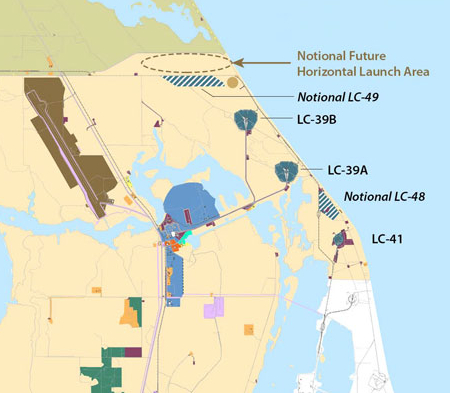
Long term Land Use map for Kennedy Space Center
From NASA’s long term road map for Kennedy,

Capitalism in space: SpaceX has submitted a new proposal for building several launchpads at the Kennedy Space Center for its Starship heavy lift rocket, including rebuilding one old pad (LC-39A) and building another at a new site (the never used LC-49).

The project for LC-49 comes in addition to the previously announced work that SpaceX began within the perimeter of Launch Complex 39A, the K Environmental Program Office said. In September 2019, an environmental assessment was completed and a finding of “no significant impact” was issued.

Musk confirmed via Twitter on Dec. 3 that construction of SpaceXโ€™s Starship orbital launch pad at LC-39A was underway. “Construction of Starship orbital launch pad at the Cape has begun”.

The KEP [Kennedy Environmental Program] office noted that this new proposed expansion would allow for not only redundancy with launches of Starship, but also โ€œallow SpaceX to increase the flight rate of Starship and minimize potential disruptions to Falcon, Falcon Heavy and Dragon missions at LC-39A.”

LC-49 is a 175 acre area just north of LC-39B, the launchpad NASA plans to use for its SLS rocket.

It also appears that SpaceX plans on creating a new Starship orbital launchpad at LC-39A that will not impact the use of that site by Falcon 9 and Falcon Heavy, though in the long run launches of those latter rockets will decrease as Starship becomes operational.

All these plans will need a full environmental assessment, but according to the article at the link, the process will be different than at Boca Chica in Texas.

The [environmental assessment]process likely wonโ€™t involve live discussions with the public, according to [Don Dankert, the technical lead for the Kennedy Environmental Planning Office], but the public will get comparable information, like with an EIS [Environmental Impact Statement]. โ€œWe will put out the same information,” Dankert said. “Weโ€™ll put out an informational packet with a .PDF chart, a description of the project and instructions on how to provide comments back to us and SpaceX.โ€

Engler said there may also be some lessons learned from the process of getting the launch facilities at Starbase approved for an orbital launch, but how that crossover would work has yet to be determined.

Sounds to me that this is all a pointless paperwork dance. The construction will be approved, no matter what, because Florida and Cape Canaveral desperately wants this new business and the jobs and tax dollars it will bring to the state.

9 comments

Superheavy prototype #4 installed on orbital launchpad

Capitalism in space: SpaceX has now installed its fourth Superheavy prototype on the orbital launchpad at Boca Chica, with the possibility of the first static fire test of Superheavy possibly occurring in the next week or so.

Around 10am CST (UTC-6), SpaceX began retracting more than a dozen clamps that hold the 69m (~225 ft) tall Super Heavy โ€“ the largest booster ever built โ€“ to its transport and work stand. By 11:30am, Booster 4 was safely extracted from the stand and hovering above it as the lift team crossed their Ts and dotted their Is before proceeding. SpaceXโ€™s newest Starbase crane then spun around and crawled a short distance to the orbital launch mount, where it lifted Booster 4 above the mount.

In a process that this particular Super Heavy prototype is thoroughly familiar with, SpaceX then very carefully lowered B4 down into the center of the donut-shaped orbital launch mount, where 20 separate clamps โ€“ each capable of deploying and retracting โ€“ form a support ring and giant hold-down clamp.

The booster has 29 Raptor engines total, with 20 in the outer ring, 8 in the inner ring, and 1 in the center. It will be quite amazing to watch all these engines finally fire and lift the entire rocket, with Starshp, off the launchpad.

As for the upcoming static fire tests, road closures have been announced starting today through the end of this week.

0 comments

SpaceX begins construction of Starship launchpad in Florida

Capitalism in space: Elon Musk yesterday announced that SpaceX has begun the construction of a Starship launchpad at its facility at Cape Canaveral, though no launch scheduled was revealed.

Musk implied that the Starship orbital launchpad is being built at Launch complex 39A. If so, it will pose some scheduling issues for SpaceX, as the company also uses that site for Falcon 9 and Falcon Heavy launches. In fact, it is the only one it uses for Falcon Heavy.

2 comments
1 14 15 16 17 18 27