Voyager wins slot to fly tourist mission to ISS in 2028

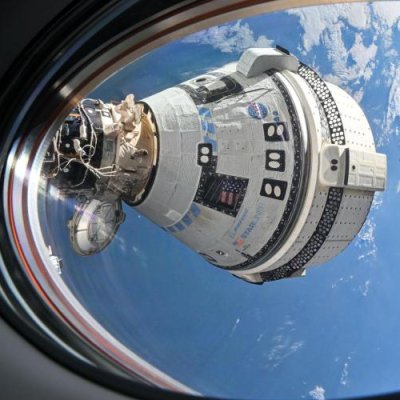
Starlab design as of December 2025

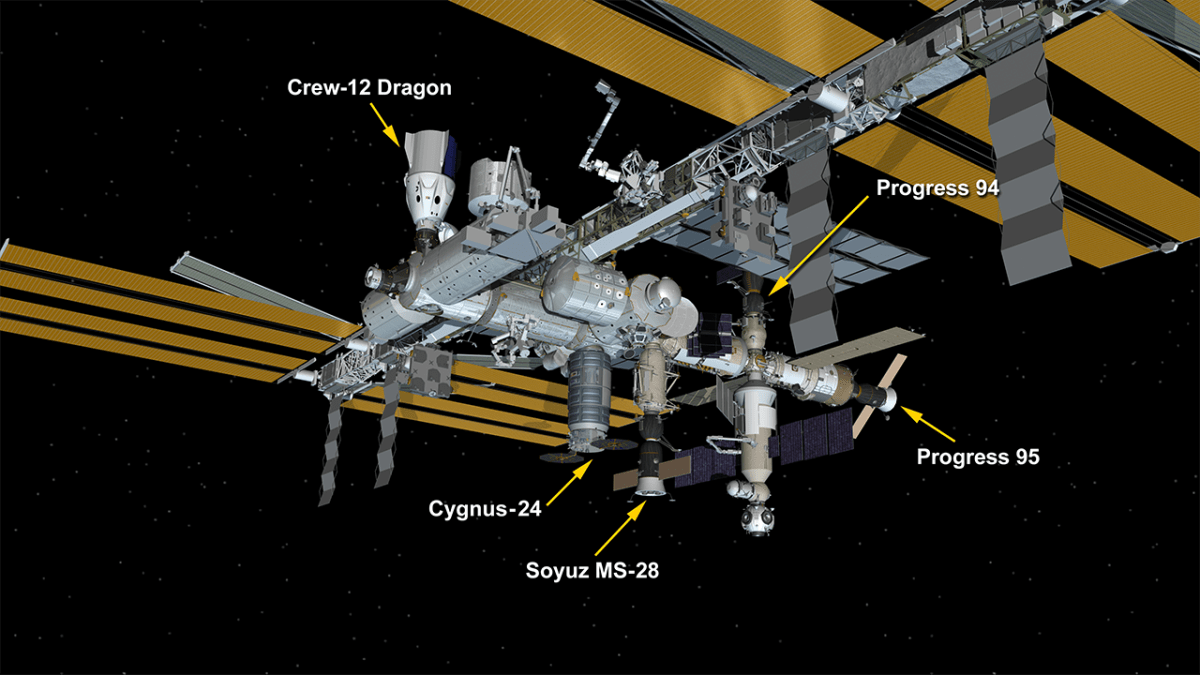
NASA today announced that it has awarded Voyager Technologies a slot to fly a tourist mission to ISS in 2028.

The mission, named VOYG-1, is expected to spend as many as 14 days aboard the space station. A specific launch date will depend on overall spacecraft traffic at the orbital outpost and other planning considerations.

Voyager will submit four proposed crew members to NASA and its international partners for review. Once approved and confirmed, they will train with NASA, international partners, and the launch provider for their flight.

Voyager is the lead company in the consortium that is building the Starlab station, a single very large module to be launched on SpaceX’s Starship.

At this moment three of the five commercial stations that are developing private space stations — Axiom, Vast, and Voyager — now have deals to fly such missions to ISS. The two remaining likely didn’t pass muster with NASA, for different reasons. Max Space is a late comer to this competition, only declaring that it is building its own station this year. Orbital Reef, led by Blue Origin and Sierra Space, is apparently a dead project, with neither company doing anything to sell its project for the past year or so.

In my rankings below of the five American commercial space stations presently in development, the first three are essentially tied at this point.
» Read more

2 comments

A very interesting and revealing interview of NASA administrator Jared Issacman

Jared Isaacman
NASA administrator Jared Isaacman

Link here. I found this interview with NASA administrator Jared Issacman to be very informative and worth reading, especially in regards to his comments on the proposed cuts to NASA’s budget.

First, he admits right off the bat that the heat shield was his biggest concern during the Artemis-2 mission. He also took a swipe at past NASA management over this issue. After noting that the initial inspection of the Artemis-2 shield after recovery showed it experienced little serious damage, he added this: “All that aside, if you’re going to wait three and a half years between missions, just replace the heat shield.” In other words, after Artemis-1 NASA management dithered when it saw the damaged heat shield. It should have immediately moved to replace it.

As for the proposed Trump budget cuts and the opposition to those cuts by many in Congress, Issacman said this:

There’s a lot of passionate people out here [referring I think to the space industry and its advocates]. They can do incredible things, from a scientific perspective. I don’t know how many of them have ever pulled together a financial model, and driven execution on some of these things to say what should or shouldn’t be the right budget.

Now, all that said, of course, we will maximize every dollar that Congress affords to the agency. But it is not healthy, for the agency, to get in this mindset that we have to spend our way out of every problem. And I don’t think it’s good for the country to think we have to print our way out of every problem. [emphasis mine]

This is not the first time Isaacman has indicated he thinks NASA can survive these cuts, and in fact can do as well if not better by using what it gets more wisely. It is however the first time he has put NASA’s budget in the context of the entire federal budget, which is badly out of control. Isaacman does not want more money from Congress because he thinks it is bad for the nation to spend itself into debt. He thinks he has enough to do the job.

The entire interview is worth reading. It indicates a very practical and honest mindset. Everyone might not agree with every proposal Isaacman has put forth, but he is clearly approaching things from a very good place.

31 comments

Orion’s risky return-to-Earth happens tonight at 8:07 pm (Eastern)

The Earth as seen by the Artemis-2 astronauts, from behind the Moon
The Earth and Moon during the lunar fly-by on April 6, 2026.
Click for original image.

After spending ten days in space, including a swing around the back of the Moon, the four-person Artemis-2 crew is now preparing for its return-to-Earth this evening, splashing down off the Pacific coast near San Diego.

At 10:53 p.m. EDT [last night], the Orion spacecraft ignited its thrusters for 9 seconds, producing an acceleration in velocity of 5.3 feet-per-second and pushing the Artemis II crew toward Earth. The crew is now more than halfway home.

About two hours before the burn, there was an unexpected return link loss of signal during a data rate change affecting the transmission of communications and telemetry from the spacecraft to the ground. Two-way communications were reestablished, and flight controllers resumed preparing for the upcoming burn with the crew shortly after.

…The third return trajectory correction burn is scheduled for April 10 at about 1:53 p.m. ahead of re-entry procedures.

This is I think the second time Orion has had a short loss of communications with ground control. In addition, the crew had to cancel a planned manual piloting demonstration of Orion while it flew past the Moon because of a leak in an internal helium tank, used to maintain pressure in the oxygen tank as the propellant is used. The leak was inside the European-built service module, which will be jettisoned before re-entry and burn up in the atmosphere.

Mission managers say this leak has not impacted any engine burns, but it will require attention before the next flight.

The return to Earth however carries the biggest risk of the entire mission. Orion’s heat shield is questionable. During its first use in the 2022 unmanned Artemis-1 flight around the Moon, it did not behave as expected, with large chunks breaking off instead of thin layers ablating away. Though mission engineers have adjusted the flight path through the atmosphere to mitigate stress, there is great uncertainty about that solution.

I have embedded NASA’s live stream of the return-to-Earth below. It begins at 6:30 pm (Eastern), though the first return event, jettison the service module, doesn’t occur until 7:33 pm (Eastern).
» Read more

21 comments

Orion completes short 15-second burn to refine its return-to-Earth

The Earth as seen from behind the Moon
The Earth as seen from Orion just before the capsule swung behind
the Moon yesterday. Click for this and other Artemis-2 lunar images.

The Orion capsule today completed a 15-second engine burn in order to fine-tune its return path for splashdown in the Pacific Ocean on April 10th.

At 8:03 p.m. EDT, the Orion spacecraft, named Integrity, ignited its thrusters for 15 seconds, producing a change in velocity of 1.6 feet-per-second and guiding the Artemis II crew toward Earth. NASA astronaut Christina Koch and CSA (Canadian Space Agency) astronaut Jeremy Hansen reviewed procedures and monitored the spacecraft’s configuration and navigation data.

During today’s mission status briefing, NASA officials shared the first images received from the crew during the lunar flyby and confirmed that the USS John P. Murtha has left port and is headed to the midway point toward the recovery site in the Pacific Ocean.

This was Orion’s second small engine burn since it left Earth orbit on April 2, 2026. Unlike the Apollo missions to the Moon in the 1960s-1970s, which involved entering and leaving lunar orbit and doing complex maneuvers while there, the Artemis-2 mission around the Moon has largely been a passive one. The capsule was sent on this course at the start, and has been coasting since. Today’s burn was merely a small adjustment, not a major burn.

The re-entry on April 10, 2026 remains the key moment of the flight, as it has always been. Will that questionable heat shield do as NASA’s engineers predict and work to protect the four astronauts during re-entry? Or will it do things unexpected, because those engineers really don’t understand the engineering issues involved?

I am hopeful and optimistic. I also know that even if everything turns out fine, this flight will simply be a demonstration that NASA has learned nothing from the Challenger and Columbia accidents, and is still willing to risk human lives in order to win some political kudos and get some good PR. And for that reason I am not confident of the agency’s ability to truly do what it says, safely and competently.

One more note: Though the images being sent back are quite beautiful, they are hardly ground-breaking. Lunar Reconnaissance Orbiter has mapped the entire surface of the Moon at much great resolution, far better than anything seen on this mission. NASA might claim the astronauts are doing science, but most of it is minor and not very significant. When you get down to it, this is simply a very expensive tourist trip for four government employees, paid for at an ungodly cost by the American taxpayer.

25 comments

Orion completes small mid-course-correction engine burn as it prepares to swing around behind the Moon

The Moon as seen by Orion's astronauts
The Moon as seen by Orion’s astronauts on April 4th, cropped
and reduced to post here. Click for original image.

NASA’s manned Orion capsule last night completed small mid-course-correction engine burn to refine the spacecraft’s trajectory around the Moon and back to Earth.

Mission control teams in Houston and the Artemis II crew completed an outbound correction burn to refine the Orion spacecraft’s trajectory to the Moon. The burn began at 11:03 p.m. EDT and lasted 17.5 seconds. NASA astronauts Reid Wiseman, Victor Glover, and Christina Koch, along with CSA (Canadian Space Agency) astronaut Jeremy Hansen, continue on a precise path to flyby the Moon on Monday, April 6.

The lunar fly-by is scheduled for this evening. As the capsule swings around behind the Moon, there will be a communications black-out from 6:44 pm (Eastern) to 7:25 pm (Eastern). NASA is making a concerted PR effort to compare this to the Apollo 8 mission around the Moon, but the differences are gigantic. Apollo 8 went into orbit around the Moon. There was considerable risk it could get stuck there if its engine failed to fire properly when behind the Moon on its last orbit. Thus, that Apollo 8 blackout was quite tension-filled.

Orion’s fly-around is instead completely benign. They aren’t going into orbit, and they are already on their path back to Earth. There will be no extra element of risk as they fly behind the Moon. All they will be doing is coast along, as they have been doing since leaving Earth orbit. They will simply be out of touch for about 40 minutes.

I sadly remain personally bored by this mission. It is is testing relatively little new engineering for future use, and is mostly designed as a PR stunt to convince everyone that “NASA is back!” Hardly. The capabilities of SLS and Orion are extremely limited, and both are ungodly expensive. Neither will make possible any colonization of the solar system. All they do is act as a jobs program for government employees.

And there still remains this mission’s biggest moment of danger, re-entry and splashdown, using Orion’s questionable heat shield that did not behave properly on its only previous unmanned mission in 2022.

30 comments

Voyager-2’s most detailed look at Neptune’s moon Triton

Triton
Click for original image.

Today we conclude our tour of the Voyager-2 fly-bys of Uranus in 1986 and Neptune in 1989 with what is the most detailed look at the alien surface of Neptune’s moon Triton, taken on August 25, 1989 and shown to the right, cropped, rotated, reduced, and sharpened to post here.

Taken from a distance of only 25,000 miles, the frame is about 140 miles across and shows details as small as [a half mile in width]. Most of the area is covered by a peculiar landscape of roughly circular depressions separated by rugged ridges. This type of terrain, which covers large tracts of Triton’s northern hemisphere, is unlike anything seen elsewhere in the solar system. The depressions are probably not impact craters: They are too similar in size and too regularly spaced. Their origin is still unknown, but may involve local melting and collapse of the icy surface.

A conspicuous set of grooves and ridges cuts across the landscape, indicating fracturing and deformation of Triton’s surface. The rarity of impact craters suggests a young surface by solar system standards, probably less than a few billion years old.

What this photograph as well as the handful of other Voyager-2 images of Triton tell us is that we only have gotten a tiny taste of what’s there, only enough to tell us we don’t understand what we are seeing in the slightest. This is a truly alien world, cold, dark, and composed of materials far different then that found in the inner solar system. Its formation is a mystery, and its subsequent geological history a cypher. Scientists have made some guesses, but to get a real understanding we need to go back, and be there for a long time.

In fact, this is the final conclusion of all of the Voyager-2 images from both Uranus and Neptune. That probe gave humanity its first good close look at these distant worlds, but the look was still a quick and very superficial one. The images and data left us with far more questions than answers.

Unfortunately, there is at present no mission approved and under development to go to either Uranus or Neptune, though several have been proposed. Thus, it will likely be at least two decades before any mission gets there, if that soon.

6 comments

SLS successfully puts Orion into orbit

SLS less than a minute after launch

NASA’s SLS rocket today successfully launched the Orion capsule, carrying three Americans and Canadian on a planned ten-day mission swinging around the Moon and back to Earth.

During the countdown there were two minor issues, the second of which causes a slight ten-minute delay in the launch. Both were resolved very quickly, though one wonders if NASA can ever do a launch with this rocket without such issues during countdown.

The crew will remain in Earth orbit until tomorrow, checking out the capsule and its systems. Once they have confirmed these are working as expected, they will then fire their engines to head to the Moon.

The live stream can be viewed here.

As this was the first U.S. government launch this year (and the first since 2022), the leader board for the 2026 launch race remains unchanged:

40 SpaceX
16 China
5 Rocket Lab
4 Russia

SpaceX continues to lead the entire world combined in total launches, as it did in both ’24 and ’25.

22 comments

Countdown begins for the Artemis-2 mission around the Moon

NASA this afternoon began the two-day long countdown leading up to the planned 6:24 pm (Eastern) launch of its Artemis-2 mission, sending three Americans and one Canadian around the Moon.

The onsite countdown clock started ticking down at 4:44 p.m. EDT to a targeted launch time of 6:24 p.m. on Wednesday, April 1. Artemis II is the first crewed launch of NASA’s SLS (Space Launch System) rocket and Orion spacecraft.

…NASA and weather officers with the U.S. Space Force’s Space Launch Delta 45 continue to pay close attention to weather conditions ahead of tanking operations. The weather forecast for launch day shows an 80% chance of favorable weather conditions with primary concerns being cloud coverage and the potential for high winds in the area. Teams will continue to monitor the weather in the coming days.

The ten-day mission will use the SLS rocket, which has only flown once previously, and has had repeated fueling issues prior to that 2022 launch as well as during dress rehearsal countdowns last month. It will also use an Orion capsule with a questionable heat shield and an untested life support system.

9 comments

The space station part of Isaacman’s new program is facing push back, from industry and Congress

The American space stations under construction
Four of the American space stations under development.
The fifth, Max Space, is a late comer and not shown.

At a hearing yesterday before the space subcommittee of the House Science, Space, and Technology Committee, both the trade organization representing the five commercial space station projects as well as some members of Congress expressed strong reservations about NASA’s new plan to build a core module as a basis for helping these companies develop their space stations.

Dave Cavossa, President of the Commercial Space Federation (CSF) that represents these companies, outlined in his statement [pdf] to the committee the industry’s dissatisfaction, not so much because of the specifics of NASA’s plan but because it follows other sudden changes last year by the previous NASA administrator Sean Duffy, and is still uncertain in its outline.

Given the delays and possible shifts in strategy, industry has been left to continue spending resources to develop private space stations without a full understanding of what NASA will require from a private station, how the agency will structure the rest of the procurement and program, and when industry may see a return on investment. This uncertainty challenges the public-private partnership business model and puts the agency at risk of deorbiting ISS before private stations are operational.

The trade group proposed that NASA stick with its previous plan to fund two or more station projects, dropping Isaacman’s core module proposal. It also wanted Congress give the agency the funds to do so.

Cavossa also strongly disputed NASA’s claim that the market at present doesn’t support these commercial stations.
» Read more

18 comments

Intuitive Machines wins $180.4 million new NASA lunar lander contract

Intuitive Machines' Nova-D lunar lander
Click for original.

The lunar lander startup Intuitive Machines announced yesterday that it has won its fifth contract from NASA, a $180.4 million deal to place its larger upgraded Nova-D lander near the Moon’s south pole.

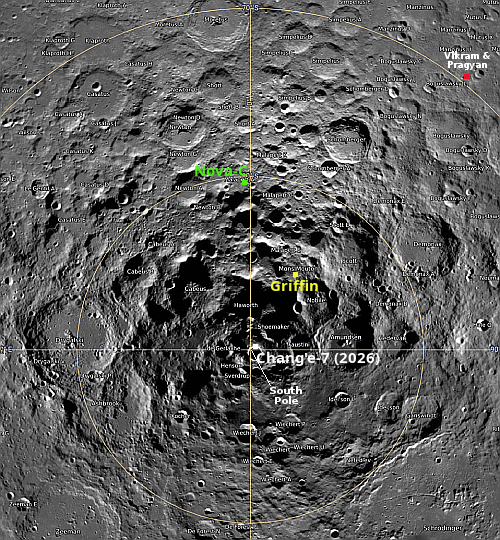
The IM-5 mission will target Mons Malapert, a ridge near the Lunar South Pole that offers continuous Earth visibility, stable illumination conditions, and access to permanently shadowed regions. These characteristics make the site a compelling location for future communications, navigation, and surface infrastructure.

The artist’s rendering to the right shows this Nova-D lander. What stands out immediately is its low-slung appearance. Intuitive Machines’ smaller Nova-C lander was tall (see this image), with a high center of gravity. In its only two landing attempts on the Moon it tipped over both times after touchdown. It appears the company has finally recognized the issue and reworked this new lander to make it more stable after touchdown.

This contract award appears to be part of the accelerated program by NASA administrator Jared Isaacman to land 30 unmanned rovers on the moon in three years, beginning in 2027. Mons Malapert is a plateau that Intuitive Machines second lander tipped over on. It is also the landing site for Astrobotics’ Griffin lander, as well as a candidate landing site for the first Artemis manned missions.

Note the small rover on the right in the graphic. While the mission will carry seven NASA science instrument payloads, it will also carry this commercial rover, built by Honeybee Robotics, a subsidiary of Blue Origin. As the company states above, the lander on this mission also has additional available payload capacity for more commercial customers.

2 comments

Lunar Gateway dead as NASA announces major changes to its future space station, lunar, and Mars plans

Capitalism in space As part of the reshaping of NASA being pushed by NASA administrator Jared Isaacman, the agency today announced major changes to its future programs in low Earth orbit, on the Moon, and in exploring Mars. Video of these changes can be viewed here and here.

The Moon

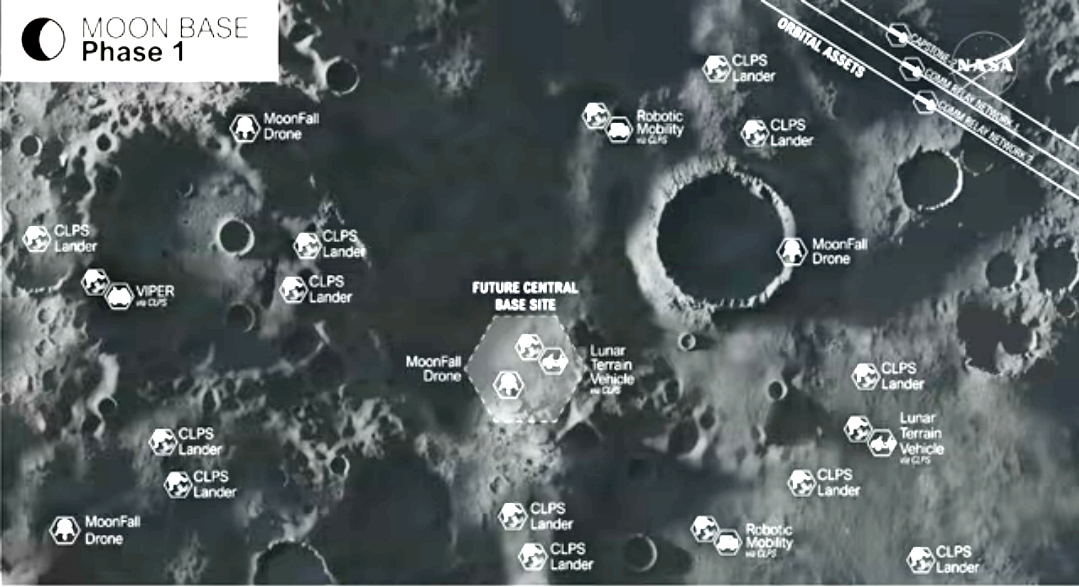
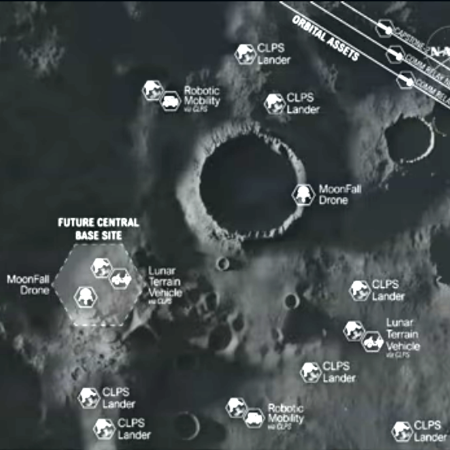
NASA will now focus all work in its lunar program on getting to the surface of the Moon. Lunar Gateway is “paused,” though the language of NASA’s press release suggests more strongly that it is dead, with the agency already trying to figure out ways to “repurpose” its already built components. NASA will instead ask for proposals from private industry and its international Artemis partners to ramp up as soon as possible a phased program to establish the infrastructure on the Moon needed for the lunar base. This new focus begins with “up to 30 robotic landings in three years, starting in 2027,” and at least two manned landings per year beginning in 2028.

The graph below, presented during today’s announcement, shows the basic plan for the next few Artemis missions, which will act as the manned foundation for this entire surface-focused program. The overall program will build out the lunar base in three phases, first to test some basic infrastructure using these smaller lunar landers, second to begin establishing the base’s foundational components with intermittent manned missions, and third to begin long-term human occupancy.
» Read more

35 comments

SLS/Orion have begun 12-hour trip from VAB to launchpad

Artemis-2 mission flight path
The Artemis-2 flight path. Click for full animation.

NASA engineers today began the long and slow 12-hour trip of the SLS rocket from the Vehicle Assembly Building (VAB) to the launchpad in preparation for a targeted April 1, 2026 launch date of this Artemis-2 mission around the Moon.

NASA’s Artemis II SLS (Space Launch System) rocket and Orion spacecraft slated to send four astronauts around the Moon began rolling to Launch Pad 39B at 12:20 a.m. EDT on Friday, March 20. Rollout operations at the agency’s Kennedy Space Center in Florida were delayed earlier in the day due to high winds in the area.

The trek to the pad is expected to take up to 12 hours, as NASA’s crawler-transporter 2 carefully carries the rocket on top of the mobile launcher approximately 4 miles along the crawlerway.

The launch will send four astronauts on a ten-day mission swinging around the Moon and back to Earth, using a questionable heat shield and a life support system not yet been tested in space. On the first unmanned Artemis-1 mission around the Moon in 2022, the shield experienced far more damage than predicted, with large chunks breaking off. NASA engineers think they understand why this happened, and have decided that they can mitigate the problem by using a less stressful flight path upon return into Earth’s atmosphere.

They don’t really know if this is so, but they hope so. As for the life support system, the plan is to remain in a high Earth orbit for the mission’s first day to test it. If it has problems then, the crew will be able to return to Earth somewhat quickly. If it has problems after heading to the Moon, however, that won’t be possible.

If a private company tried to convince NASA to do this mission with these issues, the agency would say “Hell no!” It is proceeding because, like the Challenger and Columbia failures, it is a NASA-built project and politics and schedule have superseded safety and good engineering procedures

3 comments

Voyager-2’s only close-up image of Uranus’s moon Umbriel

Uranus' five biggest moonsThe historically known moons of Uranus. Click for original NASA press release.

Umbriel as seen by Voyager-2
Click for source.

Today’s cool image continues our tour of the five largest moons of Uranus, as seen by Voyager-2 in 1986 during its close-up visit. The family portrait above, taken from more than three million miles away during Voyager-2’s approach, shows the relative sizes of those five moons as well as their location relative to Uranus, with Miranda in the closest orbit and Oberon the farthest. I have already posted close-ups from Miranda and Ariel. Today’s image moves us outward to Umbriel.

The image to the right is Voyager-2’s best picture. In fact, it is really Voyager-2’s only close-up image, and as you can see, it is not that close or sharp. I have not reduced it at all. This is how NASA released it. From the NASA press release:

The southern hemisphere of Umbriel displays heavy cratering in this Voyager 2 image, taken Jan. 24, 1986, from a distance of 346,000 miles. This frame, taken through the clear-filter of Voyager’s narrow-angle camera, is the most detailed image of Umbriel, with a resolution of about 6 miles.

Umbriel is the darkest of Uranus’ larger moons and the one that appears to have experienced the lowest level of geological activity. It has a diameter of about 750 miles and reflects only 16 percent of the light striking its surface; in the latter respect, Umbriel is similar to lunar highland areas. Umbriel is heavily cratered but lacks the numerous bright-ray craters seen on the other large Uranian satellites; this results in a relatively uniform surface albedo (reflectivity). The prominent crater on the terminator (upper right) is about 70 miles across and has a bright central peak.

The strangest feature in this image (at top) is a curious bright ring, the most reflective area seen on Umbriel. The ring is about 90 miles in diameter and lies near the satellite’s equator. The nature of the ring is not known, although it might be a frost deposit, perhaps associated with an impact crater. Spots against the black background are due to ‘noise’ in the data.

This lone picture of Umbriel by Voyager-2 illustrates even more starkly the very sparse data we have of Uranus and its moons. Voyager-2 is the only spacecraft to ever visit this planet, and it only did a quick fly-by, just long enough to give us this one dim snapshot view. It is forty years later, and no other missions have flown there, nor is any planned in the near future. There are proposals, but none are yet approved.

2 comments

The first Artemis lunar landings might not go to the Moon’s south pole

It appears from remarks recently by one NASA official, that while the south pole remains the agency’s main lunar base target, it is now looking into other landing options in order to make those first manned landing less risky and easier and quicker to achieve.

Amit Kshatriya, NASA Associate Administrator was very vague in his statement, but nonetheless this was what it appears he was saying:

We have opened up the, I would say, the performance specification for the early landing missions in as many ways as we can, in terms of different lunar orbits we want to take, or different other constraints … to make it as agile as possible, to recognize performance limitations in some of the machines we have and let our providers tell us, hey, if you took these constraints out of the way, how could we go faster? So we’re going to do that.

The agency’s administrator, Jared Isaacman, is also pushing to quickly begin sending a lot of unmanned landers to the south pole by next year. Thus, under this plan, we might actually find out first whether there really is water in those permanently shadowed craters, before committing our manned lunar base to this location.

This new approach makes a great deal of sense, especially since the data that has looked into those craters has been very inconclusive, some positive and some negative.

33 comments

A day-by-day description of the entire Artemis-2 manned mission

NASA today posted a detailed day-by-day description of the entire ten-day Artemis-2 manned mission around the Moon, outlining the tasks planned for the astronauts on each day.

The launch is now targeting April 1, 2026.

The description of their closest approach to the Moon is both interesting and underwhelming.

The Artemis II crew will come their closest to the Moon on flight day 6, while traveling the farthest from Earth. Artemis II could set a record for the farthest anyone has traveled from Earth depending on launch day, breaking the current record – 248,655 miles away – set in 1970 by the Apollo 13 crew. The distance the Artemis II crew will travel depends on their exact launch day and time.

Over the course of the day, the crew will come within 4,000 to 6,000 miles of the lunar surface as they swing around the far side of the Moon – it should look to them about the size of a basketball held at arm’s length. [emphasis mine]

In other words, Orion is not going to get very close, and in fact, the Moon will only be 2 to 3 times bigger than what we see here on Earth. I suspect the best photographs taken will be those showing both the Earth and Moon, both of which will be relatively small.

Overall, I remain highly concerned about this mission. The life support system has never been tested in space before, and they will spend the first day checking it out in Earth orbit. And the return to Earth will involve using a heat shield that did not perform well on the Artemis-1 mission in 2022, losing chunks during re-entry.

They hope a less stressful flight path will mitigate this issue, but then, they need to hit that flight path perfectly on their way back from the Moon. During yesterday’s briefing it was obvious this was a concern to NASA officials.

24 comments

Cubesat ultraviolet space telescope achieves first light

Sparcs first light images
Click for original images.

A new low-cost cubesat-sized NASA ultraviolet space telescope, dubbed Sparcs, has achieved first light, successfully taking both near- and far-ultraviolet false-color images of a nearby star.

Those images are to the right, with the top the far-ultraviolet image and the bottom in the near ultraviolet. From the press release:

Roughly the size of a large cereal box, SPARCS will monitor flares and sunspot activity on low-mass stars — objects only 30% to 70% the mass of the Sun. These stars are among the most common in the Milky Way and host the majority of the galaxy’s roughly 50 billion habitable-zone terrestrial planets, which are rocky worlds close enough to their stars for temperatures that could allow liquid water and potentially support life.

The question astronomers will try to answer with this telescope is whether the solar activity on these stars is high enough to prevent life from forming in the star’s habitable zone. Because these stars are dim and small, the habitable zone is quite close to the star, which means solar activity has a higher impact on the planet. We don’t yet have sufficient data to determine the normal activity of such stars. Sparcs will provide a good first survey.

It will also demonstrate the viability of such small low-cost cubesats for this kind of research. If successful expect more such telescopes, some of which are likely to be private, like Blue Skies Space’s Mauve optical telescope already in orbit.

0 comments

NASA now targeting an April 1st launch of Artemis-2

At a press briefing today, NASA officials said they are now targeting an April 1, 2026 launch date for the Artemis-2 mission, a ten-day manned mission sending four astronauts around the Moon.

NASA completed the agency’s Artemis II Flight Readiness Review on Thursday, March 12, and polled “go” to proceed toward launch. NASA is targeting Thursday, March 19, to roll the SLS (Space Launch System) rocket and Orion spacecraft to launch pad 39B in advance of a launch attempt Wednesday, April 1, pending close out of remaining open work.

The repair work involved replacing a helium seal that was preventing flow to and from the tanks and testing it to confirm the new seal worked. It also involved replacing batteries as well as some oxygen seals.

NASA officials also stated that they do not plan to do another wet dress rehearsal, that they are satisfied by the testing they did in the assembly building. Instead, they are go for full launch countdown, with the hope they can lift-off with no more fueling issues. They have also determined that if there is a scrub, they will also have several launch opportunities through April 6th.

To underline the risks of this mission, the Orion capsule in which they are sending four astronauts around the Moon has an uncertain heat shield and an untested life support system. To mitigate the shield uncertainties, they must hit a specific flight path through the atmosphere upon return.

7 comments

NASA’s Van Allen Probe A burns up over the Pacific

We didn’t all die! Van Allen Probe A, one of two NASA spacecraft launched in 2012 to study the Van Allen radiation belts that circle the Earth, yesterday burned up harmlessly over the Pacific ocean as expected.

Both Van Allen probes have been defunct since around 2019, when they ran out of fuel. Van Allen Probe B weighed about 1,300 pounds, so some pieces probably reached the ocean. Had it returned over land it did carry the small risk of doing harm.

The orbit of the other probe, Van Allen Probe B, is expected to decay sometime around 2030. Like its twin, it is heavy enough that some parts will survive re-entry. It is therefore a prime target for a demonstration mission proving the technology for removing space junk safely and under control. NASA should put out a request for bids to the many orbital tug companies that now exist to do exactly that, as it is NASA’s responsibility to make sure this spacecraft re-enters the atmosphere safely.

0 comments

Voyager to make “a multi-million-dollar strategic investment” in Max Space’s inflatable habitats

Voyager-Max lunar habitat
Click for original image.

In an expansion of a partnership announced last month, Voyager Technologies — the lead company in the consortium building the Starlab space station — today announced it is now making “a multi-million-dollar strategic investment” in Max Space’s inflatable habitats, aiming at winning contracts both for NASA’s proposed Moon base as well as any other “future deep space missions.”

The actual dollar amount has not yet been released, but my sources say it is in “the low eight figures,” or more than $10 million but probably less than $25 million.

This partnership appears aimed not at NASA’s space station program nor enhancing Starlab. Instead, it is focused on providing NASA (and other commercial operations) inflatable habitats that can be launched and quickly established on the Moon and elsewhere, as shown by the artist’s rendering to the right. It appears Voyager will build the foundation, base, and airlock, while Max will provide the inflatable module above. From the press release:

This initiative directly supports NASA’s historical Artemis Program and aligns precisely with Administrator Isaacman’s announcement to be on the Moon to stay by 2028. Max Space delivers critical enabling infrastructure, maximizing livable volume, enhancing crew safety, and reducing the cost and complexity of surface deployment. It complements Voyager’s broader lunar roadmap, including cislunar mission management, surface logistics, propulsion, power systems, and future surface infrastructure, reinforcing a shared vision of the Moon as an operational domain, not a temporary destination.

In other words, the two companies are aiming to become major suppliers for NASA’s Artemis lunar base, and to do that by offering a way to get it quickly built and operational, at a reasonable cost.

I suspect it will be a few years before NASA issues any such contracts. It will first want to see both companies demonstrate success, both with Voyager’s Starlab and Max Space’s own demo station module scheduled for launch in ’27. Nonetheless, this announcement puts them on the map in the race to get those contracts, and begins to put some commercial reality to the American colonization of the solar system.

4 comments

The Senate cries “Uncle!” on SLS and big goverment with its latest NASA authorization bill

I usually pay relatively little attention to the NASA authorization bills that Congress passes periodically, because these bills are generally nothing more than opportunities for the loudmouths in Congress to use them as a bullhorn to puff themselves up to the public and press. Almost never do such bills really have any real impact on the future, or if they do, that impact is often unintended and negative, as Congress is by and large ignorant about these matters and has priorities counter-productive to getting anything substantive accomplished.

I pay even less attention to authorization bills that have only been approved by a committee, and have not yet been voted on by either house. Such bills are ephemeral and the stuff of fantasy. It is nice to know what’s in them, but until such bills are actually approved by both houses of Congress and signed by the president, their language is even more unworthy of serious attention.

Have the pigs in the Senate learned to stop gorging themselves?

Nonetheless, the NASA authorization bill that was just approved by the Senate Commerce committee is worth reviewing, but not for the reasons that has interested the rest of the mainstream and even the aerospace press.

True, the bill extends ISS until 2032. True, it fully supports the commercial private space stations being built to replace it. True, it endorses NASA administrator Jared Isaacman’s restructuring of the Artemis program. True, it rejects all of Trump’s proposed cuts to NASA’s science programs. And true, it strongly endorses a Moon base as a first step to colonizing Mars.

All of these facts are significant, but to focus on each specifically — as it appears the entire press has done — is to miss the forest for the trees.
» Read more

6 comments
1 2 3 4 115