The changing surface of Comet 67P/C-G

Changes on Comet 67P/C-G after outburst

More results from this week’s 50th Lunar and Planetary Science Conference in Texas! Two presentations today focused on showing the dramatic changes on the surface of Comet 67P/C-G that were documented by Rosetta. The first focused on the changes produced after massive outbursts during the comet’s closest approach to the Sun. The second documented several more evolutionary changes that changed more slowly.

The image to the right comes from the first paper, and shows the changes that took place on the surface following one massive outburst, with the numbers in red indicating unchanged features between the two photographs.

It appears an entire cliff section has disappeared, replaced by a single large giant boulder. Interestingly there is no obvious vent opening for the outburst. Instead, it appears that the eruption occurred below ground, and merely blasted part of the surface into space. As noted in the paper:

We report here on a third cliff collapse that occurred in the southern hemisphere in the Sobek region [7], which corresponds to the neck region in the 67Pโ€™s southern hemisphere. Due to the close alignment of the 67Pโ€™s
southern summer solstice with perihelion passage, the southern hemisphere is subjected to higher solar input, resulting in higher levels of activity and more intensive erosion. The location of the collapsing cliff in Sobek is consistent with the inferred source region of one of the strong outbursts [previously reported].

The paper also showed evidence of a large boulder more than a 100 feet across moving several hundred feet over a period of seven months.

The second paper showed various changes in a number of depressions and scarps on the smooth flat surfaces near the narrow neck that connected the comet’s two lobes. Examples of this terrain can be seen in high resolution pictures here and here and here and here.

From this data scientist suggest that the neck region is slowly dissolving away, its material in these flat areas flying away because the neck happens to be a region of low gravity.

0 comments

Lava tubes on Alba Mons

Lava tubes on the western slope of Alba Mons

During oral presentations today at this week’s 50th Lunar and Planetary Science Conference in Texas, scientists revealed [pdf] a map showing what they believe are numerous lava tubes flowing down the western slope of the giant Martian volcano Alba Mons.

The image on the right is taken from their paper. The red lines indicate collapsed tube sections, maroon collapsed sections on a ridge, and yellow volcanic ridges, which I assume are external surface flows. From their paper:

Lava tube systems … occur throughout the western flank, are concentrated in some locations, and are generally radial in orientation to Alba Monsโ€™ summit. Lava tubes are typically discontinuous and delineated by sinuous chains of elongate depressions, which in many cases are located along the crests of prominent sinuous ridges. Lava tube systems occur as both these ridged forms with lateral flow textures and more subtle features denoted by a central distributary feature within the flat-lying flow field surface. Significant parts of the sinuous volcanic ridges show no collapse features, indicating a distinctive topographic signature for Alba Monsโ€™ lava tubes.

Alba Mons is in some ways the forgotten giant volcano on Mars.
» Read more

1 comment

Yutu-2 heads west!

LRO images of Yutu-2 on the Moon
Click for full image.

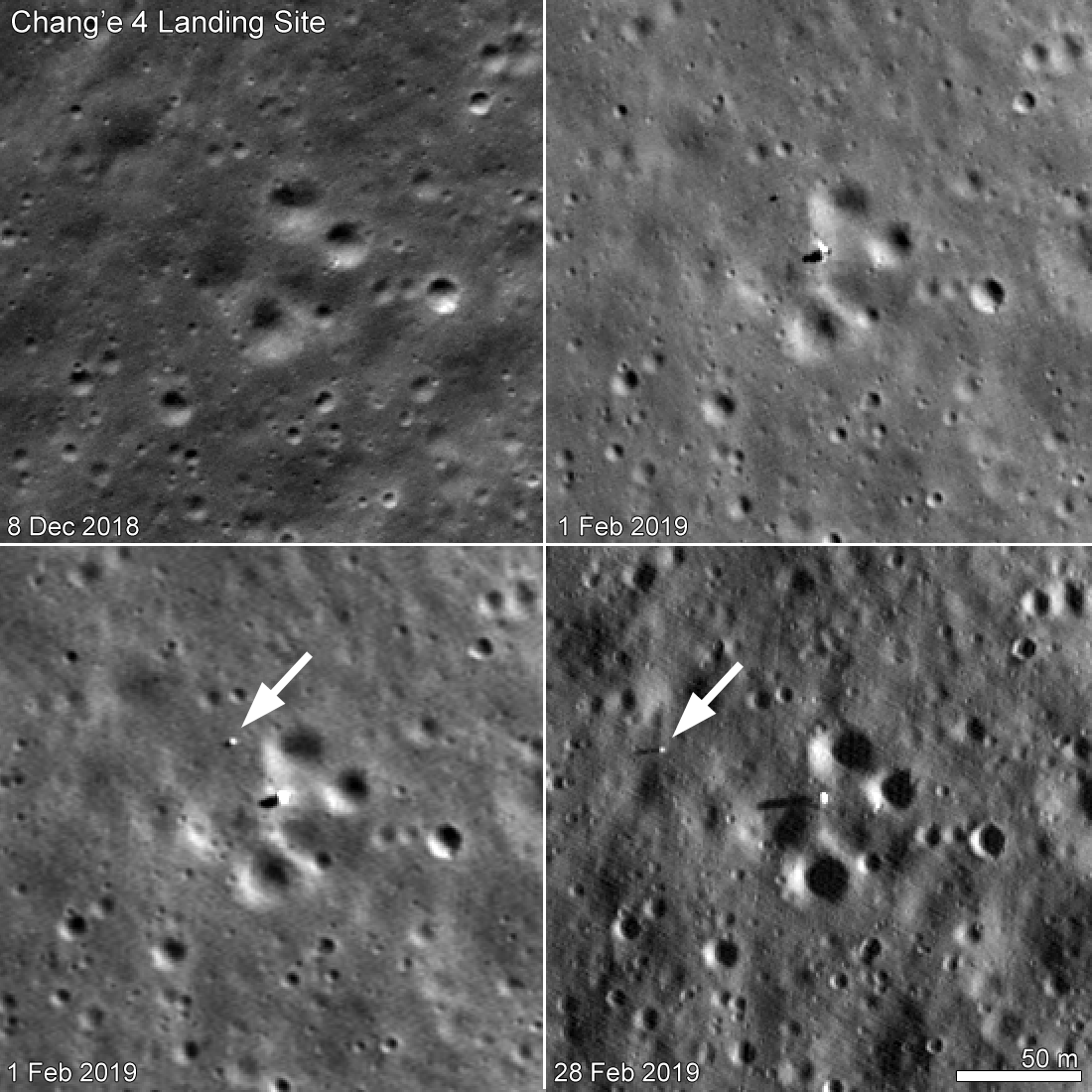
A new image from Lunar Reconnaissance Orbiter (LRO) shows the path taken by the Chinese lunar rover Yutu-2 during its second lunar day of travel on the Moon. The LRO images on the right, cropped and reduced in resolution to show here, compares the rovers position at the start and end of February. The white arrow indicates the rover, with its Chang’e-4 lander visible between the three craters to the east. As noted by the LRO science team:

LRO passes over any given place on the Moon at least once every month (in the daylight), allowing the westward progress of the Yutu-2 rover to be seen. At the end of February, Yutu-2 was 69 meters from it’s home base, the Chang’e 4 lander; LROC images show Yutu-2 made 46 meters of westward progress during the month of February.

It appears from these orbital images that they are taking the smoothest route, with the fewest obstacles, away from the lander.

0 comments

Hayabusa-2 to take close look at planned explosive impact point on Ryugu

Flight plan for Hayabusa-2's rehearsal

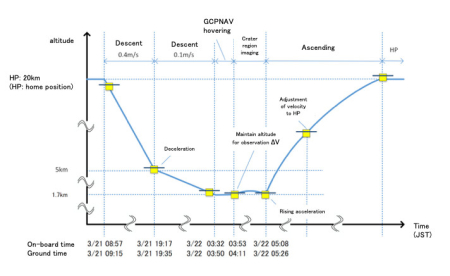
Beginning today Hayabusa-2 will do a two-day close approach of Ryugu in order to get good baseline images of the point on the surface where they will fire an explosive projectile in the first week in April. As they note:

Currently, we have scheduled the small carry-on impactor operation (SCI operation) for the first week in April. The purpose of the SCI operation is to create a crater on the surface of Ryugu, and it is important to be able to compare the asteroid surface before and after the SCI operation.

The graph on the right shows the flight plan. I expect they will do the same for this maneuver as they have done with previous close approaches, and provide real-time images as they happen.

0 comments

Air Force’s launch contracting plans under scrutiny

It appears the Air Force wants to decide now which two rocket companies it will use for its launch needs in the 2022 to 2026 time period, and this desire is raising hackles among those companies.

[T]he Air Force will choose only two companies to meet its launch needs from 2022 to 2026, with one provider winning 60 percent of the contracts and the other taking 40 percent. There is no provision to on-ramp other companies during the time frame.

This sets up a rather frantic competition between the incumbents, ULA and SpaceX, and newcomers Blue Origin (with its New Glenn booster) and Northrop Grumman (with its Omega rocket). Moreover, the timing appears to prejudice the competition in favor of the incumbents, which already have existing launch systems the government can assess.

Something is really fishy here. Why does the Air Force need to limit its services to only two companies? And why do they have to make this decision now, three to seven years before the launches will occur? Common sense says you instead issue specific contract bids, for each launch, as they are needed, thus allowing as many companies as possible to compete for the business.

In fact, this policy seems to directly contradict the Air Force’s stated goal, repeated many times in the past few years, to widen competition in the launch industry, both to lower cost and to give the military strategic redundancy in its needed launch services.

5 comments

China’s future lunar exploration plans

In a poster presented on Tuesday at this week’s 50th Lunar and Planetary Science Conference in Texas, China outlined its future plans for lunar exploration.

Systematically considering the major scientific issues of the Moon and the lunar in-situ utilization resources, Chinese scientists and technical experts have proposed a vision to preliminarily build a research station on the Moonโ€™s South Pole by implementing 3-4 missions before 2035.

The first mission will carry out a comprehensive exploration in the South Pole of the Moon, including the topography, elemental composition and volatile contents of the Moon, and the information on the structure of the South Pole from shallow to deep levels. Water (ice) in the permanent shadow area was detected in-situ to reveal the content, distribution and source of water and volatiles on the surface of the Moon. After that, a sampling return mission will be arranged to collect samples from the South Pole of the Moon and return them to the Earth. In addition to the scientific exploration of the Moon, the utilization of lunar resources should also be taken into consideration. In later missions, lunar platforms will be used to make astronomical or earth observations and to consider the use of lunar resources. [emphasis mine]

China clearly intends to put its footprints on the Moon. It is not fiddling around with an orbital lunar station, as it looks like we are with NASA’s Gateway project. While China explores the surface, we will be stuck in orbit (maybe).

4 comments

Ariane 6 gets OneWeb launch contract

Capitalism in space: Arianespace announced this week that it has signed a three-launch contract with OneWeb that will use its new Ariane 6 rocket, including the rocket’s maiden flight.

The launch service agreement specifies the use of the qualification launch of the Ariane 62 version, scheduled for the second half of 2020; the two Ariane 6 options (either in its 62 version, accommodating up to 36 OneWeb satellites, or in the 64 version, up to 78 OneWeb satellites) will be utilized starting in 2023.

The OneWeb satellites will be launched by the first Ariane 62 into a near-polar orbit at an altitude of 500 kilometers before raising themselves to their operational orbit.

Because OneWeb is in direct competition with SpaceX for building the first space-based internet satellite constellation, it has looked for other launch companies to put its satellites in orbit. Thus, the business to launch the company’s planned 650-plus satellite constellation has gone to Arianespace, Russia, Virgin Orbit, and others. This in turn appears to have saved Ariane 6, which is going to be more expensive than SpaceX’s rockets and was therefore having trouble getting launch contracts.

Isn’t competition wonderful? It looks like it is going to take us to the stars.

2 comments

Boeing delays unmanned test flight of manned capsule

According to this story today, Boeing has delayed from April to August its first unmanned test flight of its Starliner manned capsule. It has also delayed the first manned flight from August to November.

NASA refused to comment other to say it would announce new schedules next week. The article also stated this:

The initial April launch was ahead of a United Launch Alliance mission for the Department of Defense in June from the Cape Canaveral launch pad in Florida, so Boeing would have needed to clear the launch pad by the first week in May, one of the sources said, describing the pressure not just on technical issues but also launch schedules at Cape Canaveral.

I suspect the technical issues are related to Boeing’s need to do more tests of the attitude thrusters on Starliner following the leak that occurred in a test last summer.

I also hope that next week’s announcement will reveal a firming up of SpaceX’s schedule. By now they should have a good idea of when they can do their launch abort test reusing the Dragon capsule used during their successful first unmanned test flight in March. That will in turn allow them to firm up the launch date for the first manned flight.

0 comments

Andrew Yang: the fascist future of the Democratic Party

Want to know what the future of the Democratic Party will be? You need only take a look at the stated presidential goals of Andrew Yang.

Yang’s proposals in the first two stories would violate the first amendment of the Bill of Rights, having government impose its will on both free speech and religion. His proposal in the third story would bankrupt the nation while imposing back-breaking taxes on everyone. The result would be Soviet- and Venezuelan-style socialism/communism. And anyone with even the slightest education can imagine where that will get us.

The fourth story illustrates his uneducated narcissism. He fears that automation and robots are going to put people out of work forever, and wants to use the power of government to fix this danger.

Even if he is right about the dangers of automation, however, what makes him think he is so smart that he has the slightest idea what to do? He doesn’t. No single human ever does on problems of this complexity. Instead, the free market usually answers the problem quite effectively. Remember Aesop’s fable about necessity being the mother of invention?

If automation kills some jobs, others will pop up to replace them. This is what happened in the 1960s and 1970s when the first wave of panic occurred over automation. Then there were numerous articles about how automation was going to put everyone out of work. It never happened, and it won’t happen in the future.

Yang will probably not be the Democratic Party candidate for president. Still, his stance and nonchalant willingness to violate the Constitution to impose his will on others is very typical of most young Democrats. This is where that party is heading, even as it embraces bigotry and anti-Semitism, while working to corrupt the election process.

Yang is typical of the young Democratic Party. That future should send chills up the spine of every free American. As I’ve said repeatedly, they’re coming for you next.

53 comments

Streaky Mars: Slope streaks and recurring slope lineae

New recurring lineae on Mars
Click for source paper [pdf].

Numerous presentations at this week’s 50th Lunar and Planetary Science Conference in Texas have focused on two different changing features on the Martian surface, dubbed slope streaks and recurring slope lineae (or RSLs, an example of an unnecessary and unwieldy acronym that I avoid like the plague).

These apparently are considered two different phenomenon (with some overlap), something I had not recognized previously. For example, one presentation [pdf] this week described slope streaks as:

…gravity-driven dark or light-toned features that form throughout the martian year in high-albedo and low-thermal-inertia equatorial regions of Mars. The distinctive features originate from point sources on slopes steeper than ~20ยฐ, follow the topographic gradient, extend or divert around small obstacles, and propagate up to maximum lengths of a few kilometers. The streaks brighten with time, sometimes become brighter than their surroundings, and fade away over timescales of decades. [emphasis mine]

An example can be seen here. This is in contrast to the recurring slope lineae, shown in the image above, which another paper [pdf] described as:

…dark linear features that occur on the surface of steep slopes in the mid-latitudes of Mars. These areas are warm, occasionally exceeding temperatures of 273-320 K. [Lineae] recur over multiple years, growing during warm seasons and fading away during colder seasons. Their apparent temperature dependency raises the possibility that liquid water is involved in their formation. [emphasis mine]

I have highlighted the key differences. While slope streaks are long lived and change slowly, lineae change with the Martian seasons. And the slope streaks appear to exist at lower latitudes. These difference means that the formation process of each must be also different.

The problem is that scientists still don’t know what causes either, though they have many theories, involving both wet and dry processes.

Most of the presentations at the conference this week focused on the recurring lineae, which I suspect is because of their seasonal aspect. This feature strongly suggests a water-related source for the lineae, and everyone who studies Mars is always focused on finding sources on Mars where liquid water might be found. Also, slope streaks appear more often in dunes, which also strongly suggests a dry process. One paper, however, did a comparison study of lineae with one specific kind of dune slope streak to see if the freatures might be related.

The most interesting result [pdf] for all these papers documented the apparent increase in recurring lineae following the global dust storm last year. The image at the top of that post is from this paper, and shows a fresh lineae where none had been prior to the storm. From the paper’s abstract:
» Read more

0 comments
1 118 119 120 121 122 156