Fun Boy Three – Our Lips Are Sealed
An evening pause: A very typical 80s song, very sad, hopeless, and depressing. Background here.
Hat tip Dan Morris.
An evening pause: A very typical 80s song, very sad, hopeless, and depressing. Background here.
Hat tip Dan Morris.

The flare is the bright spot, center bottom. Click for original image.
The Sun today unleashed an X1-class solar flare, one of the more powerful seen since the ramp up to solar maximum began at the start of 2020.
More information here, with this quote:
The blast also hurled a CME [coronal mass ejection] into space. Coronagraph images are not yet available, but evidence for a CME is already pursuasive [sic]. The USAF reports strong Type II and Type IV radio emissions generated by a CME plowing through the sun’s atmosphere. In addition, energetic particles accelerated at the leading edge of a CME have already reached Earth.
When will the CME itself arrive? Assuming that it is Earth directed, probably on Oct. 30th or 31st. Fresh data from SOHO coronagraphs will allow a more precise forecast, so stay tuned.
During the flare, a pulse of X-rays and extreme UV radiation ionized the top of Earth’s atmosphere, causing a strong shortwave radio blackout centered on South America:
Aviators, mariners, and ham radio operators on the daylit side of Earth may have noticed strange propagation effects at frequencies below 30 MHz.
While this flare is unlikely to cause any significant disturbances to orbiting or Earth-based technology, the flare was emitted by a large sunspot that is still active, can still flare again, and is well positioned on the Sun to send more material and radiation Earthward.
Three new papers published today in the journals Science and the Journal of Geophysical Research: Planets reveal in more detail the depth of Jupiter’s storms and clouds, using a variety of different sensors and techniques.
The papers can be found here, here, and here.
Juno’s microwave radiometer (MWR) allows mission scientists to peer beneath Jupiter’s cloud tops and probe the structure of its numerous vortex storms. The most famous of these storms is the iconic anticyclone known as the Great Red Spot. Wider than Earth, this crimson vortex has intrigued scientists since its discovery almost two centuries ago.
The new results show that the cyclones are warmer on top, with lower atmospheric densities, while they are colder at the bottom, with higher densities. Anticyclones, which rotate in the opposite direction, are colder at the top but warmer at the bottom.
The findings also indicate these storms are far taller than expected, with some extending 60 miles (100 kilometers) below the cloud tops and others, including the Great Red Spot, extending over 200 miles (350 kilometers). This surprise discovery demonstrates that the vortices cover regions beyond those where water condenses and clouds form, below the depth where sunlight warms the atmosphere.
The height and size of the Great Red Spot means the concentration of atmospheric mass within the storm potentially could be detectable by instruments studying Jupiter’s gravity field. Two close Juno flybys over Jupiter’s most famous spot provided the opportunity to search for the storm’s gravity signature and complement the MWR results on its depth.
With Juno traveling low over Jupiter’s cloud deck at about 130,000 mph (209,000 kph) Juno scientists were able to measure velocity changes as small 0.01 millimeter per second using a NASA’s Deep Space Network tracking antenna, from a distance of more than 400 million miles (650 million kilometers). This enabled the team to constrain the depth of the Great Red Spot to about 300 miles (500 kilometers) below the cloud tops.
The data from these two techniques confirms that the base of the Great Red Spot is somewhere between 200 to 300 miles below the cloud tops, much deeper than most of the other storms, though even those storms are deeper than expected.
Another paper published earlier in Geophysical Research Letters looked at the storms in Jupiter’s polar regions, and found their polygonal arrangement around the poles appears stable and caused by a balanced push between these surrounding storms, trying to move to the poles, and the storms at the poles pushing back.

The religious banned at ULA
They’re coming for you next: The rocket company United Launch Alliance (ULA) yesterday fired Hunter Creger, the man who organized public protests against its COVID shot mandate.
Creger, a Laser Weld Technician at ULA, reported for his day shift at the rocket parts manufacturing plant on Wednesday for the first time this week. On Monday and Tuesday, Creger organized a protest with other employees to raise their voices in unison over the company’s COVID-19 vaccination mandate.
The mandate requires the federal workers at the plant to be vaccinated by Friday, October 29, or face termination. Creger asked his supervisors if the suspension is related to his role in the protests. He said they would not clarify that, but he has his own suspicions. “Even after all of this, after walking me out of the facility for my role that I played in the protest, at the root of all of this is because I’m a Catholic and that’s why they fired me. They denied my religious accommodation. That’s what started this whole thing.” [emphasis mine]
According to the story, more than two hundred employees filed for a religious exemption to the mandate. All were denied.
» Read more

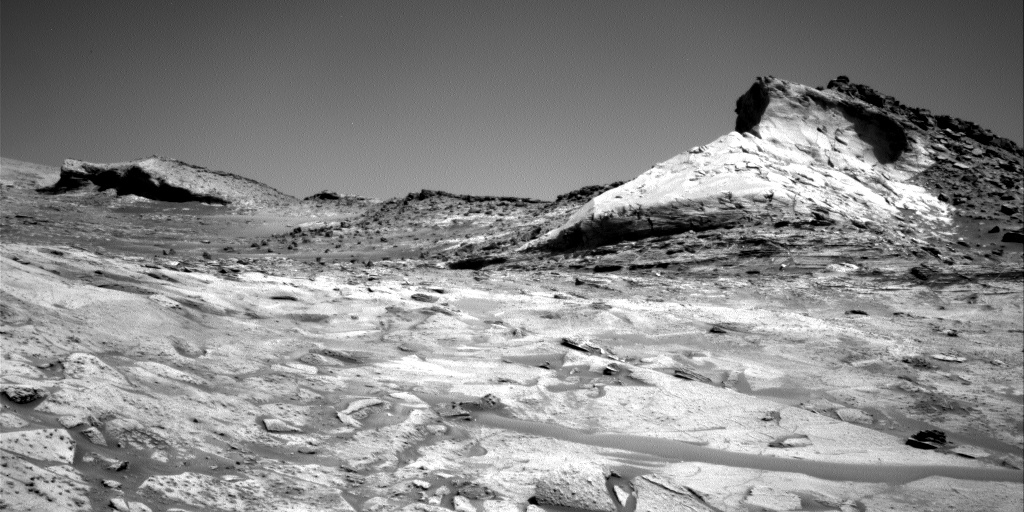
For the original images go here and here.
The image above is a mosaic made from two Curiosity navigation photos taken on October 23, 2021 and combined, cropped, and reduced to post here. It shows the top 30 feet or so of Siccar Point, the spectacular outcrop that I have featured several times previously.
Curiosity has now traveled past this outcrop, so that this view above is no longer visible to the rover. I post it now as a farewell image of what I think is the most breath-taking feature yet seen by any planetary lander — manned or unmanned — since the first set down on the Moon in the mid-1960s. It also illustrates with great clarity the alien nature of Mars. Those delicate overhanging rocks would not be possible on Earth, with a gravity about two and a half times heavier than Mars.
Note too that I have not enhanced the contrast or brightness. I think the twilight light here actually gives us a sense of the real brightness of a clear Martian day. Because the Sun is much farther away, even at high noon it provides much less illumination than on Earth. A bright day on Mars to our Earth-adapted eyes will always feel like dusk.
Meanwhile the science team is quickly pushing the rover south, to get…
…closer to the area we are targeting for our next drill campaign. This drive should leave us with bedrock in the workspace for additional contact science on the weekend. This terrain continues to be very challenging, with large boulders, sharp rocks that are wheel hazards, and sand ripples, like the terrain shown in the image. These drives take a while to plan to make sure we are avoiding all the hazards while getting to where science wants to go. Our paths end up looking a little “drunk” as we weave our way around obstacles.
Capitalism in space: The new smallsat rocket company Astra has revealed that it will make its fourth attempt to reach orbit with a launch window opening on November 5th.
That this launch could take place only a little over two months since Astra’s last attempt, which failed, speaks well of the company. They have very quickly fixed the fuel line issues that caused that August 28th failure and then moved immediately to fly again.
Moreover, the company’s overall pace of launch is excellent. This will be their fourth launch attempt since September 2020, less than fourteen months, suggesting that when they finally succeed and begin operational launches they will also keep their promise of frequent and rapid launches.
Embedded below the fold in two parts.
To listen to all of John Batchelor’s podcasts, well worth your time, go here.
» Read more
Capitalism in space: Boeing today announced that it has had to taken another $185 million charge out of its earnings, in addition to the $410 million previously deducted, in order to cover the problems and delays in developing its Starliner manned capsule.
When Boeing took the original earnings charge, it said it did so because it committed to redo the uncrewed flight test at no expense to NASA, a point a Boeing executive reaffirmed at the Oct. 19 briefing. “There’s no additional charges that will be going to the government for this. This is something that The Boeing Company will make sure we’ve got covered as we get this vehicle prepared,” said John Vollmer, vice president and program manager for Boeing’s commercial crew program.
These costs are beginning to pile up. Boeing has got to get this capsule fixed and flying, not only to begin bringing in some income but to show the world that it can do this right.
Using its Soyuz-2 rocket, Russia today successfully launched a Progress freighter to ISS, carrying more than 5,000 pounds of cargo.
The freighter is scheduled to dock with ISS Friday evening at 9:34 pm (Eastern). It will dock with the port on the 20-year-old Zvezda module, which has remained unused for the past six months because of concerns that the docking and undocking at the port was causing stress fractures in the sections of Zvezda closest to the port. The Russians have decided to do this docking for the express purpose of studying its impact on the module.
The Progress MS-18 spacecraft will link up with the rear docking port on Zvezda. With the help of cosmonauts on the station, Russian engineers have traced a small air leak on the station to the transfer compartment leading to Zvezda’s rear port. The compartment has been sealed from the rest of the space station since the departure of a previous Progress spacecraft from the rear docking port in April. But cosmonauts will re-open the compartment to unload cargo delivered by the Progress MS-18 spacecraft.
The leaders in the 2021 launch race:
38 China
23 SpaceX
18 Russia
4 Northrop Grumman
4 ULA
4 Arianespace (Europe)
China remains ahead of the U.S. 38 to 36 in the national rankings.
An evening pause: Performed live in 1986. I suspect there are a lot of guitar solos that people will label the greatest ever.
Hat tip Mike Nelson.
You can now listen to the podcast of my Monday, October 25, 2021 appearance on the Space Show at this link.
I think this was once again an excellent show, especially because of the truly excellent questions posed by the listeners, some of which are regular readers of Behind the Black. Thank you all for participating!
With the end of the solar conjunction in the first half of October, blocking communications with Mars because the Sun was in the way, Curiosity has resumed its travels. It has moved past the spectacular outcrop I have highlighted previously, an outcrop the science team has labeled Siccar Point.
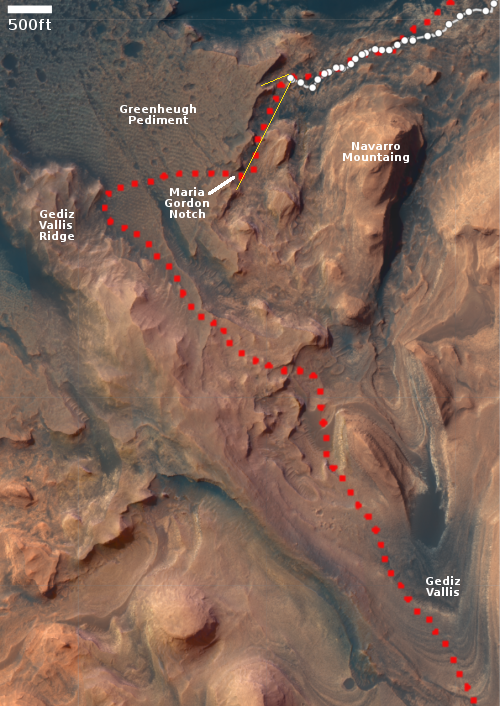
They are now moving south at the base of the cliff to the west, the top of which is a plateau they call the Greenheugh Pediment, heading for a gap where the rover will be able to turn right and head up onto that pediment. The red dotted line on the overview map to the right shows this route, which corresponds to the red dotted line on the photo above.
I estimate the cliffs on both sides of Maria Gordon Notch are about 100 feet high. The notch itself I estimate is about 750 feet away. At the pace Curiosity has been traveling across this rough ground, it could probably reach it in about two to three weeks. However, I expect the science team will stop at least once along the way to do more detailed science work, so that journey might take a month or slightly more.