Inmarsat to launch new low orbit communications satellite constellation

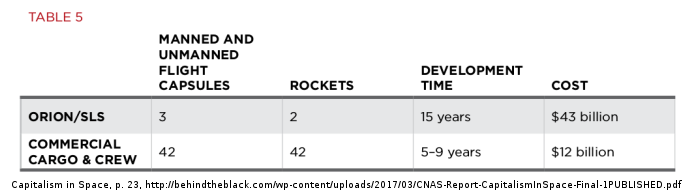
Capitalism in space: Inmarsat announced yesterday that it plans to launch a 150 satellite constellation in low Earth orbit to supplement and improve its already orbiting communications satellites in high geosynchronous orbit.

The company is investing $100 million over the next five years to lay the groundwork for deploying 150-175 LEO spacecraft.

They aim to join satellites Inmarsat has in geostationary and highly elliptical orbits from 2026. Inmarsat, which currently operates 14 satellites, is also on track to add five new GEO and two HEO spacecraft to its network over the next five years.

Its incoming multi-orbit constellation, called Orchestra, seeks to improve latency, network speeds and resiliency for communications services across its core maritime, aviation, government and enterprise markets.

This new constellation is also an effort by Inmarsat to keep its communications product competitive against the newer constellations being launched by SpaceX (Starlink) and OneWeb.

For the space launch industry, this just means more launches, more demand for rockets, and more money to be made.

Note that Inmarsat’s approach here is the correct way to respond to competition. Rather than try to squelch your competitors using government regulation, as Viasat is attempting, Inmarsat is instead up its game, improving its product, and thus matching the challenge its competitors are offering it.

One last question: Will this new constellation, set to be operational by ’26, get there before Amazon’s long promised Kuiper constellation? Right now I’m willing to bet that it will, considering how slow Amazon has been in developing that system.

3 comments

Apollo 11 lunar ascent stage might still be in orbit around the Moon

New data about the Moon’s interior and gravitational field suggest that the Apollo 11 lunar ascent stage, the part of the LM that carried the astronauts back from the Moon, might still be in orbit around the Moon, rather than have crashed into its surface as long assumed.

Using the GRAIL gravity model and the General Mission Analysis Tool (GMAT) simulator, Meador expected to find the LM’s orbit destabilizing very quickly. What he found – and was verified by a third party using different methods – was that the Ascent Stage had a feedback mechanism that caused the orbit to stabilize itself over a period of every 24 days. When he ran the simulation forward, the orbit remained stable until the present day.

The upshot of this is that the Ascent Stage may still be in orbit now and could be observed when it is in the right position in relation to the Earth and the Sun. However, Meador emphasizes that the LM was never intended to be very robust. Designed to operate for only about 10 days, it was also filled with batteries and fuel tanks, which could have exploded years ago, either destroying the craft or sending it off on a new trajectory.

If the stage is in lunar orbit, than it probably is one the most valuable and quickly reachable artifacts from one of space’s most historic missions. While the Apollo artifacts left on the Moon should be left where they are, this piece could be recaptured and returned to Earth for both study and exhibition.

In fact, if it is still in orbit it should be recovered, to preserve it.

This data also suggests that other Apollo ascent stages as well as other past lunar orbiters might also still be in lunar orbit, and should be located.

13 comments

Nauka engines fire unexpectedly after docking; forces cancellation of Starliner launch

The soap opera of the Nauka module to ISS became even more dramatic today when its engines fired unexpectedly after its docking, causing the station to shift in orbit and forcing Russian mission controllers to shut it down and fire other engines to return the station to its proper orbit.

Russia’s Roscosmos space agency attributed the issue to Nauka’s engines having to work with residual fuel in the craft, TASS news agency reported. “The process of transferring the Nauka module from flight mode to ‘docked with ISS’ mode is underway. Work is being carried out on the remaining fuel in the module,” Roscosmos was cited by TASS as saying.

It appears that because they needed to improvise the rendezvous using different engines, there is more fuel left over in Nauka than expected once it docked, and this needs to be vented safely. Somehow, instead of venting the module ignited the engines.

NASA has subsequently postponed tomorrow’s second unmanned demo launch of Boeing’s manned Starliner capsule until the agency has a clear understanding of the issue and has confirmed that Nauka’s presence is not a serious safety issue.

22 comments

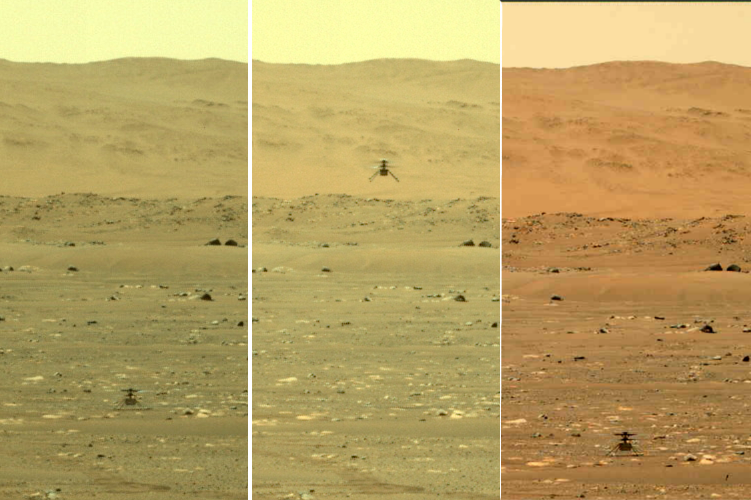
The view of Jezero Crater, from both Ingenuity and Perseverance

The view from Ingenuity during 10th flight
Click for full image.

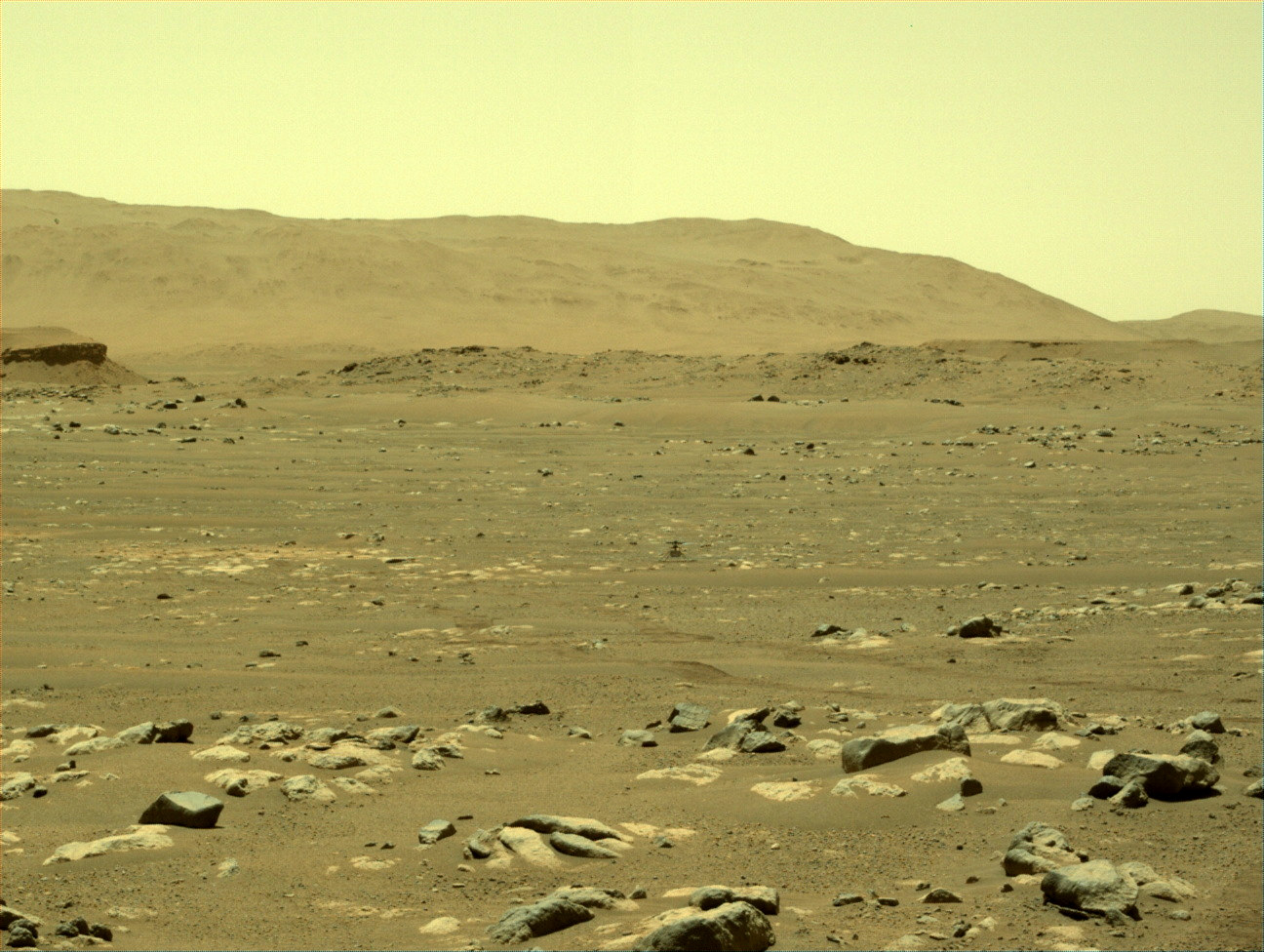
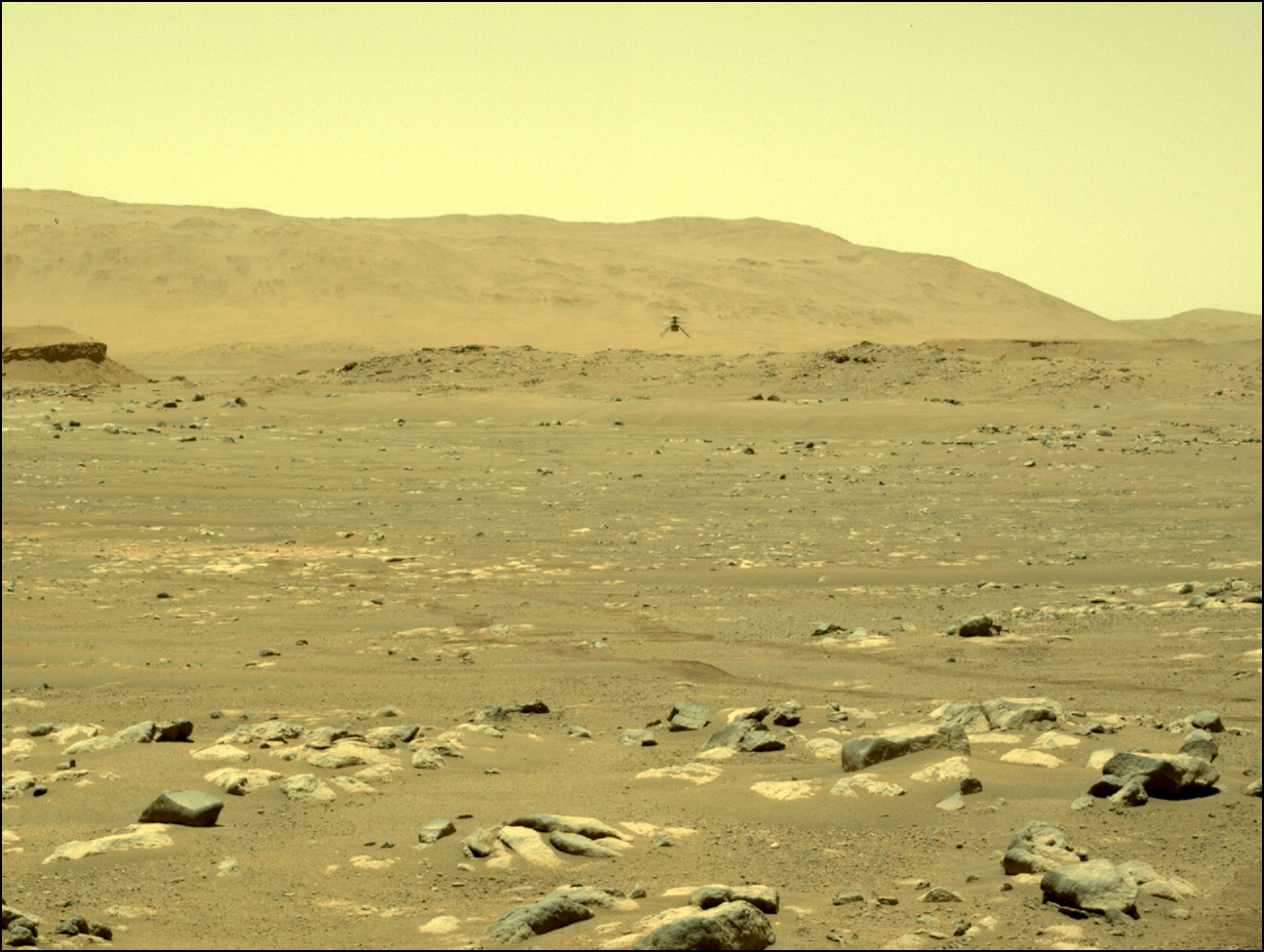
Cool image time! Today the Perseverance science team released the 200 images that Ingeniuty took during its 10th flight on July 24, 2021.

The photo to the right was taken about 25 seconds before the helicopter landed, and looks to the southwest. In the foreground can be seen the ridge of rocks and pebbles that the scientists sent Ingeniuty to photograph. In the distance can be seen the rim of Jezero Crater, about 7.5 miles away, with some rounded hills that sit in the crater floor about 5.5 miles away.

The white box indicates the area covered by two high resolution images taken by Perseverance on July 28th that I have combined into the panorama below.
» Read more

15 comments

Atomic oxygen in Mars’ atmosphere, as seen by Al-Amal

Oxygen distribution on Mars

The UAE’s Al-Amal Mars orbiter on July 19, 2021 released a new spectroscopic image, showing the global distribution of atomic oxygen in the Martian upper atmosphere.

The Emirates Ultraviolet Spectrometer (EMUS) mapped the distribution of atomic oxygen in the planet’s upper atmosphere, showing a dense patch emerging from the nightside into the new day.

The photo to the right, cropped and reduced to post here, shows this.

Over the next two years, covering one single Martian year, Al-Amal will monitor the distribution of this oxygen to see how it fluctuations from season to season, as well as from day to day. Gather this information will help the theorists untangle the past atmospheric history of Mars.

3 comments

Today’s blacklisted American: Democrat endorses racial discrimination and press censorship aimed at whites

Discriminated against by Chicago Democrats
Eagerly discriminated against by Democrats

Blacklists and segregation are back and the Democrats have got ’em: Lori Lightfoot, the Democratic Party mayor of Chicago, recently and enthusiastically defended her past racial disciminatory policy of refusing to give any one-on-one interviews to white reporters, saying she intends to do it again.

Chicago Mayor Lori Lightfoot said she would “absolutely” grant interviews only to journalists of color again after she drew waves of backlash earlier in the year when she announced the policy.

“I would absolutely do it again. I’m unapologetic about it because it spurred a very important conversation, a conversation that needed to happen, that should have happened a long time ago,” the Democrat said on a segment of the New York Times’s podcast Sway, released on Monday.

“Here is the bottom line for me: To state the obvious, I’m a black woman mayor,” she said. “I’m the mayor of the third-largest city in the country. Obviously, I have a platform, and it’s important to me to advocate on things that I believe are important. Going back to why I ran — to disrupt the status quo. The media is critically important to our democracy. … The media is in a time of incredible upheaval and disruption, but our City Hall press corps looks like it’s 1950 or 1970.”

» Read more

7 comments

For the first time astronomers measure the rotation of exoplanets

The uncertainty of science: Using the Keck Telescope in Hawaii astronomers for the first time have measured the rotation of several exoplanets orbiting the star HR8799, about 129 light years away.

Using the state-of-the-art Keck Planet Imager and Characterizer (KPIC) on the Keck II telescope atop Hawaiʻi Island’s Maunakea, astronomers found that the minimum rotation speeds of HR 8799 planets d and e clocked in at 10.1 km/s and 15 km/s, respectively. This translates to a length of day that could be as short as three hours or could be up to 24 hours such as on Earth depending on the axial tilts of the HR 8799 planets, which are currently undetermined. For context, one day on Jupiter lasts nearly 10 hours; its rotation speed is about 12.7 km/s.

As for the other two planets, the team was able to constrain the spin of HR 8799 c to an upper limit of less than 14 km/s; planet b’s rotation measurement was inconclusive.

These results are somewhat uncertain, as are any conclusions theorists try to draw from them. Even if confirmed, the sample is so small it doesn’t tell us anything yet about overall trends in planet formation or the expected spin rate of planets as they form.

Nonetheless, the detection appears valid and thus a scientific triumph. Astronomers have been telling me for years that figuring out ways to find out more about exoplanets is going to become the next hot subject in astronomy. This result illustrates this.

1 comment

Scientists: Clay, not liquid water, explains radar data under Martian south icecap

The uncertainty of science: In a new paper scientists claim that clay materials, not liquid water, better explain the radar data obtained by orbital satellites, initially hypothesized to be liquid water lakes under Mars’ south polar icecap.

Sub-glacial lakes were first reported in 2018 and caused a big stir because of the potential for habitability on Mars. Astrobiologists and non-scientists were equally attracted to the exciting news. Now, the solution to this question, with great import to the planetary science community, may be much more mundane than bodies of water on Mars.

The strength of this new study is the diversity of techniques employed. “Our study combined theoretical modeling with laboratory measurements and remote sensing observations from The Compact Reconnaissance Imaging Spectrometer for Mars (CRISM) instrument on NASA’s Mars Reconnaissance Orbiter. All three agreed that smectites can make the reflections and that smectites are present at the south pole of Mars. It’s the trifecta: measure the material properties, show that the material properties can explain the observation, and demonstrate that the materials are present at the site of the observation,” Smith said.

This paper is only one of several recently that has popped the balloon on the liquid lake theory. Nothing is actually proven, but the weight of evidence is definitely moving away from underground liquid water under the south pole icecap.

1 comment

India officially delays launch of its next lunar rover to ’22

The new colonial movement: India has now officially delayed the launch of its next lunar rover, Chandrayaan-3, to the third quarter of 2022.

Chandrayaan-3 was planned to demonstrate India’s capability of soft landing on a celestial body, with the rover then communicating with Earth via the existing orbiter from Chandrayaan-2. The orbiter has an estimated lifespan of seven years. The third mission was announced months after the Vikram lander aboard Chandrayaan-2 crash-landed on the lunar surface just 2.1 km from its destination in September 2019. Chandrayaan- 3 was initially scheduled for late 2020 or early 2021, but the disruption caused by the pandemic affected the schedule.

The Wuhan flu panic has essentially shut down India’s entire space program for more than a year. Not only has the country only done one launch so far in 2021, far less than expected, it has also had to delay its manned space program by a year, as well as the launch of its own new smallsat rocket.

The delay in launches, including that smallsat rocket, is likely losing India customers in the commercial market, especially because the private rocket companies in the U.S. have continued to launch with almost no delays. If India doesn’t get off the ground soon its rocket industry will be seriously damaged in a way that might take years to recover.

0 comments

China’s Long March 2D rocket launches earth observation satellite

China today successfully used its Long March 2D rocket to launch an earth observation satellite into orbit.

The launch was from one of China’s interior spaceports, so the expendable first stage and fairings landed within China. No word on whether they landed uncontrolled or used the parachutes or grid fins to control the landing.

The leaders in the 2021 launch race:

24 China
20 SpaceX
12 Russia
3 Northrop Grumman
3 Rocket Lab

The U.S. still leads China 30 to 24 in the national rankings.

0 comments

Nauka finally docks with ISS

ISS configuration with Nauka added
The configuration of the Russian portion of ISS with
Nauka and the as-yet launched docking hub.

This morning the new fullsize module to ISS, Nauka, finally docked with the station, ending a week of tension because of issues with its engines.

The docking was not without issue, with Russian cosmonauts noting that Nauka wasn’t on the correct course less than an hour before docking; however, a retro burn quickly corrected the issue. After also troubleshooting an issue with the TORU manual docking system, Nauka successfully docked in automated fashion to the Zvezda service module’s nadir port at 09:29 EDT / 13:29 UTC, marking the first major expansion to the Russian segment for over 20 years.

They will now begin a series of eleven spacewalks to outfit the module. This includes installing a new European-built robot arm and transferring an airlock and radiator on a different module that were originally built to be attached to Nauka and have been waiting eleven years for its much delayed arrival.

In November Russia will then launch a small docking hub module that will dock with Nauka and provide the docking ports that were lost when the Piers module was detached earlier this week (thus allowing Nauka to dock). This new docking hub is also critical, because it will allow Russia to limit dockings to the aft port on Zvezda, which has serious structural stress issues and must be treated gently to prevent further hull cracks and air leaks.

5 comments
1 69 70 71 72 73 167