Russia announces new tourist flight options to ISS

Capitalism in space: Russia has announced a range of new tourist flight options to ISS in an effort to compete against the new commercial tourist flights being offered by American companies.

Glavkosmos is offering space tourists the option of performing spacewalks from the International Space Station (ISS) and stays of up to 30 days aboard the orbital laboratory. They can even purchase the Soyuz space capsule that took them to and from the station.

The company, which is part of Roscosmos, recently upgraded its website to provide details of what paying customers can do when they book a trip to the station. The information is available in Russian and English.

You can see the English website here. It does not indicate what the prices are for these services, though it will have to be competitive with what SpaceX is charging in order to compete.

Side note: This story is on Doug Messier’s site Parabolic Arc, which is presently running a fund-raising campaign. Please consider donating. While Doug and I might disagree on many things, his work covering commercial space remains among the best on line.

0 comments

SpaceX’s focus shifts from Starship hops to the first near-orbital flight

Capitalism in space: Work at SpaceX’s Boca Chica spaceport in Texas has now definitely shifted away from doing Starship short hops, focusing instead on the first near-orbital flight using both Starship and Superheavy.

Not only is almost all recent work at Boca Chica centered on building the orbital launchpad with its tower for Superheavy, the company has apparently decided to end development of Starship prototypes 15-19, designed for hops only.

The fate of Starship SN15, following its milestone success with a smooth test flight and landing last month, is still unknown. It is likely awaiting preparations to go on display at Starbase. It is already sitting on display stands.

SN16 continues to reside in the High Bay, all but ready for rollout to the suborbital pad. However, that appears increasingly unlikely, as SpaceX focuses on the upcoming orbital attempt from the launch site next door to where SN15 completed its momentous test.

SN17โ€™s fate is known, with sections of what was to become that Starship now observed as being scrapped at the Production Site.

Meanwhile, SN20โ€™s aft dome [intended for orbit] has also been spotted by Mary (@bocachicagal), sporting three mounts for RVacs, indicating SN20 may be the first Starship to fly with both sea level and vacuum optimized engines.

All signs continue to suggest that orbital test flight will occur before the end of the summer.

4 comments

China rolls rocket to launchpad for first manned mission to station

The new colonial movement: China yesterday moved to the launchpad the Long March 2F rocket it will use to launch the first three astronauts to occupy its new space station.

The first element of the complex, the Tianhe core module, launched April 28 aboard a heavy-lift Long March 5B rocket, Chinaโ€™s most powerful launch vehicle. An unpiloted cargo ship, named Tianzhou 2, launched May 29 and docked with the Tianhe core module eight hours later, delivering fuel, food and spacesuits for the Shenzhou 12 astronauts.

The Shenzhou 12 mission will last about three months, the longest stay in space to date by Chinese astronauts. Shenzhou 12 will be Chinaโ€™s seventh crewed spaceflight since 2003.

Chinese officials have not announced the launch date for the Shenzhou 12 mission, but rockets for Chinaโ€™s last three crewed spaceflights rolled to the pad at Jiuquan about a week before liftoff. That suggests the launch could occur around June 16 or June 17.

As this launch will be from a spaceport in the interior of China, it will dump its first stage boosters on land.

During that three month mission the three astronauts will likely do several spacewalks to deploy solar panels and other equipment on the exterior of the Tianhe module, preparing it for later modules as well as the next manned mission, scheduled for October and planned to last six months.

0 comments

Ingenuity completes 7th flight on Mars

Locations of Perseverance and Ingenuity on Mars
Click for interactive map.

Ingenuity yesterday successfully completed its 7th flight on Mars, heading south and landing exactly as planned.

Ingenuity lifted off around 12:34 local mean solar time on Tuesday, which corresponds to 11:54 a.m. EDT (1554 GMT). As planned, the chopper then traveled 348 feet (106 meters) south from its previous location on the floor of Mars’ Jezero Crater, staying aloft for nearly 63 seconds, JPL officials wrote in another tweet. The solar-powered rotorcraft set down at a new airfield, the fourth one it has reached since landing on the Red Planet with NASA’s Perseverance rover on Feb. 18.

Both the rover Perseverance and Ingenuity are traveling south on the floor of Jezero Crater, with the helicopter leapfrogging ahead every few weeks. On the map the red dot indicates Perseverance location, with the green dots Ingenuity’s last three landing sites. They have not yet added to the map exactly where Ingenuity landed yesterday (#7), so I have estimated it based on the information above.

The red outline indicates the region they are planning to explore over the next few months in order to gather a very thorough understanding of the geology of the floor of Jezero Crater. They will eventually head to the northwest towards the cliffs in the upper left, which is the foot of the large delta that flowed in the past into the crater through a gap in its western rim. The route they will take to get there however remains undetermined.

0 comments

Eroding Martian lava?

Eroding Martian lava?
Click for full image.

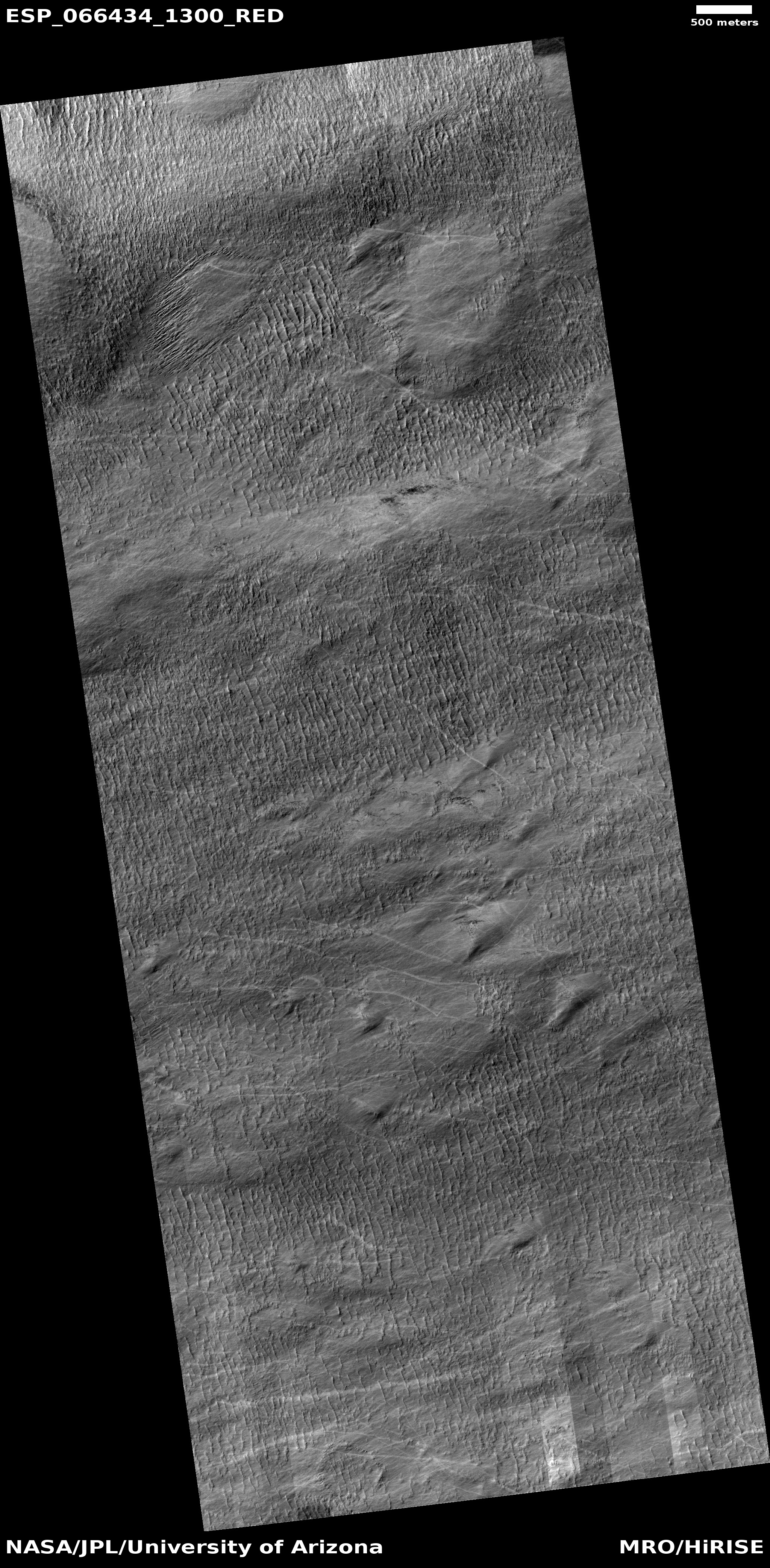
Cool image time! The photo to the right, rotated, cropped, and reduced to post here, was taken on April 19, 2021 by the high resolution camera on Mars Reconnaissance Orbiter (MRO). Requested by Colin Dundas of the U.S. Geological Surveyโ€™s Astrogeology Science Center in Arizona, the image was entitled “Enigmatic Terrain in Elysium Planitia.” The image is labeled so because, as Dundas explained,

Flood lava is a key part of the feature, best seen at the north and south ends of the image. What’s unusual is the knobby terrain at the center. … I haven’t yet been able to do a more thorough study of these features, so plenty of puzzles remain!

The higher material in the upper right is likely flood lava. A 2016 paper [pdf] led by Dundas on similar features in Elysium Planitia that were not as knobby found their origin somewhat baffling. The evidence suggested that lava, mud, wind, and ice could all be involved in their formation, but the evidence was also not sufficient to eliminate any possibility.

In the case of today’s image, the explanation might also be any of these possibilities. For example, we might be looking at the erosion of the flood lava, exposing harder knobs of different material that had been there before and had been covered by the lava. Or maybe the knobs are simply the last bits of that layer of flood lava that has not yet eroded away.

As always, the overview map provides some context.
» Read more

0 comments

Today’s blacklisted American: Leftist radical feminist Naomi Wolf

Persecution is now cool! Despite a thirty year career as a published feminist condemning the male patriarchy of American society while also working in the campaigns of both Bill Clinton and Al Gore, leftist radical feminist Naomi Wolf has found herself banned permanently by Twitter for daring to write posts condemning the lockdowns and mandates of the past year, while also raising concerns about the vaccines being offered to prevent COVID-19.

Twitter booted Wolf shortly before she intends to release her new book, Step Ten, that will explain how COVID-19 is being used by elites to grease the skids toward authoritarian fascism. โ€œA much-hyped medical crisis,โ€ Wolf argues, โ€œhas taken on the role of being used as a pretext to strip us all of core freedoms.โ€

The ironies here are endless. First, Twitter’s ban literally proves Wolf’s point. That Twitter executives don’t see that further illustrates their intolerance.

Second, the irony of Wolf’s banning might actually be somewhat amusing if it weren’t so suppressive to free thought. » Read more

8 comments

Tens of thousands of Georgia Biden ballots were likely just duplicate copies of one ballot

It appears the reason a Georgia judge decided to unseal all 147,000 mail-in ballots for close inspection were the affidavits from four poll workers stating that tens of thousands of mail-in ballots voting for Biden appeared to be mere photocopies of the same ballot, and should have been invalidated and were not.

Voyles [one of the poll workers] said she noticed that all of the ballots were printed on paper different from others she handled as part of a statewide hand recount of the presidential election.

She also said none were purportedly folded or creased, as she typically observed in mail-in ballots that had been removed from envelopes.

“All of them were strangely pristine,” said Voyles, who for 20 years has monitored elections in Fulton County, which includes much of Atlanta.

The watchdogs suspect as many as tens of thousands of the ballots may have been manufactured in a race that Biden won by just 12,000 votes, in large part because of the late surge in mail-in ballots counted after election monitors were asked to leave State Farm Arena in Atlanta.

This is the same issue that is suspected for many mail-in ballots in other states, thousands of fake ballots that appeared out of nowhere late in the vote counting, all of which were for Biden and all of which appeared very questionable.

If after inspection these allegations are found to be true , it very likely will invalidate the certified results in these states. At a minimum, it will show that the election of Joe Biden was fraudulent.

35 comments

Senate passes NASA authorization that calls for second lunar lander contract

The Senate today passed a new NASA authorization that requires the agency to award a second manned lunar lander contract in addition to the one it gave SpaceX for its Starship spacecraft.

The bill also recommended a $10 billion increase over five years in this specific lunar lander program to pay for that second contract.

None of this is law yet, as the House must agree also. In addition, as this is an authorization, not an appropriation, the extra money has not been appropriated, which means it does not yet exist. And should it be approved at these recommended numbers, it means that NASA will be forced to stretch out the creation of both lunar landers, as the money appropriated is still less than required to build either.

I suspect that this budget shortfall will not delay SpaceX’s Starship significantly, as that company has obtained sufficient private funding to build it regardless. More likely the second lunar lander will face longer delays, unless its builders decide to do what SpaceX has done, and obtain private capital to get it done fast.

Note too that this recommendations follows Congress’s general policy of imagining money grows on trees and that there is an infinite supply. While it might be a good idea to pay for two landers, the country’s debt suggests otherwise. Maybe a wiser course would be for the government to only offer a tiny percentage of the capital, and demand the builders find their own funding, as SpaceX has done.

4 comments

Juno takes first close-up images of Ganymede since 2000

Ganymede as seen by Juno
Click for full image.

Ganymede as seen by Juno
Click for full image.

On June 7th the Jupiter orbiter Juno made its first close fly-by of Ganymede, taking the first close-up images of this Jupiter moon since the orbiter Galileo flew past in 2000.

The first two images from NASA Junoโ€™s June 7, 2021, flyby of Jupiterโ€™s giant moon Ganymede have been received on Earth. The photos โ€“ one from the Jupiter orbiterโ€™s JunoCam imager and the other from its Stellar Reference Unit star camera โ€“ show the surface in remarkable detail, including craters, clearly distinct dark and bright terrain, and long structural features possibly linked to tectonic faults.

…Using its green filter, the spacecraftโ€™s JunoCam visible-light imager captured almost an entire side of the water-ice-encrusted moon. Later, when versions of the same image come down incorporating the cameraโ€™s red and blue filters, imaging experts will be able to provide a color portrait of Ganymede. Image resolution is about 0.6 miles (1 kilometer) per pixel.

In addition, Junoโ€™s Stellar Reference Unit, a navigation camera that keeps the spacecraft on course, provided a black-and-white picture of Ganymedeโ€™s dark side (the side opposite the Sun) bathed in dim light scattered off Jupiter. Image resolution is between 0.37 to 0.56 miles (600 to 900 meters) per pixel.

Both images are to the right, each slightly reduced to post here. These images of this moon of Jupiter, the largest moon in the solar system and about 26% larger than the planet Mercury, reveal many of the same unsolved geological mysteries uncovered when the Galileo orbiter photographed it two decades ago. As I wrote in my Chronological Encyclopedia

Closer inspection of Ganymede revealed a strange topography, including patches of grooved terrain (not unlike the surface of a vinyl record) overlaying other patches of grooved terrain, the different patches oriented in random and totally unrelated directions. Moreover, the surface is overlain by bright and dark patches (the bright patches thought to be caused by water frost) that often had no apparent correspondence to topographical features. Planetary geologists could only scratch their heads in wonderment.

3 comments
1 93 94 95 96 97 167