Moyun
An evening pause: Unfortunately, there is no translation on the youtube webpage to identify the music.
Hat tip Alton Blevins.
An evening pause: Unfortunately, there is no translation on the youtube webpage to identify the music.
Hat tip Alton Blevins.
Courtesy of BtB’s stringer Jay.
It will become operational in the second half of ’23, and will provide internet service to several nearby African nations. It also is planned as the first of several in Africa.
Just to get a little perspective, SpaceX built these 200 engines in about two years. In that same time, Blue Origin has struggled to build two BE-4 engines for ULA.
Though I mince no words in my criticism of China for letting this stage crash uncontrolled, Spain’s action to shut down its airport was absurd.
There remains some uncertainty about the final impact point, which might actually be two, suggesting the stage broke in half early.
Obviously, China’s ability to build this gives their space effort great capabilities, even if they steal the work of others.

Image by freepik
Last night I discovered personally that every blacklisted person in America has a great deal of power. You need only exert that power to make the bullies who are trying to destroy you helpless and confounded.
First some background. In December 2021 I was blackballed by most of the Arizona caving community because I had disagreed with their decisions to discriminate against anyone who had not gotten a COVID shot. I and a number of other people had objected to the demands of these clubs that we be jabbed in order to come to a caving event. We considered such a rule discriminatory, even as it illegally demanded private medical information. We also tried to explain to the organizers that this policy made no sense because the evidence last year had already showed that the shots provided no protection against the virus.
Their answer: I along with two others were blacklisted from all further organized caving activities for the next two years.
Since then I have been mulling how I should react. I never accepted this vindictive action. Not only had it been done in violation of the actual bylaws of these organizations, it was especially vicious because it was done by people whom I had thought were close friends. I had now discovered they were not my friends, but responding in hate goes against my nature. The true oppose of hate is utter disinterest, and it has my goal over the last ten months to put aside my baser emotions and reach this more civilized state of mind.
Anyway, last night one of the Tucson cave clubs that had blacklisted us was having its monthly public meeting, in a pizza place. Since the president of that club had sent out a public invitation saying that all were welcome, I decided it was time to show up. Essentially, I had decided to follow the advice of journalist Matt Walsh, who when attacked for criticizing the purveyors of the queer agenda for their campaign to mutilate and castrate little kids, told them this:
» Read more

Cool image time! The picture to the right, cropped, reduced, and enhanced to post here, was taken on November 2, 2022 by one of the high resolution cameras on the Mars rover Curiosity.
There isn’t much to say. This strangely eroded rock appears somewhat typical for many surface rocks in this area in the foothills of Mount Sharp. The erosion is likely from wind, combined with the rock’s low density because of Mars’ one-third Earth gravity. Even so, that wind would have needed many many eons to achieve this erosion, as the atmosphere on Mars is only about 1% as thick as Earth’s.
The lack of data also leaves open the possibility that other as-yet-unknown chemical processes contributed to that erosion.
Note: The grid pattern in the image is an artifact from the camera, and is not an actual feature on the Martian surface.
Rocket Lab today used its Electron rocket to successfully launch a Swedish atmospheric research satellite.
The attempt to catch the first stage with a helicopter as the stage came back to Earth on parachutes failed. Based on the live stream, the failure appears unrelated to the helicopter, which never even made an attempt to capture. Nor did the video from the copter ever show the stage in view. A later update explained that the helicopter had lost telemetry from the stage, and for safety reasons would not attempt a capture without that information.
The company will still recover the stage from the ocean and test its engines. An engine from a previous ocean recovery actually passed all subsequent engine tests, suggesting it could even be reused on a launch.
The leaders in the 2022 launch race:
51 SpaceX
47 China
19 Russia
9 Rocket Lab
7 ULA
American private enterprise now leads China 72 to 47 in the national rankings, though it still trails the rest of the world combined 75 to 72.
Even as Virgin Galactic has announced a contract with Axiom to fly a zero gravity suborbital training flight for one of its astronauts, the company also posted its 2021 third quarter statement, revealing losses three times higher than the previous year.
The company posted a net loss of $146 million for the three months ended Sept. 30, compared with a $48 million net loss in the same period last year. The widened loss was in part driven by increased research and development cost, which came at $97 million in the June-September quarter, three times higher than last year.
The company posted a net loss of $146 million for the three months ended Sept. 30, compared with a $48 million net loss in the same period last year. The widened loss was in part driven by increased research and development cost, which came at $97 million in the June-September quarter, three times higher than last year.
Quarterly revenue was only $767,000, down 70 percent from a year ago. Virgin Galactic hasn’t started commercial service of its suborbital spaceflight. The company currently makes money by taking deposits for future flights and providing engineering services to other companies.
Company officials still say that it will begin flying customers in the second quarter of ’23, as promised, though it also appears that the demand for its business has plummeted. At the same time, it reports it has $1.1 billion in its coffers for future development.
The German rocket startup company, Isar Aerospace, has now signed a launch agreement with a French orbital tug company, Exotrail, to put multiple tugs into orbit over a five year period.
The companies announced Nov. 3 they signed a launch services agreement to launch Exotrail’s spacevan vehicle on Isar’s Spectrum rocket on multiple missions between 2024 and 2029. The launches will take place from Andøya, Norway, and Kourou, French Guiana. The companies did not disclose a specific number of launches or the value of the agreement.
Exotrail will apparently act as the agent to get the satellite customer by providing that customer transportation to the desired orbit after deployment from Isar’s rocket.
This is the second orbital tug launch contract that Isar has won, with the first from the Italian company D-Orbit. Both deals will fly on Isar’s rocket Spectrum, which it hopes to launch for the first time next year.
Because the space burial company Celestis has now made agreements to fly into space the remains or DNA samples of so many actors or creators from the classic Star Trek television series on its next burial flight, it has named that flight its “Enterprise Mission.”
Slipping the gravitational bonds of Earth early next year, the Enterprise Flight will blast off in early 2023 using United Launch Alliance’s Vulcan rocket carrying additional cremated remains and DNA samples of “Star Trek” creator Gene Roddenberry, his wife Majel Barrett Roddenberry, “Star Trek” engineer James “Scotty” Doohan, and “2001: A Space Odyssey” VFX wizard Douglas Trumbull.
The Enterprise Flight’s trajectory will send the spacecraft roughly 93 million miles to 186 million miles (150 million to 300 million kilometers) into deep space beyond our familiar Earth-moon system. Celestis’ memorial mission intends on launching over 200 space burial flight capsules comprised of cremated ash remains, special messages, mementos and DNA samples from a range of international customers headed towards the great mystery of interplanetary space.
The flight will also include the remains or DNA samples from special effects artist Greg Jein, the series original associated producer Robert H. Justman, and actors Nichelle Nichols and DeForest Kelly.
What makes this burial flight especially unique is that the cremated remains and DNA samples will apparently be on a part of the Vulcan rocket that will escape Earth orbit and enter solar orbit.
According to a tweet from the U.S. Space Force, the out-of-control core stage of China’s Long March 5B rocket has come down in the Pacific Ocean sometime around 4 am (Mountain).
#USSPACECOM can confirm the People’s Republic of China Long March 5B #CZ5B rocket re-entered the atmosphere over the south-central Pacific Ocean at 4:01am MDT/10:01 UTC on 11/4.
The exact location has not yet been revealed, nor do we know yet if any pieces landed on any habitable islands. The odds however of the re-entry causing any damage or injury now appears nil, which is a fortunate thing considering the risks China asked everyone else to take.
In its scheduled launch today, Rocket Lab will attempt to recover the first stage of its Electron rocket, using a helicopter to snatch its parachute as it descends slowly over the ocean. This will the second attempt to do so, the first time failing after capture when the helicopter pilot decided to release the stage due to unexpected stresses and vibrations.
I have embedded the live stream below. The launch is presently scheduled for around 10:30 am (Pacific).
» Read more
Embedded below the fold in two parts.
To listen to all of John Batchelor’s podcasts, go here.
» Read more
An evening pause: Performed live in 1987 on Martha’s Vineyard.
Hat tip Alton Blevins, who sent it as a memorial for the passing of Simon’s two sisters last week.

Instagram’s instruction manual.
The modern dark age: After the Students for Life at Auburn University posted an announcement on Instagram promoting the annual March for Life anti-abortion protest in Washington, DC, Instagram immediately banned the organization, claiming simply that “Your account, or activity on it, doesn’t follow our Community Guidelines on business integrity.”
When the students appealed this decision — noting that the accusation made no sense — Instagram responded with an even more bogus and absurd explanation.
Auburn SFL, in a statement provided to The College Fix on Tuesday, said that on Oct. 13, their social media director appealed Instagram’s decision and asked for further clarification. The next day, Instagram responded saying that a potential reason for the ban was that the group “pretended to be someone else,” student President Gwen Charles said via email. [emphasis mine]
Note the highlighted word. Apparently Instagram itself doesn’t know why its banned the Students for Life account. Or more probably, it does know (“We can’t allow these Republicans *yuch!* free to say anything they want!”) but recognized it couldn’t admit this publicly.
» Read more
At an industry conference today the head of the FCC announced her plan to reorganize and enlarge the agency’s space-related operations.
In a speech at a Satellite Industry Association event, FCC Chairwoman Jessica Rosenworcel announced her intent to reorganize the commission’s International Bureau into a new Space Bureau and a standalone Office of International Affairs. That reorganization, she said, would give satellite licensing and regulatory work greater prominence and access to more resources. “The organizational structures of the agency have not kept pace as the applications and proceedings before us have multiplied,” she said, saying that the FCC has applications under consideration for systems totaling 64,000 satellites. “You can’t just keep doing things the old way and expect to lead in the new.”
Having a bureau devoted to space, she said, would go hand-in-hand with efforts to increase staffing and develop new regulations for space systems. “This organization will help ensure that the new Space Bureau and the Office of International Affairs stay relevant, efficient and effective over time.”
As noted at the article at the link, this reorganization appears tied to the FCC’s to expand its regulatory scope, including an attempt recently to regulate satellite operations and space junk that is clearly beyond its statutory authority. The agency’s chief counsel, Umair Javed, denied this in a quote in the article, but anyone who believes this denial is quite naive. Government agencies always try to increase their power, and if no one challenges them they are always willing do so, even into areas the law doesn’t permit them to go.
It is also clear that no one in the Biden administration has any plans to challenge Rosenworcel’s empire-building.
Courtesy of Jay, BtB’s stringer.
Jay also notes that according to Elon Musk, “Falcon 9 now holds record for most launches of a single vehicle type in a year.”
The panels were built by the company’s “New Mexico team.”
The launch is still scheduled for November 14th, sending an Orion capsule around the Moon for a multi-week mission.
There is a two frame movie at the link, made from that imagery.
It appears this magazine began publication in 2006, and was financed by Roscosmos. It also appears that the Russians no longer have the funds to pay for it.

Click for full resolution. The original images can be found here and here.
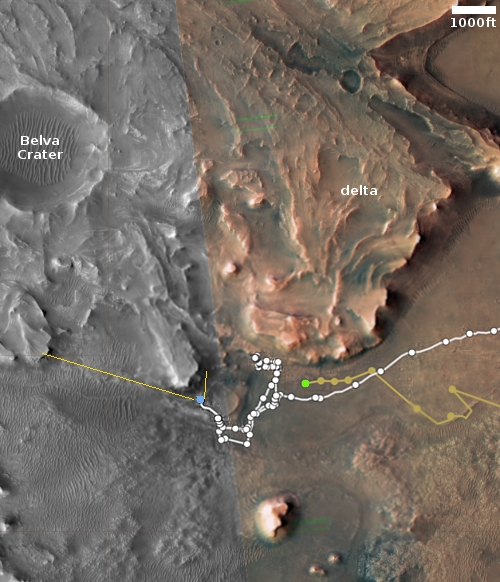
Click for interactive map.
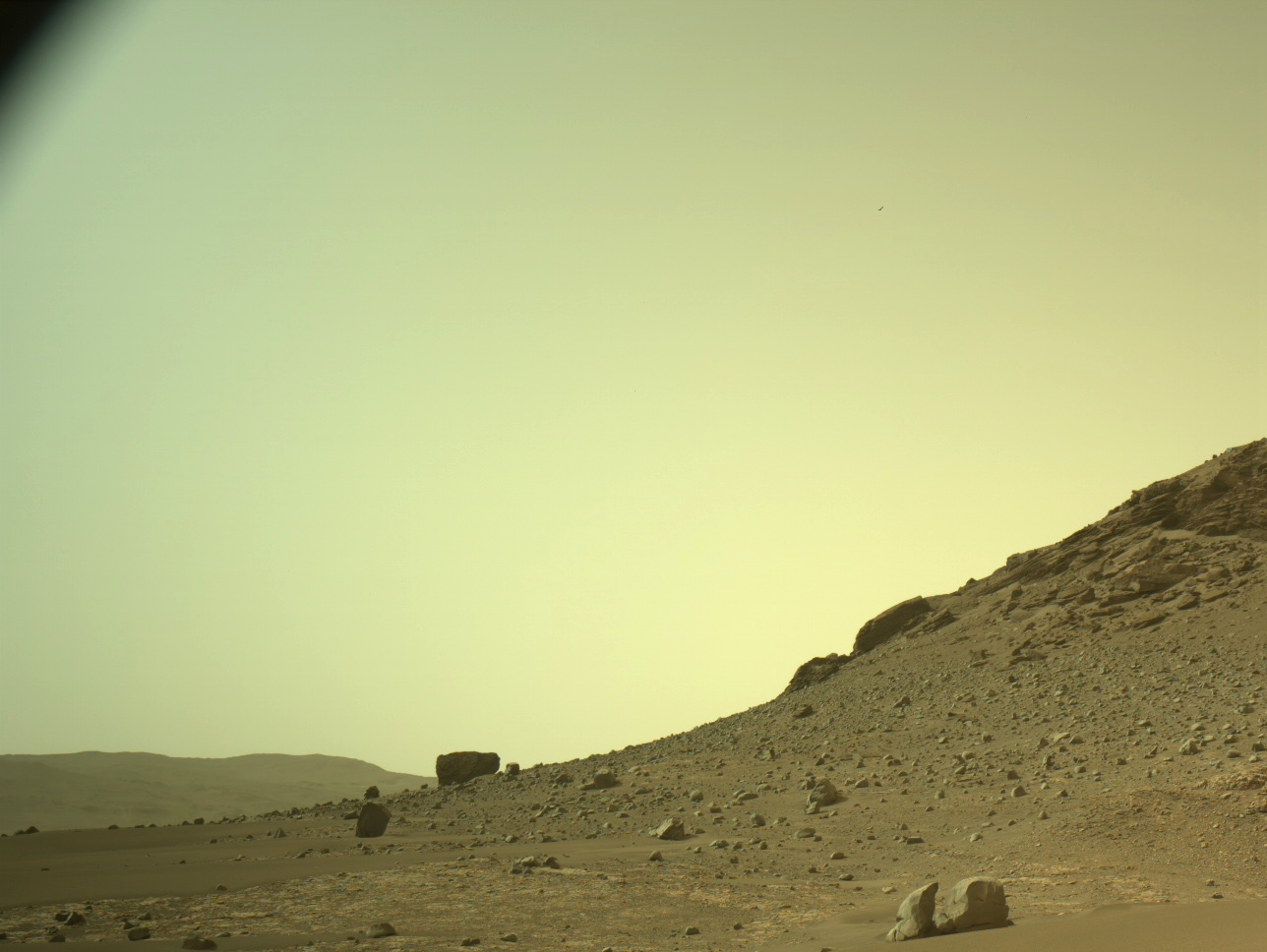
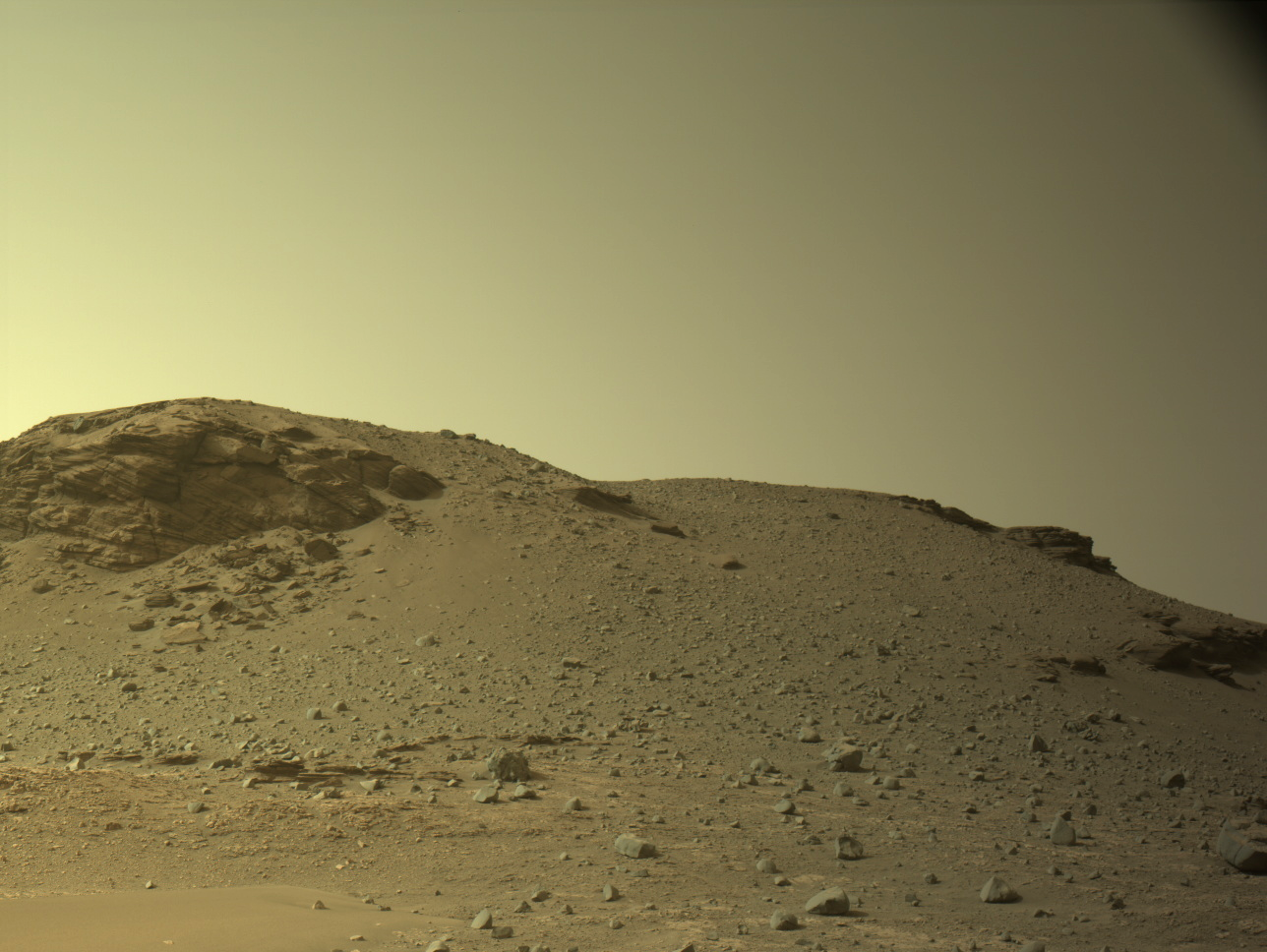
Cool image time! After spending several weeks at one location at the base of the delta that flowed into Jezero Crater eons ago, the science team today put the rover Perseverance into high gear, programming it to move 684 feet in one leap forward. The move worked, so that Perseverance has now climbed up onto a terrace of that delta so that it sits at the base of one of the hills that forms the delta’s head. The panorama above shows that hill. I estimate that hill is about thirty feet high, give or take 50%.
The blue dot on the map to the right shows the rover’s position. The yellow lines show the area viewed in the panorama above. The green dot shows the location of the helicopter Ingenuity.
It is almost certain that the science team will get another core sample from this location, as it is at least one layer higher on the delta, thus providing new geology for that core to document. I am guessing unfortunately. Unlike the Curiosity science team (which posts updates at least one to three times a week), the Perseverance science team posts updates at best only once a week, if that, and those posts have rarely provided information about the team’s future plans.
The panorama above is cool, but what prompted this post is the image below that the rover took after arriving at this location.
» Read more
NOAA has once again published its monthly update of its monthly graph that tracks the number of sunspots on the Sun’s Earth-facing hemisphere. Below is that November graph, annotated by me with some additional details added to provide context.
Though sunspot number continued to be much higher than the prediction (almost double), October saw almost exactly the same number of sunspots as seen in September, which is why this new graph seems almost identical to last month’s.
In other words, the pause in the ramp up to solar maximum, first noted in August, continues.
» Read more

Graphic of Space Perspective’s Neptune capsule.
The travel agency Cruise Planners has reserved two future 20-mile-high flights on the high altitude balloon Spaceship Neptune, being built by the Florida-based company Space Perspective.
Cruise Planners has reserved two full capsules scheduled to fly in 2025 & 2027 respectively on Spaceship Neptune.
Spaceship Neptune will differ from other spacecraft by being attached and secured to the SpaceBalloon for the entirety of the flight, making it a safe and seamless journey for the traveler. Other vessels separate mid-flight and transfer to different flight systems. According to Space Perspective, Spaceship Neptune will be lifted to space by the SpaceBalloon, powered by renewable hydrogen with no rockets and no carbon footprint. Guests won’t have the jarring blastoff that is typical of space travel, but instead will ascend steadily at 12 mph, making the experience accessible for anyone who is able to fly with a commercial airline.
Space Perspective is one of three balloon companies now planning such high altitude flights. Ticket prices will range from $50K to $125K, depending on company. At the moment Space Perspective is charging the most, but expect that to change as the competition heats up.

Chinese engineers today successfully shifted the new Mengtian module from its docking port to its permanent port to the side, thus completing the assembly of the major components of the Tiangong-3 space station. Shortly thereafter the six astronauts on board the station opened the hatch and entered the module.
The graphic to the right shows the station’s final arrangement, T-shaped. The station however is not fully complete, as the large vertical solar panels have not yet been installed. Based on past station work, these will probably have to be shipped up later, and installed during space walks.
NASA today announced that it has rescheduled the first manned demo mission of Boeing’s Starliner capsule to ISS from February to April, 2023.
The agency attributes the two month delay to scheduling conflicts with other visiting spacecraft at ISS. This might be true, but it also could be that Boeing wanted a little extra time to finish out the work it still needs to do to fix the anomalies that occurred on the unmanned demo mission, as well preparing the new capsule for launch.
This flight will carry two astronauts to ISS for about two weeks. The press release also noted this interesting tidbit:
The previously flown crew module, named Calypso, will be connected to a new service module later this year.
Apparently Boeing has decided to give names to these capsules, like SpaceX has. It also appears that the company and NASA are satisfied enough with the condition of the capsule after flying the unmanned demo flight to use it again for a manned mission.