Today’s blacklisted American: Doctors fired and blackballed for calling for race-neutral policies in medicine

Lysenko with Stalin
Trofim Lysenko preaching to Stalin. His policies destroyed
Soviet plant research, persecuted anyone who disagreed
with him, and caused famines that killed millions. And they are
all policies now being adopted by the American medical field.

Persecution is now cool! Last year, the University of Pittsburgh fired cardiologist Norman Wang because he wrote and published a peer-reviewed paper calling for race-neutral policies in medicine.

In addition, he was publicly denounced by the American Heart Association (AHA) and the journal retracted his paper, even though no one could cite any errors in his work.

As the criticism mounted, Wang was removed from his position as the director of a fellowship program in clinical cardiac electrophysiology at University of Pittsburgh Medical Center and was prohibited from making any contact with students. His boss reportedly told him that his classroom was “inherently unsafe” due to the views he expressed.

Unsafe, eh? Can’t have those students hear any opinions or facts that might contradict the modern “woke” narrative!

Wang is suing both the AHA and the University of Pittsburgh for defamation and violating his first amendment rights. Whether he wins or not remains quite unknown, especially considering the increasingly intolerant nature of today’s society.

The article at the link however goes far beyond simply telling Wang’s story. First, it describes the cases of two other doctors who were forced to resign for similar reasons: they questioned the modern obsession with race and suggested that things would be far better if “race was taken out of the conversation.” The mob immediately rose up against both, and their medical organization, the American Medical Association (AMA), then moved to get them fired or removed.

The article then however goes even farther, outlining how this evil oppressive blacklisting culture is beginning to have a much wider and very negative impact on the practice of medicine and the treatment of patients.
» Read more

29 comments

Curiosity’s dramatic path forward

Curiosity's future travels
Click for full image.

Cool image time! In the coming weeks and months the view from Curiosity is going to give us the most spectacular views of another world since the Apollo astronauts walked on the Moon.

In today’s download of new images from the Mars rover Curiosity was the photo above, reduced to post here. Taken by rover’s right navigation camera, it looks west directly in line with Curiosity’s future travels, and shows that it is now finally entering mountain country.

The overview map below provides the context.
» Read more

3 comments

New investment capital pours into commercial space

Launcher's E2 engine
Launcher’s 3D printed E2 engine, claimed by the company
to be the highest performance engine for small rockets.

Capitalism in space: Three stories today underlined superbly the robust and steadily growing state of the commercial space industry. Moreover, these stories suggest that this growth will be permanent with almost no limit to its possibilities.

To begin, we have the public appearance of another startup smallsat rocket company, dubbed Launcher.

Small launch vehicle developer Launcher has raised $11.7 million in a Series A funding round, which the company says puts it on a path to reaching orbit with a fraction of the total investment of other launch startups. Launcher said June 2 that the Series A round was co-led by Boost.VC and the company’s founder, Max Haot, both of whom earlier provided seed funding to the startup. Haot invested $5 million using proceeds of a camera company, Mevo.com, that he sold earlier this year to Logitech. Other existing and new investors also participated in the round, which Haot told SpaceNews was oversubscribed.

…Launcher is working on a small launch vehicle called Launcher Light, intended to be similar in performance to Rocket Lab’s Electron, which can place up to 300 kilograms into low Earth orbit. Launcher Light is a smaller version of Rocket-1, the company’s original vehicle, which Haot said in March should speed up development since it will require fewer engines.

The company hopes to launch by ’24, and is also planning another fund-raising round next year to raise an additional $40 million.

Considering the large number of new rocket companies raising capital, who knows if this company will make it. Certainly some will grab market share and survive, but more likely in the coming decade there will be a shake-out where many will either consolidate or disappear, similar to what happened in the early days of the automobile industry.

That so many similar new rocket companies are attracting so many investors however shows that people with money are now convinced that space is the place, and the future there is very bright for profit. And what lends weight to this sentiment are the other two stories today, both of which involve new space startups that are not rocket companies but the kind of ground facilities required by the satellites those rockets launch.
» Read more

3 comments

Third set of new results from Parker released

The scientists using the Parker Solar Probe on June 2nd released their third set of new results as part of a special issue of the journal Astronomy & Astrophysics.

The latest articles include data analysis, theory, and modeling. Among the major topics covered are magnetic switchbacks first discovered by Parker Solar Probe, the role of waves in heating solar plasma, solar angular momentum, the near-Sun dust environment, and the diversity of small energetic-particle events.

The most interesting paper I think is the one describing data that lends strong weight to the theory, proposed in 1929 by astronomer Henry Norris Russell, that a dust-free zone exists close to the Sun and all stars. From the abstract:

The observed brightness decrease in the axis of symmetry is interpreted as the signature of the existence of a dust density depletion zone between about 19 [solar radii] and 3 [solar radii] which at the inner limit of WISPR’s field of view of 7.65 [solar radii] has a dust density that is ~5% lower than the density at 19 [solar radii], instead of the expected density which is three times if no depletion zone exists.

In plain English, the data shows that from about 1.3 million to 8.2 million miles from the Sun Parker found far less dust than predicted by other models. As the probe continues to lower its orbit and get closer to the Sun with each fly-by these numbers will be better refined, and are likely to in the end prove Russell’s hypothesis.

2 comments

Today’s blacklisted American: The American flag

Banned by the NAACP
The American flag: Banned by the NAACP.

The local NAACP chapter at Central Connecticut State University (CCSU) was badly triggered over Memorial Day weekend by the horrible sight of an American flag hanging from the end of a crane’s cable at a university construction site, and demanded the cable and flag be removed.

The NAACP claimed that what really upset them was the standard cable loop just below the flag at the end of the cable, which they immediately assumed was a noose!

Ronald Davis, president of the New Britain NAACP, told FOX 61 that “Regardless of what someone else says about that, what I see, as a black man? That’s a noose. Period. No ifs, ands, or buts about it. Take it down.”

But one intrepid College Fix reader noticed there are several steel cable loops hanging from the crane, and the only one that appears to bother another is the one with the American flag on the end of it. He cites one image of the crane in which viewers can see three or four cable loops.

“I guess they noticed only the one holding the flag, which means that it’s the flag that triggers them,” the reader said. [emphasis mine]

It is clear that because he and the NAACP specifically focused on the one loop where the American flag hung tells us what really offended them. They really wanted the American flag removed. And I am sure if they had their way it would be banned forever.
» Read more

19 comments

SpaceX successfully launches cargo Dragon to ISS

Capitalism in space: SpaceX today successfully launched a cargo Dragon to ISS.

The first stage booster successfully landed on its drone ship in the Atlantic Ocean.

This Falcon 9 rocket and Dragon capsule were entirely new, making their first flights. This was the first new Falcon 9 to fly since November 2020, with sixteen launches during that period using reused boosters exclusively.

In fact, since November 2020 SpaceX has completed a total of 21 launches, all done in less than seven months. Moreover, the company has scheduled 34 (!) more launches through the rest of the year. If they achieve this ambitious schedule, they will complete 51 launches in ’21, more than doubling their previous annual record of 25 set last year. With all other American companies added in, there will be a good chance the United States launch total could exceed 70, breaking the country’s own annual launch record set in 1966 at the height of the first space race.

The leaders in the 2021 launch race:

17 SpaceX
15 China
8 Russia
2 Rocket Lab
2 ULA

The U.S. now leads China 23 to 15 in the national rankings.

5 comments

FAA grants Rocket Lab permission to resume launches following launch failure

Capitalism in space: According to a press release from Rocket Lab yesterday, the FAA has granted it permission to resume launches following its May 15th launch failure when a problem with the rocket’s upper stage prevented it from reaching orbit.

Apparently the FAA is satisfied with the thoroughness of Rocket Lab’s investigation into the launch failure, and is thus willing to let launches resume, when the company itself decides it is ready. Rocket Lab’s investigation into the failure however is not complete. According to the press release:

The review team is working through an extensive fault tree analysis to exhaust all potential causes for the anomaly and the full review is expected to be complete in the coming weeks, following which Rocket Lab anticipates a swift return to flight.

Though that review continues, the company has not yet revealed what it thinks caused the upper stage to send the rocket and payload in the wrong direction upon ignition.

0 comments

United Airlines buys 15 Boom Supersonic airplanes

United Airlines today announced that it has signed a deal with Boom Supersonic to buy fifteen of its supersonic Overture airplanes.

Under the terms of the agreement, United will purchase 15 of Boom’s ‘Overture’ airliners, once Overture meets United’s demanding safety, operating and sustainability requirements, with an option for an additional 35 aircraft. The companies will work together on meeting those requirements before delivery. Once operational, Overture is expected to be the first large commercial aircraft to be net-zero carbon from day one, optimized to run on 100% sustainable aviation fuel (SAF). It is slated to roll out in 2025, fly in 2026 and expected to carry passengers by 2029.

Boom has been developing this supersonic passenger plane since 2016, though little progress has appeared to take place during most of the last five years. This contract appears to be the company’s first real sale. It also appears that it makes United a partner in the plane’s development.

Meanwhile, another company, Aerion, is developing its own supersonic passenger jet, in partnership with Boeing and scheduled for launch in 2023.

We shall have to wait to see which company wins the race to begin commercial flights.

4 comments

Problem with Ariane 5 rocket causes Arianespace to delay Webb telescope launch

As first revealed in mid-May, Arianespace has been forced to delay the launch of the James Webb Space Telescope by at least one month because of a problem with the fairing on its Ariane 5 rocket, found during an August 2020 launch.

There have been no Ariane 5 launches since. According to yesterday’s press briefing, however:

“The origin of the problem has been found. Corrective actions have been taken,” Daniel de Chambure, acting head of Ariane 5 adaptations and future missions at ESA, said. “The qualification review has started, so we should be able to confirm all that within a few days or weeks.” He did not elaborate on the problem or those corrective actions, beyond stating that the problem took place during separation of the payload fairing. Industry sources said in May that, on the two launches, the separation system imparted vibrations on the payload above acceptable limits, but did not damage the payloads.

It appears this new delay to Webb’s launch is because two commercial payloads must lift off first before Webb, with the first now scheduled for July. According to Arianespace, it will take two months prep for the next commercial launch, followed by two months prep for the Webb launch. That puts the launch of Webb in November.

Overall this particular delay is slight, only a few weeks, and pales in comparison to the ten years of delays experienced by NASA during development and construction of Webb. It also will add very little to the telescope’s overall budget, which has grown from an original price of $500 million to now about $10 billion.

12 comments

China’s Long March 3B rocket launches new weather satellite

China early this morning successfully placed a weather satellite into orbit using its Long March 3B rocket.

No word on where the first stage crashed, though we know because the launch was from an interior launch site that it had to have crashed somewhere within China, hopefully not on any village anywhere.

The leaders in the 2021 launch race:

16 SpaceX
15 China
8 Russia
2 Rocket Lab
2 ULA

The U.S. still leads China 22 to 15 in the national rankings.

This list should change in only a few hours, as SpaceX has a Falcon 9 launch scheduled for 1:29 pm (Eastern), carrying a Dragon cargo freighter to ISS.

3 comments

NASA picks two missions to fly to Venus later this decade

NASA today announced two new missions to go to Venus to study its atmosphere and surface, both scheduled to launch sometime between 2028 and 2030.

One, dubbed DAVINCI+, send a probe into Venus’s atmosphere, both to measure its gases as well as taken the first high resolution images of a unique Venusian geological called “tesserae.” On radar images tesserae regions appear to be high plateaus cross-cut with many sharp ridges.

The second, dubbed VERITAS, will be a radar-orbiter designed to map the planet’s surface at higher resolution than the earlier Pioneer and Magellan radar orbiters. It will also do this:

VERITAS also will map infrared emissions from Venus’ surface to map its rock type, which is largely unknown, and determine whether active volcanoes are releasing water vapor into the atmosphere.

That data will help tell us whether there are now active volcanoes on Venus. The data we presently have suggest it is a planet of many volcanoes, numbering in the millions. That data has also hinted at the possibility that some are active. VERITAS will attempt to find out.

4 comments

Inexplicable ridges north of China’s Mars rover

Wrinkle ridges in Utopia Planitia?
Click for full image.

Cool image time! The photo to the right, rotated, cropped, and reduced to post here, shows some unusual geology about 450 miles north of the approximate area where China’s Zhurong rover landed in the northern lowlands of Mars. It was taken on April 14, 2021 by the high resolution camera on Mars Reconnaissance Orbiter (MRO).

These scattered ridges remind me of wrinkle ridges, formed when the surface of a place shrinks. With less surface area, the extra material needs somewhere to go, and so ridges are forced up at weak points to release the pressure.

Assuming this hand-waving explanation is true, the next question would be: What causes the shrinking? The overview map below might help provide an answer.
» Read more

1 comment

Today’s blacklisted American: Right-of-center books banned by Amazon

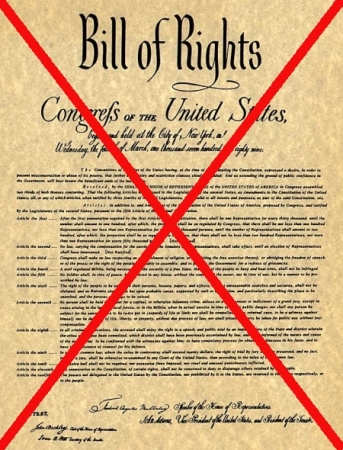
The Bill of Rights cancelled at Amazon
No first amendment on Amazon.

Blacklists are back and Amazon’s got ’em: Yesterday my blacklist column noted how Amazon has blackballed the live stream of a film biography of Supreme Court Justice Clarence Thomas.

That however is not the only example of Amazon’s anti-free speech agenda and its desire to silence conservative thought. In recent months book authors and publishers have repeatedly discovered that Amazon has been either banning outright their books, or shadow-banning them from searches so that potential customers cannot find them.

The link gives about a number of examples, but a quick internet search finds numerous others (see for example here, here, and here).

Only rarely will Amazon admit to this censorship, and when it does, it does so by claiming vague rules about preventing “hate speech,” even though this giant online store has done nothing to remove books and products promoting Islamic terrorism, Nazi paraphernalia, and Antifa-supporting materials.
» Read more

5 comments

From masks to the origins of COVID, Anthony Fauci is a liar and a fraud

Fauci: Washington's top liar
Anthony Fauci: Washington’s liar-in-chief

In the past few days a slew of 2020 emails by Dr. Anthony Fauci have revealed his dishonest, incompetent, corrupt, and political agenda during the entire COVID-19 epidemic.

The emails have revealed he lied about his connections with the Chinese Wuhan lab. They reveal that he knew all along that the virus was almost certainly leaked from that lab. They also reveal that he immediately worked to prevent these facts from being revealed publicly, lying if necessary to do it and successfully forcing publications to withdraw news stories based on his lies.

Of all these revelations, however, the one email that best illustrates Fauci’s dishonesty and venality was the one in February 2020 — before the epidemic had taken hold and before any shutdowns had been imposed — where he bluntly admitted what has been known for more than a century, that the general widespread use of masks by people who are not sick is pointless and will accomplish nothing.

In his words:

Masks are really for infected people to prevent them from spreading infection to people who are not infected rather than protecting uninfected people from acquiring infection. The typical mask you buy in the drug store is not really effective in keeping out virus, which is small enough to pass through the material. It might, however, provide some slight benefit in keep out gross droplets if someone coughs or sneezes on you. I do not recommend that you wear a mask, particularly since you are going to a vey low risk location. Your instincts are correct, money is best spent on medical countermeasures such as diagnostics and vaccines. [emphasis mine]

Less than two months later, Fauci had completely changed his tune, claiming that Americans needed to wear masks all the time. » Read more

15 comments

Sunspot update: Activity in May continued to exceed predictions

Time for our monthly sunspot update. On June 1st NOAA updated its monthly graph showing the Sun’s sunspot activity through the end of May 2021. Below is that updated graph, annotated as always to show the previous solar cycle predictions.

As has happened now for almost every month since the Sun’s sunspot cycle began to increase following the long and deep minimum in 2019, the activity in June exceeded the numbers predicted by the computer models of NOAA’s panel of solar scientists. While the activity dipped slightly from April, it still was more active than predicted.

» Read more

3 comments

Axiom strikes tourist deal with SpaceX for three more flights

Capitalism in space: Axiom today announced that it had signed a deal with SpaceX to use its Dragon capsule and Falcon 9 rocket to launch three more manned tourist missions following the first now scheduled for January.

Ax-1, Axiom’s historic first private ISS mission, has already been approved by NASA and targeted for launch to the ISS no earlier than Jan. 2022, also aboard Dragon as a result of a deal the companies signed in March 2020. Axiom last week revealed legendary astronaut Peggy Whitson and champion GT racer John Shoffner would serve as commander and pilot on its proposed Ax-2 mission – now confirmed to be a Dragon flight.

So, too, are Ax-3 and Ax-4.

Other than Whitson and Shoffner, the company has not revealed who will fly on those three additional flights. That it made this deal however strongly suggests that it has ample demand for seats and will fill those capsules with no problem.

The press release also reiterates the company’s space station plans. They will begin attaching their own modules to ISS in ’24, with the goal of detaching from the station in ’28 and operating as an independent entirely private station thereafter.

5 comments

New Zealand government blasts Rocket Lab for employment violations, even as it waives its own strict COVID border rules for the company

Two stories today from New Zealand, both related to the American company Rocket Lab, help illustrate the often absurd and irrational nature of modern government rule-making.

First, New Zealand’s Employment Relations Authority attacked the company after ruling against it in a single employee grievance case. The case involved a fired employee who filed and won his grievance when he refused to sign the company’s offered settlement. Based on this single case, authority officials quickly and publicly blasted Rocket Lab as if it had committed numerous blasphemies:

Authority member Rachel Larmer found that the dismissal was “extremely unfair” and that the company “failed to comply with even the most basic and widely understood principles of procedural fairness”.

As the article noted, it “is unusual for the authority to be so overtly critical of an employer.” Yet, attack Rocket Lab it did, very bluntly and very publicly.

Yet, at the same time, this same New Zealand government has apparently been giving this evil employer routine waivers of its draconian border restrictions imposed to prevent the arrival of COVID.

More than 150 aerospace specialists have arrived on short term visas to work in New Zealand for the satellite launch service provider Rocket Lab since the country’s border closed. Immigration New Zealand said 156 foreigners were granted border exemptions as part of a government-approved programme for the company.

Rocket Lab spokesperson Morgan Bailey said the company had focused on bringing in essential workers for its launches, who would usually stay for two weeks after completing managed isolation.

Normally visitors to New Zealand need to quarantine for two weeks. Apparently, the government is allowing foreign workers for Rocket Lab to bypass that rule and make alternative arrangements.

So which is it? Is Rocket Lab a horrible slave-driver who must be watched like a hawk so that it does not abuse its workers, or is it a generous provider of work and business for New Zealand that is so valuable gives it a privileged position where some laws don’t apply to it?

In truth, New Zealand’s laws themselves are now simply being enforced somewhat randomly, based merely on whether a specific government official personally likes or dislikes the company. That is my impression at least.

But then, that is the impression given and now common throughout the western world. We no longer treat the law as sacrosanct, but instead use it for political purposes, which require its plain meaning to shift and change like Jello, depending on the personal and political motives of the individuals involved. And all for the sake of power.

3 comments
1 560 561 562 563 564 1,761