Craters, craters, everywhere

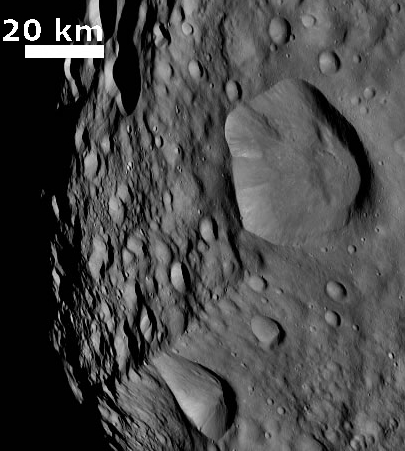
Below the fold are two images released today, one from Dawn at Vesta and the other from Messenger at Mercury. What makes them interesting to me is that, though the surfaces of both Vesta and Mercury are crater-packed, there are definitely distinct differences between them that one can spot if you look closely, all highlighting the fundamentally different environments of both worlds.

First, the Vesta photograph. The image looks out past the asteroid’s horizon, showing clearly that this dwarf planet is not spherical, with the south pole depression that puzzles scientists just on the planet’s limb. The parallel long deep grooves that are associated with this depression can be seen on the right. Notice also that the inside walls of all the craters slope downward in a very shallow manner. This gives the impression that the impacts that formed these craters smashed into an almost beachlike sandy surface. Note too the that the center of some craters have what appear to be flat small “ponds,” a phenomenon seen by the spacecraft NEAR when it orbited the asteroid Eros. These ponds are not liquid, but are actually made up of fine-grained particles that settle in the hollows of the asteroid.
» Read more
1 comment

New images from Opportunity

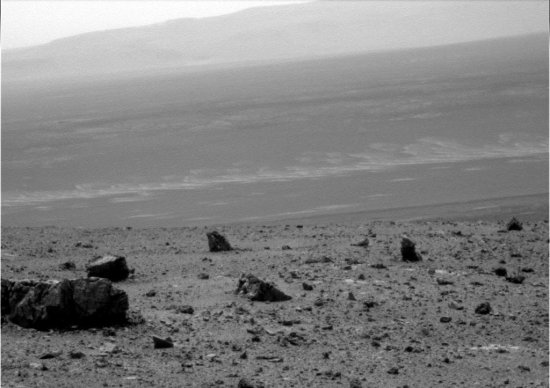
Opportunity begins exploring the rim of Endeavour Crater, taking a bunch of new images . I especially like this one, of which I’ve posted a cropped scaled-down version below. The image looks across the 13-mile-wide Endeavour Crater to its far rim on the horizon. Note the haze. Mars very clearly has an atmosphere, even though it is far thinner than Earth’s. In the foreground are scattered rocks, ejecta produced from the impact that formed a smaller nearby crater now named Opportunity Crater.

Endeavour Crater as seen by Opportunity

1 comment

The job boom for government regulators under Obama

The chart of the day, from John Merlune at Investor’s Business Daily:

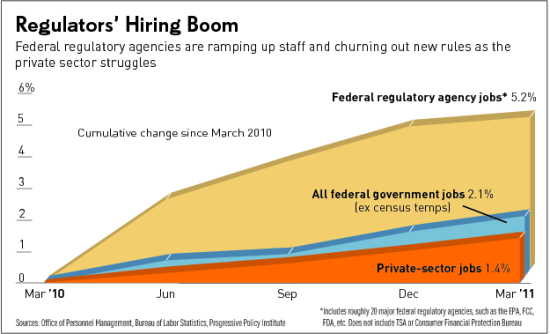
Boom in jobs for regulators

Merlune’s article outlines in frightening detail how there has been a job boom in only one place during the Obama administration, the government regulatory industry.

Regulatory agencies have seen their combined budgets grow a healthy 16% since 2008, topping $54 billion, according to the annual “Regulator’s Budget,” compiled by George Washington University and Washington University in St. Louis. That’s at a time when the overall economy grew a paltry 5%.

Meanwhile, employment at these agencies has climbed 13% since Obama took office to more than 281,000, while private-sector jobs shrank by 5.6%.

0 comments

The American Eclipse of 2017

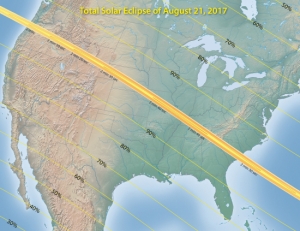
2017 Eclipse map

Time to start making your vacation plans. On August 21, 2017 a total eclipse of the sun is going to traverse the entire length of the continental United States, from Oregon to South Carolina. Kentucky will have the longest view, with totality as long as three minutes.

And astronomers are already thinking of ways to harness the help of the American people in observing this event. In a paper published today on the Los Alamos astro-ph website, a team of astronomers are proposing organizing something they have dubbed the U.S. Eclipse MegaMovie, whereby they gather together as many images of the totality as possible and assemble them into a single film, showing the evolution of the sun’s corona as it crosses the continent.
» Read more

0 comments

Using a solar sail to deflect an earth-destroying asteroid

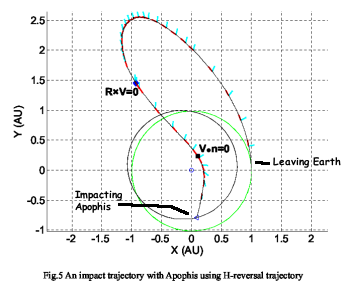
solar sail mission to Apophis

In a paper published today on the Los Alamos astro-ph preprint website, two Chinese scientists have proposed using a solar sail for deflecting any asteroid that happens to be aimed at the earth. The diagram to the right is their simulated mission to impact the asteroid Apophis, which will pass close to the earth in 2029 and — depending on whether that flyby puts it through a very small 600 meter-wide mathematical “keyhole” — could then return in 2036 on a collision course.

The idea is to use the sail to slow the spacecraft down enough so that it starts to fall towards the sun. The sail is then used to maneuver it into a retrograde orbit. When it impacts the asteroid the impact will therefore be similar to a head-on collision, thereby imputing the most energy in the least amount of time with the least amount of rocket fuel. In their Apophis simulation, a mission, weighing only 10 kilograms (about 22 pounds), launched around 2025, and hitting the asteroid in this manner in 2026, would deflect its flyby in 2029 enough to guarantee it will not fly through the “keyhole” and therefore eliminate any chance of it hitting the earth in 2036.

Obviously many questions must be answered before such a mission should fly.
» Read more

1 comment

Strange craters on Vesta

strange craters on Vesta

The images from Dawn keep rolling in. The picture on the right, released two days ago, shows the asteroid’s terminator. What makes it intriguing is the weird looking crater near the bottom of the image. It appears to have formed at impact on the wall of a cliff, something that at first glance seems impossible.

This is what I think happened: The impactor sliced down the wall of the cliff, but because of Vesta’s low gravitational field the impact scar never collapsed downward, filling in.

I once wrote an article about asteroids for Astronomy where I described these objects as having the consistency of mashed potatoes and ice cream sundaes. This image illustrates this nicely. The asteroid’s weak gravitational field limits the density of its material, so that puffy strange formations such as this crater can form.

1 comment

Hubble captures a necklace in space

necklace in space

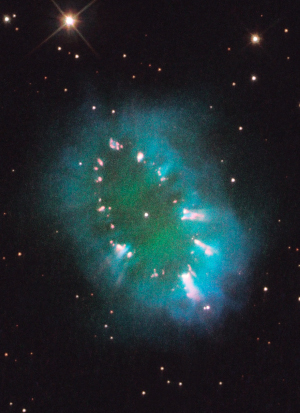
Who needs aliens and imagined cities on the moon when you have a reality that produces such strange and beautiful things as the image on the right?

On July 2, the Hubble Space Telescope took this image of a planetary nebula, aptly dubbed the Necklace Nebula. As the caption explains,

A pair of stars orbiting close together produced the nebula, also called PN G054.2-03.4. About 10,000 years ago one of the aging stars ballooned to the point where it engulfed its companion star. The smaller star continued orbiting inside its larger companion, increasing the giantโ€™s rotation rate.

The bloated companion star spun so fast that a large part of its gaseous envelope expanded into space. Due to centrifugal force, most of the gas escaped along the starโ€™s equator, producing a ring. The embedded bright knots are dense gas clumps in the ring.

The binary still exists, and can be seen as the star in the center of the necklace. The two stars are now only a few million miles apart and complete an orbit around each other in about a day.

0 comments

Making hard choices

A new poll shows that the congressional special election to replace Anthony Weiner in the traditionally Democratic district in Queens/Brooklyn, New York is surprisingly competitive.

The poll found [Democrat] Weprin, a state assemblyman, leading [Republican] Turner, a retired broadcasting executive, 48 percent to 42 percent in the race for the Democratic-friendly Queens and Brooklyn-area seat.

Two thoughts: First, this poll fits with another that shows for the first time a majority of adults don’t want their own Congressman reelected. If so, it shouldn’t be surprising that the Democrat appears so weak in Brooklyn/Queens, a place I lived for most of my life and a place I found to be so knee-jerk Democrat that you couldn’t admit to being Republican without risking being blacklisted from all things.

Second, despite the mess the federal government is in as well as the disgraceful scandal that caused the previously elected Democratic Congressman to resign, it is also not surprising that 48 percent of the population still wants to vote Democrat in this district. This is my biggest fear: the continuing unwillingness of too many Americans to honestly face our government’s budget problems.
» Read more

0 comments

The very slow ramp up to maximum

an active sun

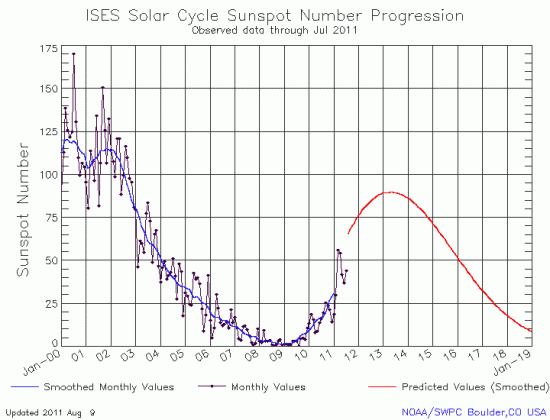
As it does every month, NOAA’s Space Weather Prediction Center released today its monthly updated graph of the Sun’s solar cycle sunspot activity. I have posted the July graph below.

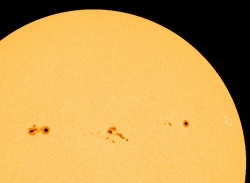
For the first time in four months there was a increase in sunspot activity, albeit small. The sun has been even more active in August, as shown by the flurry of sunspots on its face from August 1 (shown on the left) and the August 8 solar flare, the most powerful produced in four years.

This monthly graph, however, continues to suggest that the next solar maximum will be very very weak, even weaker than the most up-to-date predictions for the next solar maximum.

The sunspot graph for July 2011

0 comments

Lying for Politicians

With the recently passed debt ceiling deal, there are going to be a lot of news reports talking about how that deal is going to force cuts and reductions in government spending. Everyone one of these stories will be a lie.

Take for example this story today in Nature, discussing the fate of science research under the deal. Here is how they describe what will happen if the Congressional “super-committee” cannot come up with an agreement and across-the-board “cuts” are triggered:

“Then there will be extraordinary pain,” says Michael Lubell, director of public affairs for the American Physical Society in Washington DC. “And it will get worse in 2014.”

The two-stage structure of the debt deal explains both the short-term reprieve and the long-term worry. The first set of agreed cuts, totalling US$917 billion, will be spread over 10 years, but two factors mitigate their effect. First, reductions to defence spending will account for a significant share of the cuts โ€” meaning that other US agencies won’t bear the entire burden. Second, the cuts are heavily loaded forward onto the 2014 fiscal year and beyond, in an apparent effort to shelter the current fragile economy. Only minimal cuts will be implemented in fiscal years 2012 and 2013.

The trouble with this is that it is simply not true. There will be no cuts at all, under any condition, according the debt deal.
» Read more

0 comments
1 114 115 116 117 118 139