Mars rover update: August 11, 2017

Summary: After a two week hiatus because the Sun was between the Earth and Mars and blocking communications, both rovers are once again on the move.

Curiosity

For the overall context of Curiosity’s travels, see Pinpointing Curiosity’s location in Gale Crater.

Curiosity panorama, Sol 1782

Vera Rubin Ridge close-up

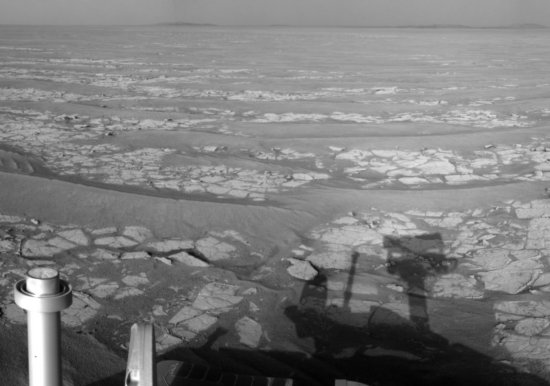
Since my last update on July 12,, Curiosity spent most of the month waiting out the solar conjunction that placed the Sun between the Earth and Mars and blocked communications. In the past few days, however, the rover has begun to send down images again while resuming its journey up Mt. Sharp. The panorama above, reduced to show here, was taken by the rover’s left navigation camera, and shows the mountain, the ridge, and the route the rover will take to circle around the steepest sections to get up onto the ridge. To see the full resolution panorama click on the picture.

To the right is a full resolution section of the area in the white box. As you can see, the geology of the ridge is many-layered, with numerous vertical seams or cracks. In order to track the geological changes across these layers as the rover climbs, the science team is as expected taking a systematic approach.

Lately, one of our biggest science objectives is to conduct bedrock APXS measurements with every 5-meter climb in elevation. This allows us to systematically analyze geochemical changes in the Murray formation as we continue to climb Mount Sharp. Yesterday’s drive brought us 6 meters higher in elevation, so another touch and go for today it is!

Below is a cropped and reduced resolution image of the most recent orbital traverse image, dated sol 1754. The dotted line shows where I think the rover’s has traveled in the last 28 sols. I have also annotated what I think is the point of view of the panorama above.
» Read more

3 comments

A Martian Journey

The exploration of the solar system has barely begun. Though we regularly get to see some spectacular images taken by the fleet of unmanned planetary probes that now circle or rove the various planets throughout the solar system, we mustn’t think we have seen very much. In truth, we have only gotten a very distant glimpse of only a few tiny spots, most of which have been viewed from very far away. Even at the highest resolution the images do not really tell us what it really will be like when we can stroll across those surfaces routinely.

To give you an idea of how much remains hidden, let’s take a journey inward from Mars orbit. The image below looks down on a good portion of the Martian globe, with the giant volcano Olympus Mons on the left, its three companion volcanoes in line to the east, and the vast valley of Valles Marineris east of these. This valley would cover the continental United States almost entirely, and extend significantly beyond into the oceans on either side.

Olympus Mons and Valles Marineris

This was essentially our first good look at Mars, taken from orbit by Mariner 9 in 1971.
» Read more

2 comments

John McCain, Liar

In commenting about the failure yesterday by Senate Republicans to pass a trimmed down version of an Obamcare repeal by a vote of 49-51, Ted Cruz (R-Texas) has this to say:

There are going be a great many Americans who tonight feel a sense of betrayal. …If you stand up and campaign and say we are going to repeal Obamacare and you vote for Obamacare, those are not consistent. And the American people are entirely justified in saying any politician who told me that and voted the other way didn’t tell me the truth. They lied to me.

He then added:

“No party can remain in power by lying to the American people.”

Cruz is right, but only partly. The entire Republican Party did not lie to its voters. Instead, a small contingent of fake Republicans lied, led by John McCain, king liar and the most likely person to stab a friend in the back I have ever seen.
» Read more

99 comments

Mueller widens witch hunt investigation

Special counsel Robert Mueller today widened his investigation on President Trump’s contacts with Russia during the campaign to now include Trump’s entire business transactions.

I haven’t posted anything about the Russian collusion story until now, because on its face it is absurd. As noted repeatedly by even Trump’s critics, there is no evidence of any illegal acts by anyone. Moreover, the media focus on the Russians distracts from the heart of the DNC hack, that it revealed illegal pay-offs and corruption by Hillary Clinton, John Podesta, and others in the Democratic Party. I don’t really care that much how these emails were obtained since what they uncovered is far worse.

What prompts me to post now is to underline the corruption of Robert Mueller himself. It is already well known that the investigation team he has put together includes at least seven Democratic donors, including an attorney who donated $34,000 to Democratic candidates. What I want to highlight is his blatant partisan actions to help cover up the IRS scandal for the Obama administration. I only remembered this recently, but when Mueller was called to testify to the House about his newly begun FBI investigation into that scandal, he couldn’t name the head of that investigation, even though he was the man who would have appointed such a person only a month prior.

I once again have embedded below the fold Mueller’s testimony in 2013 before Congress. Not only does he not know who is running his so-called IRS scandal investigation, he admits that not one victim of the IRS scandal had yet been contacted. In fact, none of these people were ever contacted, and that investigation never took place. Mueller stone-walled it for Obama, so that administration and president could get away with their use of the IRS as a weapon against their opponents. And of course, the Democratic mainstream media assisted them in this stone-wall by never pursuing the story. They let it fall, as they do today with the content of those hacked Clinton emails, into the memory hole.

And even if there were improprieties by Trump and his campaign, does anyone with even the slightest objectivity believe that Mueller’s investigation is going to non-partisan? I don’t. This is a witch-hunt, and it always has been.

And if you disagree with me I dare you to watch the video below. Mueller comes off clearly as a tool of the Democrats, something he still is today.
» Read more

35 comments

Commercial space has won

Today the Senate Subcommittee on Space, Science, and Competitiveness, chaired by Senator Ted Cruz (R-Texas), held the third of a series of hearings on the future regulatory framework required for American commercial space to prosper.

My previous reviews of the past two hearings can be found at these links:

In today’s hearing the witnesses in general once again called for a variety of reforms that would simplify the regulatory process for private enterprise. Dr. Moriba K. Jah, associate professor from University of Texas at Austin, suggested removing NOAA’s veto power on remote sensing, something that the proposed House bill I analyzed in my Federalist op-ed actually does). Jeffrey Manber of Nanoracks suggested giving the private sector a certain date when ISS will be decommissioned so that they can more easily obtain investment capital for building the privately-built space facilities that will replace it. Tim Ellis of Relativity, a company trying to build rocket engines manufactured entirely by 3D printing, called for more American spaceports, accessible by private companies, as well as a simplification of the FAA permitting process. Robert Cabana, Director at the Kennedy Space Center, talked about the need for government facilities to provide the infrastructure for private companies, as the center has done for the private launch sites and manufacturing facilities they have helped get established at Kennedy since the retirement of the shuttle.

Tim Hughes from SpaceX topped them all.
» Read more

8 comments

Mars rover update: July 12, 2017

Summary: Curiosity looks at some big dune ripples, then creeps up hill. Opportunity tests its wheels.

Curiosity

For the overall context of Curiosity’s travels, see Pinpointing Curiosity’s location in Gale Crater.

The interior of a dune ripple

Since my last update on June 23,, Curiosity has worked its way around and, for a few days, even into the small sandy field at the base of Vera Rubin ridge. The scientists noticed that the sandy here had a series of large ripples, and they wanted to take a close look at at least one. The image on the right, cropped to show here, was taken shortly after they had the rover drive through one ripple in order to expose its interior. You can see the robot arm directly above the cut created by the rover’s wheels. On the cut’s wall several distinctly different toned layers are visible. A close look reveals that they are wavy, and probably indicate numerous and repeated overlays as the wind brushes a new layer of dust on top of old layers, time after time. The different tones indicate a change in the material’s composition, which could reveal something about some past events in either Mars’ weather or geology.

In order to decipher this information, however, they will need to be able to date the layers, and figure out when each tonal change happened. I am not sure Curiosity can do this, especially since they have not scooped up any of this dust for later analysis.

They are now approaching Vera Rubin Ridge, and should climb up onto in the coming weeks. At that point they will move off the Murray Formation, where they have been since March 2016, made up of dried and ancient crushed mud, and up onto a lighter, yellowish layer of rock, dubbed the Hematite Unit. This October 3, 2016 press release. gives a good outline of the geology of these regions.
» Read more

0 comments

Pablum from Pence on space

If you want to waste about about 25 minutes of your life, you can listen to the speech that Vice President Mike Pence gave today at the Kennedy Space Center here, beginning at the 49:30 minute mark.

My advice is that you don’t do it. Pence said nothing. He handed out a lot of empty promises and cliches, without any specifics or details of any kind. He confirmed for me what I have suspected of Pence for several years, that despite the fact that he lives and breathes a conservative and honorable personal life, as a politician he is a hack.

He made a big deal about the recreation of the National Space Council, which he now leads. However, as this article by Eric Berger properly noted the people who seem to be exerting the most influence on that council, on Trump, and on Pence are from the big space companies that have spent more than a decade and a half spending about $40 billion trying to build a big rocket (SLS) to fly a single unmanned test flight of the Orion capsule.

My pessimism here might be misplaced. We still do not know who will be on this space council. Furthermore, the Trump administration has been very good at doing a lot of public relations and soft stroking of its opponents in order to put them off guard prior to hitting them hard, where it hurts. This might be what Pence was doing here.

Nonetheless, the lack of any substance in Pence’s remarks makes me fear that he will be easily influenced by the big players who simply want the federal cash cow to continue sending them money, whether or not they ever build anything.

9 comments

As predicted climate scientists begin adjusting satellite data to fit models

If the facts don’t fit the theory, change the facts! The scientists in charge of the climate satellite data produced by Remote Sensing Services (RSS) in California have decided to adjust their satellite data to increase the warming trend since 2000 and make that data more closely match the surface temperature data that NASA and NOAA have already altered to show that same warming trend.

Researchers from Remote Sensing Systems (RSS), based in California, have released a substantially revised version of their lower tropospheric temperature record. After correcting for problems caused by the decaying orbit of satellites, as well as other factors, they have produced a new record showing 36% faster warming since 1979 and nearly 140% faster (i.e. 2.4 times larger) warming since 1998. This is in comparison to the previous version 3 of the lower tropospheric temperature (TLT) data published in 2009.

How have they done this? They made several changes, the first two of which appear quite questionable. First, they addressed the “time of observation issue.” There is a belief among some climate scientists that the time temperature readings were taken can introduce an error in the long term trends.

To account for changes in observation times, the RSS group used a number of different approaches and models to try and estimate what the temperature would have been if the measurement time remained constant. This involves a combination of satellite observations (when different satellites captured temperatures in both morning and evening), the use of climate models to estimate how temperatures change in the atmosphere over the course of the day, and using reanalysis data that incorporates readings from surface observations, weather balloons and other instruments.

Depending on the time of the observation correction approach chosen, the resulting temperature trends between 1979 and 2016 ranged from as low as 0.13C per decade to as high as 0.22C per decade. The RSS group ultimately decided that the most reasonable set of parameters give a temperature trend of 0.17C. [emphasis mine]

I am puzzled by this, since satellites in orbit do not take readings at one particular time, but at a wide range of times. In fact, I would say that the number of readings, at all different times, would easily introduce enough randomness into the results that any error would be insignificant. Instead, these scientists have decided to adjust the raw data to add a warming trend of almost a tenth of a degree centigrade.

Next, they simply decided that the data coming from some satellites should be excluded.
» Read more

10 comments

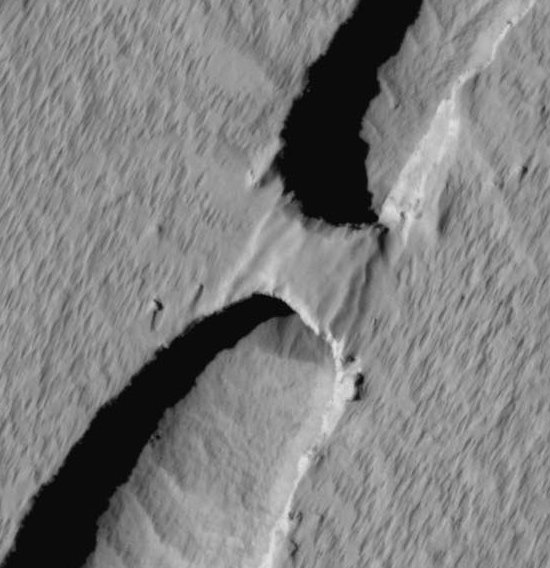
A river canyon on Mars

A river on Mars

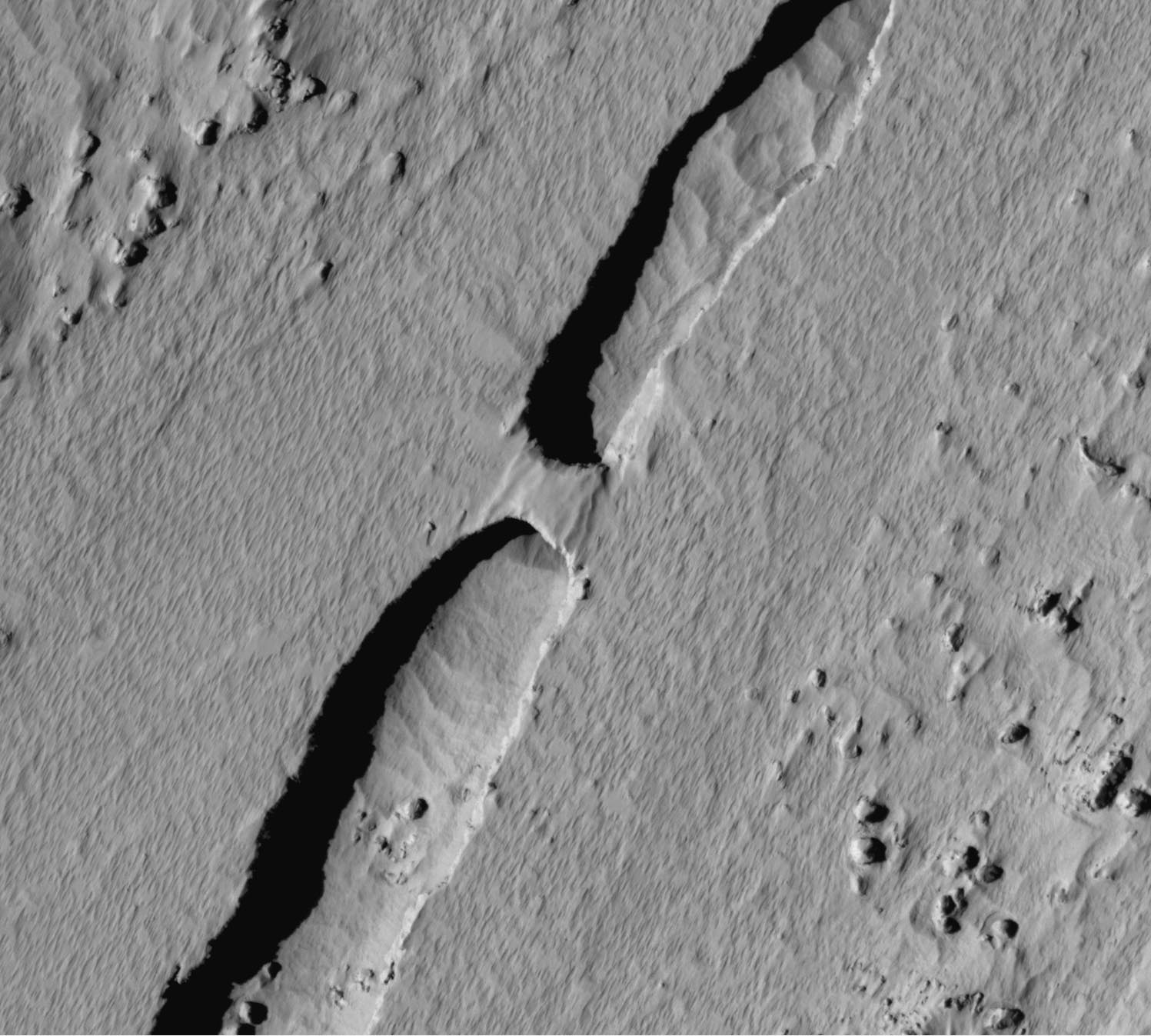
Cool image time! The image on the right, reduced in resolution significantly to show here, was taken by the Themis camera on Mars Odyssey, and shows an unnamed canyon on Mars. Be sure to click on the image to see the full resolution version.

This canyon of course no longer has anything flowing in it. Moreover, it is not clear whether this was formed by water or lava. Unfortunately, the image is part of a series of “Art images” from Mars Odyssey, where they pick an image and suggest it looks like something else. In this case, they are claiming this looks like a “snake, slithering down the image.” Cute, but not very helpful. And unfortunately, they don’t add any further details at all about the image or its location. The context image suggests this canyon is next to a volcano.

After doing further research at the Themis image site, I was able to locate this image on Mars (using latitude 32.0515 and longitude 152.236 given at the link) and look at the images surrounding this one. Further research identified the volcano as Hecates Tholus in the Elyesium Plantia region to the west of Mars’s giant volcanoes.

Looking at all the nearby Mars Odyssey images, it appears that there are a lot of flows like this in this area, and all of them appear to be lava flows, with this one being the largest. A close look at the area just to the south of where the deep canyon opens out shows that the small surface flow draining into the canyon also appears to sit on much larger surface flows (at least two) that left the surface higher than the surrounding terrain.

Elyesium Plantia itself is a plateau, somewhat close to the border between Mars’s southern highlands and the northern plains where some scientists think an ocean might have once existed. Thus, it makes sense that the canyon drains north, as it is following the dip down to those northern low plains.

1 comment

Mars rover update: June 23, 2017

Summary: Curiosity continues up hill. Opportunity has wheel problems.

Curiosity

For the overall context of Curiosity’s travels, see Pinpointing Curiosity’s location in Gale Crater.

The march up Mt Sharp continues. Since my last update on May 15, Curiosity has continued working its way up towards what the science team has named Vera Rubin Ridge, the beginning of a lighter, yellowish layer of rock, dubbed the Hematite Unit, that sits higher up the mountain’s slope. They have been traveling on the Murray Formation now for more than a year, since March, 2016, so entering this new layer of geology is eagerly anticipated by the science team. (This October 3, 2016 press release. gives an overall picture of the geology Curiosity is traversing.)

Reader Phil Veerkamp sent me a beautiful panorama he stitched together from recent Curiosity images of Vera Rubin Ridge, directly to the south of the rover and higher up hill. Below is a reduced resolution version. Be sure you click on it to explore the full resolution image. This is a new type of terrain, significantly different than anything Curiosity has seen up to now. It also appears that the rover will see far less dust, and might be traveling mostly over solid boulders. Below I have cropped out a very small section of the ridge line near the center of the full image, just to illustrate this.
» Read more

6 comments

It’s the hate, not the violence

The last few days have probably been the ugliest I have ever seen in American culture. Not only was an attempt made to commit mass murder against a group of Republican elected officials, the response from too many mainstream Democrats has generally been tone deaf and even supportive of the violence. Worse, the violence appears to be on-going, with no sign of relief.

My list is hardly complete. The stories above are only a small sampling of the ugly stuff I have read since the shooting on June 14. The best I have seen from some Democrats is a hint that maybe they have let their rhetoric get out of hand, but even here they often backtrack to blame Republicans and only Republicans for the shooting.

Are Republicans innocent here? No. The coarseness of language and increasing anger I have seen from both sides in the past six months has been appalling. Rather than respond strongly but intelligently and with civility, too many Republicans have decided they can be as harsh and as coarse and as vicious as the Democrats.

Nonetheless, the bulk of the coarseness and viciousness and violence falls mainly to the Democratic and liberal side of the political spectrum. You need only scan this list of attacks against conservatives since in the past year, many of which I have noted here on Behind the Black. The left has been getting increasingly violent, with no protest by the left’s leaders in the Democratic Party. Even an attempted mass murder seems insufficient to cause much horror or shame in Democratic and leftwing circles.

The key to all this however is the single word I have highlighted in the fourth headline link above. That word is “hate.” What is motivating all of this violence and ugliness is hate, a blind irrational emotion that now prevents these people from looking at reality coolly. Trump is “evil.” He is a “nazi.” He is an “anti-Semite.” He is “racist.” He wants to “kill sick people.”

None of this is true. Trump is surely not the most ideal person to be our president at this moment of time, but he is also not any of the terrible things the left is accusing him of being.

Facts and rational thought however no longer matter to the left. They hate, and their hatred can now be used to justify almost any act, including an attempt at mass murder. This is beyond the pale, and it is turning the left into everything it has said it opposes for the past century: bigoted, hateful, violent, and oppressive. They had better cool their minds down a bit or else they will find themselves in the middle of hellstorm, targets themselves, with no way to control it.

One more thought. Right after the Tucson attack on Congresswoman Gabby Giffords in 2011, I noted the disgusting inflammatory language of the left. They demanded civility from conservatives, while simultaneous calling for their murder. I said then that they had better tone down their rhetoric or face a firestorm that they themselves might not survive.

This behavior must stop. Violent and angry rhetoric can and will cause violence. And it probably has, considering the fact that a large number of the random violent acts in recent years have actually been committed by deranged individuals with liberal, not conservative, leanings. This is not to say that I blame the left for this violence, but that the left has as much of a responsibility as the right to think carefully about what it says, before it says it. Otherwise, they might find that they have made their less rational followers more angry than they ever imagined, or can control.

Or as Michael York says to his Nazi friend at the end of this scene from the 1972 movie, Cabaret. “You still think you can control them?”

We are now six and a half years later, and instead of toning down their rhetoric, the left has escalated it to violence and murder. They have embraced their hate, and it is making them insane.

50 comments

Using math to protect the Washington power structure

What could possible go wrong? A group of mathematicians have written software designed to prevent the gerrymandering of congressional districts, and are offering that software as a weapon for the courts to force states to revise the districts, even though those districts were created by fairly elected state legislatures.

Leaning back in his chair, Jonathan Mattingly swings his legs up onto his desk, presses a key on his laptop and changes the results of the 2012 elections in North Carolina. On the screen, flickering lines and dots outline a map of the state’s 13 congressional districts, each of which chooses one person to send to the US House of Representatives. By tweaking the borders of those election districts, but not changing a single vote, Mattingly’s maps show candidates from the Democratic Party winning six, seven or even eight seats in the race. In reality, they won only four — despite earning a majority of votes overall.

Mattingly’s election simulations can’t rewrite history, but he hopes they will help to support democracy in the future — in his state and the nation as a whole. The mathematician, at Duke University in Durham, North Carolina, has designed an algorithm that pumps out random alternative versions of the state’s election maps — he’s created more than 24,000 so far — as part of an attempt to quantify the extent and impact of gerrymandering: when voting districts are drawn to favour or disfavour certain candidates or political parties.

There are numerous problems here, all of which center on my basic disbelief in the non-partisan objectivity of these scientists and their work.

First, note the first example used. Mattingly proudly shows how his software demonstrates that Democrats could have won more districts in North Carolina. In fact, if you read the article, he claims that the district revisions produced by his software (producing more victorious Democrats) creates fairer districts than the districts created by the state’s fairly elected Republican legislature. Moreover, it was the Republican redistricting that prompted this mathematician to write the software.

Funny how he never felt compelled to do this when it was Democrats controlling the legislatures and gerrymandering the congressional districts to their benefit.

Second, he has offered this software to the courts as evidence to overrule the redistricting done by fairly elected legislatures. In other words, this software will be used to justify letting unelected experts decide how congressional districts should be shaped, not elected officials picked by voters.

Third, note who has expressed interest in using this mathematician as a witness to win its lawsuits:
» Read more

22 comments
1 75 76 77 78 79 139