
Punch Brothers – Wreck of the Edmund Fitzgerald
An evening pause: Performed live March 2022 in Boston, where it appears things might finally be going back to normal.
Hat tip Tom Biggar.
An evening pause: Performed live March 2022 in Boston, where it appears things might finally be going back to normal.
Hat tip Tom Biggar.

As noted by the Spirit of Christmas Present in Dickens’
The Christmas Carol, ‘This boy is ignorance, this girl is want.
Beware them both, but most of all beware this boy.’
While today’s blacklisting essay is mostly about one specific story, what it really does is illustrate starkly the overall ugliness and ignorance that fuels the blackballing, and how that ugliness and ignorance has seeped into every aspect of our political and cultural lives.
In a story that is hardly unique or surprising, the Los Angeles City Council last week passed a new regulation that bans the use of any gas appliances in new construction, both residential and commercial.
The council’s reasons for imposing this ban — as is usual for such bans — was based not on any actual documented problem that presently exists but on a fear that one might someday occur. From the opening paragraph of the actual motion:
As the gravity and urgency of the climate emergency become more apparent with each passing year of rising temperatures, dangerous wildfires, and more severe droughts—all of which disproportionately impact communities of color and the most vulnerable Angelenos—the City of Los Angeles must do all in its power to reduce its carbon emissions and move toward a sustainable, zero-carbon economy. [emphasis mine]
Note the highlighted words. » Read more

An artist’s impression of a World View tourist balloon in flight
The future of space tourism is not going to be limited to rockets, no matter how romantic those rockets might be. For a lot of people, getting into space might not be a good option simply because of cost. Moreover, even if one could afford the cheaper suborbital flights presently offered by Blue Origin and are promised someday from Virgin Galactic, the short length of the journey, no more than ten minutes in space, could for many people make these flights not worth doing.
There is an alternative however, one that won’t get you into space, but will fly you high enough that you will be above 90% of the atmosphere, see the curve of the Earth, and get to do it for hours for far less money. This alternative comes from the high altitude balloon companies that are now working hard to begin flying tourists sometime in the next two years.
There are presently two American companies on the verge of flying tourists to up about 20 miles altitude. One is Space Perspective in Florida. If all goes as planned, it will begin flying passengers on its Neptune balloon by ’24, at a ticket price of $125K per head. It is presently accepting reservations with a $1,000 deposit.
The second company is Tucson-based World View. Up until 2019 the company had been planning to fly tourists, but a change in leadership brought on by its failure to meet the terms of a local development deal caused it to put those plans aside. Then in 2021 it restarted those plans.
Tickets will cost $50,000 per person, with World View providing what it calls “flexible financing options.” The company expects the first flight no earlier than early 2024.
At the moment about 1000 people have put down a deposit of $500 for a flight.
Both companies will be offering flights lasting most of one day, with additional pre- and post-flight activities.
On May 18, 2022, I attended an event held by World View at its Tucson headquarters. The event showcased the company’s talent, its facilities, and the value of hi-tech high stratospheric balloons. To begin the event, CEO Ryan Hartman gave a short presentation describing his goals for the company and the strategy he is following to reach them. The two graphics below come from that presentation, and provide I think the clearest outline of those goals and strategy.
» Read more
It is time for another sunspot update! On June 1 NOAA released its monthly update of its graph tracking the number of sunspots on the Sun’s Earth-facing hemisphere. As I do every month, I have posted it below, having added some addition details to provide a larger context.
In May the sunspot activity on the Sun almost literally exploded, producing some of the strongest solar flares in years as well as the most sunspots since the previous solar maximum in 2014. On several days there were as many as eight sunspot groups on the Sun, with one so large that it was visible to the naked eye on Earth (if viewed properly with a protective filter).
» Read more
Using its Soyuz-2 rocket, Roscosmos successfully launched and docked a Progress freighter to ISS, bringing with it three tons of cargo.
The leaders in the 2022 launch race:
22 SpaceX
17 China
8 Russia
3 Rocket Lab
3 ULA
The U.S still leads China 31 to 22 in the national rankings, as well as leading the entire world combined 31 to 28.
An evening pause: Performed live 1990.
Hat tip Dan Morris.

Blacklisted for opposing her school from giving porno to kids
They’re coming for you next: Brenda Danielle Reprieto, a substitute teacher in Georgia, was fired the day after she spoke out at the Cherokee County School District’s (CCSD) school board meeting, publicly criticizing the board for its policies.
Reprieto attended the meeting both as a teacher and as a parent of one of the district’s students. The topic of controversy was the porno that the school board was allowing in its elementary school libraries — for little kids to read — that was so vile the school board’s chairwoman, Kyla Cromer, would not allow it to be read aloud to adults. It was also considered too obscene for the parent, Chelle Brown, to email the text to the board members. As Brown noted at the beginning of her presentation, all her emails bounced because, as she noted “the content was so vulgar.” Watch her get cut off by the board:
» Read more
Capitalism in space: At a ceremony today that included officials from the government, the private commercial company ANANTH opened India’s first private satellite manufacturing facility.
Located at Karnataka Industrial Area Development Board Aerospace Park, Bengaluru, the new establishment is equipped with clean rooms for spacecraft sub-systems manufacturing and is large enough to cater to four spacecraft simultaneously.
This unveiling is part of India’s effort to transition from a government-built space effort to one run by the private sector. In the past all satellite construction in India was designed, managed, and owned by India’s space agency ISRO. This facility will now take over that function, and do so not only for ISRO but for any private company that wishes to have a satellite built.
Click for full image.
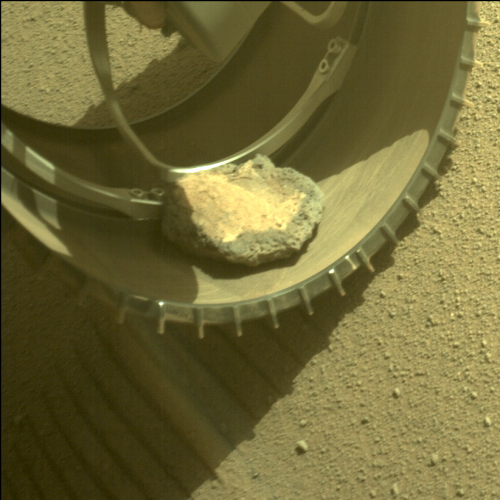
Since early February the Mars Rover Perseverance has been toting with it a small rock in its front left wheel, as shown in the image to the right, cropped and reduced to post here and taken by the rover’s left hazard avoidance camera on February 6, 2022.
From an update today by the Perseverance science team:
Back on sol 341— that’s over 100 sols ago, in early February— a rock found its way into the rover’s front left wheel, and since hitching a ride, it’s been transported more than 5.3 miles (8.5 km). This rock isn’t doing any damage to the wheel, but throughout its (no doubt bumpy!) journey, it has clung on and made periodic appearances in our left Hazcam images.
You can see the most recent photo of the rock, taken on May 26, 2022, here. It is very clear that the rock’s repeated tumbling inside the wheel well has worn away its sharp edges as well as reduced its overall size. Given enough time its surface could even become somewhat smooth.
As the update notes, when this rock finally drops off it will create a potential mystery for future geologists, who if they are not aware that Perseverance moved it, will wonder how it got where it was, being geologically out-of-place in its new location.
Capitalism in space: NASA yesterday awarded separate contracts to two different companies, Axiom and Collins Aerospace, to build spacesuits for its astronauts, either when they do spacewalks in space or when they are exploring the lunar surface.
The contract enables selected vendors to compete for task orders for missions that will provide a full suite of capabilities for NASA’s spacewalking needs during the period of performance through 2034. The indefinite delivery and indefinite quantity, milestone-based xEVAS contract has a combined maximum potential value of $3.5 billion for all task order awards. The first task orders to be competed under the contract will include the development and services for the first demonstration outside the space station in low-Earth orbit and for the Artemis III lunar landing.
Each partner has invested a significant amount of its own money into development. Partners will own the spacesuits and are encouraged to explore other non-NASA commercial applications for data and technologies they co-develop with NASA.
More information can be found in each companies’ press release, located here (Axiom) and here (Collins).
These commercial contracts replace NASA’s own failed effort to make its own Artemis spacesuits, which spent fourteen years and more than a billion dollars before being abandoned by the agency because wouldn’t be able to deliver anything on time.
The contracts also continue NASA’S transition — as recommended in my 2017 policy paper Capitalism in Space [pdf] — from a failed space contractor to merely being the customer buying products from the commercial sector. The result is we now have a vibrant and ever growing private space sector with products available quickly and cheaply not only for NASA, but for others. The Axiom press release illustrates these facts with this quote:
The Axiom spacesuit is key to the company’s commercial space services. This new NASA contract enables Axiom to build spacesuits that serve the company’s commercial customers and future space station goals while meeting NASA’s ISS and exploration needs.
Capitalism in space: NASA has now announced that it is buying five additional manned missions to ISS from SpaceX, beginning in ’26.
This new contract is in addition to a February ’22 NASA award that purchased three more Dragon flights.
After a thorough review of the long-term capabilities and responses from American industry, NASA’s assessment is that the SpaceX crew transportation system is the only one currently certified to maintain crewed flight to the space station while helping to ensure redundant and backup capabilities through 2030.
The current sole source modification does not preclude NASA from seeking additional contract modifications in the future for additional transportation services as needed.
The press release repeatedly makes it clear that NASA very much wishes to buy tickets on Boeing’s Starliner, but until it is declared operational it must give its business to SpaceX. Once Starliner begins flying, NASA will then buy seats on it and alternate between the two companies. Until then however this new SpaceX contract guarantees NASA enough flight capacity to keep ISS occupied, even if Starliner gets further delayed.
Regardless, Boeing has once again lost business to SpaceX because its Starliner capsule is not yet ready. In the long run this contract means fewer total flights for Boeing to ISS, which means less profits.
NASA announced yesterday that engineers have finally completely restored its Mars orbiter MAVEN, after a three month period when the spacecraft was in safe mode due to an attitude control problem.
To fix the problem engineers uploaded new software that allowed the spacecraft to determine its orientation in space not from its onboard inertial units, but from locking onto stars in the sky.
All instruments were healthy and successfully resumed observations; however, the spacecraft was constrained to pointing at the Earth until testing of all-stellar mode was completed, so the instruments were not oriented as they normally would be during science operations. Nevertheless, some limited science was still possible, and MAVEN even observed a coronal mass ejection impact Mars less than two days after the instruments were powered on.
Moreover, for some parts of the year it will still need its inertial units, so a fix for those time periods is still required.
Regardless, MAVEN can now resume acting as a communications relay between the Earth and the rovers on Mars, which for the past year has become its prime mission. While both rovers can communication without that relay, it is often necessary depending on a number of factors, and it also provides redundancy and a greater communications capacity.
Capitalism in space: The new rocket engine company Ursa Major yesterday announced a new more powerful rocket engine, dubbed Arroway, designed to replace rocket engines that Russia had been selling.
Arroway is a 200,000-pound thrust liquid oxygen and methane staged combustion engine that will serve markets including current U.S. national security missions, commercial satellite launches, orbital space stations, and future missions not yet conceived. The reusable Arroway engine is available for order now, slated for initial hot-fire testing in 2023, and delivery in 2025.
Notably, Arroway engines will be one of very few commercially available engines that, when clustered together, can displace the Russian-made RD-180 and RD-181, which are no longer available to U.S. launch companies.
Arroway could replace the RD-181 engines that Northrop Grumman uses on the first stage of its Antares rocket. Both engines are comparable in size. However, with Arroway available no sooner than ’25 it still will leave a gap, since right now the company only has enough stock on hand to launch two more rockets, both of which should launch before ’24.
Arroway is also about half as powerful as Blue Origin’s BE-4 engine, so if ULA wishes to use it in its Vulcan rocket a major redesign would be required.
Either way, Ursa Major is demonstrating here again the value of freedom and competition, as well as the foolishness and negative consequences of Russia’s invasion of the Ukraine. In response to the international sanctions against it, Russia blocked future rocket engine sales to the U.S. Not only did that not get the sanctions lifted, Russia is now losing that U.S. business, as other American companies are stepping up to replace it.
China today used its Long March 2C rocket to launch the first nine satellites in a commercial data collection constellation.
Owned by GeeSpace, a subsidiary of Geely Technology Group, the satellite constellation will be mainly used to research and validate technologies, such as travel services of intelligent connected vehicles, and vehicle/mobile phone and satellite interaction. It will also provide data support for marine environmental protection.
The leaders in the 2022 launch race:
22 SpaceX
17 China
7 Russia
3 Rocket Lab
3 ULA
The U.S. still leads China 31 to 17 in the national rankings, and the entire world combined 31 to 27.
Embedded below the fold in two parts.
To listen to all of John Batchelor’s podcasts, well worth your time, go here.
» Read more
An evening pause: I never watched Dr. Who, so I have no idea if this clip is a typical representation of the show. Its schlockiness however is quite impressive.
Hat tip Cotour.

If they could, the Democrats would do this to anyone who opposes them.
Blacklists are back and the Democrats have got ’em: The local government of Long Beach, California will on June 6, 2022 begin harsh discrimination and punishment against any city employee who refuses to get the COVID jab.
Anyone granted the personal exemption option must pay for weekly COVID-19 testing (rapid antigen/PCR), which can be done during city work hours, with the cost of the testing deducted from the employee’s paycheck, according to Ambrosini’s memo. Those receiving medical or religious exemptions will still be subject to weekly COVID-19 testing, but at city expense, according to the memo.
All unvaccinated city employees must continue to wear a mask of at least medical or surgical grade while at work under this new policy, according to memo. Employees not doing so are subject to disciplinary measures, up to and including termination, according to the policy.
Employees found not in compliance with the vaccination mandate will be subject to a wide range of disciplinary measures, including up to six months of suspension and then possible separation or even termination should non-compliance continue, according to the city.
The absurdity and injustice of this is even more pronounced considering the vast evidence now available to show the COVID shots don’t provide any real protection while carrying a potential health risk to those that take it. The link above, from May 11, 2022, provides links to a lot of this research. Here are just a few more examples, published in only the past few weeks:
» Read more

Click for full panorama.

Click for interactive map.
Cool image time! The panorama above, cropped, reduced, and enhanced to post here, was compiled from 29 photos taken on May 31, 2022 by the right navigation camera on the Mars rover Curiosity. It shows the steepness of the slope that the rover ended up parking on yesterday after it completed its drive. As noted in today’s rover update by Abigail Fraeman, Planetary Geologist at NASA’s Jet Propulsion Laboratory:
Curiosity starts the plan parked at an impressive 17˚ pitch (front up) and 17˚ roll (left up) for a total 24˚ tilt. You can get a bit of a sense of the rover’s non-horizontal position by looking at its orientation with respect to the ground in the above Navcam mosaic. Even though this slope is getting close to the limit of what Curiosity can traverse, we don’t think we’ll have any problems unstowing the arm or driving the rest of the way to the top because of the terrain we’re on – nice smooth bedrock with only a thin sand cover is almost the Martian equivalent of a paved road.
On the far right of the image you can also see Curiosity’s tracks. The rover had first approached this slope about 80 feet to the west, then backed off slightly to parallel the slope as it came east and then turned uphill. In the far far distance can be seen the rim of Gale Crater, about about 30 miles away and obscured by the atmosphere’s winter dust.
The overview map above shows Curiosity’s location with the blue dot. The approximate area covered by the section of the panorama above is indicated by the yellow lines. The red dotted line shows the rover’s original planned route. The white arrows indicate what the scientists have dubbed the “marker horizon,” a distinct layer found in many places on the flanks of Mount Sharp that they are very eager to study up close. The green dot marks the approximate location of a recurring slope lineae, a place where the cliff is seasonally darkened by a streak that appears each spring and then fades.
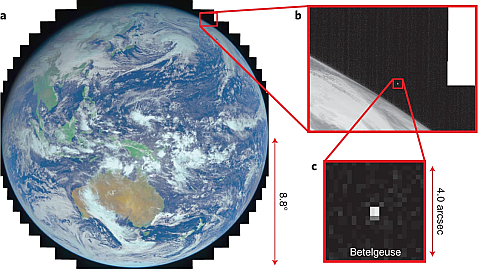
From Figure 1 of the paper. Click for full image and caption.
In a paper published on May 30th, astronomers described how they used the Japanese weather satellite Himawari-8 to monitor the dimming of Betelgeuse that occurred in 2019 and 2020.
“We saw a tweet stating that the moon was in its images,” Daisuke Taniguchi, a Ph.D. student in astronomy at the University of Tokyo and first author of the paper, told Space.com. “I chatted with [third author] Shinsuke Uno on the usage of meteorological satellites for astronomy, found Betelgeuse is in the field of view of Himawari-8 and realized that maybe the Great Dimming of Betelgeuse could be investigated.”
Himawari-8 has been positioned 22,236 miles (35,786 kilometers) above Earth’s equator since 2015 to study weather and natural disasters (including the eruption of the Hunga Tonga-Hunga Haʻapai volcano on Jan. 15). Although the satellite is up there to image Earth every 10 minutes, the edges of its images include stars.
Taniguchi and his colleagues were able to see Betelgeuse in images taken throughout Himawari-8’s lifetime and measured its brightness roughly every 1.7 days between January 2017 and June 2021.
The scientists were lucky that the star’s unexpected dimming happened to occur during this time period. The image above is Figure 1 from their paper (which you can read here).
They note that their observations appeared to confirm the theory that the dimming was caused by a dust cloud crossing in front of the star, not the theory that it was caused by a dark spot on the star’s surface. Moreover, their data suggests that dust was relatively close to the star, and could even been created by a burst from the star.
Capitalism in space: Blue Origin announced yesterday that it has rescheduled the next New Shepard passenger flight for June 4.
The original launch date of May 20th had been scrubbed because of an unexplained issue with the spacecraft’s “back-up systems.” The company has not provided any further information on what had been wrong, or what had been done to fix it.
This flight will be New Shepard’s fifth passenger flight, and its 21st overall.