United Kingdom’s new comprehensive space strategy: develop a robust private sector

Map of UK space strategy

Capitalism in space: The United Kingdom yesterday released a new comprehensive space strategy that seems generally focused on encouraging the growth of a private aerospace industry.

You can read the actual strategy here [pdf].

Though most of the text is high-sounding but mostly meaningless political talk, the overall strategy is excellent. It is focused not on creating a “space program” that the British government will design and build — what had been the traditional but generally unsuccessful approach since the 1960s — but to instead find ways to encourage the private sector to achieve what it wants to do. The map to the right, taken from the strategy document, illustrates this. The focus is entirely in supporting the growth of a commercial private industry by either creating industrial centers for space manufacturing or spaceports for launching satellites.

In this context, the vagueness of the strategy’s goals makes sense. The UK government has properly concluded that it is not its place to set those goals, but to let the commercial sector do it based on where they think they can make the most profit.

All in all, this strategy bodes well for the UK’s future in space.

3 comments

Blue Origin sets October 12th for next suborbital tourist flight

Capitalism in space: Blue Origin announced yesterday that it has scheduled October 12, 2021 for its next New Shepard suborbital tourist flight, carrying four passengers, two of which have been revealed.

The company has revealed two of the four crewmembers will be Chris Boshuizen, co-founder of Earth observation company Planet Labs, and Glen de Vries, vice chair for life sciences and healthcare at French software company Dassault Systèmes. The remaining two crewmembers will be announced in the coming days, Blue Origin said in a statement.

The NS-18 mission, the 18th flight overall for the New Shepard rocket, will lift off from Blue Origin’s Launch Site One in West Texas at 9:30 a.m. EDT (8:30 a.m. CDT or 1330 GMT) on Oct. 12. In addition to the four passengers, the flight will carry thousands of postcards from Blue Origin’s foundation, Club for the Future, which aims to inspire future generations to pursue careers in sciences, technology, engineering and mathematics (STEM).

There have been rumors that William Shatner will be one of the other passengers, but this has not yet been confirmed.

2 comments

Satellite company Terran Orbital to build big satellite factory in Florida

Capitalism in space: The satellite company Terran Orbital announced yesterday it will build a large factory to manufacture more than a 1,000 small satellites per year.

At the Launch and Landing Facility, formerly known as the NASA Space Shuttle Landing Facility, Terran Orbital, the parent company of Tyvak and PredaSAR, plans to claim 10 hangars for what Space Florida calls “the world’s largest satellite manufacturing facility.”

“Not only will we be able to expand our production capabilities to meet the growing demand for our products, but we will also bring valuable space vehicle manufacturing opportunities and capabilities to the State of Florida, investing over $300 million in new construction and equipment,” Marc Bell, Terran Orbital co-founder and CEO said in a statement. “By the end of 2025, we’re going to create approximately 2,100 new jobs with an average wage of $84,000.”

It appears that Lockheed Martin is both a customer for these satellites as well as one of Terran Orbital investors.

Regardless, with that many smallsats in the pipeline for construction provides one explanation why investors have been flocking to finance new rocket companies.

5 comments

China’s Long March 3B successfully launches satellite, which then fails

China’s Long March 3B rocket successfully launched a military satellite yesterday, though the satellite then had an undisclosed issue which caused it to fail.

Though the satellite failed to function immediately after launch, it appears the launch itself was successful, which based on my criteria means this launch is counted in China’s 2021 launch totals. The leaders in the 2021 launch race are thus:

34 China
23 SpaceX
15 Russia
4 Northrop Grumman

The U.S. still leads China 35 to 34 in the national rankings.

11 comments

Data suggests the winds in Jupiter’s Great Red Spot are changing

Changing wind speeds in Great Red Spot
Click for original image.

Data accumulated from 2009 to 2020 by the Hubble Space Telescope suggest that the outer winds in Jupiter’s Great Red Spot have speeded up by about 8%, while the winds in the spot’s inner regions have slowed.

The change in wind speeds they have measured with Hubble amount to less than 1.6 miles per hour per Earth year. “We’re talking about such a small change that if you didn’t have eleven years of Hubble data, we wouldn’t know it happened,” said Simon. “With Hubble we have the precision we need to spot a trend.” Hubble’s ongoing monitoring allows researchers to revisit and analyze its data very precisely as they keep adding to it. The smallest features Hubble can reveal in the storm are a mere 105 miles across, about twice the length of the state of Rhode Island.

“We find that the average wind speed in the Great Red Spot has been slightly increasing over the past decade,” Wong added. “We have one example where our analysis of the two-dimensional wind map found abrupt changes in 2017 when there was a major convective storm nearby.”

The graphic above shows the different wind speeds between the spot’s inner and outer regions, not the increase in speed described in this press release.

To put it mildly, these results are uncertain. We simply could be seeing the long term random fluctuations in the storm, or the change could simply be a reflection of the data’s margin of error. Moreover, since the data covers only the top layer of the Great Red Spot, it tells us nothing about the storm’s deeper regions or its more fundamental origins.

6 comments

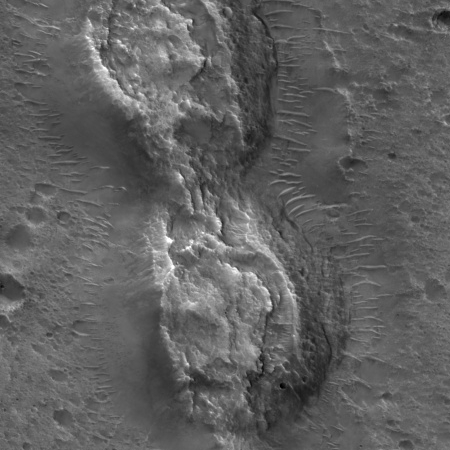
Rivulets in Martian lava

Overview map

Today’s cool image is another example of scientists finding cool things hidden within distant pictures. The small white rectangle on the overview map to the right shows us where we are heading, to the severely eroded lava plains to the southwest of Mars’ largest volcano, Olympus Mons.

The white spot is about 500 miles from the caldera of Olympus Mons. In elevation it sits about 58,000 feet below that caldera, more than twice the height of Mt. Everest. Yet, despite these great distances, the material at that white rectangle was almost certainly laid down during an eruption from Olympus Mons, thus illustrating the gigantic scale of volcanic events on Mars. Because of the red planet’s light gravity, about 38% of Earth’s, not only can lava flow farther, it does so much faster.

The second image below is a wide angle photo taken by the context camera on Mars Reconnaissance Orbiter (MRO) in January, 2012, rotated, cropped, expanded, and enhanced to post here.
» Read more

1 comment

Today’s blacklisted American: Unvaccinated students at Penn State banned from remote classes

Coming to your town in America soon!
Rounding up the unclean unvaccinated: It is coming.

They’re coming for you next: Unvaccinated students at Penn State who fail to get a COVID test for three weeks in a row are now banned from the school, including a ban from even attending remote classes.

At Penn State University, 117 students have been placed on interim suspension for failure to comply with the university’s weekly COVID-19 testing requirement.

Students at University Park who are subject to required weekly COVID-19 testing and who have missed at least three weeks of testing have been notified by Penn State that they are out of compliance with the university’s health and safety policies and have been placed on interim suspension through the Office of Student Conduct, a statement from Penn State said.

Students on interim suspension may not participate in classes, in-person or remotely; are not allowed on university property; and may not attend any Penn State-sponsored events, programs, and activities, including football games. On-campus students on interim suspension also are temporarily removed from their residence halls.

The highlighted word prove the insanity and irrationality of this policy. » Read more

23 comments

ULA successfully launches Landsat 9

Capitalism in space: Using its Atlas-5 rocket ULA today successfully launched Landsat 9, built by Northrop Grumman.

At the time of writing, the rocket and payload are in orbit and in a 60-minute coast phrase prior to payload deployment.

This was only the third launch this year by ULA, tying them with Rocket Lab but still too few launches to make the leader board. The leaders in the 2021 launch race remains the same:

33 China
23 SpaceX
15 Russia
4 Northrop Grumman

The U.S. now leads China 35 to 33 in the national rankings. In 2020 the U.S. completed 40 launches total, the most since 1968. At the moment there are sixteen more U.S. launches scheduled for launch in 2021. If all occur as planned, that would make 51 launches, making ’21 the fifth best launch year for the U.S. ever, exceeded only by four years in the mid-1960s.

For ULA, the low number of launches so far this year continues a slow downward trend since 2014, when the company completed fourteen launches. ULA still has four launches listed for ’21, but one, the unmanned Starliner demo launch, is likely to get delayed till ’22. The dates of two other launches remain “too-be-determined”, which also makes them questionable.

0 comments

China launches Earth observation satellite

China today successfully launched an Earth observation satellite using its smallsat Kuaizhou-1A rocket, the first launch of this quick response rocket since a failure in November 2020.
The satellite is supposedly for commercial use, but little information has been released about it and its constellation.

The leaders in the 2021 launch race:

33 China
23 SpaceX
15 Russia
4 Northrop Grumman

The U.S. still leads China 34 to 33 in the national rankings, with these numbers changing in a few hours should ULA successfully launch Landsat 9 using its Atlas-5 rocket.

3 comments
1 876 877 878 879 880 2,916