
Vangelis – Chariots Of Fire
An evening pause: Performed live at the Temple of Olympian Zeus in Athens on June 28, 2001.
Hat tip Edward Thelen.
An evening pause: Performed live at the Temple of Olympian Zeus in Athens on June 28, 2001.
Hat tip Edward Thelen.
Embedded below the fold. Recorded live, from the Grand Canyon.
» Read more
An evening pause: Hat tip Jim Mallamace.
Russia today successfully launched its first Proton rocket in almost a year.
A jury has ruled in favor of SpaceX and against a former employee who claimed he was fired because he complained about management and testing policies at the company.
Though it is hard to say what really happened, it does appear that, once given all the evidence, the jury agreed with SpaceX that the former employee was fired for good cause.
What could possible go wrong? A group of mathematicians have written software designed to prevent the gerrymandering of congressional districts, and are offering that software as a weapon for the courts to force states to revise the districts, even though those districts were created by fairly elected state legislatures.
Leaning back in his chair, Jonathan Mattingly swings his legs up onto his desk, presses a key on his laptop and changes the results of the 2012 elections in North Carolina. On the screen, flickering lines and dots outline a map of the state’s 13 congressional districts, each of which chooses one person to send to the US House of Representatives. By tweaking the borders of those election districts, but not changing a single vote, Mattingly’s maps show candidates from the Democratic Party winning six, seven or even eight seats in the race. In reality, they won only four — despite earning a majority of votes overall.
Mattingly’s election simulations can’t rewrite history, but he hopes they will help to support democracy in the future — in his state and the nation as a whole. The mathematician, at Duke University in Durham, North Carolina, has designed an algorithm that pumps out random alternative versions of the state’s election maps — he’s created more than 24,000 so far — as part of an attempt to quantify the extent and impact of gerrymandering: when voting districts are drawn to favour or disfavour certain candidates or political parties.
There are numerous problems here, all of which center on my basic disbelief in the non-partisan objectivity of these scientists and their work.
First, note the first example used. Mattingly proudly shows how his software demonstrates that Democrats could have won more districts in North Carolina. In fact, if you read the article, he claims that the district revisions produced by his software (producing more victorious Democrats) creates fairer districts than the districts created by the state’s fairly elected Republican legislature. Moreover, it was the Republican redistricting that prompted this mathematician to write the software.
Funny how he never felt compelled to do this when it was Democrats controlling the legislatures and gerrymandering the congressional districts to their benefit.
Second, he has offered this software to the courts as evidence to overrule the redistricting done by fairly elected legislatures. In other words, this software will be used to justify letting unelected experts decide how congressional districts should be shaped, not elected officials picked by voters.
Third, note who has expressed interest in using this mathematician as a witness to win its lawsuits:
» Read more
Luxembourg has revised its proposed new space law in order to try to address the property right concerns posed by the Outer Space Treaty.
The legislation is patterned on the U.S. Commercial Space Launch Competitiveness Act of 2015, which includes provisions that grant U.S. companies the rights to resources they extract from asteroids or other celestial bodies. One difference, Schneider said, will be that while the U.S. law requires companies to be based in the country, Luxembourg’s protections would cover companies regardless of their location. “We don’t really care where the money comes from,” he said.
The bill also creates a system for the authorization and continuing supervision of commercial space activities that are regulated by the country. The lack of similar policy in the United States for “non-traditional” commercial space activities like asteroid mining — required, many argue, in order to comply with Article 6 of the Outer Space Treaty — has been an issue debated in the last few years.
…Luxembourg is also in the process of creating a national space agency, Schneider said. The country is a member of the European Space Agency but has not previously had its own national agency. However, he said the agency will be structured differently than those in other countries. “This space agency will not be a copy of NASA or ESA, but it will be a space agency whose only focus on the commercial use of space resources,” he said. It will be set up a public-private partnership between the government and private funds.
I would say that the competition in space is definitely now heating up. These actions by Luxembourg might not solve the legal problems with the Outer Space Treaty, but they will certainly up the pressure on the world’s space-faring nations to face the issue.
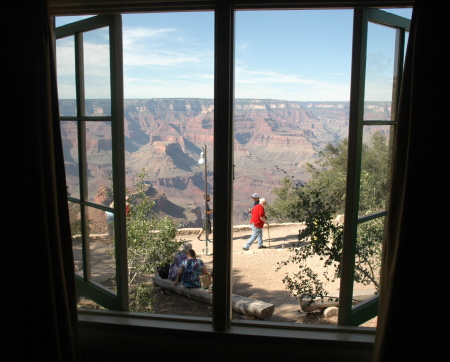
On a lark, last week I called Xanterra, the vendor that runs the hotels on the south rim of the Grand Canyon, to see if they had any rooms available anytime during the summer. Diane and I wanted to do a day hike down the Hermit Trail, and to do it we needed to stay at a hotel the night before and the night after.
To my surprise, they had a rim view room available in Bright Angel Lodge, for tonight and tomorrow. The picture on the right is taken from our room, right after we arrived earlier today. I am right now sitting at that window, watching the sun set on the canyon buttes even as I type. Yowza!
I will post more tonight, and some tomorrow night as well. I will also do my podcast with John Batchelor tomorrow, live, from this room. Most cool, I must say.
An evening pause: From a recent live performance. I’ve posted this song before, sung by others, but not surprisingly, the best version is still performed by the originals.
I also think of this verse today whenever I read of the insane craziness going on in the political world:
And in the naked light I saw
Ten thousand people, maybe more
People talking without speaking
People hearing without listening
People writing songs that voices never share
No one dared
Disturb the sound of silence
Hat tip Peter Fenstermacher.
The uncertainty of science: The only known fossils of a T Rex’s skin suggest that the dinosaur was covered with scales, not feathers as recent research has theorized.
[I]f these large tyrannosaurs had any feathers at all, says the team, their fluff would have been limited to their backs—the only body part for which they were lacking fossil impressions. Because their earlier cousins did have feathers, it’s likely that the large tyrannosaurs lost them somewhere along the way, the team suggests.
Astronomers have confirmed that the Wow! signal, thought to be the most promising detection by SETI of alien life, was actually caused by a comet.
Last year, a group of researchers from the Center of Planetary Science proposed a new hypothesis that argued a comet might be the culprit. The frequency could be caused by the hydrogen cloud they carry, and the fact that they move accounts for why it seemingly disappeared. Two comets, named 266/P Christensen and P/2008 Y2 (Gibbs), happened to be transiting through that region of space when the Wow! signal was detected, but they weren’t discovered until after 2006.
To test the hypothesis, the team made 200 radio spectrum observations between November 2016 and February 2017. Sure enough, 266/P Christensen was found to emit radio waves at a frequency of 1,420 MHz, and to double check, the researchers moved their radio telescope by one degree. As expected, the signal vanished, and only returned when the telescope was trained back on the comet.
This story demonstrates once again why, in science, it is very dangerous to jump to any conclusions. The data we receive is a mystery. We must keep an open mind to solve that mystery.
China has chosen the landing site for its Chang’e-5 lander/rover and sample return mission, planned to launch later this year.
Liu Jizhong, director of China Lunar Exploration and Space Engineering Center of China National Space Administration (CNSA), for the first time disclosed the probe landing site, an isolated volcanic formation located in the northwest part of the Moon’s near side.
They also said their focus will be the Moon’s south pole, where there is evidence of the possible presence of water ice.
Though they are about to resume Proton launches, Russia today revealed that they only intend to launch the rocket five times in 2017, not seven as announced earlier.
Russia plans five Proton-M carrier rocket launches this year, including three commercial launches, Khrunichev Space Center CEO Andrei Kalinovsky told TASS on Wednesday. “Our plans for this year also additionally include four Proton-M carrier rocket launches. These are two commercial launches with Amazonas 5 and AsiaSat 9 satellites, and also two federal launches,” the chief executive said.
Even more interesting, the article notes that Russia only has contracts to launch 15 commercial satellites through 2023. That’s a launch rate of only about 2.5 to 3 commercial Proton launches per year, a rate that seems much less than in the past. Moreover, while they say they haven’t lost any customers in the past year, it also appears they haven’t gotten any either.
Embedded below the fold.
» Read more
An evening pause: In memory of those who died on D-Day, to keep us free.
Hat tip Jim Mallamace.
The uncertainty of science: Climate scientists are increasingly publishing papers that show no clear temperature global trend.
Last year there were at least 60 peer-reviewed papers published in scientific journals demonstrating that Today’s Warming Isn’t Global, Unprecedented, Or Remarkable.
.
Just within the last 5 months, 58 more papers and 80 new graphs have been published that continue to undermine the popularized conception of a slowly cooling Earth temperature history followed by a dramatic hockey-stick-shaped uptick, or an especially unusual global-scale warming during modern times.
.
Yes, some regions of the Earth have been warming in recent decades or at some point in the last 100 years. Some regions have been cooling for decades at a time. And many regions have shown no significant net changes or trends in either direction relative to the last few hundred to thousands of years.
.
Succinctly, then, scientists publishing in peer-reviewed journals have increasingly affirmed that there is nothing historically unprecedented or remarkable about today’s climate when viewed in the context of long-term natural variability. [emphasis in original]
At the link are 80 graphs from the most recent papers. Take a look. If you are convinced that the climate is warming than you must come up with an explanation for this data. Or you can put your fingers in your ears, cover your eyes, and chant “La-la-la-la-la-la-la-la-la-la-la-la-la-la-la-la!” as loud as you can so that you don’t have to deal with it.
In order to build its space station, beginning in 2019, China will increase its manned mission rate, completing four missions in five years.
This is still a somewhat glacial pace, compared to other nations. It will seem even slower based on what I expect will start happening once a number of competitive private American rockets begin hauling tourists into space.
The article notes one additional tidbit about China’s station. They plan to run 3 to 6 month long missions there.
Astronomers using ground-based telescopes have identified two more moon circling Jupiter, bringing its total now to 69.
Both of these discoveries, as with the vast majority of Jupiter’s moons, occupy retrograde orbits, with inclinations greater than 90°, meaning that they move in directions opposite that of the planet’s spin. These distant, irregular orbits imply that these bodies formed elsewhere in the outer solar system and were captured while passing by early in the planet’s history.
A number of the moons recently discovered have since been lost because their orbits were too poorly constrained. However, some of these lost moons have also be recovered.
Capitalism in space: The Air Force has awarded SpaceX the contract to launch the next X-37B mission, presently scheduled to launch in August.
The contract amount was not announced, but it certainly is going to be less than ULA charged for its own launches of the X-37B. Also, this launch is scheduled only two months hence, which means SpaceX has to somehow wedge it into its already crowded schedule.
It is about time: More than 130 Muslim religious leaders in the United Kingdom are refusing to perform funeral rites for the terrorists who attacked people this past Saturday on London Bridge.
The decision by the Muslim leaders was seen as an “unprecedented” move because the funeral ritual is typically performed on a deceased Muslim no matter the person’s past actions. The group of religious leaders have urged others to join them in declining to pray for the dead killers.
“We, as Muslim imams and religious leaders, condemn the recent terror attacks in Manchester and London in the strongest terms possible,” the Muslim leaders said in a statement. “Coming from a range of backgrounds, and from across the U.K.; feeling the pain the rest of the nation feels, we have come together to express our shock and utter disgust at these cold-blooded murders. We are deeply hurt that a spate of terror attacks have been committed in our country once more by murderers who seek to gain religious legitimacy for their actions. We seek to clarify that their reprehensible actions have neither legitimacy nor our sympathy.”
So, does this mean they had no problems with performing rites for the terrorists of earlier attacks, such as at Westminster earlier this year and the July 7 attacks several years ago? Meh.
I must say that though this is the right response on their part, I am not very impressed. For more that two decades the Islamic community in the west has sat on its hands, making believe they have nothing to do with Islamic terrorism, or quietly supporting it by non-action. They are suddenly realizing now that people are losing patience with them, and that their safe havens in the west are now increasingly threatened. Most politicians might still be mouthing platitudes of “We have to all get along,” but the public is increasingly angry and demanding action, even if it means kicking every Islamic practitioner back to the Middle East.
Thus, though I do not like attacking people with such broad strokes, I can understand why it is happening. And the Muslim community has no one to blame but themselves.