May 10, 2023 Zimmerman/Batchelor podcast
Embedded below the fold in two parts.
To listen to all of John Batchelor’s podcasts, go here.
» Read more
Very brief descriptions, with appropriate links, of current or recent news items.
Embedded below the fold in two parts.
To listen to all of John Batchelor’s podcasts, go here.
» Read more
Courtesy of BtB’s stringer Jay.
Quite cool. As the tweet notes, this “was the hottest and fastest [fairing return] we’ve ever attempted.”
Most of this is simply lobbying for more money. The shortage of plutonium will only matter if NASA’s planetary program gets a gigantic budget boost.
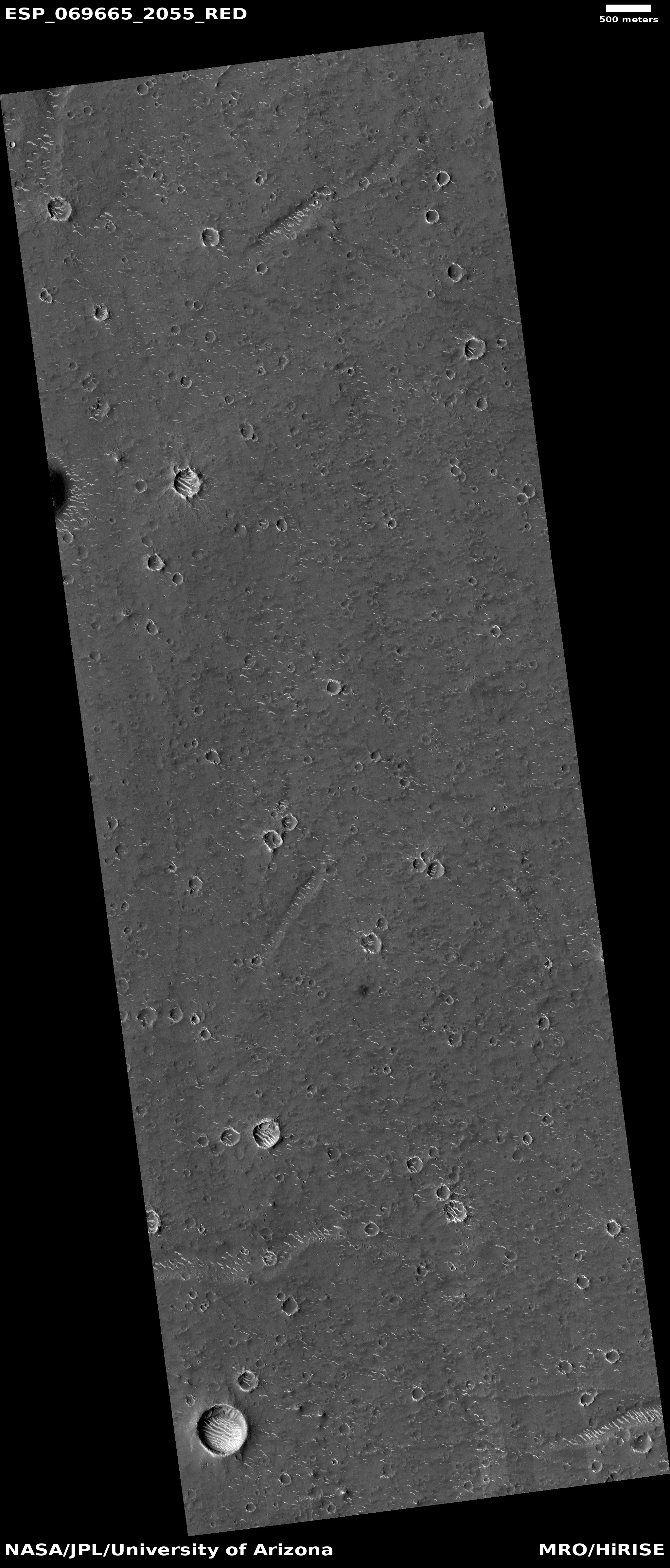
Cool image time! My headline paraphrases slightly the witches’ chant from Shakespeare’s MacBeth, if only to make it more accurately describe the picture to the right, cropped and reduced to post here. Taken on January 5, 2023 by the high resolution camera on Mars Reconnaissance Orbiter (MRO), it shows a patch of mid-latitude terrain in the icy northern lowland plains of Mars.
While some of the craters here were certainly caused by impact, it is also likely that most were instead cryo-volcanic in nature, whereby ice bubbles up from below as changing temperature conditions — none of which need to be very warm — cause it to either melt temporarily into liquid or sublimate directly into a gas. The dark pimplelike hole on the picture’s right edge is a perfect example, with the hole sitting at the top of a cone.
» Read more

Megan Brock, without question still
being targeted by the government
Bring a gun to a knife fight: When Pennsylvania parent Megan Brock demanded, under her state’s right-to-know law, public documents of the Bucks County health department concerning its decisions to impose Wuhan flu lockdowns and school closures (with the office of open records ruling in her favor), county officials then sued her multiple times to try to prevent her access to the records.
The court has now ruled against the county’s lawsuits, while also ruling that the county had operated in “bad faith” and fined it $1,500, the maximum allowed by law.
After the court conducted an in-camera review of the records, Judge Denise M. Bowman ruled on April 28 that more than half of Brockโs requests, which were made under the stateโs Right-to-Know Law (RTK), had been withheld โin bad faith.โ She ordered the county to release certain documents and pay $1,500 in sanctions for each of the two lawsuits brought against Brock, the maximum allowed under RTK.
You can read the ruling here [pdf]. It notes in particular how county officials had even refused to provide the court one of these documents for review, demonstrating clearly its bad faith.
» Read more
I appeared on Robert Pratt’s Pratt on Texas podcast yesterday, doing a short ten minute interview about the lawsuit filed against the FAA that is attempting to shut down Starship/Superheavy development.
That podcast is embedded below. It can also be listened to here, beginning at 12:15 minutes.
» Read more
The Super-Pressure Balloon Imaging Telescope (Super-BIT) that has been circling Antarctica for the last two weeks has now obtained two more more high resolution wide-field astronomical pictures.
The picture to the right, cropped to post here, is of Messier 104 (the Sombrero Galaxy). While the telescope cannot zoom in closer than this to such objects, it is able to get much wider and sharp pictures, covering an entire galaxy or nebula that ground-based telescope using adaptive optics (designed to counter the fuzziness caused by the atmosphere) cannot. Adaptive optics only work on very small fields of view, thus making it unable to observe some of the larger nearby astronomical objects like galaxies and nebulae.
If you look at the live stream of the balloon’s track, it has now almost completed its second circuit of Antarctica.

Click to watch full animation.
Using data from a variety of space- and ground-based telescopes, astronomers now think they have recorded the moment a star similar to our Sun actually swallowed a planet thought to be comparable to Jupiter or smaller.
Once the science team put all the evidence together, they realized the dust they were seeing with NEOWISE [in orbit] was being generated as the planet spiraled into the starโs puffy atmosphere. Like other older stars, the star had begun to expand in size as it aged, bringing it closer to the orbiting planet. As the planet skimmed the surface of the star, it pulled hot gas off the star that then drifted outward and cooled, forming dust. In addition, material from the disintegrating planet blew outward, also forming dust.
What happened next, according to the astronomers, triggered the flare of optical light seen by ZTF [survey telescope in California]. โThe planet plunged into the core of the star and got swallowed whole. As it was doing this, energy was transferred to the star,โ De explains. โThe star blew off its outer layers to get rid of the energy. It expanded and brightened, and the brightening is what ZTF registered.โ
Some of this expanding stellar material then escaped from the star and traveled outward. Like the boiled-off layers of the star and planet that previously drifted outward, this material also cooled to form dust. NEOWISE is detecting the infrared glow of all the newly minted dust.
The picture above is a screen capture from a short artist’s animation created to illustrate what happened. The most amazing aspect of this event is how long the planet skimmed the surface of that star. It appears it did so for several orbits at least.
Courtesy of BtB’s stringer Jay.
These are the same two images the company posted on April 10th, so either nothing is happening, or they are simply not telling us anything.
The idea is to simulate the lunar environment and find out ways to eliminate dust issues.
It appears the launch tower will be completed one month early, in May, with the foundation hole for the second pad 96% dug.
The company hopes with this plan it will be bought whole by a single buyer and thus saved. There remains no guarantee that will happen. The auction will now occur on May 18th.
All told, completed or parts of 11 Starships exist, as well as completed or parts of 8 Superheavies.
Cool image time! The picture to the right, cropped, reduced, and sharpened to post here, was taken on January 17, 2023 by the high resolution camera on Mars Reconnaissance Orbiter (MRO) by the camera team not as part of any particular research project but in order to fill a gap in the camera’s schedule so as to maintain its proper temperature. In such cases the camera team tries to pick potentially interesting spots.
This cliff, about 1,100 feet high, is the north wall of a major volcano channel flowing across the Tharsis Bulge, the lava plains that surround Mars’ giant volcanoes. Located in the dry equatorial regions, there is no near surface ice here, but a lot of dust, much of it likely volcanic ash. In the full picture are several ancient craters, all of which are almost entirely buried by this dust and ash.
The cliff wall itself is made up of numerous layers, each representing a past volcanic flood lava event that covered this region with a new flow of material. These events occurred over more than a billion years.
» Read more
NOAA this week once again published an update of its monthly graph that tracks the number of sunspots on the Sun’s Earth-facing hemisphere. As I do every month, I have posted this graph below, with some additional details included to provide some context.
In April the number of sunspots dropped again, for the second time in the past three months. The high activity previously had suggested that the solar maximum was going to be much higher than predicted, or possibly would come sooner than expected. The drop however now suggests that the fast rise in sunspot activity that we have seen since the beginning of the ramp up to solar maximum in 2020 might finally be abating.
» Read more

Whitworth University, where teaching close-mindedness
is our number one goal!
They’re coming for you next: When the conservative Turning Point USA chapter at the private Christian Whitworth University in Washington state arranged a lecture from Xi Van Fleet — a refugee from communist China — it discovered it could not do so because it needed the approval of the college’s student organization, and the leaders of that organization voted 9-4 to blacklist that speaker.
On April 12, Whitworthโs student government voted 9-4 to deny a conservative groupโs request to invite Chinese dissident Xi Van Fleet to speak at the university in Spokane, Washington. Van Fleet, now a Virginia resident, escaped Mao Zedongโs Cultural Revolution and frequently criticizes ideas such as critical race theory and hecklersโ vetoes that, in her view, mirror it.
The minutes of this student government meeting are available online [pdf]. If you read them, you find that it is very clear these students do not believe in freedom of speech and instead think the most important thing a college can do is to protect them from hearing ideas they don’t like. These university-level government activists also exhibited an incredible level of general ignorance. Consider this comment from Niraj Pandey, listed as an International Student Senator:
» Read more
Cool image time! The picture to the right, reduced and sharpened to post here, was taken by the Hubble Space Telescope and released today. It shows a galaxy only 30 million light years away, making almost our neighbor. From the caption:
NGC 3489 has an active galactic nucleus, or AGN. The AGN sits at the center of the galaxy, is extremely bright, and emits radiation across the entire electromagnetic spectrum as the black hole devours material that gets too close to it.
This lenticular galaxy is a Seyfert galaxy, which is a class of AGN that is dimmer than other types of AGNs. They generally donโt outshine the rest of the galaxy, so the galaxy surrounding the black hole is clearly visible. Other types of AGNs emit so much radiation that it is almost impossible to observe the host galaxy.
That active nucleus is the bright dominate sphere at the galaxy’s center, large enough to overwhelm a large percentage of the rest of the galaxy. Its existence and dominance suggests that this galaxy is aging, and is beginning the transition from a spiral to an elliptical. In fact, its arms have already mostly vanished, and there is at present little star-formation on-going.