Ispace announces new launch date and landing site on Moon for Hakuto-R lander

Lunar map showing Hakuto-R's landing spot

Ispace today announced that its commercial lunar lander, Hakuto-R, will now launch on a Falcon 9 rocket on November 28, 2022 and will arrive on the Moon in 54-mile-wide Atlas Crater in April 2023.

The white dot on the map to the right shows this landing spot, in the crater’s northern quadrant. Atlas is distinct in that its crater floor has many large fissures with the crater’s interior rim terraced, but this area is relatively smooth.

The spacecraft will carry seven commercial payloads, including the UAE rover Rashid, which is about the size of a small Radio Flyer wagon and will operate on the surface for about two weeks (one lunar day). It has cameras, whose primary research function will be to photograph the variety of different materials attached to the rover’s wheels to see how each interacts with the Moon’s very harsh and abrasive dust.

2 comments

Rocket Factory Augsburg signs deal to use German engine test facility

Rocket Factory Augsburg (RFA), one of three German rocket startups pushing to begin test launches next year, has signed a contract with Germany’s aerospace agency DLR to use of its engine test facility for static fire tests of its Helix engine.

RFA announced the deal at the Space Tech Expo Europe in Bremen, Germany, Nov. 16, which will allow RFA to use the P2.4 test site in Lampoldshausen. DLR provides the basic infrastructure while RFA brings its own test stand and supporting infrastructure.

Test stands in Lampoldshausen have so far only been used by DLR, the European Space Agency and ArianeGroup.

The new test stand will add to RFA engine testing capacity already established in Esrange in northern Sweden, where the company has been conducting testing on the Helix engine for the RFA One launcher. Testing will continue in Sweden but the new development simplifies logistics and bureaucracy related to import and export rules. [emphasis mine]

The highlighted sentence is the news. The German government has decided to break the monopoly held by government related operations of these facilities, and open up their use to private independent commercial companies.

RFA says it already has a dozen customers, and hopes to begin commercial launches by ’24.

1 comment

Canadian rocket startup with balloon for 1st stage wins launch contract

SpaceRyde, a Canadian smallsat rocket startup company that intends to use a stratospheric balloon to act as its first stage before releasing its orbital rocket, has won a contract for four launches from ISILaunch, a Netherlands satellite company.

Customers will pay $250,000 to launch 25-kilogram payloads on SpaceRyde’s Ryder rocket and Flying Spider balloon. The flights are scheduled to begin in 2024. For the SpaceRyde flights, ISILaunch will offer customization including scheduling weeks prior to launch, access to custom orbits and various fairing configurations.

…Stratospheric balloons will serve as the first stage, lifting Ryder rockets through Earth’s atmosphere before rocket engines fire. Ryder’s upper stage, called Black Bay, is designed to remain in orbit, maneuvering and refueling as needed to provide in-orbit servicing and in-space transportation.

The first test flights are scheduled in ’23, with commercial flights starting in ’24. The company apparently is targeting the smallest smallsat market, aiming to win customers with very very low launch prices.

2 comments

Ten cubesats released by SLS on way to Moon; one has problems

Shortly after SLS’s upper stage completed its engine burn to send Orion to the Moon, it separated and then successfully released ten cubesats on their own deep space missions.

These CubeSats will fly to various destinations including the Moon, asteroids, and interplanetary space. They will study various facets of the Moon and interplanetary travel, ranging from navigation techniques to radiation and biology. One of them is even planned to conduct a soft landing on the lunar surface.

Because of SLS’s numerous delays, there was a chance that many of these cubesats would lose the charges on their batteries and not function after launch. According to the article at the link, communications with six of these cubesats has been established.

The last cubesat above, from Japan and dubbed Omotenashi, was designed as a demonstration test. According to Japan’s space agency, JAXA, however, communications with the spacecraft are “unstable.”

Japan’s space agency said Thursday it has been unable to establish stable communication with the country’s mini moon lander launched on a U.S. rocket the previous day along with a mini satellite. The Japan Aerospace Exploration Agency said it is now trying to control the position of the Omotenashi lander, adding its system of automatically turning to the Sun to gain solar power appears to be not functioning.

Before launch JAXA had rated the mission’s chances of success at 60%, but that mostly referred to the lunar landing. Though intended as a demo mission, it will be unfortunate if it fails for these reasons this early in the mission.

0 comments

November 16, 2022 Quick space links

Courtesy of Jay, BtB’s stringer.


4 comments

Glaciers everywhere in Mars’ glacier country

Glaciers everywhere in Mars' glacier country
Click for full image.

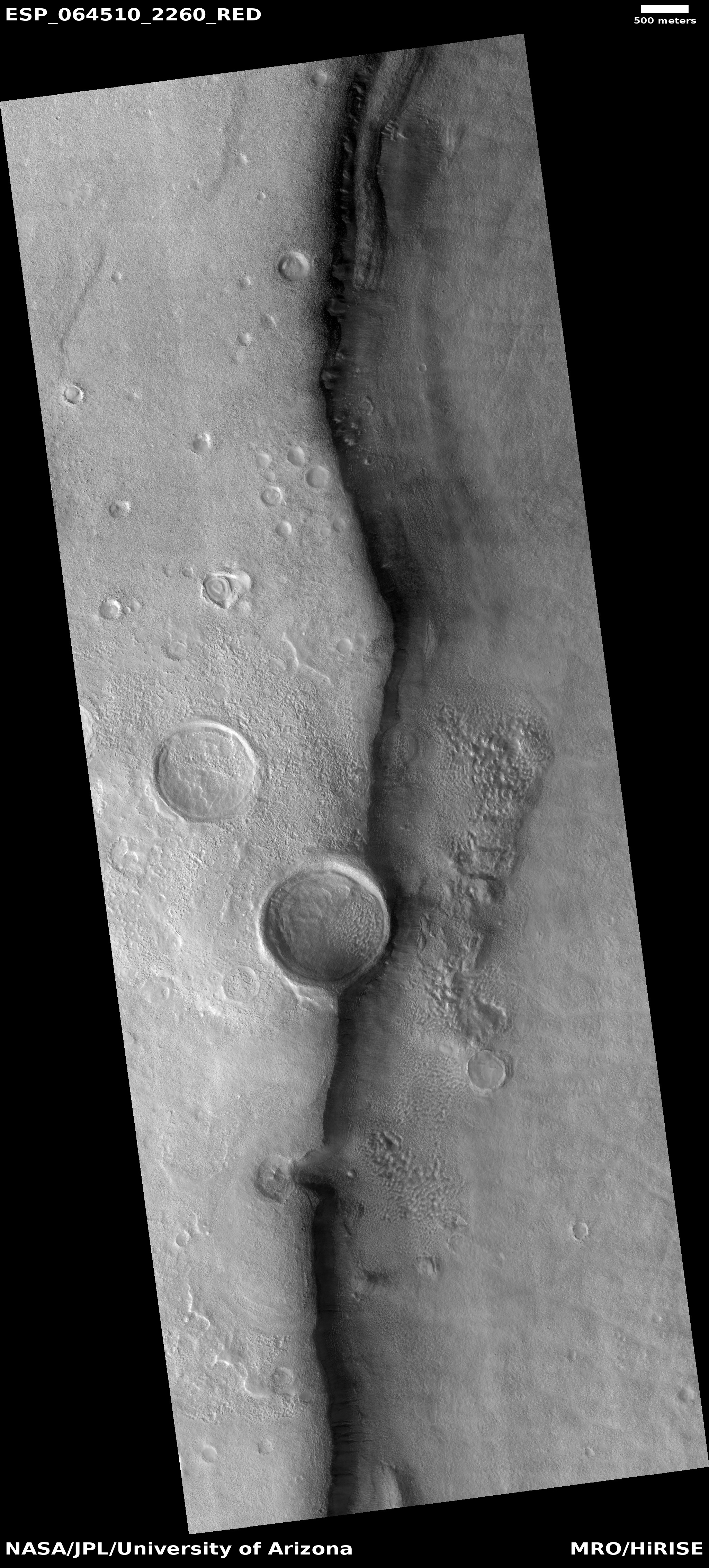
Cool image time! The picture to the right, rotated, cropped, reduced, and annotated to post here, was taken on August 24, 2022 by the high resolution camera on Mars Reconnaissance Orbiter (MRO). It shows glaciers apparently flowing down from two different mesas to the north and south.

The arrows indicate a major glacial stream coming from two directions. The many layered flow on the image’s upper right illustrates the many past climate cycles of Mars, with each subsequent period of snowfall and glacial growth producing progressively less ice. The chaotic region in the lower right marks what I think is the lowest point between the two mesas. Here the flows form eddies as the glaciers collide.

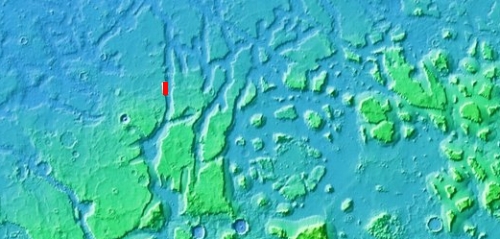
The overview map below shows us why there are so many glaciers at this spot on Mars.
» Read more

0 comments

A hidden baby star, seen in infrared

A hidden baby star, seen in infrared
Click for original image.

Using the Webb Space Telescope, astronomers have obtained a new high resolution infrared false color view of the bi-polar jets of a new solar system and star, hidden within its dark cloud of dust.

That image is the photo to the right, reduced and sharpened to post here. From the press release:

NASA’s James Webb Space Telescope has revealed the once-hidden features of the protostar within the dark cloud L1527, providing insight into the beginnings of a new star. These blazing clouds within the Taurus star-forming region are only visible in infrared light, making it an ideal target for Webb’s Near-Infrared Camera (NIRCam).

The protostar itself is hidden from view within the “neck” of this hourglass shape. An edge-on protoplanetary disk is seen as a dark line across the middle of the neck. Light from the protostar leaks above and below this disk, illuminating cavities within the surrounding gas and dust.

The region’s most prevalent features, the clouds colored blue and orange in this representative-color infrared image, outline cavities created as material shoots away from the protostar and collides with surrounding matter. The colors themselves are due to layers of dust between Webb and the clouds. The blue areas are where the dust is thinnest. The thicker the layer of dust, the less blue light is able to escape, creating pockets of orange.

Scientists estimate this star is only about 100,000 years old, and is in its earliest stage of formation. That protoplanetary disk is estimated to be about the size of our solar system.

0 comments

UK awards launch license to Cornwall airport

After several months delay, the Civil Aviation Authority (CAA) in the United Kingdom yesterday issued a license to a Cornwall airport, dubbed Spaceport Cornwall, allowing Virgin Orbit to begin final preparations for the first orbital launch from within the British Isles.

The red tape however is not done.

The licence means that Virgin Orbit, which is behind the launch (named Start Me Up after the Rolling Stones song), is clear to begin to carry out mission-readiness tasks. But further licences are needed relating to this specific mission before blast-off can happen.

Melissa Thorpe, the head of Spaceport Cornwall, said: “To be the first spaceport in the UK with a licence to operate is a historic moment. Cornwall is now ready to open up the use of space for good.” She added: “The CAA continues to work on several licence applications, including being in very advanced stages with Virgin Orbit on its applications for launch and range licences, as well as the satellite operators, ahead of a proposed first UK launch.

I am reminded of the meme showing a crowd of officials surrounding one ditch digger, with the only one doing any real work that digger. It appears right now that the bureaucrats in the CAA might outnumber the staffing at both Virgin Orbit and Cornwall, and all they have to do is issue a piece of paper.

0 comments

NASA awards Starship a second manned lunar landing contract

Capitalism in space: NASA yesterday modified its manned lunar lander contract with SpaceX to award Starship a second manned lunar landing for $1.15 billion.

Known as Option B, the modification follows an award to SpaceX in July 2021 under the Next Space Technologies for Exploration Partnerships-2 (NextSTEP-2) Appendix H Option A contract. NASA previously announced plans to pursue this Option B with SpaceX. The contract modification has a value of about $1.15 billion.

…The aim of this new work under Option B is to develop and demonstrate a Starship lunar lander that meets NASA’s sustaining requirements for missions beyond Artemis III, including docking with Gateway, accommodating four crew members, and delivering more mass to the surface.

NASA is also accepting bids for a competitive second manned lunar lander, but has awarded nothing as yet.

Combined with earlier investments and contracts, SpaceX now had garnered about $13 billion for developing Starship and Starlink, about $9 billion from private investment capital and about $4 billion from NASA, with most of the cash used for Starship. In addition, the company plans another investment funding round that will raise its valuation to $150 billion.

SLS might have flown once, but it appears both NASA and the investment community is increasingly putting its eggs in the Starship basket.

1 comment

Chinese pseudo-company Galactic Energy launches five satellites into orbit

The Chinese pseudo-company Galactic Energy today used its Ceres-1 rocket to put five Earth observations satellites into orbit.

According to China’s state run press, Ceres-1 is a “small-scale solid-propellant carrier rocket capable of sending micro-satellites into low-Earth orbit.” In other words, it was developed initially by the military for missile use, and the government has allowed it to be upgraded for civilian use.

The leaders in the 2022 launch race:

52 SpaceX
52 China
19 Russia
9 Rocket Lab
8 ULA

The U.S. still leads China 76 to 52 in the national rankings, but trails the rest of the world combined 80 to 76.

The 52 launches by China ties its yearly record, set last year, for the most successful launches in a single year. Like the U.S. China appears set to smash its launch record in 2022.

2 comments

The lunar surface is arid

The uncertainty of science: According to a paper published at the end of October, scientists have used data from the LADEE lunar orbiter (that circled the Moon in 2013-2014) and found that the surface of the Moon is extremely arid, and if there is any ice trapped in the permanently shadowed craters at the poles it did not come from meteorite impacts elsewhere on the Moon. From the abstract:

The upper bound for exospheric water derived here from data collected in 2013–2014 by the neutral mass spectrometer on the Lunar Atmosphere and Dust Environment Explorer spacecraft [LADEE], about three molecules/cc, pales in comparison to the concentration of ∼15,000 molecules/cc needed to sequester the meteoritic water influx. The only pragmatic conclusion is that the hypothesis for water ice accumulation at the poles due to exospheric transport is false.

The theory had been that any water from these meteorites could have been transported by various processes to the polar cold traps. This data says that did not happen, and if there is water ice in the polar cold traps, its origin remains unknown, though comet impacts at the poles might have been a source.

This result also appears to contradict other orbital data that has suggested there is some water in the lunar regolith at mid and low latitudes.

0 comments

NASA’s SLS rocket successfully launches Orion toward the Moon

After almost eighteen years of development and almost sixty billion dollars, NASA tonight finally completed the first unmanned test launch of its Space Launch System (SLS) rocket, lifting off at 1:41 am (Eastern).

The two solid rocket boosters functioned as planned, separating from the core stage with no problem. Then core stage and its four former shuttle engines completed its burn, putting the capsule and its upper stage into Earth orbit, and then separated cleanly. At about 30 minutes after launch the service module’s solar arrays completed their deployment. At 53 minutes after launch a 30 second burn circularized the orbit in preparation for the trans-lunar-injection (TLI) burn that will send Orion to the Moon. TLI occurred about 90 minutes after launch, after a period of check-out in orbit.

Orion will spend 26 days in space, about a week of which will be in a wide lunar orbit, testing its systems. If all goes right it will splashdown on around December 11th.

As this was the first U.S. government launch in more than a decade, since 2011 when the space shuttle was retired, the leader board for the 2022 launch race remains unchanged:

The leaders in the 2022 launch race:

52 SpaceX
51 China
19 Russia
9 Rocket Lab
8 ULA

The U.S. now leads China 76 to 51 in the national rankings, and trails the rest of the world combined 79 to 76.

20 comments
1 543 544 545 546 547 2,413