
USS Cobia – Its history and future
An evening pause: Hat tip Wayne DeVette.
An evening pause: Hat tip Wayne DeVette.
Courtesy of BtB’s stringer Jay. This post is also an open thread. I welcome my readers to post any comments or additional links relating to any space issues, even if unrelated to the links below.

On Christmas Eve 1968 three Americans became the first humans to visit another world. What they did to celebrate was unexpected and profound, and will be remembered throughout all human history. Genesis: the Story of Apollo 8, Robert Zimmerman's classic history of humanity's first journey to another world, tells that story, and it is now available as both an ebook and an audiobook, both with a foreword by Valerie Anders and a new introduction by Robert Zimmerman.
The print edition can be purchased at Amazon or any other book seller. If you want an autographed copy the price is $60 for the hardback and $45 for the paperback, plus $8 shipping for each. Go here for purchasing details. The ebook is available everywhere for $5.99 (before discount) at amazon, or direct from my ebook publisher, ebookit. If you buy it from ebookit you don't support the big tech companies and the author gets a bigger cut much sooner.
"Not simply about one mission, [Genesis] is also the history of America's quest for the moon... Zimmerman has done a masterful job of tying disparate events together into a solid account of one of America's greatest human triumphs."--San Antonio Express-News
The lunar rover startup Lunar Outpost revealed yesterday that it has raised $30 million in private investment capital in its latest funding round.
Lunar Outpost, the leader in off-planet mobility and in-space infrastructure, today announced a $30M Series B led by Industrious Ventures, with participation from Type One Ventures, Eniac Ventures, Promus Ventures, Reliable Equity, and others. The capital injection accelerates production and deployment of the company’s advanced robotics and mobility platforms as it scales the critical industrial layer required for a permanent human presence in space.
The company started out competing for NASA’s initial planned contract to build a manned lunar rover, proposing its “Eagle” rover and even signing a contract with SpaceX to deliver it to the Moon on Starship. Since then it has developed and successfully tested an autonomous excavator, dubbed Owl, while expanding its product line beyond rovers.
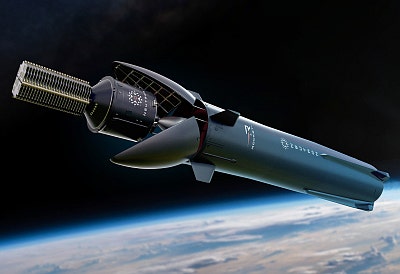
Artist’s rendering of Neutron’s first stage fairings opening
to deploy the payload with the second stage engine.
Rocket Lab announced yesterday that it has won a big new launch contract with an undisclosed customer for three launches of its Electron rocket and five launches of its new Neutron rocket.
The multi-launch agreement includes five dedicated Neutron launches and three dedicated Electron launches baselined to launch between 2026 and 2029. The missions will lift-off from both Rocket Lab Launch Complex 1 in New Zealand and Rocket Lab Launch Complex 3 in Virginia. Pricing for these launches aligns with Rocket Lab’s average selling price for Neutron and Electron. The remaining terms of the deal are undisclosed.
Based on the known average launch prices for these rockets, this deal is likely worth somewhere between $250 million to $300 million. That a customer was willing to purchase five launches of Neutron before the rocket has even launched is also a strong statement of confidence in Rocket Lab itself. The company hopes to do the first test launch of Neutron before the end of this year.
Rocket Lab also made a slew of other announcements yesterday. The company will be partnering with Anduril as part of its 20-launch contract with the War department to use its suborbital HASTE version of its Electron first stage for hypersonic testing. The deal involves three of those twenty launches.
The company also announced a partnership with Raytheon to “demonstrate advanced capabilities for the United States Space Force’s Space Based Interceptor program.” Rocket Lab also revealed it is acquiring the California robotic company Motiv Space Systems that has built equipment used on the Mars rover Perseverance.
Rocket Lab might not be as big as SpaceX, but it has unquestionably been as successful in its own way.

Now available in hardback and paperback as well as ebook!
From the press release: In this ground-breaking new history of early America, historian Robert Zimmerman not only exposes the lie behind The New York Times 1619 Project that falsely claims slavery is central to the history of the United States, he also provides profound lessons about the nature of human societies, lessons important for Americans today as well as for all future settlers on Mars and elsewhere in space.
“Zimmerman’s ground-breaking history provides every future generation the basic framework for establishing new societies on other worlds. We would be wise to heed what he says.” —Robert Zubrin, founder of the Mars Society.
All editions are available at Amazon, Barnes & Noble, and all book vendors, with the ebook priced at $5.99 before discount. All editions can also be purchased direct from the ebook publisher, ebookit, in which case you don't support the big tech companies and the author gets a bigger cut much sooner.
Autographed printed copies are also available at discount directly from the author (hardback $29.95; paperback $14.95; Shipping cost for either: $6.00). Just send an email to zimmerman @ nasw dot org.
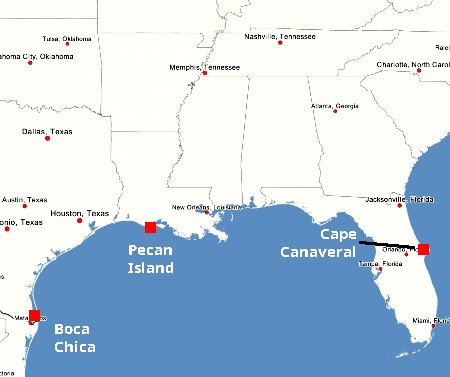
In response to the story earlier this week that SpaceX might be acquiring a 200-plus square mile patch of land near Pecan Island on the southern coast of Louisiana, a state senator has now confirmed that two unnamed aerospace companies have been talking with landowners about a possible purchase.
State Sen. Bob Hensgens, R-Abbeville, said he knows of two companies — he did not reveal if it is Elon Musk-owned SpaceX or Jeff Bezos’ Blue Origin — that have reached out to landowners in coastal Vermilion and Cameron parishes about a possible acquisition. “I know both companies are trying to find property in southwest Louisiana,” Hensgens said. “I know from people in the parishes that the companies have made outreach in the area.”
If so, we might actually have a bidding war for this property. Note however that nothing has yet been confirmed, including the names of the companies involved. The article at the link however provides some background into the 136K acre plot owned by Exxon, and how it might now be for sale. It also reports that a number of legislators (not Hensgens) have signed non-disclosure agreements about the negotiations.
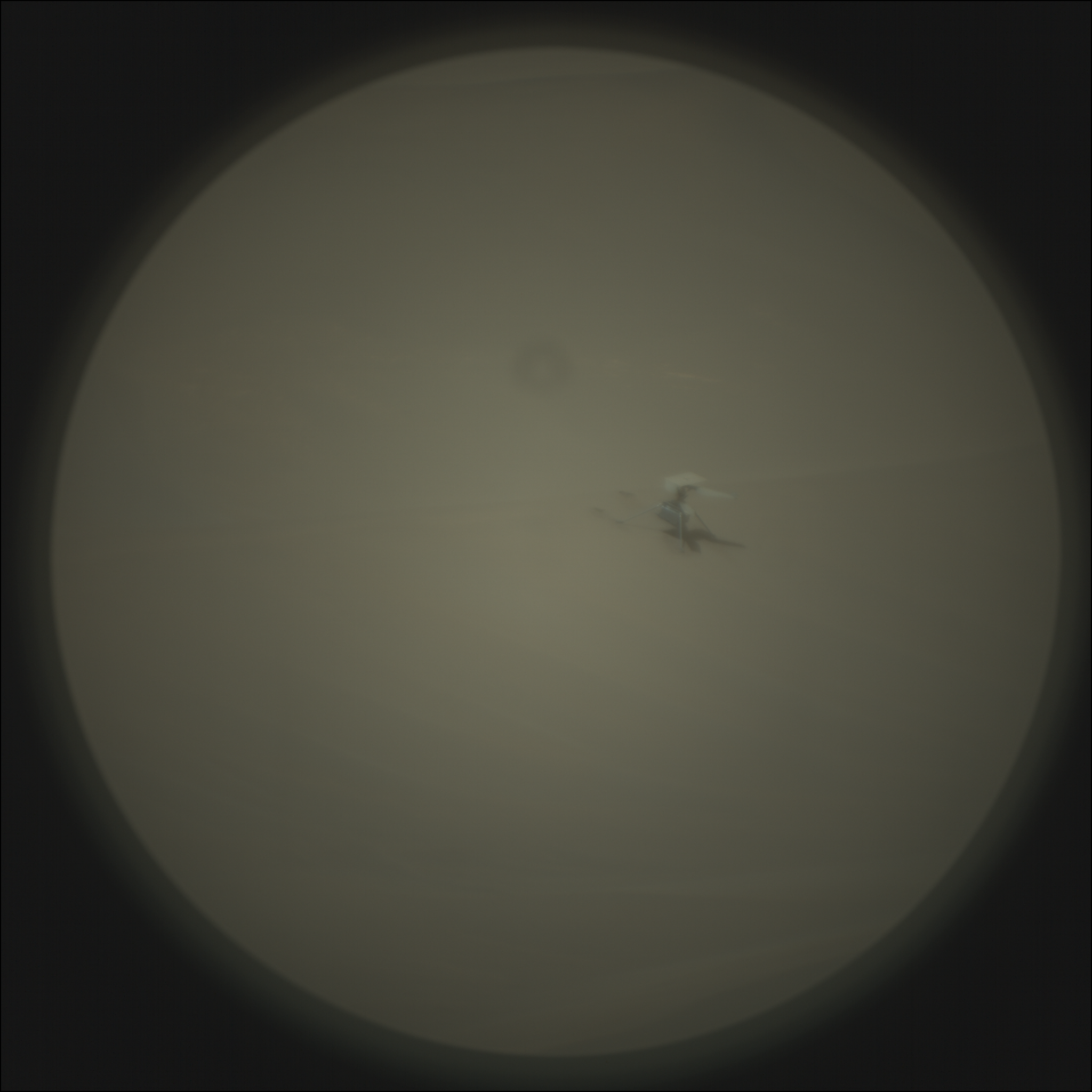
Ingenuity with its missing blade, at its final resting place on Mars.
Click for original image.
Engineers from JPL and the aerospace company AeroVironment have been testing a new set of high speed rotors that they hope to use on the next generation Mars helicopters, designed to increase their payload capacity by as much as 30%.
The rotors of Ingenuity — the first helicopter to fly on Mars — never spun faster than 2,700 rpm, because at faster speeds it would be approaching the speed of sound (on Mars), when unpredictable things could happen. Engineers are pushing those limits with these new rotors, in a chamber mimicking the thin Martian atmosphere.
The test engineers had taken the precaution of lining part of the chamber with sheet metal in case the blades broke apart during the supersonic experiment. From a control room a few yards away from the chamber, the team watched displays showing data and a view inside the chamber as the rpm climbed as high as 3,750. At that rate, the tips were traveling at Mach 0.98 [just under the Martian speed of sound]. Then the engineers activated a fan inside the chamber that pelted the rotors with headwinds. After each run, they increased in wind velocity for the next run.
The team pushed rotor tip speeds to Mach 1.08, boosting the Mars vehicle’s lift capability by 30%. This breakthrough allows future missions to support heavier scientific payloads, including advanced sensors and larger batteries for extended flight. Next the team tried their luck with the two-bladed SkyFall rotor. Because it is slightly longer than the three-bladed version, only 3,570 rpm was needed to achieve the same near-supersonic speed at the rotor tips prior to introducing the headwinds.
NASA administrator Jared Isaacman has said he wants to send a fleet of helicopters to Mars in 2028, on that first nuclear-powered mission. Whether or not that mission happens as he proposed, there is ample evidence scientists plan on sending more helicopters there in the next few years (see here, here, here). These tests lay the groundwork for those future missions.
Leaving Earth: Space Stations, Rival Superpowers, and the Quest for Interplanetary Travel, can be purchased as an ebook everywhere for only $3.99 (before discount) at amazon, Barnes & Noble, all ebook vendors, or direct from my ebook publisher, ebookit.
If you buy it from ebookit you don't support the big oppressive tech companies and I get a bigger cut much sooner.
"Leaving Earth is one of the best and certainly the most comprehensive summary of our drive into space that I have ever read. It will be invaluable to future scholars because it will tell them how the next chapter of human history opened." -- Arthur C. Clarke

Paraguay yesterday became the 67th nation to sign Artemis Accords, continued the flood of smaller third world nations that have signed up in the last few weeks following the completion of the Artemis-2 mission around the Moon.
The remarks of NASA administration Jared Isaacman in connection with this event I find most tantalizing:
“They join an ever-growing coalition of like-minded nations committed to the peaceful, transparent, and responsible exploration of space. Established by President Trump in his first term, the Artemis Accords provided the principles for how we explore the Moon, Mars, and beyond. Now, with his national space policy, we are putting the Artemis Accords into practice with our Moon Base. We are creating opportunities for all Artemis Accords signatories, including Paraguay, to join us on the lunar surface and advance our shared objectives in this next era of exploration.” [emphasis mine]
While that national space policy [pdf] accepts the Outer Space Treaty’s limitation on establishing American law on other worlds, including property rights, it also makes its first goal that of promoting private enterprise.
» Read more
An evening pause: Performed live 2012.
Hat tip Rex Ridenoure.
Courtesy of BtB’s stringer Jay. This post is also an open thread. I welcome my readers to post any comments or additional links relating to any space issues, even if unrelated to the links below.
Click for original image.
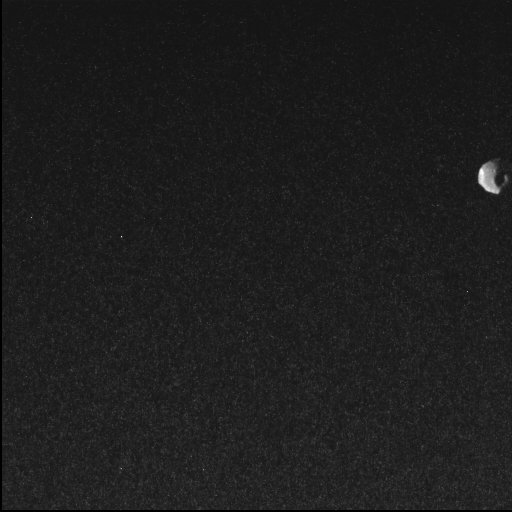
Though the Jupiter orbiter Juno is in its final orbits as it is running out of fuel, on May 1, 2026 it did a close fly-by of the 50 by 72 mile-wide Jupiter moon Thebe, getting within 3,100 miles.
The picture to the right, cropped and expanded to post here, is the best image released from that fly-by. It is very comparable to a photo taken by the Galileo orbiter on January 4, 2000. Both show the very large crater, dubbed Zethus.
The picture was taken by Juno’s Stellar Reference Unit (SRU) camera, designed not to do science but to “image star fields for navigation.” Thus, the picture is somewhat fuzzy, and was pointed poorly so the moon is on the far right, almost off camera.
It is very unclear how much longer Juno will function. It has apparently survived attempts by the Trump administration to zero out its operating budget, but there have been indications that its fuel supply is low.
Three different articles in the aerospace media today document multiple maneuvers by multiple military satellites from Russia, China, and America, either doing proximity operations near each other or moving close to another country’s satellites to spy on them.
This article in space.com describes the rendezvous operations of Russia’s Cosmos 2581, 2582, and 2583.
The satellites, known as COSMOS 2581 and COSMOS 2583, got within just 10 feet (3 meters) or so of each other on April 28, according to COMSPOC, a Pennsylvania-based space situational awareness software company. “This wasn’t a coincidental pass — COSMOS 2583 performed several fine maneuvers to maintain this tight configuration,” COMSPOC wrote in a May 1 post on X, which featured an animation of the rendezvous.
The two satellites and a third one, COSMOS 2582, launched to low Earth orbit in February 2025 atop a Soyuz rocket. According to COMSPOC, all three of them were involved in the recent rendezvous and proximity operations (RPO), as was “Object F,” a subsatellite previously deployed by COSMOS 2583.
Then russianspaceweb.com had two different articles describing different similar operations. First, a set of satellites launched in February 2026 appeared to be testing operations in very low orbit, illegally transmitting data using frequencies that the International Telecommunications Union (ITU) allocates for amateur radio operations.
Finally, the website reported a complex dance between Russian, American, and Chinese satellites in geosynchronous orbit.
Almost immediately after entering the geostationary orbit, Kosmos-2589 was “approached” by a presumed American inspector satellite, officially known as USA-325. On April 19, 2026, the US satellite, itself drifting eastward relative to the geostationary position and the Earth’s surface, seemingly overshot Kosmos-2589, but once the Russian satellite stabilized at 98 East longitude, USA-325 stopped and returned. By around April 28, 2026, … one approach under favorable lighting conditions for the “inspector” was within 13 kilometers from Kosmos-2589, according to a team of observers from Exton, PA, cited by COMSPOC.
In turn … Kosmos-2589 essentially occupied a position registered by China under designation CHNSAT-98E, with three Chinese commercial and military satellites deployed in relative vicinity of that location.
… Moreover, in April 2026, China’s presumed inspector satellite — TJS-10 — pre-positioned itself at 92.4 degrees East longitude after an easterly drift, which would put it on a rendezvous course with Kosmos-2589 at 98.0 East longitude. Instead, the Chinese satellite stopped its drift with a maneuver on May 1, 2026, which “fixed” it in a geostationary orbit at 92.4 degrees East longitude, in the vicinity of the US AEHF military satellite, which carries high-security communications of the US military and its allies.
With this last story, we have this almost absurd situation: The U.S. satellites are spying on Russian satellites, which are spying on Chinese satellites, which are spying on American satellites.
All this maneuvering however indicates once again that the ability of commercial satellites to rendezvous with other objects — either to de-orbit space junk or repair damaged satellites — is only going to get better. The military might control these capabilities now, under a veil of secrecy, but such capabilities always leak out into the private sector shortly thereafter.
Fraud is a given when it comes to government operations, whether in the U.S. or Russia. A contractor doing work on the production facilities for Russia’s new Angara rocket has now been arrested for stealing more than $7 million.
In May 2026, Gazeta.ru, citing regional courts, reported an arrest of Dmitry Zolotarev, the Director General at OOO RST Genpodryad, which was involved in renovations and upgrades of facilities for serial production of Angara rockets at PO Polyot under a contract with GKNPTs Khrunichev.
Zolotarev and his accomplices were accused of stealing 545 million rubles (approximately $7.3 million) during a period from 2022 to 2025, by submitting the Federal treasury agency in Moscow forged documents with an inflated purchase price of overhead cranes and pocketing the difference. According to Gazeta.ru, Zolotarev was suspected of other similar schemes and faced 10 years in prison if convicted.
Government routinely does a bad job in monitoring its spending, which thus creates an easy temptation for others to put their hands in the cookie jar and take what’s not theirs. We can see this same thing occurring now in the U.S. with many so-called “safety net” programs. Since Russia’s entire aerospace industry is government controlled, this kind of corruption therefore happens frequently within it.
A legal fight between Lockheed Martin and Northrop Grumman has broken out over Northrop Grumman’s recent request to the Federal Trade Commission (FTC) to ease a 2018 consent order that restricts Northrop Grumman’s ability to market its solid rocket motors (SRM).
On April 2, Northrop petitioned the Federal Trade Commission to drop a 2018 consent order helmed when Northrop acquired solid rocket motor maker Orbital ATK. The consent agreement requires Northrop to supply SRMs to its competitors in the missile market on a non-discriminatory basis and to firewall its SRM business away from its other operations.
At the time, the FTC believed the measure was necessary due to Northrop’s status as a prime contractor and Orbital ATK’s position as one of only two American makers of solid rocket motors.
Northrop is not a major manufacturer in the American missile space, which is dominated by Raytheon and Lockheed. However, if the order is dropped, Northrop will be able to vertically integrate its solid rocket motor business with any munitions the company designs in the future — including potentially prioritizing SRM supplies for Northrop over competitors, Lockheed stated in a response to the petition.
This consent order has prevented Northrop from marketing its solid-fueled rockets openly. Instead, it appears it forces the company to sell to its competitors, such as Lockheed, who then garners the big profits in marketing them. That order I think has also limited Northrop’s ability to use its boosters for other purposes, such as launching satellites.
Overall it appears this consent order has been very counter-productive, in hindering competition in the American solid-fueled rocket industry. At present there is a shortage of production capacity in the U.S., so much so that the Italian rocket company has moved in to market its own solid-fueled rockets here. In fact, it is selling its rockets to Lockheed and Raytheon, which suggests Northrop is entirely justified in asking to be released from this order.
Even as it prepares for the first orbital launch attempt of its Vikram-1 rocket, the Indian rocket startup Skyroot has raised $60 million in private investment capital in a recent funding round, bringing the total raised by the company to $160 million.
The startup announced it had raised $60 million at a valuation of $1.1 billion prior to the funding. The round was co-led by early Google investor Ram Shriram’s venture capital firm, Sherpalo Ventures, and Singapore’s sovereign wealth fund, GIC. New investors in the round include funds managed by BlackRock, Playbook Partners, Shanghvi Family Office, and others. Existing investors that also participated in the round include the founders of Greenko Group and Arkam Ventures.
The company hopes to launch Vikram-1 in about two months, though no specific launch window has been announced. The rocket is presently being shipped to India’s Sriharikota spaceport.
Embedded below the fold in two parts.
To listen to all of John Batchelor’s podcasts, go here.
» Read more
An evening pause: Chorus:
Take back your evidence
It has no power to deceive
I`ll believe it when I see it for myself
I don`t need no one to tell me about heaven
I look at my daughters, and I believe.
I don`t need no proof when it comes to God and truth
Hat tip Clark Jerrell.
Courtesy of BtB’s stringer Jay. This post is also an open thread. I welcome my readers to post any comments or additional links relating to any space issues, even if unrelated to the links below.
According to the most recent financial report from the Canadian satellite communications company Telesat, it expects its Lightspeed low-Earth-orbit (LEO) satellite constellation to be launched and operational by 2028.
During the first quarter, Telesat invested $171 million into the Lightspeed program, reflecting $19 million in operating expenses and $152 million in capital expenditures, bringing its total investment to date to approximately $2.7 billion.
The company reported advancing through several technical milestones in early 2026. “During the quarter, we held further design reviews with our satellite and launch vehicle dispenser manufacturers and progressed our work on user terminals, network and satellite operations software development, and ground station deployments,” noted Telesat President and CEO Dan Goldberg.
The company confirmed it remains fully funded, utilizing cash on hand and existing financing facilities, to reach full global commercial service around the end of the first quarter of 2028.
At the moment however the company has launched no satellites in this LEO constellation. Moreover, in a recent amendment to its FCC application, the company reduced the size of the constellation from 1,671 satellites to only 300, with no explanation.
We shall see what happens. My instincts sense a bit of blarney here. This constellation will likely launch, but I think the company’s proposed schedule is questionable.

Click for movie. Original images found here, here, here, and here.
In their latest drilling campaign using the drill on the Mars rover Curiosity, the science team picked up a big surprise that could have been a serious problem, but turned out all right in the end. When they tried to extract the drill from the hole, the drill instead stayed stuck to the rock, and picked the whole rock up instead.
The four images to the right show the sequence, sourced from here, here, here, and here.
On April 25, 2026, Curiosity drilled a sample from a rock nicknamed “Atacama,” which is an estimated 1.5 feet in diameter at its base, 6 inches thick and weighs roughly 28.6 pounds (13 kilograms). When the rover retracted its arm, the entire rock lifted out of the ground, suspended by the fixed sleeve that surrounds the rotating drill bit. Drilling has fractured or separated the upper layers of rocks in the past, but a rock has never remained attached to the drill sleeve. The team initially tried vibrating the drill to shake off the rock, but saw no change.
Then, on April 29, they tried reorienting Curiosity’s robotic arm and vibrating the drill again. Imagery in the GIF shows sand falling from Atacama, but the rock stayed attached to the rover.
Finally, on May 1, Curiosity’s team tried again, tilting the drill more, rotating and vibrating the drill, and spinning the drill bit. The team planned to perform these actions multiple times but the rock came off on the first round, fracturing as it hit the ground.
Had they not been able to release the rock it could have seriously impacted the mission, even ended it.
As noted by the science team in their own update today about this situation:
Future activities involve wrapping up the drill campaign on Atacama and, nominally, seeking a more firmly rooted drill target in order to collect drill tailings for analysis, which were lost from Atacama as part of the effort to dislodge the drill bit from the rock.
In other words, they are going to have hunt around for a better drill spot, as they really do want to study some drill samples at this location. They have left the boxwork area and have moved uphill closer to the pure sulfite unit, and want to see how the geology has changed.
Proposed or active spaceports in North Europe
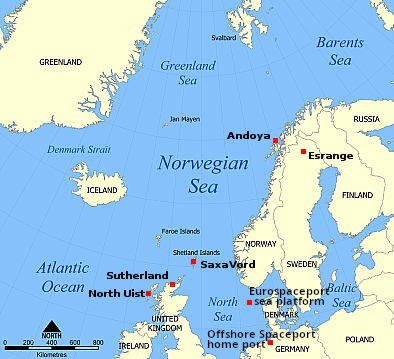
In a news report yesterday about the failure of the United Kingdom’s rocket startup Orbex in February 2026, the following details about the Sutherland spaceport in Scotland suggests that spaceport is now defunct, with little chance of being revived.
Administrators say that one of Orbex’s key remaining assets is the Sutherland Spaceport site near Melness – although the only construction work undertaken at the site is some 600m of access road. The company responsible for it, Sutherland Spaceport Ltd (SSL), remains financially stable, according to administrators. This means the site could still be sold or potentially restarted, even though no launch activity is currently taking place.
The spaceport sits on land leased from local crofters under a long-term arrangement managed through Highlands and Islands Enterprise. SSL holds a 50-year sublease, with an option to extend for 25 years, and a break clause in 2027.
Orbex had originally intended to launch from Sutherland — close to the rocket factory it had built — but local opposition by billionaire Anders Holch Povlsen (who is a major owner in the competing Saxavord spaceport on the Shetland Islands) as well as endless bureaucratic delays from the UK’s Civil Aviation Authority made that impossible. The company attempted to switch its launches to Saxavord, but the cost and new licensing requirements were too much.
No other launch company has expressed any interest in using Sutherland, and it appears none will be forthcoming in the near future. The red tape in the UK, combined with that powerful local opposition, has made Sutherland a pariah to the smallsat rocket companies looking for launch sites.
Though the spaceport might say it is “financially stable”, without any customers I guarantee it is going to disappear at some point.


