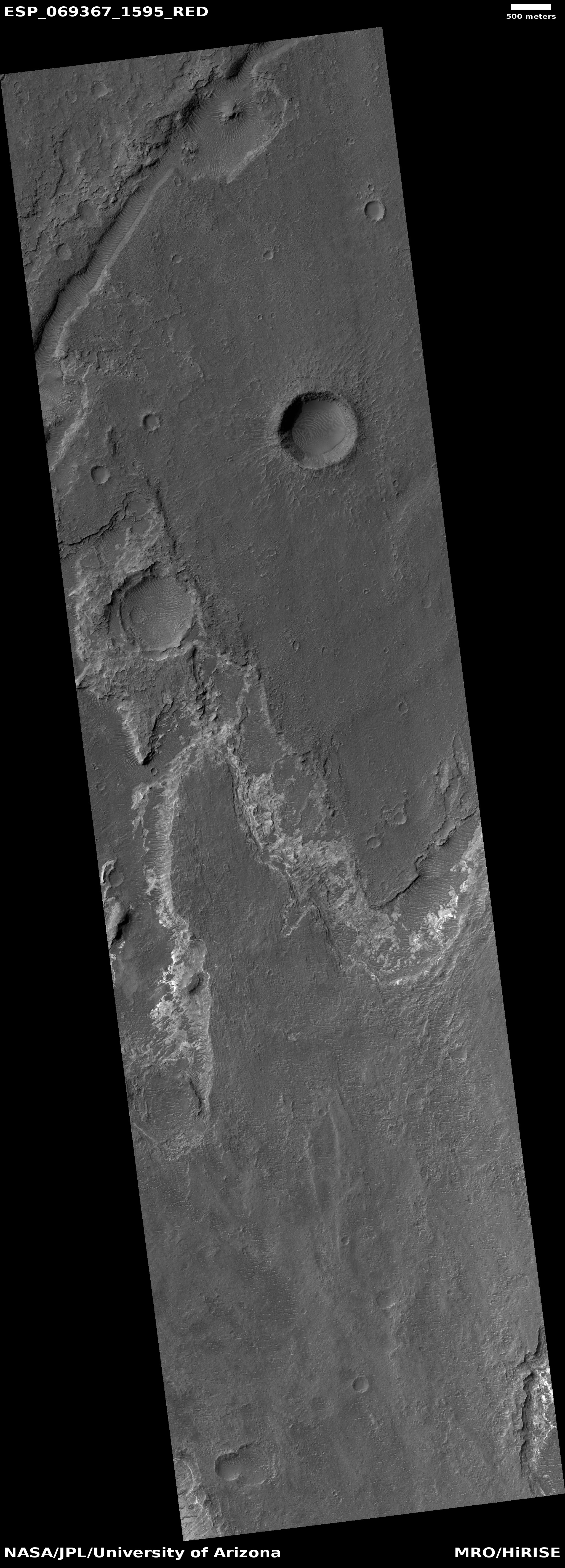
Eroding glacier on Martian slope?

Eroding glacier on Martian slope?
Click for original image.

Cool image time! The picture to the right, enhanced, cropped, reduced, and sharpened to post here, was taken on April 1, 2023 by the high resolution camera on Mars Reconnaissance Orbiter (MRO). It shows what the science team labels as “Rough Ground and Bright Exposures” on the flanks of a wide mountain range on Mars, whose highest point is about 4,400 feet higher to the northeast and about 30 miles away.

The arrow indicates the downhill grade. Notice the smooth flat areas that seem to only partially cover much rougher terrain below. To my eye this top layer resembles an Earth glacier that has partly sublimated or melted away, exposing the rougher bedrock below that has been ground and scraped by the glacier previously.

However, this is not on Earth, so assuming it is like an Earth glacier is dangerous.
» Read more

0 comments

NASA worried FAA launch permit delays to Starship/Superheavy will delay first lunar landing

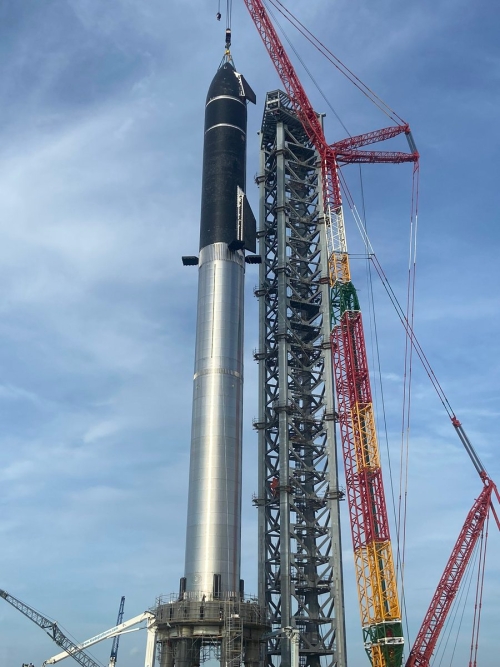
During a public meeting on June 7, 2023, a NASA official expressed concerns that the FAA’s slow launch permit process for SpaceX’s test program for developing Starship/Superheavy will end up seriously delaying the first Artemis manned lunar landing, presently targeting a December 2025 launch date.

The official, Jim Free, was very careful how he worded his comments, but the FAA issue loomed large in his mind.

Free said NASA met with the Federal Aviation Administration recently to discuss the importance of the Starship rocket to the space agency’s moon exploration plans. The FAA is overseeing SpaceX’s investigation into the problems encountered on the April 20 test launch, when the flight termination system took longer to destroy the rocket than expected. The destruct system is designed to terminate the flight before an errant rocket threatens populated areas.

The FAA is not expected to grant SpaceX another Starship launch license until the investigation is complete, and federal regulators are satisfied with changes to the rocket to address any public safety concerns. “They just have to get flying,” Free said of SpaceX. “When you step back and you look at (it), that’s a lot of launches to get those missions done, so our FAA partners are critical to that.”

For the FAA to treat SpaceX’s test program like ordinary launches, requiring a detailed investigation by it after every test flight, will likely delay the development of Starship/Superheavy by years.

Following the early suborbital tests of Starship, the FAA did not “oversee” the investigations. The FAA merely observed closely SpaceX’s investigation, and let it move forward when SpaceX was satisfied. Now the FAA wants to determine for itself when each launch will occur, even though there is no one at the FAA truly qualified to do that. The result will be endless delays and paperwork, and many fewer flights spaced many more months apart, none of which will do anything to aid the development.

NASA is obviously trying to get the FAA to see this, but we must remember that the change in policy at the FAA almost certainly came from the Biden administration, which doesn’t care as much for getting to the Moon as it does wielding its power to hurt Elon Musk, whom it now sees as a political opponent. Expect NASA’s pleas to fall on deaf ears.

22 comments

Genesis cover

On Christmas Eve 1968 three Americans became the first humans to visit another world. What they did to celebrate was unexpected and profound, and will be remembered throughout all human history. Genesis: the Story of Apollo 8, Robert Zimmerman's classic history of humanity's first journey to another world, tells that story, and it is now available as both an ebook and an audiobook, both with a foreword by Valerie Anders and a new introduction by Robert Zimmerman.

The print edition can be purchased at Amazon or any other book seller. If you want an autographed copy the price is $60 for the hardback and $45 for the paperback, plus $8 shipping for each. Go here for purchasing details. The ebook is available everywhere for $5.99 (before discount) at amazon, or direct from my ebook publisher, ebookit. If you buy it from ebookit you don't support the big tech companies and the author gets a bigger cut much sooner.


The audiobook is also available at all these vendors, and is also free with a 30-day trial membership to Audible.
 

"Not simply about one mission, [Genesis] is also the history of America's quest for the moon... Zimmerman has done a masterful job of tying disparate events together into a solid account of one of America's greatest human triumphs."--San Antonio Express-News

Firefly buys orbital tug company Spaceflight

Firefly Aerospace announced yesterday that it has purchased the orbital tug company Spaceflight, and will now offer its Sherpa tug as part of its launch services.

Spaceflight Inc. was known as a leader in arranging launches of small satellites on small launch vehicles or as secondary payloads on larger launch vehicles, deploying more than 460 payloads. Spaceflight had also developed its own series of orbital transfer vehicles called Sherpa, using a mix of chemical and electric propulsion systems.

Spaceflight has worked with a wide range of launch providers, although at one point it ran afoul of one of its largest partners, SpaceX. However, Firefly said that Spaceflight’s services will, going forward, be used only with Firefly’s vehicles.

Though Firefly will honor the contracts Spaceflight arranged for smallsats to be launched on other rockets, it appears it will be no longer be acting as a launch arranger. Instead, it will offer smallsats a package launch deal, including both its Alpha rocket and the tug. For this deal to pay off however Firefly has got to get Alpha operational. The two launches scheduled for this summer should do this, assuming they fly with no problems.

0 comments

Space Force awards SpaceX and ULA contracts for six launches each

As part of its long term launch agreement with SpaceX and ULA, the Space Force today awarded both companies contracts for six launches each, all to occur beginning in 2025.

According to the overall agreement, each company got five-year contracts to launch as many as 40 missions. ULA won 60% of the missions and SpaceX 40%. However, the delays to ULA’s Vulcan rocket will likely change those numbers:

In a report released June 8, the Government Accountability Office noted that the NSSL program office continues to order launch services from ULA and SpaceX amid concerns about Vulcan’s delays. “ULA delayed the first certification flight of the Vulcan launch system … to accommodate challenges with the BE-4 engine and a delayed commercial payload, nearly two years later than originally planned,” said GAO. “In the event that Vulcan is unavailable for future missions, program officials stated that the Phase 2 contract allows for the ability to reassign missions to the other provider.”

One of the reasons that ULA has not hurried its effort to make Vulcan reusable and more competitive with SpaceX is that is already has this guaranteed military launch commitment. It doesn’t need to be as competitive.

What needs to happen is a third or fourth company has to enter the market, giving the military other options. The military also has to cancel this long term launch agreement, which limits the number of companies it will do business with to just SpaceX and ULA. It would be much better to open the competition up to everyone. The ULA would be forced to compete.

4 comments

Conscious Choice cover

Now available in hardback and paperback as well as ebook!

From the press release: In this ground-breaking new history of early America, historian Robert Zimmerman not only exposes the lie behind The New York Times 1619 Project that falsely claims slavery is central to the history of the United States, he also provides profound lessons about the nature of human societies, lessons important for Americans today as well as for all future settlers on Mars and elsewhere in space.

 
Conscious Choice: The origins of slavery in America and why it matters today and for our future in outer space, is a riveting page-turning story that documents how slavery slowly became pervasive in the southern British colonies of North America, colonies founded by a people and culture that not only did not allow slavery but in every way were hostile to the practice.  
Conscious Choice does more however. In telling the tragic history of the Virginia colony and the rise of slavery there, Zimmerman lays out the proper path for creating healthy societies in places like the Moon and Mars.


“Zimmerman’s ground-breaking history provides every future generation the basic framework for establishing new societies on other worlds. We would be wise to heed what he says.” —Robert Zubrin, founder of the Mars Society.


All editions are available at Amazon, Barnes & Noble, and all book vendors, with the ebook priced at $5.99 before discount. All editions can also be purchased direct from the ebook publisher, ebookit, in which case you don't support the big tech companies and the author gets a bigger cut much sooner.


Autographed printed copies are also available at discount directly from the author (hardback $29.95; paperback $14.95; Shipping cost for either: $6.00). Just send an email to zimmerman @ nasw dot org.

X-ray telescope on ISS develops light leak

The NICER X-ray telescope on ISS has developed a light leak that now limits its use during daylight hours.

The team suspects that at least one of the thin thermal shields on NICER’s 56 X-ray Concentrators has been damaged, allowing sunlight to reach its sensitive detectors.

Pending any repair attempts, observations during the daytime are now restricted to objects in the sky opposite the Sun. Night observations remain unaffected.

2 comments

Study: Long periods of weightlessness caused changes in the brain

Scientists studying the brains of 30 astronauts who spent from two weeks to one year on ISS have found that the longer a person stayed in weightlessness the greater the changes caused in the brain, and the longer it takes to recover.

Their findings, reported today in Scientific Reports, reveal that the brain’s ventricles expand significantly in those who completed longer missions of at least six months, and that less than three years may not provide enough time for the ventricles to fully recover.

Ventricles are cavities in the brain filled with cerebrospinal fluid, which provides protection, nourishment and waste removal to the brain. Mechanisms in the human body effectively distribute fluids throughout the body, but in the absence of gravity, the fluid shifts upward, pushing the brain higher within the skull and causing the ventricles to expand.

“We found that the more time people spent in space, the larger their ventricles became,” said Rachael Seidler, a professor of applied physiology and kinesiology at the University of Florida and an author of the study. “Many astronauts travel to space more than one time, and our study shows it takes about three years between flights for the ventricles to fully recover.”

You can read the paper here. The expansion of ventricles is a normal process due to aging, but I could not find any description in the paper noting its impact, for good or ill. Long periods of weightlessness brings it about quickly, but only temporarily.

5 comments

Leaving Earth cover

Leaving Earth: Space Stations, Rival Superpowers, and the Quest for Interplanetary Travel, can be purchased as an ebook everywhere for only $3.99 (before discount) at amazon, Barnes & Noble, all ebook vendors, or direct from my ebook publisher, ebookit.

If you buy it from ebookit you don't support the big oppressive tech companies and I get a bigger cut much sooner.


Winner of the 2003 Eugene M. Emme Award of the American Astronautical Society.

 
"Leaving Earth is one of the best and certainly the most comprehensive summary of our drive into space that I have ever read. It will be invaluable to future scholars because it will tell them how the next chapter of human history opened." -- Arthur C. Clarke

China’s Kuaizhou-1A solid-fueled rocket launches satellite

China’s Kuaizhou-1A solid-fueled rocket today successfully placed what its state-run press described as a “experiment satellite … to verify satellite communication and remote sensing technologies.”

The rocket lifted off from China’s interior Jiuquan spaceport in the Gobi desert. No word on where the rocket’s three lower stages crashed, or whether they did so near habitable areas.

The leaders in the 2023 launch race:

38 SpaceX
22 China
8 Russia
5 Rocket Lab

American private enterprise still leads China 43 to 22 in the national rankings, and the entire world combined 43 to 38, with SpaceX by itself now tied those other nations combined 38 to 38.

1 comment

Abbott & Costello – Modern Math

An evening pause: From their 1941 movie, In the Navy.

Hat tip sippin_bourbon, who “actually re-enacted this for a few classmates in 7th grade, then walked out
while they scratched their heads. The teacher, who had been watching caught me in the way out the door and told me not to do that on a test.” Sadly, a modern teacher today might consider this good math.

5 comments

Pushback: Racial quotas on corporate boards, imposed by California Democrats, struck down by court

The Democratic Party's long held support of racial hate
Segregation: The Democratic Party’s long held #1 goal,
then and now.

Pushback: A federal court has now struck down a 2020 law passed by the California legislature — run entirely by a Democratic Party super-majority — that required corporations to impose racial quotas on who they hired for their corporate boards.

In Alliance for Fair Board Recruitment v. Weber, [the court] struck down a state statute that required racial and gender-identity quotas for board members of publicly held corporations in California. The court ruled that this quota statute violates the U.S. Constitution as well as federal civil rights law.

The 2020 statute, AB 979, required California corporations to have as members on their board of directors individuals from supposedly “underrepresented groups,” including “an individual who identifies as Black, African American, Hispanic, Latino, Asian, Pacific Islander, Native American, Native Hawaiian, or Alaska Native, [or] gay, lesbian, bisexual, or transgender.”

The number of directors needed to satisfy these quotas was determined by the size of the corporation, but a minimum of one to three members was required. This racist statute went so far as to impose fines ranging from $100,000 to $300,000 for noncompliance.

» Read more

9 comments

Ice-filled fissure on Mars?

Ice-filled fissure on Mars?
Click for original image.

Cool image time! The picture to the right, cropped, reduced, and sharpened to post here, was taken on February 15, 2023 by the high resolution camera on Mars Reconnaissance Orbiter (MRO). The science team labeled this a “Terrain Sample”, which suggests but doesn’t guarantee that it was to fill a gap in the camera’s schedule in order to maintain that camera’s proper temperature, and therefore was targeted at a relatively random but potentially interesting location.

What we see is a fissure canyon, about 250 to 300 feet deep with cliffs about 125 high, that appears surrounded and even filled with icelike features. Even the craters on the plateau above the canyon appear like they either impacted in ice, or have since been filled and eroded by that ice.

But is it ice?
» Read more

0 comments

Scientists claim to identify cause of Sun’s fast solar wind

The uncertainty of science: Using data from the Parker Solar Probe, scientists now believe they have identified the cause of Sun’s fast solar wind that streams from the magnetic regions on the Sun that are dubbed coronal holes.

In a paper published June 7, 2023 in the journal Nature, a team of researchers used data from NASA’s Parker Solar Probe to explain how the solar wind is capable of surpassing speeds of 1 million miles per hour. They discovered that the energy released from the magnetic field near the sun’s surface is powerful enough to drive the fast solar wind, which is made up of ionized particles—called plasma—that flow outward from the sun.

The results depend a great deal on computer modeling, based on our presently limited understanding of magnetic field processes in environments like stars. It will need to be confirmed by more data from Parker as well as later probes.

1 comment

Webb’s first deep field infrared image reveals hundreds of very early galaxies

The uncertainty of science: Using the Webb Space Telescope to take a 32-day-long infrared exposure, scientists have obtained the deepest deep field picture of the universe’s earliest time period, within which they have found more than 700 galaxies, 717 to be exact.

The initial survey of these galaxies appear to reveal several facts.

About a sixth of early galaxies in the JADES sample are in the throes of star formation of a kind we don’t see in the nearby universe, Endsley explains, marked by extremely bright emission at certain wavelengths. “Stars within very early galaxies are forming in these super-compact clumps,” he adds, “forming hundreds, perhaps thousands of these very massive, young stars all at once, basically within the span of a couple millions of years.”

But they weren’t “on” all the time. The low fraction of galaxies with such emission suggests that individual clumps would suddenly light up with new stars and then rest for some time. This “bursty” mode of star formation could explain the unexpectedly bright galaxies announced by other astronomers — they were simply looking at the galaxies fired up with unexpectedly intense star formation.

However, while these findings explain too-bright galaxies, they don’t explain the too-massive galaxies, another early, albeit controversial find from JWST data. Endsley explains that even as hot, massive newborn stars light up their galaxy, they’re not necessarily associated with all that much mass. “We’re not really finding evidence of these over-massive objects within our JADES sample,” he states.

In other words, this data appears to contradict earlier data from Webb that other researchers said revealed galaxies that were too massive and developed to have formed that soon after the Big Bang.

All of this data remains somewhat uncertain, and is based on only tiny tidbits of information, gleaned from mere smudges of red-shifted infrared light. Much more research will be required, some not possible by Webb, before we have any solid answers, and even then there is going to be a lot of uncertainty.

4 comments
1 556 557 558 559 560 2,928