Scientists claim to identify cause of Sun’s fast solar wind

The uncertainty of science: Using data from the Parker Solar Probe, scientists now believe they have identified the cause of Sun’s fast solar wind that streams from the magnetic regions on the Sun that are dubbed coronal holes.

In a paper published June 7, 2023 in the journal Nature, a team of researchers used data from NASA’s Parker Solar Probe to explain how the solar wind is capable of surpassing speeds of 1 million miles per hour. They discovered that the energy released from the magnetic field near the sun’s surface is powerful enough to drive the fast solar wind, which is made up of ionized particles—called plasma—that flow outward from the sun.

The results depend a great deal on computer modeling, based on our presently limited understanding of magnetic field processes in environments like stars. It will need to be confirmed by more data from Parker as well as later probes.

1 comment

Webb’s first deep field infrared image reveals hundreds of very early galaxies

The uncertainty of science: Using the Webb Space Telescope to take a 32-day-long infrared exposure, scientists have obtained the deepest deep field picture of the universe’s earliest time period, within which they have found more than 700 galaxies, 717 to be exact.

The initial survey of these galaxies appear to reveal several facts.

About a sixth of early galaxies in the JADES sample are in the throes of star formation of a kind we don’t see in the nearby universe, Endsley explains, marked by extremely bright emission at certain wavelengths. “Stars within very early galaxies are forming in these super-compact clumps,” he adds, “forming hundreds, perhaps thousands of these very massive, young stars all at once, basically within the span of a couple millions of years.”

But they weren’t “on” all the time. The low fraction of galaxies with such emission suggests that individual clumps would suddenly light up with new stars and then rest for some time. This “bursty” mode of star formation could explain the unexpectedly bright galaxies announced by other astronomers — they were simply looking at the galaxies fired up with unexpectedly intense star formation.

However, while these findings explain too-bright galaxies, they don’t explain the too-massive galaxies, another early, albeit controversial find from JWST data. Endsley explains that even as hot, massive newborn stars light up their galaxy, they’re not necessarily associated with all that much mass. “We’re not really finding evidence of these over-massive objects within our JADES sample,” he states.

In other words, this data appears to contradict earlier data from Webb that other researchers said revealed galaxies that were too massive and developed to have formed that soon after the Big Bang.

All of this data remains somewhat uncertain, and is based on only tiny tidbits of information, gleaned from mere smudges of red-shifted infrared light. Much more research will be required, some not possible by Webb, before we have any solid answers, and even then there is going to be a lot of uncertainty.

4 comments

Genesis cover

On Christmas Eve 1968 three Americans became the first humans to visit another world. What they did to celebrate was unexpected and profound, and will be remembered throughout all human history. Genesis: the Story of Apollo 8, Robert Zimmerman's classic history of humanity's first journey to another world, tells that story, and it is now available as both an ebook and an audiobook, both with a foreword by Valerie Anders and a new introduction by Robert Zimmerman.

The print edition can be purchased at Amazon or any other book seller. If you want an autographed copy the price is $60 for the hardback and $45 for the paperback, plus $8 shipping for each. Go here for purchasing details. The ebook is available everywhere for $5.99 (before discount) at amazon, or direct from my ebook publisher, ebookit. If you buy it from ebookit you don't support the big tech companies and the author gets a bigger cut much sooner.


The audiobook is also available at all these vendors, and is also free with a 30-day trial membership to Audible.
 

"Not simply about one mission, [Genesis] is also the history of America's quest for the moon... Zimmerman has done a masterful job of tying disparate events together into a solid account of one of America's greatest human triumphs."--San Antonio Express-News

Boeing sued for stealing specialized tooling to assembly SLS

A Colorado company, Wilson Aerospace, on June 6, 2023 filed a lawsuit against Boeing, claiming that the company conspired with Wilson’s direct competitors to steal the designs of its specialized tool for installing the core station engines on SLS.

According to the lawsuit, after some initial discussions, Boeing arranged for a “live” demonstration of Wilson’s torque device, during which participants could handle and operate it to verify the tool’s capability and performance. What Wilson claims it did not realize, however, is that some of the participants in this demonstration were not Boeing employees. “Wilson later learned that at least seven of those in attendance for the live presentation were external to Boeing and were, at the time, employees of Wilson’s direct competitors,” the lawsuit states. “This fact was concealed from Wilson who was deceived by Boeing and the ‘Bogus Boeing Employees’ into giving the presentation by falsely suggesting to Wilson that everyone was a Boeing employee.”

The complaint alleges that Boeing subsequently used information from this demonstration, as well as proprietary drawings and designs, to work with Wilson’s competitors to develop a cheaper solution. “Boeing concealed these facts from Wilson as part of its scheme to defraud Wilson and to transmit Wilson’s IP to its direct competitors,” the lawsuit states.

The company is demanding a jury trial. If its charges are proved true, it will be another piece of evidence demonstrating the level of corruption that exists at Boeing.

6 comments

ULA completes dress rehearsal launch countdown and static fire test of Vulcan

ULA yesterday successfully completed a full dress rehearsal launch countdown new Vulcan rocket, including a short 2-second static fire test of the rocket’s two first stage BE-4 engines.

A Vulcan rocket fired its two BE-4 engines in a static-fire test called the Flight Readiness Firing (FRF) at 9:05 p.m. Eastern from Cape Canaveral’s Space Launch Complex 41. The engine start sequence started at T-4.88 seconds, ULA said in a statement an hour after the test, with the engines throttling up to their target level for two seconds before shutting down, concluding the six-second test.

The test appeared to go as planned. “Nominal run,” Tory Bruno, president and chief executive of ULA, tweeted moments after the test.

This dress rehearsal had originally been scheduled for late May, but issues on the rocket required ULA to scrub the launch and return the rocket to the assembly building.

There appear to be only three issues remaining before that first launch can occur. First there is the hydrogen leak that caused the destruction of the rocket’s Centaur upper stage during a static fire engine test in March. The company has apparently still not determined what action — if any — must be taken on this.

Second is whether the rocket’s primary payload, Astrobotic’s Peregrine lunar lander, is ready for launch. It appears it has completed all ground testing, but there were questions whether its software has been adjusted for a new landing site that NASA assigned it in February.

Third is scheduling. Peregrine’s monthly launch windows are only four to five days long each month. This limitation also has to be juggled with other ULA launches on the same launchpad, using its soon-to-be retired Atlas-5 rocket.

1 comment

Conscious Choice cover

Now available in hardback and paperback as well as ebook!

From the press release: In this ground-breaking new history of early America, historian Robert Zimmerman not only exposes the lie behind The New York Times 1619 Project that falsely claims slavery is central to the history of the United States, he also provides profound lessons about the nature of human societies, lessons important for Americans today as well as for all future settlers on Mars and elsewhere in space.

 
Conscious Choice: The origins of slavery in America and why it matters today and for our future in outer space, is a riveting page-turning story that documents how slavery slowly became pervasive in the southern British colonies of North America, colonies founded by a people and culture that not only did not allow slavery but in every way were hostile to the practice.  
Conscious Choice does more however. In telling the tragic history of the Virginia colony and the rise of slavery there, Zimmerman lays out the proper path for creating healthy societies in places like the Moon and Mars.


“Zimmerman’s ground-breaking history provides every future generation the basic framework for establishing new societies on other worlds. We would be wise to heed what he says.” —Robert Zubrin, founder of the Mars Society.


All editions are available at Amazon, Barnes & Noble, and all book vendors, with the ebook priced at $5.99 before discount. All editions can also be purchased direct from the ebook publisher, ebookit, in which case you don't support the big tech companies and the author gets a bigger cut much sooner.


Autographed printed copies are also available at discount directly from the author (hardback $29.95; paperback $14.95; Shipping cost for either: $6.00). Just send an email to zimmerman @ nasw dot org.

Chinese pseudo-company launches its rocket for 2nd time

The Chinese pseudo-company CAS Space yesterday successfully launched its rocket Lijian-1 rocket for second time, lifting off from China’s interior Jiuquan spaceport in the Gobi Desert and carrying a record (for China) of 26 cubesats.

As was usual for China, its state-run press revealed almost nothing about the satellites. Nor did it provide any information about where the rocket’s lower stages crash-landed in China, or if they did any damage or landed near habitable areas.

This pseudo-company is actually even more pseudo than other Chinese pseudo-companies, as it is a direct spin-off created by the government Chinese Academy of Sciences, with most of its investors directly linked to that academy.

The leaders in the 2023 launch race:

38 SpaceX
21 China
8 Russia
5 Rocket Lab

American private enterprise still leads China 43 to 21 in the national rankings, and the entire world combined 43 to 37, with SpaceX by itself beating those other nations combined 38 to 37.

0 comments

Leaving Earth cover

Leaving Earth: Space Stations, Rival Superpowers, and the Quest for Interplanetary Travel, can be purchased as an ebook everywhere for only $3.99 (before discount) at amazon, Barnes & Noble, all ebook vendors, or direct from my ebook publisher, ebookit.

If you buy it from ebookit you don't support the big oppressive tech companies and I get a bigger cut much sooner.


Winner of the 2003 Eugene M. Emme Award of the American Astronautical Society.

 
"Leaving Earth is one of the best and certainly the most comprehensive summary of our drive into space that I have ever read. It will be invaluable to future scholars because it will tell them how the next chapter of human history opened." -- Arthur C. Clarke

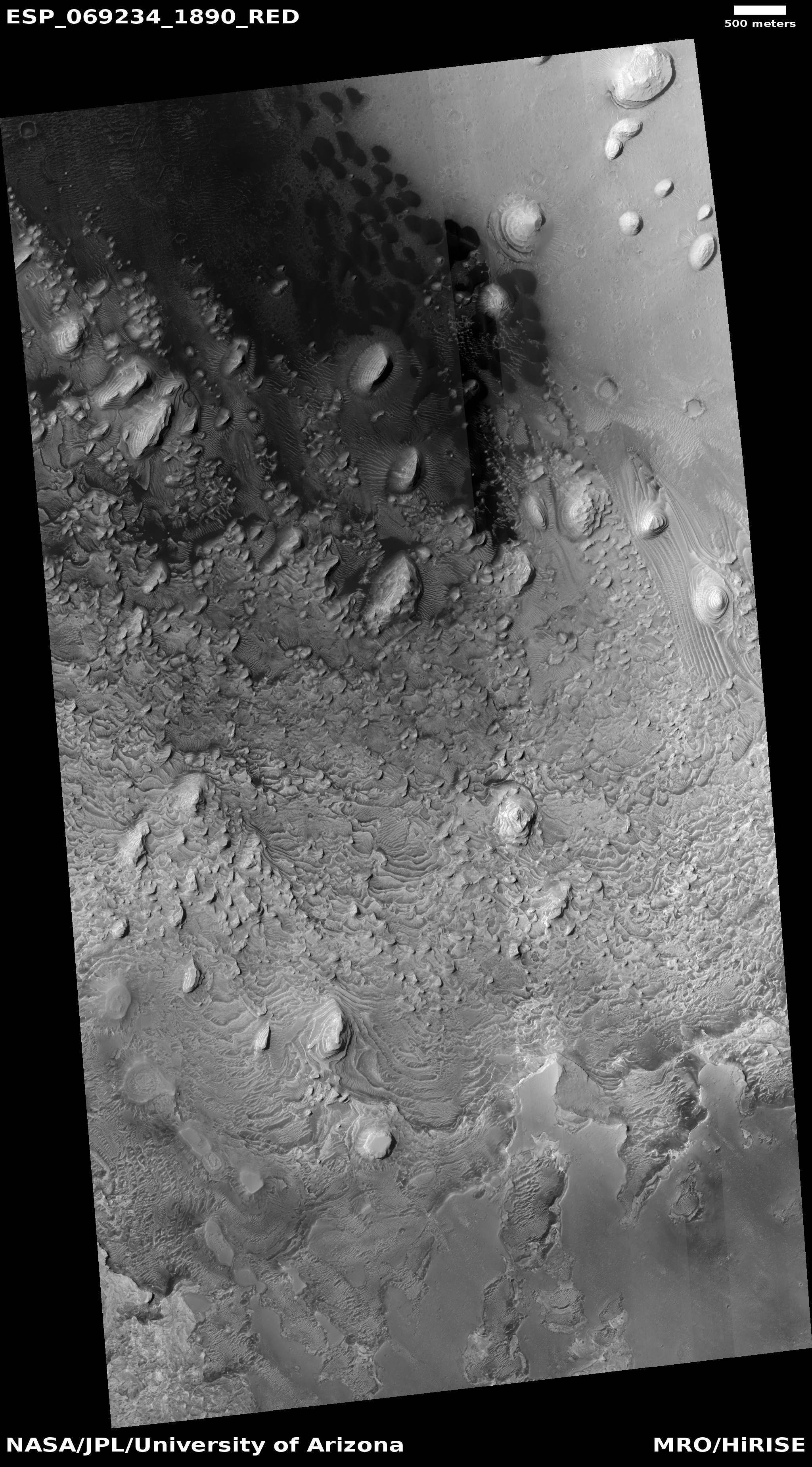
Distorted floor of a Martian crater

Overview map

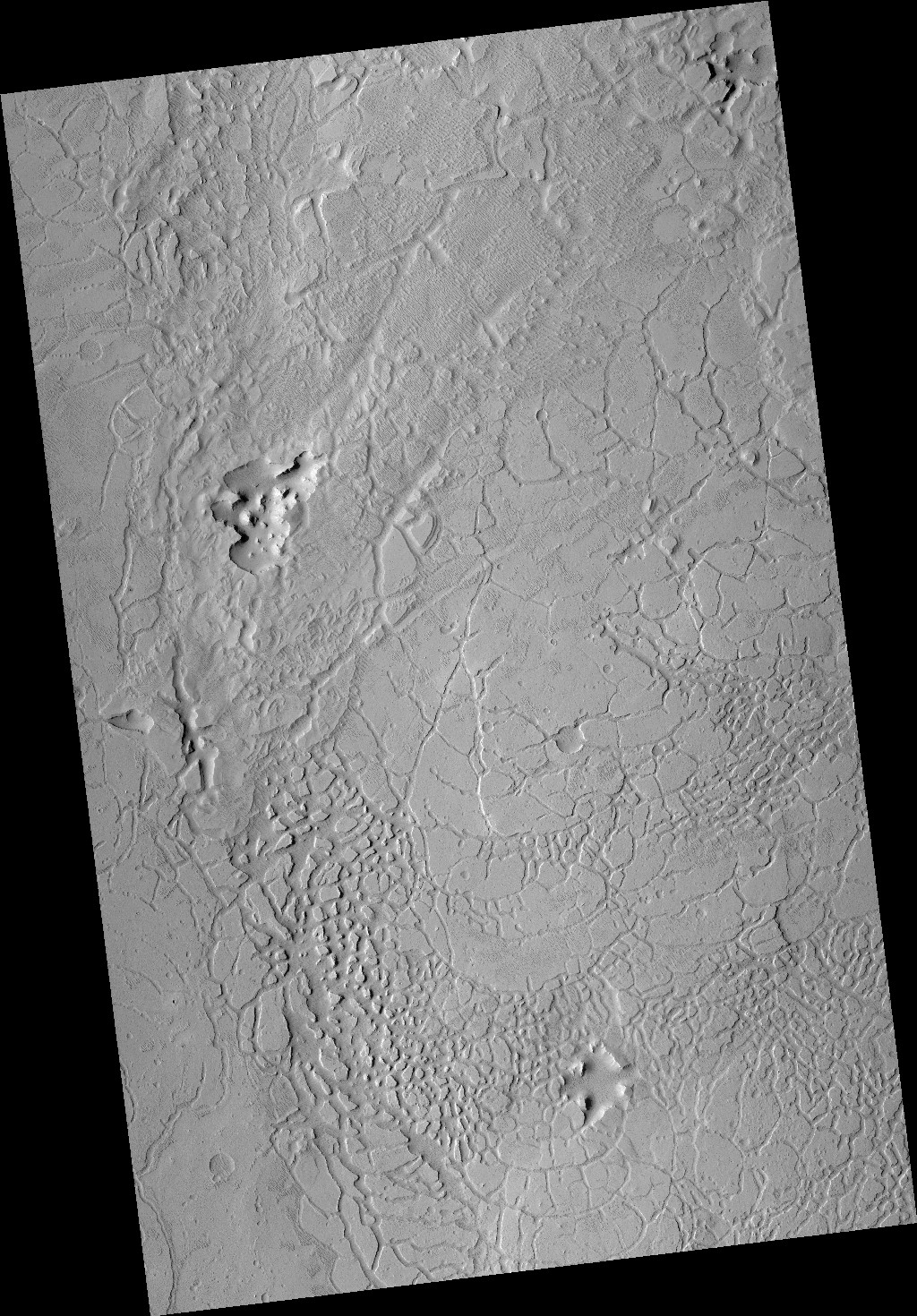
Distorted floor of a Martian crater
Click for original image.

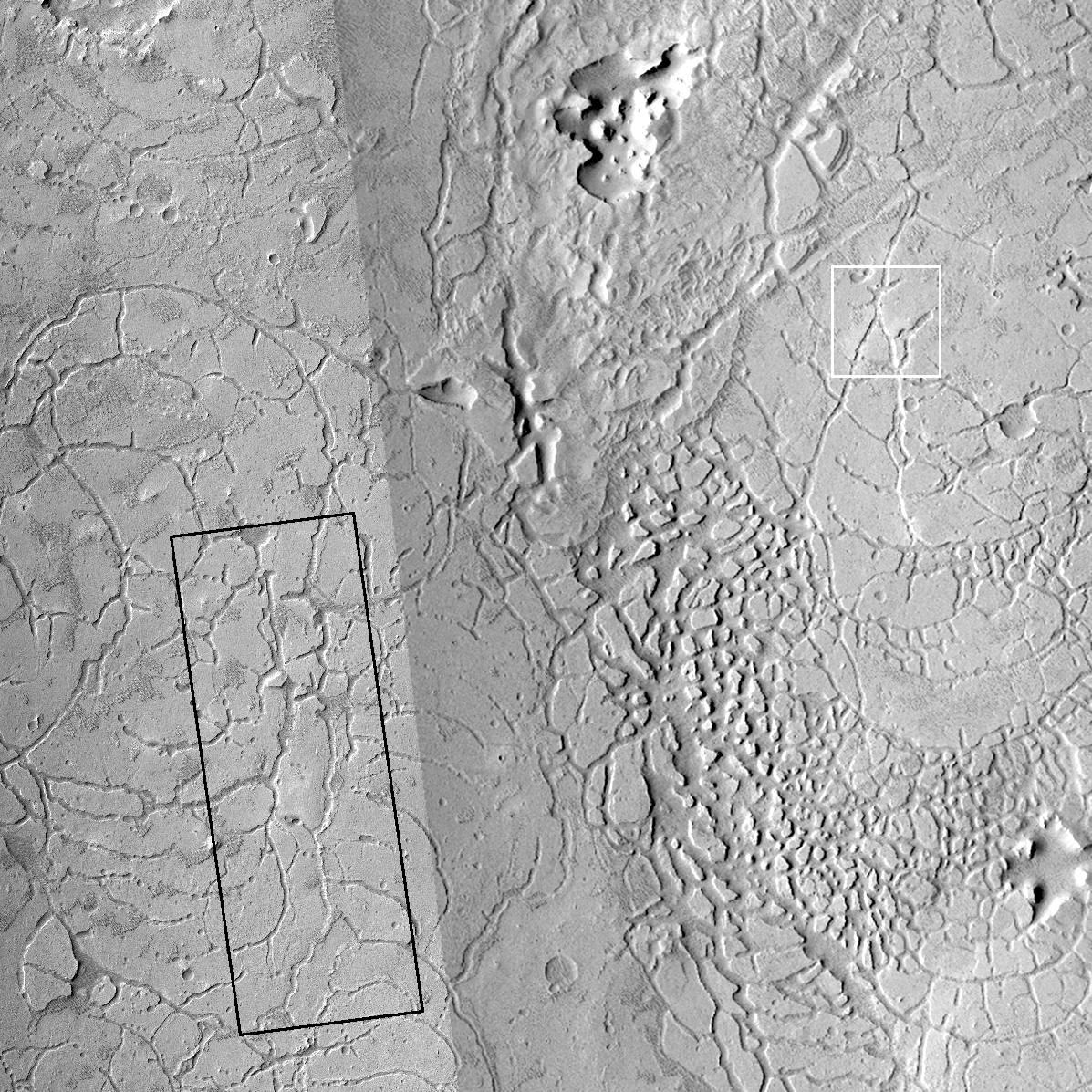
Cool image time! The picture to the right, rotated, cropped, reduced, and sharpened to post here, was taken on February 18, 2023 by the high resolution camera on Mars Reconnaissance Orbiter (MRO). It shows what the science team labels “Mantle Layers in Southern Mid-Latitudes.”

I would be less vague. These strangely shaped features invoke the typical glacial features seen throughout the mid-latitudes of Mars. The knobs and outcrops suggest some underlying breakdown that the top layers of glacial material has covered. They also suggest some form of sublimation or erosion process to the glacier itself.

The white rectangle inside the inset on the overview map above marks this location, covering the floor of an unnamed 10-mile-wide crater in the cratered southern highlands at 41 degrees south. In this region all the craters show some evidence of this sublimation, all suggesting that there is a near-surface underlying ice layer that when exposed vanishes to leave depressions or hollows. Here however it appears that ice layer is mostly intact, the knobs and ridges indicating the shape of the bedrock and large breakdown below.

0 comments

Who blew up the dam in the Ukraine?

section of ISW map
Taken from ISW’s report on June 6, 2023. Click for original.

Since the news broke yesterday that someone had blown up the Nova Kakhovka dam on the Dnipro River, there has been endless speculation by numerous pundits attempting to pin the blame. It seems that half say Russia, and half say the Ukraine.

Let me provide my readers the answer right up front: We as yet haven’t got the foggiest idea who did it.

Why am I so sure? Because in reviewing all the information I can glean from many different sources, it appears both sides had good reasons to do it, as well as good reasons to not want it to happen at all. Let’s list those reasons.
» Read more

45 comments

Astronomers downsize their proposal for rebuilding Arecibo

Faced with little interest from the National Science Foundation to spend the half a billion dollars required for their initial proposal to rebuild the Arecibo radio telescope, astronomers have now downsized their proposal significantly.

[I]n 2021 Anish Roshi, the observatory’s head of radio astronomy, unveiled a proposal to replace the telescope with a phased array of 1112 parabolic dishes each 9 m in diameter, placed on a tiltable, plate-like structure. This new facility, with an estimated cost of $454m, would provide the same a collecting area as a 300 m parabolic dish. “It would have a much wider sky coverage and would offer capabilities for radio astronomy, planetary, and space and atmospheric sciences,” Roshi says. “It would be a unique instrument for doing science that competitive projects couldn’t do.”

A lack of support from the NSF, however, has forced researchers to go back to the drawing board to make the array “more cost-effective both for construction and operation” as Roshi puts it. In the revised proposal, submitted to arXiv late last month, his team now envisions a downsized version of the original concept. Dubbed NGAT-130, it would consist of 102 dishes each 13 m in diameter that would in combination have a collecting area equivalent to a single 130 m dish.

No cost estimates are as yet available for this new proposal. Nor has the NSF expressed any opinion on whether it is even interested. At the moment its only action at Arecibo has been to propose converting the observatory into an education center, one that is located far from anything, is hard to reach, and will likely see few students or visitors.

5 comments

Gemini telescope in Hawaii fixed, captures nearby supernova

Gemini North image of supernova in Pinwheel Galaxy
Click for original image.

The Gemini telescope in Hawaii, which was damaged in 2022 during normal maintenance operations, has now been fixed and resumed observations, beginning with a spectacular image of the newly discovered supernova in the Pinwheel Galaxy, only 20 million light years away.

The Gemini North telescope, one half of the International Gemini Observatory operated by NSF’s NOIRLab, has returned from a seven-month hiatus literally with a bang, as it has captured the spectacular aftermath of a supernova, a massive star that exploded in the large, face-on, spiral Pinwheel Galaxy (Messier 101). The supernova, named SN 2023ixf [as indicated by the arrow], was discovered on 19 May by amateur astronomer Koichi Itagaki.

Since its discovery, observers around the globe have pointed their telescopes toward Messier 101 to get a look at the burst of light. Over the coming months, Gemini North will allow astronomers to study how the light from the supernova fades and how its spectrum evolves over time, helping astronomers better understand the physics of such explosions.

As one of the closest supernova to occur in years, SN 2023ixf has become a major target by astronomers. This type of supernova signals the collapse and death of a star 8 to 10 times the mass of the Sun. Since the life cycle of such massive stars is not yet fully understood, this nearby supernova provides a great opportunity for astronomers to learn more.

2 comments

Firefly delays NASA launch to August

According to papers filed with the FCC, Firefly’s July launch attempt of its Alpha rocket, carrying a set of NASA cubesats, has now been delayed one month to August.

Meanwhile, a second launch by Firefly for the Space Force is presently tentatively scheduled for June, and the company says it is wrapping up preparations for that launch. That contract’s prime focus is to demonstrate to the military the ability to launch with only a 24-hour notice.

If so, then this new rocket company, which has only launched twice before, with the second launch barely reaching orbit, will be launching twice in only a matter of weeks, both times from its launchpad at Vandenberg.

0 comments
1 557 558 559 560 561 2,928