
Cyndi Lauper – Time After Time
An evening pause: Performed live on the Tonight Show, March 1, 1984.
Hat tip Diane Zimmerman.
An evening pause: Performed live on the Tonight Show, March 1, 1984.
Hat tip Diane Zimmerman.

Click for full image.
Cool image and video time! The image to the right, cropped and reduced to post here, shows something that when I spotted it in reviewing the newest image download from the high resolution camera on Mars Reconnaissance Orbiter (MRO), I found it very baffling. The photo was taken on March 3, 2020, and shows an incredible number of linear groves on the slope of a large dune inside Russell Crater, located in the Martian southern highlands at about 54 degrees south latitude.
If these were created by boulders we should see them at the bottom of each groove. Instead, the grooves generally seem to peter out as if the boulder rolling down the slope had vanished. Making this even more unlikely is that the top of the slope simply does not have sufficient boulders to make all these groves.
The image was requested by Dr. Candice Hansen of the Planetary Science Institute in Tucson, Arizona, who when I emailed her in bafflement she responded like so:
» Read more

On Christmas Eve 1968 three Americans became the first humans to visit another world. What they did to celebrate was unexpected and profound, and will be remembered throughout all human history. Genesis: the Story of Apollo 8, Robert Zimmerman's classic history of humanity's first journey to another world, tells that story, and it is now available as both an ebook and an audiobook, both with a foreword by Valerie Anders and a new introduction by Robert Zimmerman.
The print edition can be purchased at Amazon or any other book seller. If you want an autographed copy the price is $60 for the hardback and $45 for the paperback, plus $8 shipping for each. Go here for purchasing details. The ebook is available everywhere for $5.99 (before discount) at amazon, or direct from my ebook publisher, ebookit. If you buy it from ebookit you don't support the big tech companies and the author gets a bigger cut much sooner.
"Not simply about one mission, [Genesis] is also the history of America's quest for the moon... Zimmerman has done a masterful job of tying disparate events together into a solid account of one of America's greatest human triumphs."--San Antonio Express-News
This makes perfect government sense: The shutdowns that our governments have imposed on people and businesses nationwide due to the Wuhan panic has forced hospitals to cut staff and shorten hours.
The article describes the growing collapse of medical services caused by the state-imposed lockdowns in Ohio, Massachusetts, Kentucky, Connecticut, South Carolina, Tennessee, New Jersey, Oregon, Virginia, and Arizona. That’s only ten states, but it is very likely the remaining states are experiencing the same problems, as described in the article:
The Connecticut Children’s Medical Center is furloughing 400 across its health system as a result of surgeries being delayed, which has caused patient volumes to plummet, resulting in millions of dollars of lost revenue, according to the Hartford Courant.
The number of elective cases at Prisma Health in South Carolina has fallen by over 75% in two weeks. CEO Mark O’Halla issued a letter to employees informing them of furloughs, adding that they will be able to file for unemployment and apply for open positions at the hospital.
Two-hundred healthcare workers in Tennessee are being furloughed as a result of “dramatically reduced” hospital visits, which means a loss of revenue, according to the Tennessean.
We need to bankrupt ourselves in order to save us! Thank you government and centralized rule!
The estimated lose to the U.S. economy due to the shutdown over the Wuhan panic is now estimated at $32 trillion, more than the entire annual gross national product for the country.
That number is of course preliminary, but for a first guess I think it is probably low, especially because it does not include the following:
It also assumes we get back to work relatively soon. Should the shut down extend through May, I think the Great Depression will appear like a lark in comparison.
Note that the overall social cost of this panic and shutdown cannot be measured, as it is also establishing new social distancing customs that are probably overwrought and counter-productive for a healthy society.

Now available in hardback and paperback as well as ebook!
From the press release: In this ground-breaking new history of early America, historian Robert Zimmerman not only exposes the lie behind The New York Times 1619 Project that falsely claims slavery is central to the history of the United States, he also provides profound lessons about the nature of human societies, lessons important for Americans today as well as for all future settlers on Mars and elsewhere in space.
“Zimmerman’s ground-breaking history provides every future generation the basic framework for establishing new societies on other worlds. We would be wise to heed what he says.” —Robert Zubrin, founder of the Mars Society.
All editions are available at Amazon, Barnes & Noble, and all book vendors, with the ebook priced at $5.99 before discount. All editions can also be purchased direct from the ebook publisher, ebookit, in which case you don't support the big tech companies and the author gets a bigger cut much sooner.
Autographed printed copies are also available at discount directly from the author (hardback $29.95; paperback $14.95; Shipping cost for either: $6.00). Just send an email to zimmerman @ nasw dot org.
For security reasons, SpaceX has banned its employees from using Zoom for video conferencing or communications.
Elon Musk’s rocket company SpaceX has banned its employees from using video conferencing app Zoom, citing “significant privacy and security concerns,” according to a memo seen by Reuters, days after U.S. law enforcement warned users about the security of the popular app.
…The Federal Bureau of Investigation’s Boston office on Monday issued a warning about Zoom, telling users not to make meetings on the site public or share links widely after it received two reports of unidentified individuals invading school sessions, a phenomenon known as “zoombombing.”
Investigative news site The Intercept on Tuesday reported that Zoom video is not end-to-end encrypted between meeting participants, and that the company could view sessions.
It appears that Musk’s concern is that someone might use Zoom’s security weaknesses to do some industrial spying. Based on what I have read about Zoom, it seems to me that Musk’s concern is valid.
The European Space Agency (ESA) has reactivated four science spacecraft, two in Mars orbit and two headed for the Sun, after putting them in safe mode because the agency had shut down many operations due to one person becoming infected with COVID-19.
Fortunately, the initial case remained the only one as the people in quarantine did not develop any symptoms. “When we shut down science, we established very clear criteria to decide when it would restart, and as of this weekend we have begun to gradually bring the missions back into their normal state,” adds Paolo.
…Because of preventative measures taken early to limit the chance of infection spreading, the situation at ESOC is now stable. The few individuals that periodically go on site are predominantly working in isolation, and generally do not even meet each other. If they have to be in the same room, they follow very strict social distancing rules and protections.
It remains unclear whether this reactivation means there will be sufficient staffing for the fly-by of Earth by ESA’s BepiColumbo Mercury mission on April 10th. The information at the link is very encouraging, but it is also an official statement from ESA. Getting the real truth from such statements is not guaranteed.
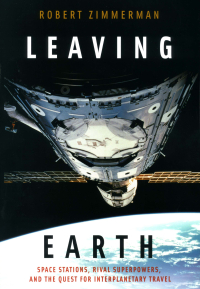
Leaving Earth: Space Stations, Rival Superpowers, and the Quest for Interplanetary Travel, can be purchased as an ebook everywhere for only $3.99 (before discount) at amazon, Barnes & Noble, all ebook vendors, or direct from my ebook publisher, ebookit.
If you buy it from ebookit you don't support the big oppressive tech companies and I get a bigger cut much sooner.
"Leaving Earth is one of the best and certainly the most comprehensive summary of our drive into space that I have ever read. It will be invaluable to future scholars because it will tell them how the next chapter of human history opened." -- Arthur C. Clarke
Capitalism in space: Momentus, a company that sells a small upper stage designed to provide orbital transportation for cubesats, has won a new contract with Taiwan university.
Under the agreement, Momentus will provide in-space transportation for a satellite mission called Intelligent Remote-Sensing and Internet Satellite (IRIS)-A. Odysseus is providing pre-launch testing and arranging launch services for the IRIS-A mission developed by Taiwan’s National Cheng Kung University. IRIS-A is designed to test technology to improve the quality of downlink signals.
In spite of the COVID-19 pandemic, Momentus executives say they are continuing to sign up customers interested in traveling on Vigoride, a vehicle to move small satellites from their drop-off point in orbit to their final destination.
The article does not say what rocket will launch the cubesat plus Vigoride, but Momentus has a contract with SpaceX to launch five cubesats as secondary payloads, so this is probably how the payload will reach orbit.
Normally cubesats launched as secondary payloads on big rockets like the Falcon 9 have very limited options on the orbits they can reach. The primary payload’s requirements are what rules. The idea here is Vigoride takes over once deployed and moves the satellite to the exact orbit needed. If Momentus is successful in doing this it will give cubesat makers many more launch options. It will also put more competitive pressure on the smallsat rockets like Rocket Lab’s Electron, since its main selling point is how it can put cubesats where they want to go, something that bigger rockets have not been able to do, up until now.
Embedded below the fold in two parts.
» Read more
The rigging of elections begins: As part of the Wuhan panic, state legislators (as well as Joe Biden, the present Democratic Party front runner for president), are now pushing to change election laws to allow more voting by mail, and to even eliminate in-person voting at the polls.
States are weighing measures to change voting rules in November’s presidential election as they struggle with social-distancing orders during the worldwide coronavirus outbreak, according to a report Tuesday. “More people who vote early or vote by mail, means fewer people standing in line on election day,” California Secretary of State Alex Padilla told the Axios news website.
But the effort to keep voters from going to the polls in person Nov. 3 faces legislative and financial roadblocks. The price for states to change their methods of voting could pass $2 billion, Axios said.
Of course, they are completely sincere about their desire to protect us from this evil virus. None of them would ever take advantage of an election conducted entirely by mail to rig the results. Never! How could anyone think such a thing?!
I mean, really, these are the same kinds of people who wrote the FISA court legislation, and then administered it perfectly! They are also the same kind of governmental people who run the IRS and never use it to go after people they don’t like, for political reasons. Never!
I await the coming our perfect government-run utopia. All will be well. Just accept it.
An evening pause: Rather than post an April Fool’s prank today, why don’t we see some modern magical engineering that even engineers can’t figure out.
Hat tip Tom Biggar.

Click for full image.
Cool image time! The photo on the right, cropped and reduced to post here, is a perfect example of the difficulty of explaining the alien landscapes on Mars, based on orbital imagery. It was taken by the high resolution camera of Mars Reconnaissance Orbiter (MRO) on January 23, 2020.
In this one image alone we have the following strange features, all within an area about 8 by 11 miles in size:

The spot is located in the Martian southern cratered highlands, as shown by the blue cross in the overview map to the right. Complicating its geological history is that it sits inside a very gigantic very old and degraded crater, with numerous newer smaller impacts overlaid on top. Any explanation needs to include these impacts, and the ejecta from them.
If you click on the image and study the full resolution photograph, you can find even more enigmatic features. For most there is a reasonable geological theory. Putting them all in one place and somehow getting all those different explanations to fit together however is far more difficult.
Link here.
This editorial tries to remind people that when you look at the whole picture, the coronavirus epidemic simply does not yet justify the fear it has caused, or the over-the-top authoritarian measures politicians have imposed. For example:
On its own, 3,000 fatalities [from COVID-19 as of yesterday] might seem like a tremendously large number. But that’s before you learn that an average of 7,700 people die in the U.S. every single day. Which means that over the past week, when the coronavirus took 2,000 lives, nearly 54,000 people died from other causes. [emphasis in original]
They then list the many other preventable causes of death that each year kill far more people than the coronavirus, and yet pass entirely unnoticed, with no panic, fear, or government-imposed edicts. The mortality numbers for other infectious diseases I find especially revealing:
Once again, these are numbers for deaths that occur routinely, each year. I don’t remember the government declaring martial law over these. Do you?
COVID-19 could still be as bad as our panic-stricken leaders say, with predictions of between 100,000 to 200,000 deaths this year. I remain very skeptical. Such numbers would be from two to four times higher than the worse flu epidemic. The data from too many sources suggest this prediction is absurdly high.
And even if it is correct, I suspect these deaths will not be additional mortality, on top of all other causes. Instead, I predict that overall the mortality will be about the same, if not less, because of the imposition of martial law. Unable to go out, there will be fewer traffic accidents and flu infections, for example, causes that routinely kill a lot of people.
Thus, the overall death numbers will not be significantly different than we normally see, a result that will hardly justify the panic that has gripped everyone.

Cool image time! A new image release from Lunar Reconnaissance Orbiter (LRO) takes a look at the impact process that created the crater Messier and its neighbor crater Messier A. The photo to the right, cropped to post here, shows both craters.
Take a close look at Messier A. It is actually a double crater itself. From the release:
Messier A crater, located in Mare Fecunditatis, presents an interesting puzzle. The main crater is beautifully preserved, with a solidified pond of impact melt resting in its floor. But there is another impact crater beneath and just to the west of Messier A. This more subdued and degraded impact crater clearly formed first.
Did these three craters happen as separate events. According to the data, it appears no. Instead, they might have all been part of a single rain of asteroids, all occurring in seconds.
» Read more
Even though SpaceX’s first demonstration manned mission to ISS has not yet occurred, NASA yesterday announced the selection of the full four person crew for the second flight, set for later this year and intended as the first operational mission to ISS, lasting six months.
This announcement tells us several things, all good. First, it appears NASA has now definitely decided that the demo mission, presently scheduled for mid-May, will be a short-term mission. They had considered making it a six-month mission, but it now appears they have concluded doing so will delay the demo launch too much.
Second, that NASA is solidifying its plans for that operational flight, the second for Dragon, including a tentative launch date later in 2020, is further evidence that they intend to go through with the demo mission in mid-May.
Finally, it appears that NASA has decided that it will not buy more seats on Russian Soyuz capsules, something that they had previously hinted they needed to do because the agency was worried the American capsules would not be ready this year. The article describes the negotiations on-going with the Russians about the use of Dragon, as well as the future use by Americans of Soyuz. NASA wishes to have astronauts from both countries fly on both spacecraft (Starliner too, once operational), but Russia is as yet reluctant to fly its astronauts on Dragon. They want to see that spacecraft complete more missions successfully.
Regardless, future flights of Americans on Soyuz will cost NASA nothing, as the agency wishes to trade the seats on the U.S. capsules one-for-one for the seats on Soyuz. It also means that NASA has decided it doesn’t need to buy Soyuz flights anymore, as it now expects Dragon to become operational this year.
Capitalism in space: According to a new industry report, 2019 was one of the strongest in years for the entire commercial space industry.
More than 183,000 workers were employed in the U.S. space workforce at the end of 2019, according to the U.S. Bureau of Labor Statistics. Core employment, those jobs most closely aligned with the space industry and not the larger aerospace industry, rose to 141,520 jobs in 2019. This represents a 4.1% increase from the 135,930 private sector workers in 2018 and marks the third year in a row of increasing employment in this workforce and the highest level since 2012.
Some sectors saw significant gains in employment over the last five years. Together, the workforce supporting manufacturing of space vehicles, space vehicle propulsion units, and other space vehicle parts grew by nearly 20% over the past five years, adding more than 14,000 new employees. Other sectors experienced decline. Broadcast and wireless communications equipment manufacturing employment decreased 9.8% over the past five years, shedding more than 5,000 workers.
The report also noted that the COVID-19 panic will likely cause a major negative impact to the industry in 2020, hurting the smaller companies the most.
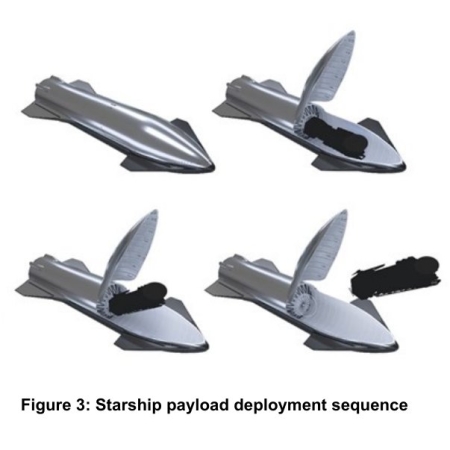
Capitalism in space: Even as SpaceX has begun preparing its third Starship prototype for new testing, it has also released a first user manual for the rocket, outlining its proposed capabilities and potential uses by customers.
From the first link:
The next round of testing is anticipated to begin this week with cryogenic proof testing. These tests will see the vehicle filled with liquid nitrogen at cryogenic temperatures and flight pressures. Prior Starship test vehicles have had their campaigns cut short by failed cryogenic testing, including the last flight vehicle SpaceX rolled to the Boca Chica launch pad, Starship SN1.
If all goes right, they hope to begin short flight tests with this prototype, moving to longer and higher flights with the next.
The user manual [pdf] is mostly a short description of what they hope they will be able to accomplish with Starship. It notes that they will build both a cargo and manned variety, and that both will be available for point-to-point transportation on Earth. It also notes:
Starship has the capability to transport satellites, payloads, crew, and cargo to a variety of orbits and
Earth, Lunar, or Martian landing sites. Potential Starship customers can use this guide as a resource for preliminary payload accommodations information.This is the initial release of the Starship Users Guide and it will be updated frequently in response to customer feedback.
I guarantee that much of what is written and drawn here, such as the illustration above, will change significantly as development proceeds.
China’s Yutu-2 rover and Chang’e-4 lander have now successfully completed their sixteenth lunar day on the far side of the Moon, and have been put into hibernation for the long lunar night.
This means that both spacecraft have now worked longer on the Moon than any previous mission.
The news report, from China’s state-run press, provides only one real piece of information: Yutu-2 has now traveled a total of 424.45 meters (1,393 feet), which means it traveled about 24 meters (79 feet) during this sixteenth lunar day.
Their goal is to reach a different geological area of basalt a little over a mile away, a journey they say will take about a year.
I question that time frame however. Yutu-2 has averaged about 88 feet travel per lunar day. To go a mile at that pace will take about sixty lunar days, which is equivalent to between four and five years. The difference might be because the information at the second link is a bit unclear, and that they hope to begin entering the basalt region much sooner.
We shall just have to wait and see.
An evening pause: Hat tip Diane Zimmerman.
According to the latest weekly report of overall mortality in Europe, the number of deaths during the March 18 to 24 time period had dropped, even though that was the exact period when the panic and alarm over the COVID-19 epidemic began to reach its height.
The article at the link also notes that this particular flu season has so far been relatively mild, which corresponds with the U.S. data I posted on March 26.
Both the article and his source speculate with some puzzlement as to why this is the case. Obviously, the panic shutting down our entire economy and society is probably helping. At the same time, this flu season was already clearly going to be a mild one, long before the Wuhan panic took over.
Regardless, what these numbers once again suggest is that the response to COVID-19 has been way out of line and over the top. While our bankrupt press keeps focusing on specific deaths and coronavirus mortality rates, they are failing to note that the overall death rate is not changing, and is possibly even dropping.
A good example are the wild rumors, widely reported, of a gigantic order of burial urns for China, implying that these urns were needed because of millions of extra COVID-19 deaths, not reported by the Chinese authorities. What nobody asks is how many urns are normally ordered each year? I suspect the numbers would be quite similar.
We are not all going to die from the Wuhan virus, though the extreme measures our government is forcing us to take might very well kill us, in other ways. At a minimum, those extreme measures are destroying what was once a free society.
So, why hasn’t Trump fired everybody there? A new inspector general review of 29 FBI FISA warrant applications has found that on every single application looked at, the FBI made numerous errors, often failing entirely in doing the most basic required documentation.
The [inspector general] review released Tuesday suggests that the FBI’s problems are widespread. “As a result of our audit work to date and as described below, we do not have confidence that the FBI has executed its Woods Procedures in compliance with FBI policy,” the [report] said in a memo to FBI Director Christopher Wray.
More information here, including the revelation that the FBI could not even find the files for four of these warrants. The IG suspects they might never have existed.
I repeat: Why has Trump so far not fired the entire upper management at the FBI involved in this work? Every single one of these bums should be out on the street, looking for work (though to be honest, the last place I’d want to see them working is as a stock person in a supermarket. They’d hoard and steal, and everyone else would starve.).
For example, the IG memo was submitted to Wray, who has been a top manager at the agency for years, and was directly involved in issuing most of these FISA warrants. Does anyone really expect him to fix this problem? He’s part of it.
Until Trump begins a real house-cleaning, I have no faith in his claim that he is “draining the swamp.” Instead, I see him as simply doing a little light dusting, just enough to make us peons not notice the thick piles of dirt buried under the rugs and beneath all the cushions and behind the books.
Also, this IG report provides further proof that Congress should not renew the FISA court law, when it comes up for renewal again in about two months. The entire law and all involved with it are corrupt, and routinely have abused the power it gave them.