More Webb images released

Southern Ring Nebula, as taken by Webb
Click for full image.

As planned, NASA this morning released four new science images from the James Webb Space Telescope, in addition to the deep field image released yesterday.

All are spectacular, with each producing new information not previously observed. To see the Stephen’s Quintet image go here. For the exoplanet data, showing the presence of water in its atmosphere, go here. For the Carina nebula image, go here.

The image to the right, reduced to post here, shows the Southern Ring Nebula as taken by two Webb cameras in different infrared wavelengths. From the press release:

Two stars, which are locked in a tight orbit, shape the local landscape. Webb’s infrared images feature new details in this complex system. The stars – and their layers of light – are prominent in the image from Webb’s Near-Infrared Camera (NIRCam) [at the top], while the image from Webb’s Mid-Infrared Instrument (MIRI) on the [bottom] shows for the first time that the second star is surrounded by dust. The brighter star is in an earlier stage of its stellar evolution and will probably eject its own planetary nebula in the future.

In the meantime, the brighter star influences the nebula’s appearance. As the pair continues to orbit one another, they “stir the pot” of gas and dust, causing asymmetrical patterns.

Because this is an infrared image, the colors are not natural, but were assigned based on the slightly different infrared wavelengths produced by the object’s different features. From the image’s webpage:

Several filters were used to sample narrow and broad wavelength ranges. The color results from assigning different hues (colors) to each monochromatic (grayscale) image associated with an individual filter.

Eventually astronomers will use Webb to look at many astronomical objects that Hubble has been observing for the past thirty years, adding a high resolution infrared view that will add to Hubble’s views.

7 comments

Superheavy prototype #7 explodes during tanking test

Capitalism in space: SpaceX’s Superheavy prototype #7 exploded yesterday during a tanking test in Boca Chica, Texas.

I have embedded the video of the explosion below, cued to just before it occurred.

According to Musk, the engineering teams are presently assessing damage. The booster itself appeared relatively intact afterward, though leaning slightly to one side.

At a minimum this incident will delay the orbital launch attempt, especially if booster #7 must be replaced with booster #8, already being prepped in the assembly building nearby.

» Read more

28 comments

First science image released from Webb

Webb's first deep field image
Click for original image.

The first science image from the James Webb Space Telescope has now been unveiled.

That image is to the right, reduced to post here. From the press release:

Known as Webb’s First Deep Field, this image of galaxy cluster SMACS 0723 is overflowing with detail. Thousands of galaxies – including the faintest objects ever observed in the infrared – have appeared in Webb’s view for the first time. This slice of the vast universe covers a patch of sky approximately the size of a grain of sand held at arm’s length by someone on the ground.

This deep field, taken by Webb’s Near-Infrared Camera (NIRCam), is a composite made from images at different wavelengths, totaling 12.5 hours – achieving depths at infrared wavelengths beyond the Hubble Space Telescope’s deepest fields, which took weeks.

The image shows the galaxy cluster SMACS 0723 as it appeared 4.6 billion years ago. The combined mass of this galaxy cluster acts as a gravitational lens, magnifying much more distant galaxies behind it. Webb’s NIRCam has brought those distant galaxies into sharp focus – they have tiny, faint structures that have never been seen before, including star clusters and diffuse features.

The smeared concentric arrangement of many reddish objects surrounding the picture’s center strongly suggests we are seeing distortion by the gravity of this galaxy cluster.

While nothing in this image appears at first glance to be different than many earlier Hubble images, it looks at objects in the infrared that are much farther away than anything ever seen before, farther than Hubble in the optical could see. To understand the new discoveries hidden in such an image will likely take several years of further research. For example, before astronomers can understand what this image shows they need to determine the red shift of each galaxy, thus roughly determining its distance and the overall 3D structure of the objects visible. Moreover, the consequences of the gravitational lensing must be unpacked.

The White House briefing itself was somewhat embarrassing to watch, as Vice President Kamala Harris, President Joe Biden, and NASA administrator Bill Nelson all struggled to explain what this image shows, and failed miserably. Moreover, the briefing had technical problems, started very late, and it appeared that Bill Nelson especially had no idea what he was looking at. The briefing also ended very abruptly when it shifted to reporters’ questions.

11 comments

Collapse pits on Mars

Elongated collapse pit on Mars
Click for full image.

Cool image time! The photo to the right, cropped to post here, was taken on May 21, 2022 and was today’s picture of the day from the high resolution camera on Mars Reconnaissance Orbiter (MRO). Dubbed “An Elongated Collapse Pit” by the science team, their caption explains:

This observation can help to tell whether or not there is a subterranean connection to this pit. As an added bonus, the much smaller depression to its south also appears to be another collapse pit.

This image had already been in my queue for a future cool image post, but since the scientists have posted it, it is time that I did as well.

In the inset I have brightened the image drastically to try to illuminate the darkest spots in both pits. The elongated pit appears to slope downward towards a hole in the southeast corner, while the interior of the second pit to the south remains completely dark. Both appear to suggest a void below that both reach.

The wider context image and overview map below shows that there is further evidence of more voids in this region of Mars, dubbed Ceraunius Fossae, because of its many north-south parallel fissures.
» Read more

3 comments

More lacy Martian rocks

lacy Martian rock
Click for full image.

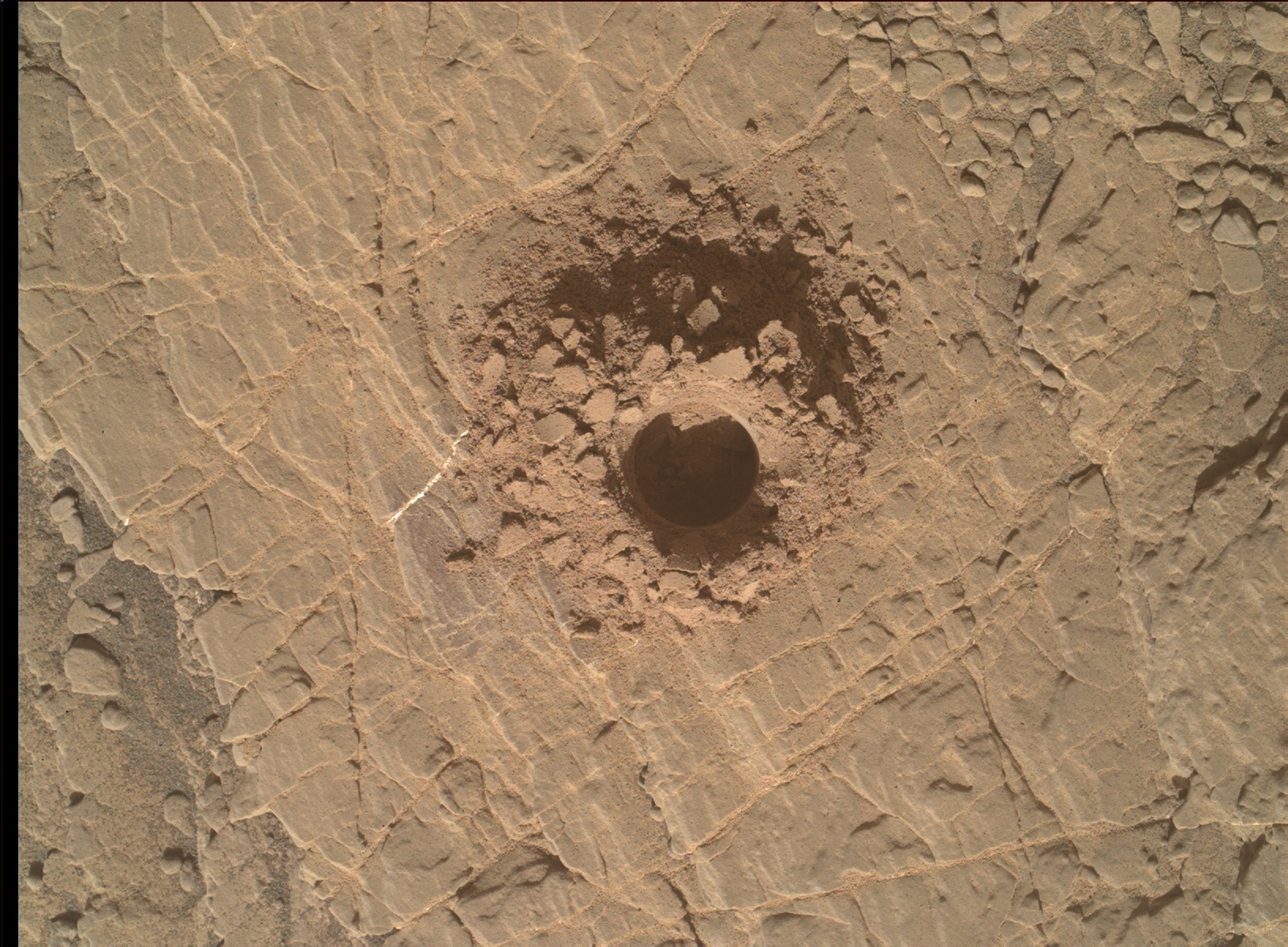
Cool image time! Because the Curiosity team is presently conducting a drilling campaign at its present position in the lower mountains of Gale Crater, the rover has not moved in the past few weeks. At these times, the science team also has the rover’s other cameras do extensive surveys of the surrounding terrain, including high resolution mosaics by its high resolution camera.

To the right is one photo from the most recent mosaic, cropped to post here. It was taken on July 10, 2022, and shows one many layered rock on the ground near the rover. Though no scale is provided, I suspect the extended flake from this rock is somewhere between six to twelve inches long.

Another illustration of the alien nature of Mars. This flake could not exist on Earth, where the heavier gravity and atmosphere would have acted to break it.

1 comment

Biden to unveil first Webb science image today

This should be entertaining: NASA today announced that the unveiling of the first science image from the James Webb Space Telescope has been moved up to later today, so that President Joe Biden can do the unveiling from the White House. From the NASA tweet:

We can’t contain the excitement for @NASAWebb’s first full-color images!

On Monday, July 11 at 5pm ET (21:00 UTC), President Biden will unveil one of the space telescope’s first images of deep space as a preview of what’s ahead.

It appears that the picture Biden will use in this photo op will be the only deep field cosmological picture scheduled for release:

SMACS 0723: Massive foreground galaxy clusters magnify and distort the light of objects behind them, permitting a deep field view into both the extremely distant and intrinsically faint galaxy populations.

The remaining four images will still be released on July 12, 2022, as originally planned.

The live stream of this event will be broadcast on NASA TV.

8 comments

SpaceX launches another 46 Starlink satellites

Capitalism in space: Using its Falcon 9 rocket, SpaceX today successfully launched another 46 Starlink satellites from Vandenberg Space Force Base in California.

The first stage completed its sixth flight, landing on the drone ship in the Pacific.

A minor note: SpaceX has clearly decided to simplify these broadcasts. Each is now starting much closer to launch, and the announcers have reduced their narration to the absolute minimum. Overall, this seems a wise policy, because though these live streams are good advertising, most of the people listening at this point do not need detailed explanations of everything. If anything, too much chatter is annoying, and as always less is more.

The leaders in the 2022 launch race:

29 SpaceX
21 China
9 Russia
4 Rocket Lab
4 ULA

The U.S. now leads China 41 to 21 in the national rankings, and the entire world combined 41 to 36. The forty-one launches in just over half of ’22 beats the U.S.’s total for the whole year just two years ago.

1 comment

Elon Musk gives a tutorial on the Raptor-2 engine

Tim Dodd of Everyday Astronaut on Friday released another video from his most recent tour of Starbase at Boca Chica with Elon Musk. I have embedded it below.

Essentially, this 41 minute video is Elon Musk giving us a tutorial on how SpaceX simplified and improved its Raptor engines from its first iteration to the present Raptor-2. He does this while standing in front of a long row of finished Raptor-2s, all meant for installation in the seventh prototype of Superheavy, the booster now on the launchpad with those engines installed and being prepared for its first static fire test prior to the orbital flight.

Musk revealed two interesting factoids during this video. First SpaceX blew up approximately 20 to 30 Raptor engines during the development phase, and melted the chambers on another 50. All of this was perfectly acceptable, because they designed engine manufacture so that a high production rate was built in. As Musk noted, “A high production rate solves many ills.” Losing engines during testing and development was no big deal because they were able to quickly replace them, with revisions and upgrades.

Secondly, Musk claimed that the Raptor-2 engine has a 99% efficiency, a level of efficiency that is unheard of in any engine for any purpose ever. I wonder if that claim will hold up as new companies and engineers work to beat SpaceX in the coming centuries.

» Read more

13 comments

A galaxy with swirling arms

A galaxy with swirling arms
Click for full image.

Cool image time! The picture to the right, cropped and reduced to post here, was released yesterday by the science team that operates the Hubble Space Telescope. It captures a galaxy about 520 million light years away that appears to have been reshaped due to a galaxy merger.

That merger somehow distorted the disk of the inner galaxy, the brightest area, while also producing two sweeping spiral streams in the surrounding periphery.

Despite its unusual shape, astronomers did not choose to study this galaxy. From the caption:

This observation is a gem from the Galaxy Zoo project, a citizen science project involving hundreds of thousands of volunteers from around the world who classified galaxies to help scientists solve a problem of astronomical proportions: how to sort through the vast amounts of data generated by telescopes. A public vote selected the most astronomically intriguing objects for follow-up observations with Hubble. CGCG 396-2 is one such object, imaged here by Hubble’s Advanced Camera for Surveys.

7 comments

The colorful layers of the Martian north pole icecap

Colorful layers in the Martian north pole ice cap
Click for full image.

Wider view
Click for full image.

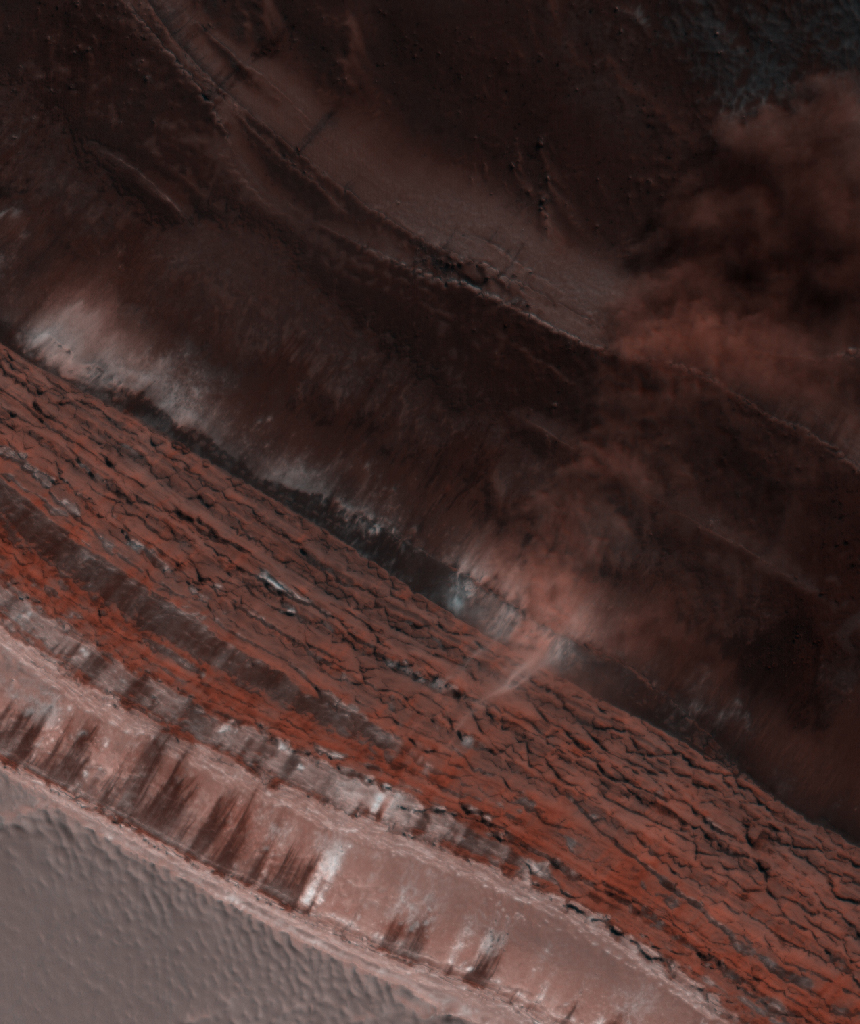
Today’s cool image above, rotated, reduced, and annotated to post here, comes from today’s picture of the day for the high resolution camera on Mars Reconnaissance Orbiter (MRO), which in turn is a retrospective of a captioned image first taken in 2010. The photo to the right, rotated, cropped, and reduced to post here, shows a larger area to provide some context. For this image north is towards the top. The rectangle indicates the area covered by the picture above.

The ice cap at the north pole is about 600 miles across and a little less than 7,000 feet deep, made up of many layers that are a mixture of water ice and cemented dust and sand. From the picture’s caption:

In many locations erosion has created scarps and troughs that expose this layering. The tan colored layers are the dusty water ice of the polar layered deposits; however a section of bluish layers is visible below them. These bluish layers contain sand-sized rock fragments that likely formed a large polar dunefield before the overlying dusty ice was deposited.

The lack of a polar ice cap in this past epoch attests to the variability of the Martian climate, which undergoes larger changes over time than that of the Earth.

The overview map below provides some further context.
» Read more

1 comment

NASA announces the targets picked for Webb’s first science images

NASA today announced the astronomical targets scientists have chosen for the first infrared science images taken by the James Webb Space Telescope which will be unveiled on July 12, 2022.

  • Carina Nebula. The Carina Nebula is one of the largest and brightest nebulae in the sky, located approximately 7,600 light-years away in the southern constellation Carina. Nebulae are stellar nurseries where stars form. The Carina Nebula is home to many massive stars, several times larger than the Sun.
  • WASP-96 b (spectrum). WASP-96 b is a giant planet outside our solar system, composed mainly of gas. The planet, located nearly 1,150 light-years from Earth, orbits its star every 3.4 days. It has about half the mass of Jupiter, and its discovery was announced in 2014.
  • Southern Ring Nebula. The Southern Ring, or “Eight-Burst” nebula, is a planetary nebula – an expanding cloud of gas, surrounding a dying star. It is nearly half a light-year in diameter and is located approximately 2,000 light years away from Earth.
  • Stephan’s Quintet: About 290 million light-years away, Stephan’s Quintet is located in the constellation Pegasus. It is notable for being the first compact galaxy group ever discovered in 1877. Four of the five galaxies within the quintet are locked in a cosmic dance of repeated close encounters.
  • SMACS 0723: Massive foreground galaxy clusters magnify and distort the light of objects behind them, permitting a deep field view into both the extremely distant and intrinsically faint galaxy populations.

That only the last image is focused on distant deep space cosmology, the scientific research that Webb’s infrared instruments are optimized for suggests that NASA wishes to highlight the telescope’s other observational possibilities.

The images will be released one by one during a press conference beginning at 10:30 am (Eastern) on July 12th. It is once again important to note that though the images are likely to be spectacular, they will be false color infrared images measuring the heat produced by the objects, not optical images that we could see with our eyes.

1 comment

OSIRIS-REx’s sample grab at Bennu in 2020 proved the rubble-pile asteroid has far less cohesion than predicted

The post touchdown crater on Bennu

The OSIRIS-REx science team, using data gathered during the spacecraft’s sample grab at Bennu in 2020, has determined that the rubble-pile asteroid has far less cohesion than predicted, with its rubble behaving less like a solid object and more like the playground ball-pits found in amusement parks.

After analyzing data gathered when NASA’s OSIRIS-REx spacecraft collected a sample from asteroid Bennu in October 2020, scientists have learned something astonishing: The spacecraft would have sunk into Bennu had it not fired its thrusters to back away immediately after it grabbed dust and rock from the asteroid’s surface.

It turns out that the particles making up Bennu’s exterior are so loosely packed and lightly bound to each other that if a person were to step onto Bennu they would feel very little resistance, as if stepping into a pit of plastic balls that are popular play areas for kids.

The image above shows what the touch down crater looked like after the sample grab, taken from the video that was part of the press release. The false colors indicate the depth changes produced by the touch down. The final crater was 26 feet across and more than two feet in depth, far larger than expected. Moreover, the energy from the spacecraft’s thrusters as it lifted off had increased the size of that crater further, by about 40%.

These results about the asteroid’s lack of cohesion match the earlier results studying a different impact crater on Bennu.

3 comments
1 433 434 435 436 437 1,353