
Antique tortoise shell singing bird box
An evening pause: Unlike yesterday’s evening pause, tonight we look at some remarkable engineering that works perfectly, from the 1920s.
I would love to learn how this works.
Hat tip Diane Wilson.
An evening pause: Unlike yesterday’s evening pause, tonight we look at some remarkable engineering that works perfectly, from the 1920s.
I would love to learn how this works.
Hat tip Diane Wilson.

Click for full image.
Cool image time! The image to the right, reduced, cropped, and annotated by me to post here, was part of the July image download from the high resolution camera on Mars Reconnaissance Orbiter (MRO) and was titled “Melt Pools around Mojave Crater”.
You can see that the flow began to the south, flowed northward (in the middle of the image), and then pooled in the two places as indicated. In the full photograph you can also see that the flow continued to the north, forming more pools.
The title to me suggests that this flow and the melt pools were lava, not ice. The low latitude, 7 degrees north, also suggests this is not ice. Though I was unable to reach the person who requested these images, it appears his research is aimed understanding the melt events that occur in the vicinity of craters upon impact. From his website:
» Read more
Japan’s today provided an update on what it has done to prepare the location where Hayabusa-2’s samples from the asteroid Ryugu will land on Earth.
The landing site is in the Woomera Prohibited Area (WPA) in the outback of southern Australia. Japan has already signed an agreement with that country for the recovery, as well as done preliminary surface work
The recovery site is an Australian Government prohibited area and is not accessible to the public. As part of the preparatory work, a field survey of the proposed recovery site in the WPA was conducted with permission from the Australian Government. This preparatory work confirmed the suitability of both the proposed recovery site and the candidate site for the antenna station that will search for the capsule.
The landing of the recovery capsule is now scheduled for late in 2020.
Capitalism in space: Sierra Nevada yesterday unveiled a full scale prototype of a habitable module that it developed under a NASA contract for the agency’s proposed Lunar Gateway space station.
[The module] measures more than 8 meters long, and with a diameter of 8 meters has an internal volume of 300 cubic meters, which is about one-third the size of the International Space Station.
Sierra Nevada developed this full-scale prototype under a NASA program that funded several companies to develop habitats that could be used for a space station in orbit around the Moon, as well as potentially serving as living quarters for a long-duration transit to and from Mars. As part of the program, NASA astronauts have, or will, spend three days living in and evaluating the prototypes built by Sierra Nevada, Boeing, Lockheed Martin, Northrop Grumman, and Bigelow Aerospace.
The selling point for Sierra Nevada’s habitat is its size, which is possible because the multi-layered fabric material can be compressed for launch, then expanded and outfitted as a habitat once in space. It can fit within a standard payload fairing used for launch vehicles such as SpaceX’s Falcon Heavy rocket, United Launch Alliance’s Vulcan booster, or NASA’s Space Launch System. It is light enough for any of those rockets to launch to the Moon.
What we are seeing here is the unfolding of the Washington lobbying game to guarantee Gateway gets funded and built. NASA is spreading its available Gateway cash around to multiple companies, who will now have a vested interest in lobbying Congress to get this lunar space station funded and built.
The one very good component of this lobbying process is that NASA is not doing the building or the designing. It is hiring private companies, which means the project will act to stimulate the American aerospace industry. Moreover, it is leaving the ownership of the spacecraft and the decision on what launch vehicle to use to the companies, which means this cannot be used as a lever to fund the SLS boondoggle. Under this arrangement more will get done faster for less.
Even so, Lunar Gateway will mostly act to slow the United States’ effort to colonize the solar system. We will be spending our government space dollars on an orbiting lunar space station, thus generally trapping us in orbit, as we watch China, India, Russia and others land and explore the surface.
There is only one way Gateway could possibly be beneficial to the United States. NASA gets it built fast and cheaply, so that it then can be used as a jumping off point for further exploration. This would give the U.S. capabilities in space that far exceed other countries.
My fear is that NASA has a terrible track record in the past half century of doing anything fast or cheaply. Instead, NASA projects like Gateway end up taking forever and costing many times their initial proposed budget. SLS is a perfect poster child for this. Its goal is not so much to launch as to provide Congress endless pork.
Using the X-ray space telescope Insight it launched in 2017, China has successfully tested an autonomous navigation system using pulsars.
The time interval of two adjacent pulses emitted by the pulsar is constant. If a spacecraft moves toward the pulsar, the received pulse interval will be shortened, and vise versa. Thus the observed pulse profile will change as the spacecraft moves in space. The relative arrival times of pulses also indicate the relative position of the spacecraft with respect to the pulsar. Therefore, by analyzing the characteristics of the pulsar signals received by the spacecraft, the three-dimensional position and velocity of the spacecraft can be determined, Zheng explained.
From Aug. 31 to Sept. 5, 2017, Insight observed the Crab pulsar for about five days to test the feasibility of pulsar navigation. The research team had also proposed an algorithm for X-ray pulsar navigation, according to Zhang Shuangnan, lead scientist of the Insight space telescope.
The research team further improved the algorithm and applied it in the processing of the observation data of the three detectors onboard Insight. The satellite’s orbit was determined successfully, with the positioning accuracy within 10 km, comparable to that of a similar experiment conducted on the International Space Station, Zhang said.
This is not the first such test. U.S. scientists did something similar using an X-ray telescope on ISS in 2017.
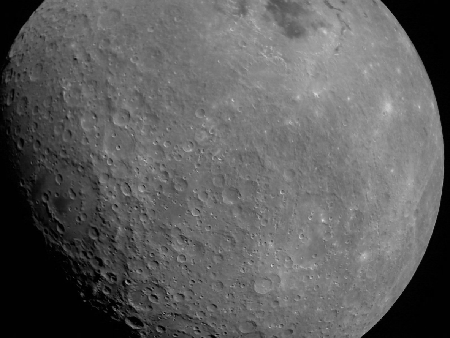
India’s space agency ISRO has released the first image taken by Chandrayaan-2 after entering orbit around the Moon.
That image is to the right, reduced to post here. It was taken from about 1,600 miles elevation, and shows mostly the far side of the Moon. The dark mare in the upper right is the Sea of Moscow, which is the only large mare on the far side.
This image once again proves the camera and the spacecraft’s ability to point it accurately are both functioning.
Russia and ULA both successfully placed spacecraft into Earth orbit today.
Russia sent an unmanned upgrded Soyuz capsule to ISS, filled with cargo, in a test flight that also tested a new upgraded version of the Soyuz rocket.
According to Navias, this Soyuz launch is a critical shakedown flight to test the performance of the upgraded Soyuz capsule and the Soyuz 2.1a booster before the first crewed flight on the rocket in March 2020.
“The Soyuz 2.1a booster, equipped with a new digital flight control system and upgraded engines, is replacing the Soyuz FG booster that has been used for decades to launch crews into space,” NASA officials wrote in a statement. “The Soyuz spacecraft will have an upgraded motion control and navigation system, as well as a revamped descent control system,” they added.
The mission will also help Roscosmos develop a cargo version of the Soyuz capsule capable uncrewed reentry to return experiments and other gear to Earth, Navias said. Russia’s Progress cargo ships can currently only deliver supplies, and are filled with trash and discarded at the end of their missions.
ULA in turn launched an Air Force GPS satellite in the last launch of the Delta-4 Medium version of its Delta rocket family.
The leaders in the 2019 launch race:
13 China
13 Russia
10 SpaceX
6 Europe (Arianespace)
4 India
4 Rocket Lab
4 ULA
The U.S. leads Russia and China 19 to 13 in the national standings.
An evening pause: A breath-taking collection of crashes and failures during the 2018 National Hot Rod Association race season One could call this a collection of engineering failures, but I don’t see it that way. For one, absolutely no one was seriously hurt, proving the design of their safety features. For another, the engine failures show how they are pushing the engineering to the max to win.
Hat tip Cotour.
Capitalism in space: The first privately launched car, a Tesla placed in solar orbit on SpaceX’s first launch of its Falcon Heavy, has now completed its first orbit around the sun.
Its future?
Car and driver will probably make many more laps around our star. Last year, an orbit-modeling study calculated that the Roadster will eventually slam into either Venus or Earth, likely within the next few tens of millions of years. But there’s just a 6 percent chance of an Earth impact, and a 2.5 percent chance of a Venus impact, within the next million years, the study’s authors found.
Chandrayaan-2 today made its first engine burn while in lunar orbit, reducing the orbit’s apolune (its high point) down to 4,412 kilometers from 18,072 kilometers.
Three more orbital adjustments to go before they enter the required orbit for landing.


Click for full image.
Cool image time! In my never-ending review of new images downloaded each month from the high resolution camera of Mars Reconnaissance Orbiter (MRO), I came upon an image dubbed merely “Terrain Sample” in the August release. To the right, cropped and rotated to post here, is the weird terrain from that image, with the section in the white box shown below at full resolution.
To keep MRO functioning properly, they need to take images on a regular basis, even if they have no planned features coming into view. As noted by Singleton Thibodeaux-Yost, the HiRISE Targeting Specialist at the University of Arizona who requested this image,
It was not taken in response to a suggestion from the public or our team database. This image was a ride-along with another instrument on MRO. [The scientists for that other instrument] targeted this region for a particular reason and we just turned on our camera as well to gather more data while they collected their data. I title these types of images “terrain sample” as we don’t always know what the results will be.
In other words, the scientists running the high resolution camera have no inkling what they will see until see it.
This image shows the inside rim of a crater, with the crater rim to the south just beyond the image’s bottom edge. This somewhat large crater is located in the middle of Arabia Terra, one of the largest regions of the transition zone between the southern highlands and the northern lowlands (where some scientists believe an intermittent ocean might have once existed). This transition zone has many features that suggest a tidal basin on the edge of that ocean.
A few months ago I would have been entirely baffled by what we see here. I might have speculated that these strange features were another variation of that shoreline region. Maybe these features are the erosion one sees on a dried lakebed after the water has drained away.
I might have also speculated that these shapes looked like the kind of frozen ice blocks one sees in the icecap of the Arctic here on Earth.
Both speculations then would have been complete guesses.
I now know, based on things I have recently learned in writing about several other images from MRO, that the second guess is likely right (though of course my opinion as a very amateur planetary geologist should not be taken very seriously). My reasons?
» Read more
Capitalism in space: Astrobotic, the private company building a lunar lander for NASA, has chosen ULA’s Vulcan rocket for its launch vehicle.
Astrobotic announced today that it selected United Launch Alliance’s (ULA) Vulcan Centaur rocket in a competitive commercial procurement to launch its Peregrine lunar lander to the Moon in 2021.
“We are so excited to sign with ULA and fly Peregrine on Vulcan Centaur. This contract with ULA was the result of a highly competitive commercial process, and we are grateful to everyone involved in helping us make low-cost lunar transportation possible. When we launch the first lunar lander from American soil since Apollo, onboard the first Vulcan Centaur rocket, it will be a historic day for the country and commercial enterprise,” said Astrobotic CEO, John Thornton.
This is the second contract announcement for ULA’s Vulcan rocket, with the first being Sierra Nevada’s announcement that it would use Vulcan for Dream Chaser’s first six flights.
Isn’t competition wonderful? It appears to me that ULA must be offering very cut-rate deals to get these contracts, since the rocket has not yet flown while SpaceX’s already operational Falcon Heavy (with three successful launches) could easily do the job and is a very inexpensive rocket to fly. These lower prices, instigated by competition and freedom, will mean that funding missions to the Moon will continue to become more likely, even if NASA and the federal government fail to get their act together.
The head of ISRO today announced that, after completed a 29 minute engine burn, India’s Chandrayaan-2 orbiter/lander/rover has successfully entered the correct orbit around the Moon.
In his briefing, Dr. Sivan announced that “The LOI maneuver was performed successfully today morning using the onboard propulsion system for a firing duration of about 29 minutes. This maneuver precisely injected Chandrayaan-2 into an orbit around the Moon.” He emphasised the unique requirement of 90 degree orbital inclination of Chandrayaan-2 and said that it was achieved by the precise execution of both the Trans Lunar Injection (performed on August 14, 2019) and today’s LOI maneuver.
“The satellite is currently located in a lunar orbit with a distance of about 114 km at perilune (nearest point to the Moon) and 18,072 km at apolune (farthest point to the Moon)”, he added.
Over the next four lunar orbits they will execute four more engine burns to lower the spacecraft to the orbit needed to send the lander/rover to the surface on September 7 in the south polar region of the Moon between the craters Manzinus C and Simpelius N at about 71 degrees latitude.
Both Rocket Lab and China today launched rockets to put satellites into orbit, though it is as yet still unclear whether the Chinese launch was successful.
Rocket Lab successfully placed four smallsats into orbit. It was the company’s eightth consecutive successful launch, continuing its perfect launch record.
More important, the company now has completed four launches in 2019. Their goal, announced early this year, was to achieve a monthly pace by summer, then ramp up to twice a month by the end of the year. So far they are not quite meeting that goal, averaging one launch every 1.5 months (March, May, June, August). Still, this record is quite impressive, considering they are a very new and very small private company that it now is beginning to match or exceed the launch pace of other nations (India) as well as well-established companies (ULA).
China’s Long March 3B launched a civilian communications satellite, but according to the story at the link, “the usual announcement of a successful separation has yet to published by Chinese State media.” For the purposes of the launch standings, I will assume at the moment that this was a successful launch, but will revise this post should we learn the satellite did not reach orbit. Update: It appears the launch was successful, but the satellite is having problems. This would mean the launch counts below.
The leaders in the 2019 launch race:
13 China
12 Russia
10 SpaceX
6 Europe (Arianespace)
4 India
4 Rocket Lab
The U.S. now leads China 18 to 13 in the national rankings.
The engineering and science team for the Parker Solar Probe have decided they can turn on its science instruments for a longer period during future solar fly-bys, and have now done so for its upcoming third approach.
Parker Solar Probe turned on its four instrument suites on Aug. 16, 2019 — earlier than during its previous two solar encounters, extending the observation period from 11 days to about 35 days.
During the spacecraft’s first two solar encounters, the science instruments were turned on when Parker was about 0.25 AU from the Sun and powered off again at the same distance on the outbound side of the orbit. (One AU, or astronomical unit, is about 93 million miles, the average distance between the Sun and Earth.) For this third solar encounter, the mission team turned on the instruments when the spacecraft was around 0.45 AU from the Sun on the inbound side of its orbit and will turn them off when the spacecraft is about 0.5 AU from the Sun on the outbound side.
This decision will allow them to get more data about the solar wind from farther from the Sun.
Northrop Grumman has become the first private company to lease a bay of the Vehicle Assembly Building at the Kennedy Space Center, where it will its new OmegA rocket.
Northrop Grumman will assemble and test its new OmegA rocket inside the massive facility’s High Bay 2, one of four high bays in the building. … The company also is modifying mobile launcher platform-3 (MLP-3) to serve as the launch vehicle’s assembly and launch platform. Both the VAB and MLP-3 were originally built for the Apollo Program and went on to enable the three-decade Space Shuttle Program.
OmegA’s development is being funded by an $800 million contract with the Air Force.
In many ways, I could ask the exact same question here as I just did in the post below about the Chinese government’s pseudo private launch industry: From an American private enterprise perspective, this Air Force attempt to create a commercial launch industry using government funds but tight government supervision and control is very puzzling. OmegA will be competing directly with other American launch companies that are privately funded, owned, and run by private corporations (though also getting significant government contracts for their already operational products). How the federal government prevents its government agencies (NASA, the Air Force) from putting their thumbs on the scale to favor one over the other I do not understand.
China today successfully completed the first orbital launch of its privately-funded but government-built smallsat Smart Dragon rocket, putting three smallsats into orbit.
From the Chinese state press:
The rocket, developed by the China Rocket Co. Ltd. affiliated to the China Academy of Launch Vehicle Technology (CALVT), blasted off from the Jiuquan Satellite Launch Center in northwest China at 12:11 p.m. (Beijing Time).
The three satellites, respectively developed by three Beijing-based companies, will be used for remote sensing services, communication and Internet of Things.
Different from the carrier rockets of the Long March family, the new Dragon series is developed in a commercial mode to meet the market demand of launching small commercial satellites, said Wang Xiaojun, head of CALVT.
What they mean by “a commercial mode” is that the funding comes from private Chinese investors who hope to make money from the rocket’s launches. However, this is not a private operation by any means, since the rocket is owned and built by a government entity and uses military solid motors.
From an American perspective, this Chinese attempt to create a commercial launch industry using private funds but tight government supervision and control is very puzzling. This government company is now competing directly with other Chinese launch companies that are, at least superficially, owned and run by private corporations (though also supervised closely by the government). How the Chinese government prevents its government agencies from putting their thumbs on the scale to favor one over the other I do not understand.
The leaders in the 2019 launch race:
12 Russia
12 China
10 SpaceX
6 Europe (Arianespace)
4 India
The U.S leads 17 to 12 over Russia and China in the national rankings.
Deep Space Systems, one of the private companies that bid for a NASA contract to build a private lunar lander to carry NASA instruments to the moon, and did not get the contract, has filed a protest against that decision.
I found out about this through my industry sources. I have no further information about the protest itself.
The timeline however is intriguing. The contracts were awarded to three different companies on May 31, 2019. Deep Space Systems’ protest was filed on June 24, 2019.
On July 30, 2019 one of contract winners, Orbit Beyond, backed out of the deal. Whether the protest or Orbit Beyond’s exit are related is at present unknown, though I wonder if they might be connected.
Either way, the question now arises: Who will replace Orbit Beyond? I also wonder if this protest gives Deep Space Systems an advantage for getting that replacement contract. This last thought is pure speculation and very unlikely. There are several other companies that are more well known and might be better qualified, and it would be inappropriate for NASA to allow its decision-making process to be pressured because of this protest.
Regardless, stay tuned for more information. This story is going to get more interesting.
Turf war: Several powerful Texas lawmakers announced yesterday their opposition to NASA’s decision to give the lead management for the next lunar lander to the Marshall Space Flight Center in Alabama.
The question is which Center will manage development of the landers, a plum assignment. NASA plans to procure them through public-private partnerships rather than traditional contracts. The actual design will be determined by whatever companies win the contracts, but NASA’s concept is for a trilogy of vehicles: a transfer vehicle to take the crew from the Gateway to a lower lunar orbit, then a descent vehicle to take them to the surface and an ascent vehicle to return them to Gateway.
…According to Ars Technica, … NASA is assigning overall responsibility for the lunar lander program to Marshall, which will also oversee acquisition of the transfer and descent vehicles. JSC will oversee the ascent vehicle.
In a letter to Bridenstine today, Senators Ted Cruz and John Cornyn and Rep. Brian Babin, all Republicans, expressed surprise and asked Bridenstine to reconsider. They argue that JSC should be in charge of the entire program, not just one of the three vehicles. Marshall’s expertise is in rocketry while JSC is “ground zero for human space exploration.”
They also disagree with splitting the work between two Centers, “an unnecessary and counterproductive departure from the unquestionable success” of the lander for the Apollo program.
This fight is not over who will actually build anything, but how to distribute the pork. In truth, the NASA agency that does this “management” does almost nothing. It is the contractor that builds the spacecraft. You could condense the management into a team of less two dozen (and that’s probably high). Instead, NASA and these politicians use the contractors to justify the existence of whole departments and hundreds of employees and large facilities, all of which are mostly irrelevant, especially if the Trump administration is serious about letting private industry do the job.
Worse, this fight — and NASA’s need to make these politicians happy — is forcing the agency to turn the work once again into a Frankenstein monster, distributing responsibility in absurd ways. I guarantee that in the end the management will not all go to Texas, meaning that the management of the different contractors will be split to different agencies, making for a very inefficient and badly managed program.
The result is going to be, as always, delays, cost overruns, bad designs, a lot of wasted money, and little accomplished.
I want to make special note of Senator Ted Cruz (R-Texas) in this affair. He ran for president as a new conservative, out to drain the swamp of Washington. Now, as senator, he is increasingly becoming captured by that swamp, participating in all the same corruption he railed against during his presidential run.
If he was really serious about draining the swamp, he would be pushing to trim NASA’s management, both in Alabama and in Texas. Instead he is fighting to build it up.
An evening pause: There is a lot of modern art blarney in this artist’s view of the depth of this work, which is both literally and figuratively very shallow. Nonetheless, attention must be paid to the brilliant engineering and beauty of the work.
Hat tip Cotour.