Russia faces launchpad bottleneck in 2020

Because of the decommissioning of one of their two Soyuz launchpads at Baikonur in late 2019, the Russians will have a significant launchpad bottleneck in 2020.

According to the official, the so-called Gagarin’s Start launch launchpad at the site number 1 would be put out of exploitation due to the upcoming decommissioning of the Soyuz-FG rocket.

The source noted that a large number of Soyuz launches planned for 2020 was related to the implementation of the OneWeb internet satellite constellation project, which would require up to eight launches. Moreover, from five to seven launches of manned missions on Soyuz and Progress spacecraft to the International Space Station (ISS), as well as several launches of unmanned spacecraft have been planned.

The source continued by saying there was a “bottleneck” in the capacity of the testing facility at the launch site 31, which amounted to 15 rockets per year.

It appears that this limitation of 15 launches per year is going to put a crimp on something. Since the Russians will make money on the OneWeb launches, those will get first priority. What next? The unnamed additional launches almost certainly include some military satellites, as well as communications, Glonass GPS, and Earth resource satellites needed by Russia. Will they get sacrificed to maintain Russian launches to ISS? If the U.S. is no longer flying our astronauts on their rockets and paying them for it, I can see them cutting back here to fly some of those other satellites.

Either way, for Russia to be cutting back on launch sites at a time when the rocket industry appears to be booming is a clear sign of big problems there. I suspect that they had intended the Vostochny spaceport to pick up this slack, but the corruption and delays there apparently make that impossible. Moreover, they have lost most of their commercial business, and appear unable to figure out ways to recapture it.

3 comments

Musk tweets peek at Starship hopper

Starship test hopper

Capitalism in space: Elon Musk this week tweeted an image of the Starship test hopper, adding that they hope to begin test flights by March.

“This test hopper is at full body diameter of 9m / 30 ft, just not full height. Super Heavy will be full height & diameter,” Musk tweeted, indicating that the company will go directly to building a full-scale version of the rocket booster, rather than a truncated test version.

It seems to me that Musk continues to embarrass all other rocket companies, both private and governmental, with his effective use of current technology to innovate and produce new designs. While everyone else seems locked into building the same old things, his company is using what it knows to try to build something smarter and more efficient.

SpaceX’s track record suggests that it will do exactly what it is trying to do, even if it likely takes longer than they predict. Others should take heed, or they will all get left behind.

24 comments

Russian Soyuz launches 28 satellites

A Russian Soyuz rocket today launched 28 satellites, the bulk of which were commercial smallsats.

The primary payload was two Russian Earth observations satellites.

The leaders in the 2018 launch race:

37 China
21 SpaceX
15 Russia
11 Europe (Arianespace)
8 ULA

This should close out Russia’s launch total for the year, that country’s lowest yearly total since the very beginnings of the space age in the 1960s.

1 comment

Dried mud cracks on Mars?

Mud cracks on Mars?

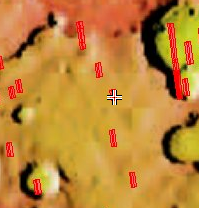
Cool image time! The image to the right, cropped and rotated to post here, was one of the uncaptioned photographs in the December Mars Reconnaissance Orbiter (MRO) image release. If you click on the image you can see the entire photograph. I have cropped the most interesting area, though cracks can be seen in other areas in the image.

What we appear to have here is a darker lower valley filled with dried mud, which over time has cracked as it dried. At its edges there appear to be ripples, almost like one sees on the beach as waves wash the shore. The perimeter slopes even show darker streaks as if the water in some places lapped up the slopes, and in others flowed downward into the valley.

Later, several meteorite impacts occurred, the largest of which produced concentric dried cracks on its outside perimeter. This impact also provides a rough idea of the depth of the mud in this valley.

Mud of course suggests that this lower valley once was filled with water. Was it? It is not possible now to come to a firm conclusion, but this image’s location shown by the red dot in the overview map below and to the right, provides a clue that strengthens this hypothesis.
» Read more

0 comments

China launches military satellite

The new colonial movement: China today used its Long March 3C rocket to launch a military communications satellite.

This was China’s 37th successful launch in 2018, only three launches less than their predicted 40 launches for the year. It almost doubles their previous record of 20 in 2016.

The leaders in the 2018 launch race:

37 China
21 SpaceX
14 Russia
11 Europe (Arianespace)
8. ULA

China leads in the national rankings, 37 to 34, over the U.S.

0 comments

SpaceX successfully launches GPS satellite

Capitalism in space: In launching an Air Force GPS satellite today, SpaceX successfully completed its 21st launch of 2018, the most ever achieved in a single year by a private company, ever, beating the record the company set last year by three.

The company has been so successful that many will take this achievement for granted. They should not.Ten years ago SpaceX barely existed. In that short time it has revolutionized the rocket industry, and recaptured for the U.S. the commercial market share that was lost by the older American rocket companies to Russia and Europe, because they were fearful and lazy and refused to compete.

The result however has not been zero sum. Launches in total have increased, and the potential for a revitalization of space exploration for everyone has not been as good since the 1960s. I know this will make some groan, but the sky now is literally the limit.

You can watch a replay of today’s SpaceX launch here.

The leaders in the 2018 launch race:

36 China
21 SpaceX
14 Russia
11 Europe (Arianespace)
8 ULA

China leads in the national rankings 36 to 34 over the U.S. At the moment only one more U.S. launch is scheduled, so it appears China will hold that lead. Stay tuned for my annual assessment of the launch industry, coming the first week in January.

12 comments

OSIRIS-REx flies over Bennu’s north pole

Bennu's north pole

Cool movie time! OSIRIS-REx has completed its first planned fly-over of Bennu, this time above its north pole, and the science team has released a short movie showing part of that fly-over. I have embedded the movie below the fold.

This series of MapCam images was taken over the course of about four hours and 19 minutes on Dec. 4, 2018, as OSIRIS-REx made its first pass over Bennu’s north pole. The images were captured as the spacecraft was inbound toward Bennu, shortly before its closest approach of the asteroid’s pole. As the asteroid rotates and grows larger in the field of view, the range to the center of Bennu shrinks from about 7.1 to 5.8 miles (11.4 to 9.3 km).

They have four more fly-overs of the asteroid’s poles and equator as they assemble a detailed map of its surface.
» Read more

3 comments

China launches first prototype of new low-cost communications constellation

The new colonial movement China today launched the first prototype Hongyun communications satellite.

Developed by the China Aerospace Science and Industry Corporation (CASIC), this is the fist satellite of a vast space-based communications network capable of covering every corner on the Earth, including the Arctic and Antarctica. The satellite mission is to verify low-orbit broadband communication technologies to be used on the Hongyun satellite constellation.

Announced by CASIC in September 2016, the Hongyun project has the goal of building a space-based communications network of 156 communications satellites into low Earth orbit, at an altitude of 160 to 2,000 km. Each satellite of the network will be able to transmit 500 megabytes of data per second. It will become operational in 2022.

These satellites, aimed at lowering cost, appear to be in direct competition with many of the new smallsat constellations being developed in the west by SpaceX, OneWeb, and others.

The leaders in the 2018 launch race:

36 China
20 SpaceX
14 Russia
11 Europe (Arianespace)
8 ULA

China has widened its lead over the U.S. in the national rankings, 36 to 33, and has likely now clinched that lead for the year. Stay tuned for my annual full report on the state of the launch industry in 2018.

7 comments

FCC fines company $900K for unapproved satellite launch

The FCC has issued a $900K fine against the smallsat company Swarm for its unlicensed launch in January on an Indian rocket of four smallsats.

Along with paying a massive fine, Swarm has agreed to submit reports to the FCC before every satellite launch it wants to make for the next three years. These reports must include all of the details about the launch vehicle that will carry the satellites, the time and location of the launch, and contact information for who is coordinating the launch. And Swarm has to do this a lot, too. Reports need to be submitted within five days of Swarm purchasing a ride on a rocket, or within 45 days of the flight. Additional reports must be submitted when the satellites are shipped to be integrated on the rocket, whenever the satellites are actually integrated, and around the time the launch is supposed to take place.

Within the next two months, Swarm must also establish its own “compliance plan” and appoint a compliance officer to make sure the company adheres to all of the regulations surrounding a satellite launch. This entails crafting clearly defined procedures and checklists that every employee must follow to confirm that the FCC’s licensing requirements are being met.

I have very mixed feelings about this. While it is important that the FCC make sure U.S. satellites are compliant with the Outer Space Treaty and that satellite makers and launch companies do not do things willy-nilly without some common sense coordination, this settlement, with its complex bureaucratic paperwork requirements, strikes me more as a power play by the agency to tell everyone that the government will rule here.

At the same time, I can understand the FCC’s concern. We are about to see a smallsat revolution, with tens of thousands of these satellites being built and launched by numerous big and small companies. The FCC wanted it very clear to everyone the need to get that licensing done properly. This settlement makes that clear.

5 comments

Russia’s Proton launches military satellite

Russia today successfully launched a military communications satellite using its Proton rocket.

This was only the second Proton launch this year, a rocket that was once Russia’s commercial workhorse with a launch rate more akin to what SpaceX has today.

The leaders in the 2018 launch standings:

35 China
20 SpaceX
14 Russia
11 Europe (Arianespace)
8 ULA

China leads the U.S. in the national rankings, 35 to 33.

0 comments

No rotational light curve from Ultima Thule?

Data from New Horizons as it is quickly approaching Ultima Thule has found that even though the object is expected to be oblong or even two objects it has shown absolutely no variation in light as it rotates.

Even though scientists determined in 2017 that the Kuiper Belt object isn’t shaped like a sphere – that it is probably elongated or maybe even two objects – they haven’t seen the repeated pulsations in brightness that they’d expect from a rotating object of that shape. The periodic variation in brightness during every rotation produces what scientists refer to as a light curve.

“It’s really a puzzle,” said New Horizons Principal Investigator Alan Stern, of the Southwest Research Institute. “I call this Ultima’s first puzzle – why does it have such a tiny light curve that we can’t even detect it? I expect the detailed flyby images coming soon to give us many more mysteries, but I did not expect this, and so soon.”

They have several theories, all implausible, to explain this. It could be they are looking at the object’s pole. Or maybe a dust cloud or numerous tumbling moons surround the object and hide the light variation.

Fortunately, we shall have an answer to this mystery in less than two weeks, when New Horizons zips past.

12 comments

InSight installs seismometer on Martian surface

InSight has successfully placed its first instrument, its seismometer, on Martian surface.

They aren’t yet ready to start gathering data, however.

In the coming days, the InSight team will work on leveling the seismometer, which is sitting on ground that is tilted 2 to 3 degrees. The first seismometer science data should begin to flow back to Earth after the seismometer is in the right position.

But engineers and scientists at JPL, the French national space agency Centre National d’Études Spatiales (CNES) and other institutions affiliated with the SEIS team will need several additional weeks to make sure the returned data are as clear as possible. For one thing, they will check and possibly adjust the seismometer’s long, wire-lined tether to minimize noise that could travel along it to the seismometer. Then, in early January, engineers expect to command the robotic arm to place the Wind and Thermal Shield over the seismometer to stabilize the environment around the sensors.

They plan on deploying the heat probe (which will drill down about 16 feet) in January.

3 comments

Curiosity’s future travels

MRO image of Curiosity's future travels

In the December release of images from the high resolution camera on Mars Reconnaissance Orbiter (MRO), there was one image entitled “Monitor Region Near Curiosity Rover.” To the right is a reduced, cropped, and rotated section of that image, annotated by me to show Curiosity’s future planned route (indicated by the yellow line). If you click on the image you can see the untouched full resolution version.

Curiosity’s journey has not yet brought it onto the terrain shown in this image. (For the overall context of Curiosity’s travels, see Pinpointing Curiosity’s location in Gale Crater.) The rover is right now just off the left edge of the photograph, on the white ridge dubbed Vera Rubin Ridge visible in the uppermost left. This week it completed the last planned drill sampling on that ridge, and it will soon descend off the ridge and begin heading along the yellow route up the mountain. The white dots along its future route are the locations of recurring slope lines, believed to be seasonal seeps of brine coming from below and causing gentle landslides that darken the surface. As you can see, they hope to get very close to the first seep, and will observe the second from across the canyon from a distance of about 1,200 feet.

The peak of Mount Sharp is quite a distance to the south, far beyond the bottom of the photograph. Even in these proposed travels the rover will remain in the mountain’s lowest foothills, though the terrain will be getting considerably more dramatic.

Below is a full resolution section of the image showing the spectacular canyon to the south of that second seep. This is where Curiosity will be going, a deep canyon about 1,500 feet across and probably as deep, its floor a smooth series of curved layers, reminiscent of The Wave in northern Arizona. The canyon appears to show evidence of water flow down its slopes, but that is unproven.
» Read more

0 comments

SpaceX raises a half billion for its Starlink satellite constellation

Capitalism in space: SpaceX has raised $500 million in investment capital to help fund its planned Starlink internet constellation expected to have just under 12,000 satellites in orbit.

I wonder if SpaceX will also be using this money for the development of Super Heavy/Starship. The article implies no, but the article also does not have access to the specific terms of the deal.

I also notice the interesting timing of this story today and yesterday’s story about how the Starlink satellites pose a threat of hitting people when they get de-orbited. Timing like this is rarely an accident. There are a lot of competitors to SpaceX who do not want it to succeed, and it would not surprise me if they are trying to throw a wrench in the operation to stop Starlink. A bad report like yesterday’s might cause big investors to back out.

1 comment

BepiColombo begins first operational engine burn

The European/Japanese mission to Mercury has begun the first operational firing of its four ion engines, set to last for the next two months.

This might seem like a ridiculously long burn, since most conventional rocket engines fire for minutes, not months. These are ion engines, however, far more efficient but producing a very tiny acceleration. It takes a long time for their burns to accumulate a velocity change.

1 comment

NASA approves Dream Chaser design

Capitalism in space? Sierra Nevada has, after several years of work, obtained NASA’s approval of the design of its Dream Chaser mini-shuttle, and will now begin construction.

I put a question mark in the header above because I am no longer sure Sierra Nevada is building a privately designed and privately owned spacecraft for the launch market. It seems that they have been captured entirely by NASA, and will instead be building the spacecraft NASA wants, which might raise costs enough to make this vehicle unaffordable for other customers.

The situation is understandable. Sierra Nevada does not have the independent capital that gives SpaceX its independence. It needs NASA to get this ship built, and thus will do whatever NASA demands. I just worry that NASA, unconcerned about cost (as is every agency in the federal government today), will spoil Dream Chaser’s viability in the commercial market.

2 comments
1 465 466 467 468 469 814