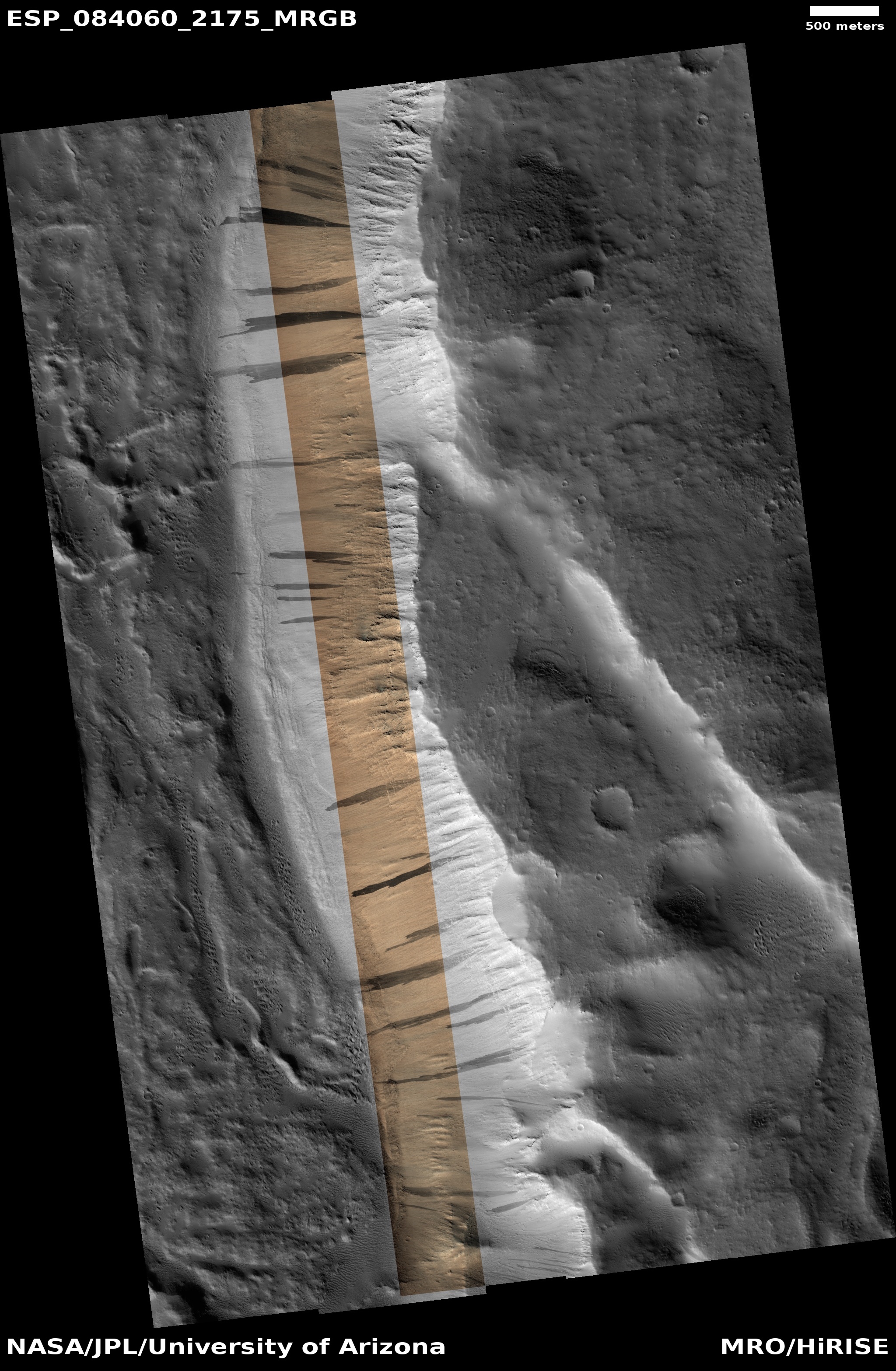
“What the heck?!” glaciers on Mars

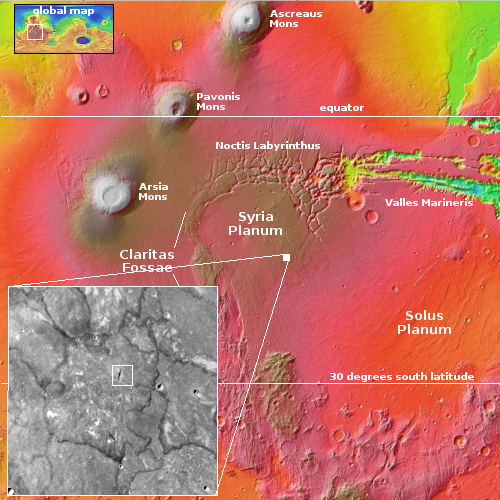
Overview map

Another
Click for original image.

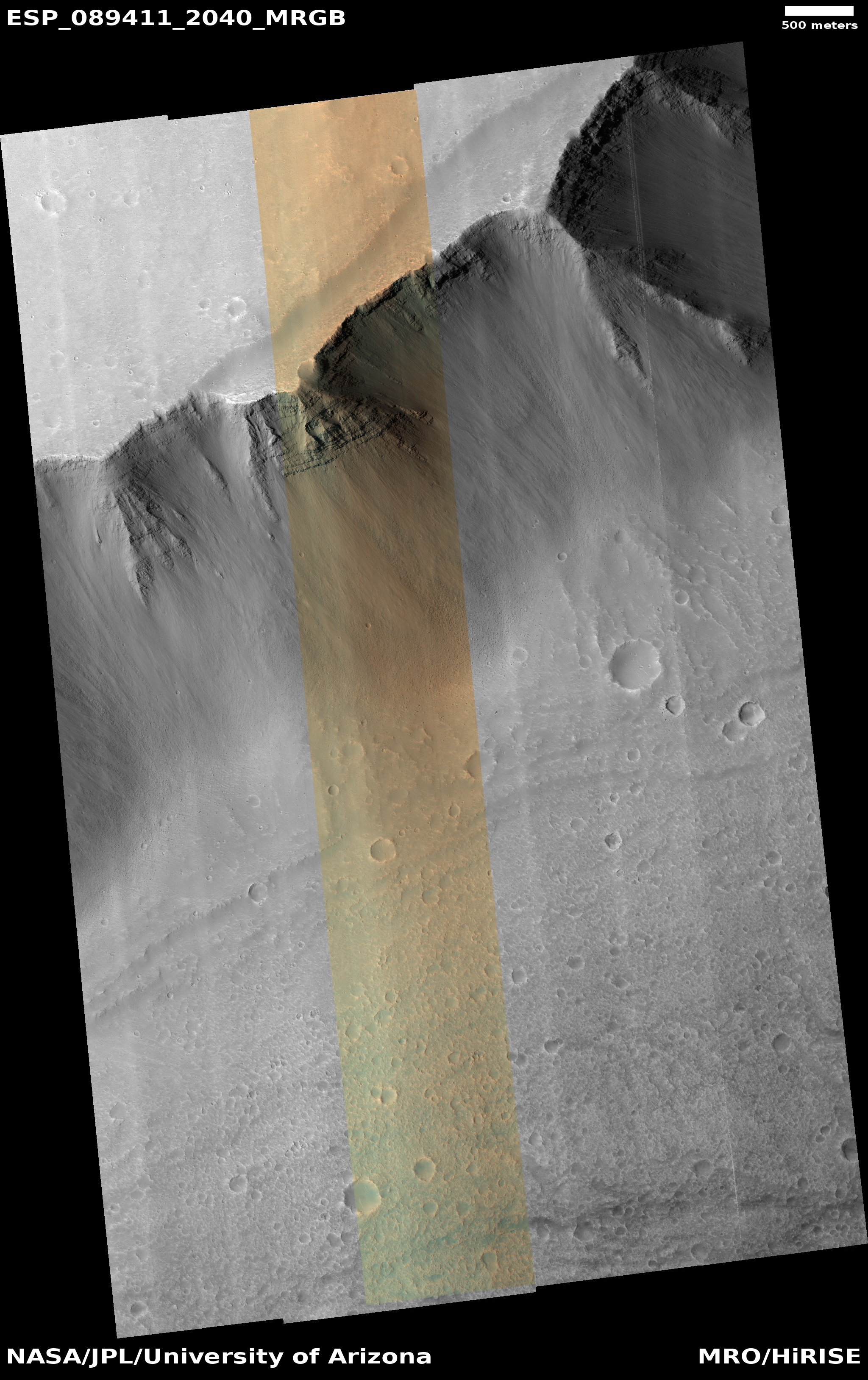
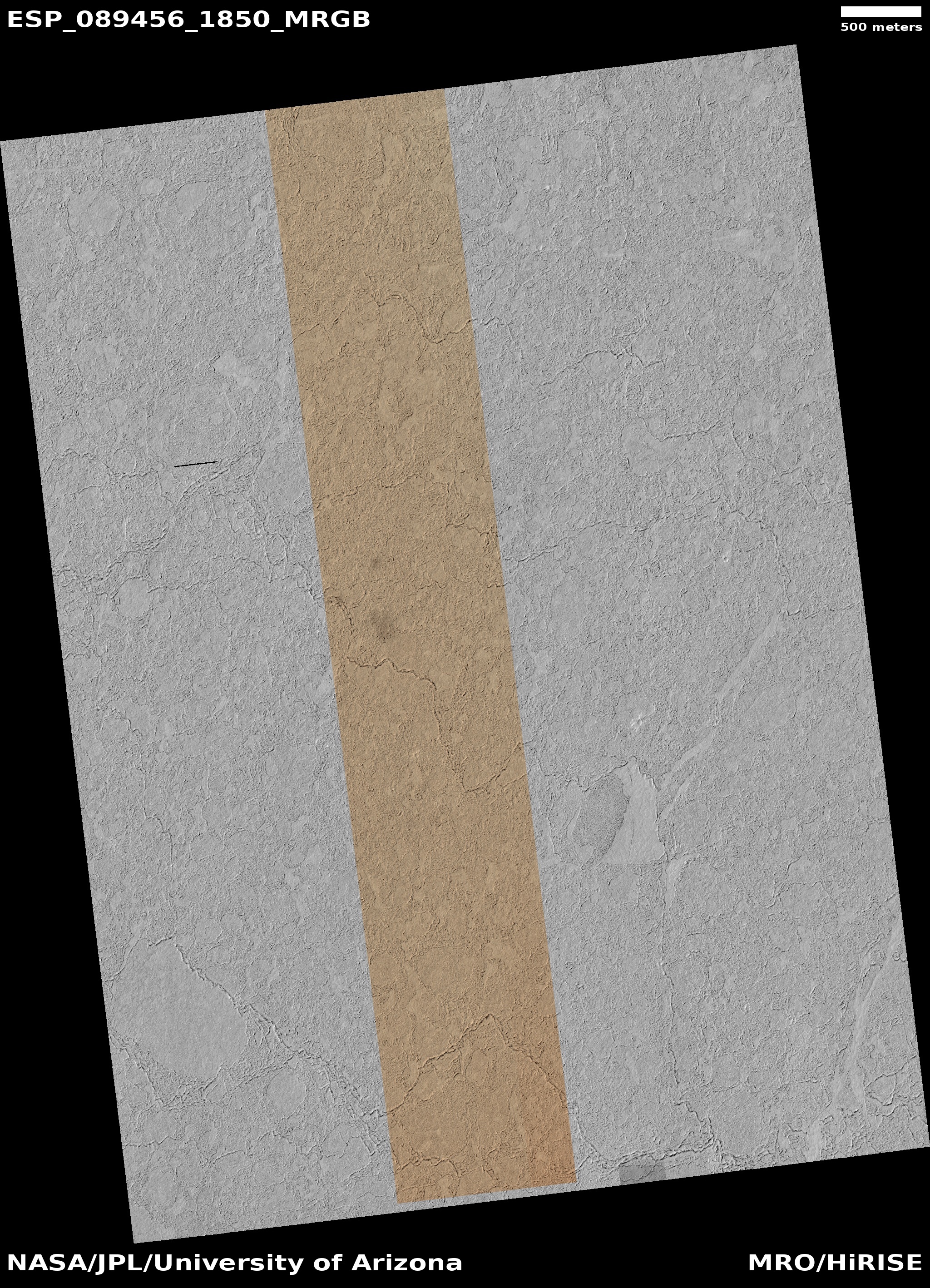
Cool image time! The picture to the right, cropped, reduced, and sharpened to post here, was taken on June 29, 2025 by the high resolution camera on Mars Reconnaissance Orbiter (MRO). It falls into what I call my “What the heck?!” category of Martian land-forms, simply because their shape is so strange and inexplicable it is difficult to conceive a geological process that could create them.

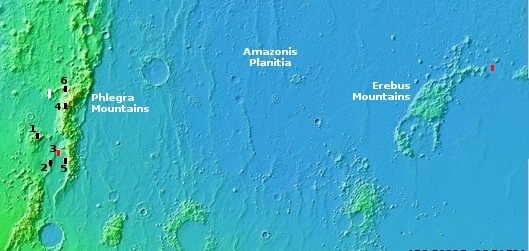
Nor does it help much that we know what these land-forms are made of. The white dot on the overview map above marks the location, inside the 2,000-mile-wide northern mid-latitude strip I label glacier country, because almost every image taken shows glacial features. In this case, this strange geology is located on the floor of a canyon that is part of a large region of chaos terrain, a landscape typical of glacier country. This floor, as well as all the low areas, seems filled with glacial flows. This particular canyon appears to roughly flow downhill to the northwest, though the downhill grade in the entire region varies widely in all directions.

Based on all the orbital data, these flows are glacial in nature, the ice protected by a thin top layer of dirt and debris. The strange features at the top of all the small mesas in the picture above suggest that the wind possibly blew off the dirt and debris, exposing the ice and allowing it to sublimate away. This in turn produced the knobby hollows at the top of each mesa.

I am guessing, and no one should trust my guess considering I only make believe I’m a geologist on the internet.

3 comments

Juice successfully completes Venus fly-by

The European orbiter Juice, on its way to Jupiter, successfully completed its fly-by of Venus on August 31, 2025, zipping 6,923 miles above the planet’s surface to get some of the velocity needed to get to Jupiter in 2031.

It still has to do two more fly-bys of Earth before it has enough speed to reach Jupiter.

There were no science observations during the Venus fly-by, as the spacecraft had to be oriented so that its large high gain antenna would protect its instruments from the Sun’s heat. It appears however that the science team has confirmed the spacecraft is in fine shape using its medium-gain antenna.

Once in orbit around Jupiter the spacecraft’s prime mission will be to do numerous fly-bys of the large icy Galilean moons, Europa, Ganymede, and Callisto. Its data will also reinforce what Europa Clipper will learn while it does the same, beginning in 2030.

0 comments

Exoplanet detected inside gap in accretion disk surrounding a Sunlike star

Exoplanet in gap of disk

For the first time since 2018, scientists have obtained a clear detection of an exoplanet inside the accretion disk surrounding a Sunlike star. Furthermore, the planet sits inside a gap in that accretion disk, the first time such an exoplanet has been found.

The image to the right, taken from figure one of the research paper [pdf], shows the exoplanet, dubbed WISPIT 2b. The star, located about 435 light years away, has a mass only slightly larger than our Sun, and is considered a close match. The planet itself is estimated to be about the mass of Jupiter, though its orbit within that gap is much farther away, 57 astronomical units versus 5.2. It is these details that make the discovery significant. From the paper’s conclusion:

As the planet resides in the cleared gap and its mass is consistent with the modeled planet mass required to open such a gap, we argue that it likely formed in situ through core accretion and that there is no rapid migration on dynamical timescales. Future follow-up observations of WISPIT 2b with ALMA and [Webb] will enable studies of its atmosphere and the impact of the embedded planet on the disk’s gas kinematics and surface density structure. This will allow us to calibrate ALMA observations of other embedded planet candidates, to unlock the full potential of this complementary technique.

…The discovery of WISPIT 2b embedded in the gap of a seemingly unperturbed disk demonstrates, for the first time, that wide-separation gas giants, discovered by direct imaging around older systems, can indeed form in situ. Thus, WISPIT 2b marks a promising starting point to study wide separation planets in time.

It has long been theorized that gas giants can form much farther from their star, and then migrate inward as the system evolves. This discovery counters that supposition, or least demonstrates that it does not have to occur in every new solar system.

The image also shows that the accretion disk has a second gap farther out, as well as a cleared area close to the star, comparable in size to our solar system. Though other exoplanets have not been detected yet, these gaps suggest they exist, thus indicating that a solar system comparable to our own is now forming.

3 comments

A baby star and its protoplanetary disk

A baby star and its protoplanetary disk
Click for originial.

Cool image time! The picture to the right, cropped, rotated, reduced, and sharpened to post here, is the Webb picture of the month from NASA and the European Space Agency (ESA), released today. It shows a baby star about 525 light years away.

IRAS 04302+2247, or IRAS 04302 for short, is a beautiful example of a protostar – a young star that is still gathering mass from its environment – surrounded by a protoplanetary disc in which baby planets might be forming. Webb is able to measure the disc at 65 billion km across – several times the diameter of our Solar System. From Webb’s vantage point, IRAS 04302’s disc is oriented edge-on, so we see it as a narrow, dark line of dusty gas that blocks the light from the budding protostar at its centre. This dusty gas is fuel for planet formation, providing an environment within which young planets can bulk up and pack on mass.

When seen face-on, protoplanetary discs can have a variety of structures like rings, gaps and spirals. These structures can be signs of baby planets that are burrowing through the dusty disc, or they can point to phenomena unrelated to planets, like gravitational instabilities or regions where dust grains are trapped. The edge-on view of IRAS 04302’s disc shows instead the vertical structure, including how thick the dusty disk is. Dust grains migrate to the midplane of the disc, settle there and form a thin, dense layer that is conducive to planet formation; the thickness of the disc is a measure of how efficient this process has been.

The dense streak of dusty gas that runs vertically across this image cocoons IRAS 04302, blotting out its bright light such that Webb can more easily image the delicate structures around it. As a result, we’re treated to the sight of two gauzy nebulas on either side of the disc. These are reflection nebulas, illuminated by light from the central protostar reflecting off of the nebular material.

As this is a baby star, the cones above and below the disk indicate the original spherical cloud, with the upper and lower halves now being pulled downward into a spinning disk, where the solar system is forming.

This image is not simply an infrared Webb image. The Hubble Space Telescope provided the optical view, which the Atacama Large Millimetre/submillimetre Array (ALMA) in Chile provided data in those wavelengths. Note also the many background galaxies. The universe is not only infinite, it is infinitely populated.

1 comment

Perseverance looks west

Perseverance looks west
Click for full resolution. For original images go here and here.

Overview map
Click for interactive map.

Cool image time! The panorama above, reduced and sharpened to post here, was created using two pictures taken on August 28, 2025 by the left navigation camera on the Mars rover Perseverance (here and here).

The blue dot on the overview map to the right marks Perseverance’s location when it took these pictures. The yellow lines indicate the approximate area covered by the panorama. The red dotted line indicates the rover’s planned route, with the white dotted line its actual travels.

The recent geological research focused on the lighter-colored ridge on the right center, dubbed Soroya. From the August 27, 2025 update by the science team:

Soroya was first picked out from orbital images as a target of interest because, as can be seen in the above image, it appears as a much lighter color compared to the surroundings. In previous landscape images from the surface, Mars 2020 scientists have been able to pick out the light-toned Soryoa outcrop, and they noted it forms a ridge-like structure, protruding above the surface. Soroya was easily identifiable from rover images as Perseverance approached since it indeed rises above the surrounding low-lying terrain.

The view is looking downhill away from Jezero Crater. The curve of the horizon is an artifact of the navigation camera’s wide view, accentuated by the slope that the rover sits on. The low resolution of this western region on the overview map is because the science team has not yet had Mars Reconnaissance Orbiter (MRO) get highest resolution pictures there yet.

Note the utter barrenness of this terrain. This is Mars, a lifeless world that has only the future potential for life, once we humans start to colonize it. Whether there was ever any past life remains uncertain, but the nature of its terrain as seen by both Perseverance and Curiosity suggests strongly that past life never existed, or if it did it barely survived and was quickly wiped out, a long time ago.

0 comments

Mars’ interior is more chaotic than Earth’s

Martian quake map as seen by InSight
The largest quakes detected by InSight, indicated
by the red dots.

Using archival quake data from the Mars lander InSight, scientists now believe that the upper layers in the interior of the red planet are not as coherently layered as the Earth’s, that its mantle is broken up in a much more chaotic manner. From the paper’s abstract:

We report the discovery of kilometer-scale heterogeneities throughout Mars’ mantle, detected seismically through pronounced wavefront distortion of energy arriving from deeply probing marsquakes. These heterogeneities, likely remnants of the planet’s formation, imply a mantle that has undergone limited mixing driven by sluggish convection. Their size and survival constrain Mars’ poorly known mantle rheology, indicating a high viscosity.

These “heterogeneities” are large blocks of material, some as large as two to three miles wide, that are thought left over from the planet’s initial formation. These initial pieces of the mantle were layered like the Earth, but subsequent impacts during the accretion process cracked them and shifted them about.

These results have some uncertainty, as so far only one seismometer, InSight’s, has be placed on Mars. It will require more sensors and years of data to fully map the interior with greater precision and reliability.

2 comments

Another great hiking location on Mars

Another great hiking location on Mars
Click for original image.

In honor of our just completed visit to the south rim of the Grand Canyon, today’s cool image takes us to another location on Mars that to me appears a perfect place to install some hiking trails. The picture to the right, cropped, reduced, and sharpened to post here, was taken on June 30, 2025 by the high resolution camera on Mars Reconnaissance Orbiter (MRO).

The image shows a two-mile wide canyon with a number of scattered narrow mesas within. The north and south rims rise about 550 feet above the canyon floor. The two mesas labeled “A” and “B” rise about 200 and 100 feet respectively.

The hiker in me immediately imagines what a great hike it would be to go up the western nose of either ridge and walk along its crest. The knife-edge nature of ridge “A” would mean that for a large majority of the hike you’d be at the north and south edges at the same time.
» Read more

2 comments

Sand dunes inside the Martian north polar icecap

Sand dunes inside the Martian north polar icecap
Click for original image.

Today’s cool image returns to the Martian north pole. The picture to the right, rotated, cropped, reduced, and enhanced to post here, was taken on July 3, 2025 by the high resolution camera on Mars Reconnaissance Orbiter (MRO). It shows the top of a ridge near the edge of that icecap, with dunes visible in the hollow several thousand feet below.

The angle of this picture does not show us the many layers on the cliff leading down to those dunes. It does show evidence, however, of the top few layers on the flat crest of that ridge. The white lines delineate those layers, each line marking the edge of a series of wide terraces.

The dunes in the canyon below are of interest because their source is likely the dust that is mixed into thick icecap’s ice. As that ice sublimates away on the face of the cliff, the dust falls into the canyon, where it is trapped.
» Read more

1 comment

The beauty of Mars’ many-layered northern icecap

The beauty of Mars' ice cap
Click for original image.

Cool image time! The picture to the right, rotated, cropped, reduced, and sharpened to post here, was taken on July 1, 2025 by the high resolution camera on Mars Reconnaissance Orbiter (MRO).

The science team labels it clumsily as “North Polar layered deposits structural geology in icy layers”. What we see are the many layers that make up the north polar cap, produced by the red planet’s many climate cycles that scientists think Mars has undergone over the eons as the red planet’s rotational tilt, or obliquity, rocked back and forth from 11 degrees inclination to as much as 60 degrees. At the extremes, the ice cap was either growing or shrinking, while today (at 25 degrees inclination) it appears to be in a steady state.

These layers are a mixture of ice and dust. The variations from dark to light likely indicate changes in the amount of dust in the atmosphere. Dark layers suggest the atmosphere was more dusty due to volcanic eruptions. Light layers suggest the planet’s volcanic activity was more subdued.

At least that’s one hypothesis.
» Read more

0 comments

Wind-eroded terrain on the edge of Mars’ largest volcanic ash field

Wind-eroded terrain in Mars' largest volcanic ash field

Cool image time! The picture to the right, cropped and sharpened to post here, was taken on July 2, 2025 by the high resolution camera on Mars Reconnaissance Orbiter (MRO).

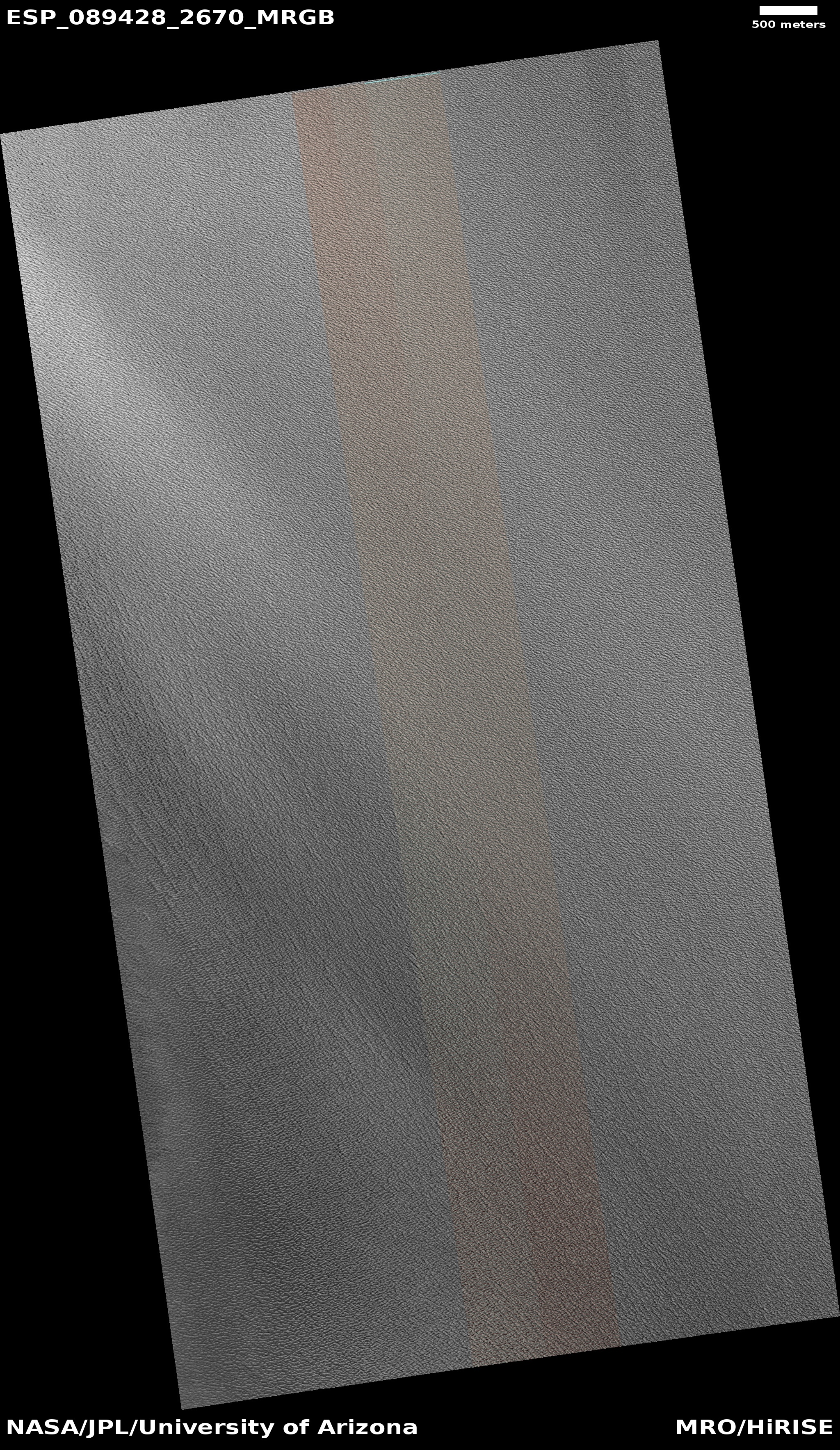
Labeled simply as “wavy terrain” by the MRO science team, it shows a relatively flat plain of hollows and terraced ridges that suggest the prevailing winds come from the west-southwest. As they blow, they slowly cause the layers of material to peel away, exposing those terraces.

This wavy landscape extends for many miles to the west, covering a region 135 by 160 miles in area. The layering and wavy nature of the terrain suggests the material here is fragile and easily peeled away by the winds of Mars’ very thin atmosphere. Think of the sandstone that forms Monument Valley and Canyonlands in the southwest United States, shaped almost entirely by wind.

And in fact, the overview map below confirms this.
» Read more

0 comments

Using Webb astronomers have for the first time identified the source of a fast radio burst

Fast Radio Burst source

Astronomers using the Webb Space Telescope have now successfully pinpointed a specific object that appears to be the source for a fast radio burst (FRB), extra-galactic short bursts of radio energy whose cause and origin have up-to-now been unexplained.

Blanchard and his team used a discovery of an FRB in a nearby galaxy made with the CHIME Outriggers array, a radio telescope in Canada, which was recently upgraded to enable FRB detections with precise positions. The researchers then turned to NASA’s James Webb Space Telescope to look for an infrared signal from the same location.

…The infrared data revealed an object, dubbed NIR-1, that is likely a red giant star or possibly a middle-aged massive star. A red giant is a Sun-like star near the end of its life that has expanded and brightened, while the other possibility is a star much more massive than the Sun.

Although these stars are unlikely to directly produce FRBs, the scientists say, they may have an unseen companion, such as a neutron star, pulling material away from the red giant or massive star. This process of transferring mass

The burst itself occurred on March 16, 2025 about 130 million light-years away in the galaxy NGC 4141. You can read the discovery paper here [pdf].

There remain of course great uncertainties. For one, NIR-1 is itself not likely the cause of the FRB, but related to its source in some manner. The scientists posit a number of explanations, from either an unseen magnetar (a pulsar with a powerful magnetic field), or a flare from this massive star reflecting off that unseen magnetar.

Regardless, this discovery helps narrow the theories considerably.

0 comments

Slumping landslide in Mars’ glacier country

Overview map

Slumping landslide in Mars' glacier country
Click for original image.

Cool image time! The picture to the right, rotated, cropped, reduced, and sharpened to post here, was downloaded on July 1, 2025 from the high resolution camera on Mars Reconnaissance Orbiter (MRO).

Labeled by the science team as a “flow,” it shows what appears to be a major collapse of the canyon’s south wall. The white dot on the overview map above marks the location, near the center of the 2,000-mile-long strip in the northern mid-latitudes of Mars that I label “glacier country” because almost every single high resolution image of this region shows glacial features.

This picture is no exception. First, the canyon appears filled with a glacial material, though its flow direction is unclear. Orbital elevation data suggests that this collapse is actually at the canyon’s high point, with the drainage going downhill to the east and west.

Second, the collapse itself doesn’t look like an avalanche of rocks and bedrock, but resembles more a mudslide. Since liquid water cannot exist in Mars’ thin atmosphere and cold climate, the soft nature of the slide suggests it is dirt and dust impregnated with ice. At some point, either because of the impacts that created the craters on its southern edge or because the sun warmed the ice causing it sublimate away thus weakening the ground structurally, the entire cliff wall slumped downward to the north.

The canyon itself is about 800 feet deep. It likely formed initially along a fault line, with ice acting over time to widen and extend it.

1 comment

Psyche snaps picture of Earth-Moon system

Earth and Moon, as seen by Psyche
Click for original image.

In a successful test of its cameras and pointing capabilities, the science team operating the probe Psyche — on its way to the asteroid Psyche — were able to snap a picture of Earth-Moon system from about 180 million miles away.

On July 20 and July 23, the spacecraft’s twin cameras captured multiple long-exposure (up to 10-second) pictures of the two bodies, which appear as dots sparkling with reflected sunlight amid a starfield in the constellation Aries.

One of those pictures is shown to the right. The scientists had previously taken similar calibration images of Jupiter and Mars.

To determine whether the imager’s performance is changing, scientists also compare data from the different tests. That way, when the spacecraft slips into orbit around Psyche, scientists can be sure that the instrument behaves as expected. “After this, we may look at Saturn or Vesta to help us continue to test the imagers,” said Jim Bell, the Psyche imager instrument lead at Arizona State University in Tempe. “We’re sort of collecting solar system ‘trading cards’ from these different bodies and running them through our calibration pipeline to make sure we’re getting the right answers.”

The spacecraft is scheduled to arrive at the metal asteroid Psyche in 2029, and will then spend at least two years flying in formation with it.

1 comment

Scientists link near Earth asteroids Bennu and Ryugu to much larger main belt asteroid

Ryugu and Bennu

Scientists comparing the spectroscopy of samples returned from the near Earth asteroids Bennu and Ryugu have found they closely resemble the much larger main belt asteroid Polana, suggesting all three formed at the same time and place.

You can read the paper here [pdf] From the press release:

The study compared spectroscopy data from Polana with spacecraft and laboratory data from Bennu and Ryugu samples, discovering similarities in their near-infrared spectrum sufficient to support the theory that they originate from the same parent asteroid. “Very early in the formation of the solar system, we believe large asteroids collided and broke into pieces to form an ‘asteroid family’ with Polana as the largest remaining body,” said SwRI’s Dr. Anicia Arredondo, lead author of the study. “Theories suggest that remnants of that collision not only created Polana, but also Bennu and Ryugu as well.”

While the similarities are great, the paper notes there are differences, possibly from “space weathering, particle size, surface texture, or different compositions.” The scientists believe the differences were caused by the asteroids’ different environments, with the 33-mile-wide and much older Polana in the asteroid belt beyond Mars, and Ryugu and Bennu, both less than a mile wide, orbiting the Sun inside Mars.

It is also possible the asteroids have little to do with each other, and the similar spectroscopy only informs us of some of the more common components of the early solar system.

0 comments

Gullies on a crater wall in the icy north of Mars

Gullies on a crater wall
Click for original image.

Cool image time! The picture to the right, cropped, reduced, and sharpened to post here, was taken on July 4, 2025 by the high resolution camera on Mars Reconnaissance Orbiter (MRO). It shows the lower right quadrant of a five-mile-wide unnamed crater in the high northern mid-latitudes of Mars.

The science team in its label for this picture focuses on the gullies visible on the crater’s interior wall. To my Earth-bound eye, these gullies look like recent erosion caused by underground ice sublimating into gas, causing the surface to collapse downward into the crater. This however is a purely uneducated guess.

The floor of the crater however shows features that resemble glacial fill, seen in numerous high latitude craters on Mars. This is not surprising, as the crater is located at 59 degrees north latitude, close enough to the pole for there to be a lot of near surface ice to be present.
» Read more

3 comments

Slope streaks within Mars’ largest mountain region

Overview map

Today’s cool image revisits Lycus Sulci, the largest mountain range on Mars, about 1,400 mile wide and 1,800 miles long. The overview map to the right gives a sense of the roughness and chaotic nature of this region, extending north from Mars’ largest volcano, Olympus Mons.

At present scientists are unsure of the geology that formed Lycus Sulci, and how it is linked with Olympus Mons. The wide view to the right suggests it is the remains of a very ancient lava flow descending from the volcano that over time has become eroded to produce this wildly knobby terrain. That hypothesis remains unproven however. There is also evidence that the material here might instead be volcanic ash, deposited in many layers and eroded away with time.

The location of the cool image below is marked by the white dot, with the inset providing us a wider view of the surrounding terrain. Note the two craters to the north and west. Both appear to have been partly filled by flows coming from the south and east, respectively, adding weight to the theory that this region formed from lava flow.
» Read more

2 comments

Webb: An Earth-sized exoplanet in habitable zone appears to lack an atmosphere

Scientists using the Webb Space Telescope have concluded that an Earth-sized exoplanet, orbiting the red dwarf star Trappist-1 in the habitable zone, does not appear to have an atmosphere, or if it does have one it is not like Earth’s.

The TRAPPIST-1 system is located 40 light-years away and was revealed as the record-holder for most Earth-sized rocky planets around a single star in 2017, thanks to data from NASA’s retired Spitzer Space Telescope and other observatories. Due to that star being a dim, relatively cold red dwarf, the “habitable zone” or “Goldilocks zone” – where the planet’s temperature may be just right, such that liquid surface water is possible – lies much closer to the star than in our solar system. TRAPPIST-1 d, the third planet from the red dwarf star, lies on the cusp of that temperate zone, yet its distance to its star is only 2 percent of Earth’s distance from the Sun. TRAPPIST-1 d completes an entire orbit around its star, its year, in only four Earth days.

Webb’s NIRSpec (Near-Infrared Spectrograph) instrument did not detect molecules from TRAPPIST-1 d that are common in Earth’s atmosphere, like water, methane, or carbon dioxide.

You can read the paper here [pdf].

The likelihood of life on this exoplanet has always been slim, simply because it orbits so close to the red dwarf, where it is vulnerable to the high energy flares the star periodically releases.

0 comments

When Martian lava meets a Martian mountain

When Martian lava meets a Martian mountain
Click for original image.

Cool image time! The picture to the right, rotated, cropped, reduced, and sharpened to post here, was taken on April 24, 2025 by the high resolution camera on Mars Reconnaissance Orbiter (MRO), and was posted yesterday by the science team to illustrate the vast lava flows that cover much of Mars. From the caption:

This image captures the edge of a lava flow that partially buries older terrain in the Martian Southern Highlands. Where the edge of the lava flow made contact with the higher-standing topography, it formed a rumpled and ridged surface.

This lava flow is one of many massive flows that extend southwest from Arsia Mons, one of the largest shield volcanoes on Mars.

The mountain to the south rises about 3,700 feet above that rumpled lava ocean at its base.
» Read more

0 comments

Radar images of near Earth asteroid as it zipped past the Earth

Radar images of near Earth asteroid
Click for original. Go here for movie made from these images.

Using the Goldstone radar antenna in California, astronomers have produced a series of 41 radar images of the near Earth asteroid 2025 OW as it made a close pass of the Earth on July 28, 2025.

Those images, cropped, reduced, and sharpened to post here, are to the right.

The asteroid safely passed at about 400,000 miles (640,000 kilometers), or 1.6 times the distance from Earth to the Moon.

The asteroid was discovered on July 4, 2025, by the NASA-funded Pan-STARRS2 survey telescope on Haleakala in Maui, Hawaii. These Goldstone observations suggest that 2025 OW is about 200 feet (60 meters) wide and has an irregular shape. The observations also indicate that it is rapidly spinning, completing one rotation every 1½ to 3 minutes, making it one of the fastest-spinning near-Earth asteroids that the powerful radar system has observed. The observations resolve surface features down to 12 feet (3.75 meters) wide.

The asteroid’s fast rotation suggests it is a solid object, structurally strong, rather than a rubble pile held together loosely by gravity. It would thus be very damaging if it should ever hit the Earth.

No worries however. The refined orbital data says this asteroid will not come this close again in the foreseeable future.

8 comments

Webb: Evidence of gas giant exoplanet orbiting the central star of Alpha Centuri

Webb infrared data
Click for original image.

The uncertainty of science: Astronomers using the Webb Space Telescope now think they have detected a gas giant exoplanet orbiting the central star of the Alpha Centuri triple star system, the closest star to our Sun at only four light years distance.

The false-color image to the right shows the candidate exoplanet labeled as S1, with the light of the central star blocked out but indicated by the star at the center. A lot of processing was required to bring out this bright blob, including eliminating optical effects that normally act to hide such objects.

Alpha Centauri, located in the far southern sky, is made up of the binary Alpha Centauri A and Alpha Centauri B, both Sun-like stars, and the faint red dwarf star Proxima Centauri. Alpha Centauri A is the third brightest star in the night sky. While there are three confirmed planets orbiting Proxima Centauri, the presence of other worlds surrounding Alpha Centauri A and Alpha Centauri B has proved challenging to confirm.

Now, Webb’s observations from its Mid-Infrared Instrument (MIRI) are providing the strongest evidence to date of a gas giant orbiting Alpha Centauri A. …Based on the brightness of the planet in the mid-infrared observations and the orbit simulations, researchers say it could be a gas giant approximately the mass of Saturn orbiting Alpha Centauri A in an elliptical path varying between 1 to 2 times the distance between Sun and Earth.

If confirmed the exoplanet would be orbiting the star within the habitable zone, though as a gas giant life as we know it would likely be impossible. The location, only four light years away, makes this exoplanet and the entire system a prime target for further observations.

Hat tip to BtB’s stringer Jay.

3 comments
1 11 12 13 14 15 55