Ingenuity’s status uncertain but likely healthy

Overview map
Click for interactive map.

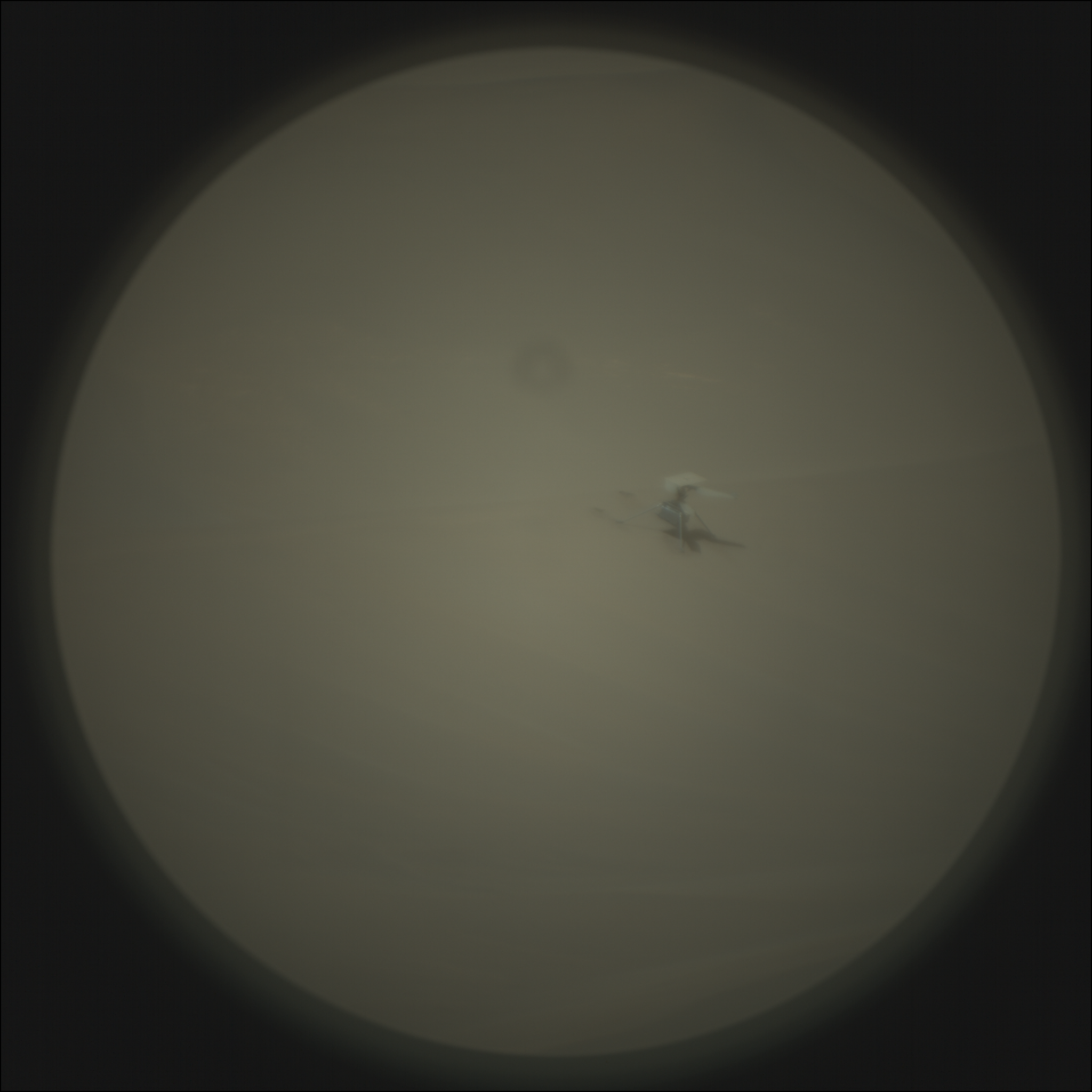
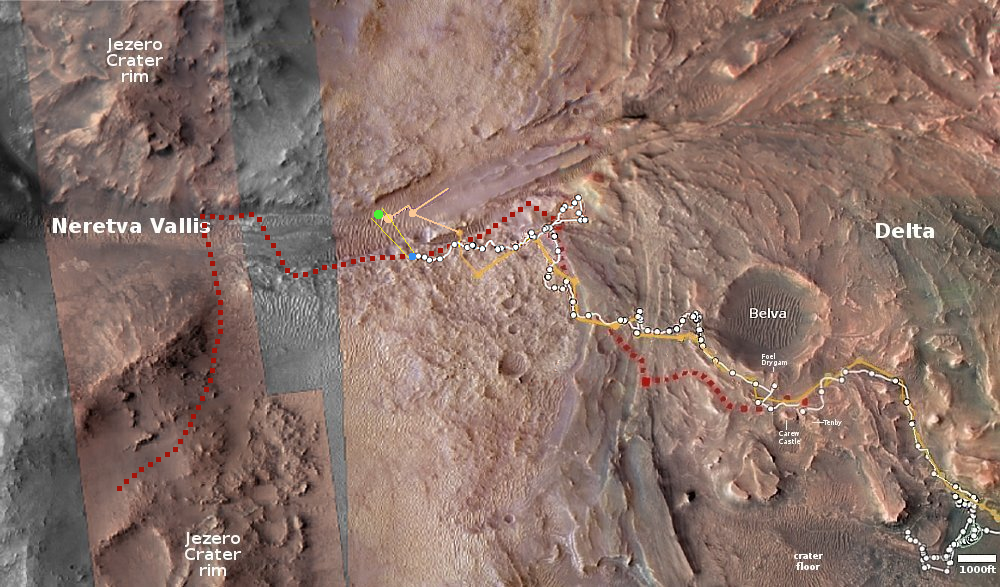
Updates from the engineering team that operates the Mars helicopter Ingenuity in the past two days have suggested the helicopter might be in trouble. First the team issued a status update yesterday that indicated communications had been lost prematurely during the helicopter’s 72nd flight.

The flight was designed as a quick pop-up vertical flight to check out the helicopter’s systems, following an unplanned early landing during its previous flight. Data Ingenuity sent to the Perseverance rover (which acts as a relay between the helicopter and Earth) during the flight indicates it successfully climbed to its assigned maximum altitude of 40 feet (12 meters). During its planned descent, communications between the helicopter and rover terminated early, prior to touchdown.

A further update today said that communications had been regained, but also noted that the engineering team still did not have a full understanding of the helicopter’s status.

We’ve reestablished contact with the #MarsHelicopter after instructing @NASAPersevere
to perform long-duration listening sessions for Ingenuity’s signal.

Based on the information released (or lack thereof) from the previous flight, the 71st, it is my sense that the situation is not as dire as these reports suggest, and that the situation might simply be related to issues of communications. Let me explain why I have come to this conclusion.
» Read more

1 comment

SLIM lands on the Moon

Telemetry after SLIM's landing

According to telemetry data (as shown on the screen capture to the right), Japan’s SLIM lander has apparently landed on the Moon near Shioli Crater, proving its autonomous precision landing system worked as planned.

At the moment however Japan’s space agency JAXA has not yet confirmed that the landing was completely successful. After landing the announcers on the live stream repeatedly noted that though the telemetry indicated it had landed as planned, engineers had not yet confirmed that the lander was still operational. Note how the data to the right suggests the spacecraft is tilted slightly. This tilt appears to match the tilt of the surface, but it could also indicate a problem with communications.

A press conference announcing either a confirmation or a failure will begin shortly at the live stream above.

4 comments

Scientists: Evidence of large deposits of buried ice along Martian equator

Theorized buried ice deposits on Mars
Click for original figure from paper.

Using data obtained from Europe’s Mars Express orbiter, scientists believe they have detected evidence of a very large and extensive deposit of buried ice in the dry Martian equatorial regions, buried within the Medusae Fossae Formation, what is thought to be the largest volcanic ash deposit on Mars.

The blue-to-orange areas inside the Medusae on the map to the right, taken from figure 5 of the paper, shows where they have detected potential buried ice, at depths ranging from one to two thousand feet below the surface. The orange areas indicate the thickest ice deposits, as much as two miles thick. From the paper’s abstract:

The MARSIS radar sounder [on Mars Express] detects echoes in Medusae Fossae Formation deposits that occur between the surface and the base which are interpreted as layers within the deposit like those found in Polar Layered Deposits of the North and South Poles. The subsurface reflectors suggest transitions between mixtures of ice-rich and ice-poor dust analogous to the multi-layered, ice-rich polar deposits.

Assuming this detection is real, this would be the largest reservoir of potential water in the dry equatorial regions found yet, comparable to another similar buried detection deep below the giant canyon Valles Marineris but much larger.

Accessing this water however will not be simple, as it is deep underground. You couldn’t just drill a well, as it is ice, not a liquid water table. It would have to mined like minerals on Earth. There are uncertainties about this conclusion as well. It is possible the detection is not water but volcanic ash or dust compacted in a way that mimics an ice detection.

1 comment

A rock tadpole on Mars

A rock tadpole on Mars

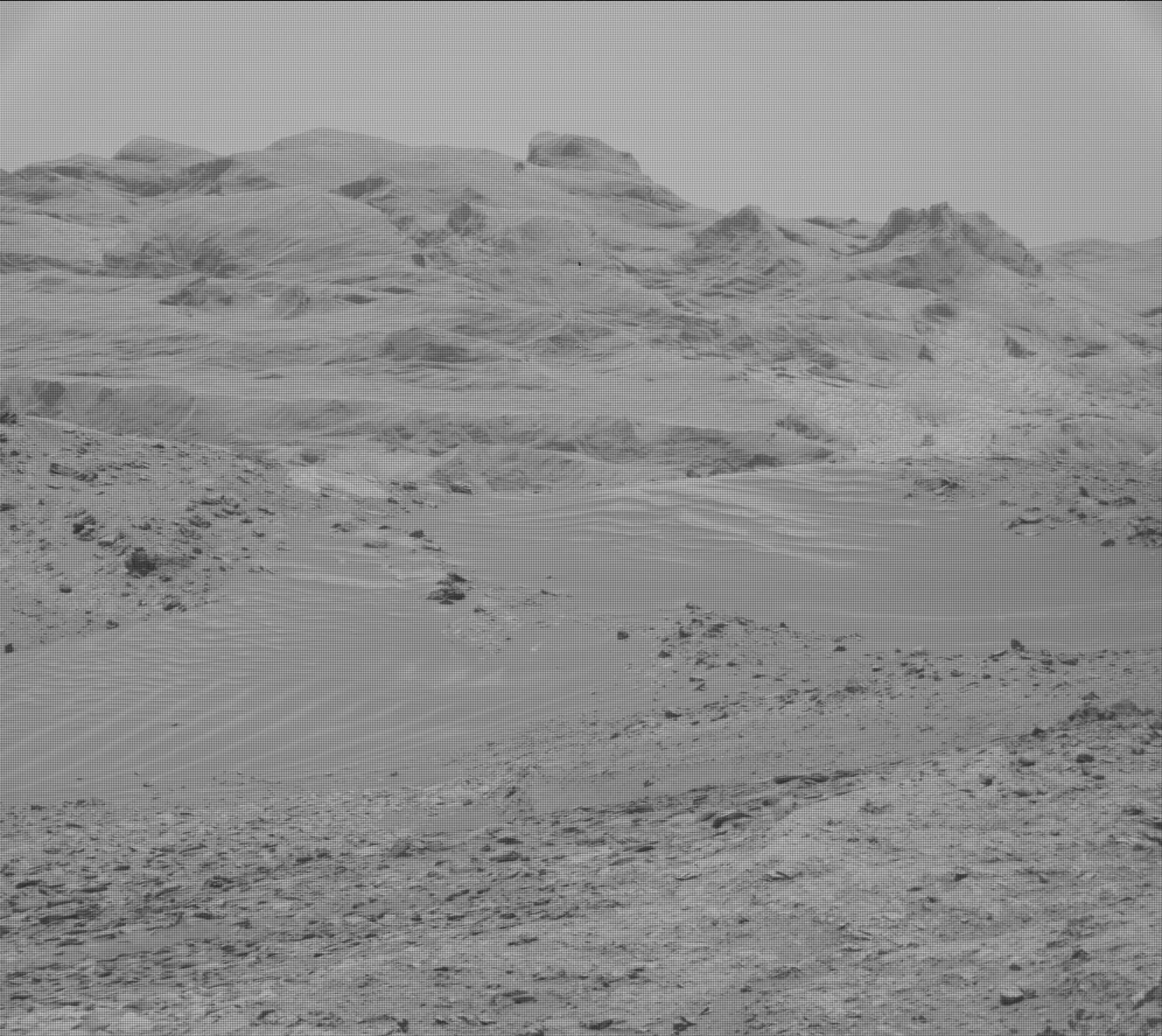
Cool image time! The picture to the right, cropped, reduced, and sharpened to post here, was taken on January 11, 2024 by the left navigation camera of the Mars rover Curiosity.

The picture was highlighted in yesterday’s update from the rover’s science team, describing the team’s upcoming geological goals for the next few days.

We have observed resistant, polygonal fractures/ridges in many recent bedrock blocks. There is much speculation among the team as to the origin of these features. Hypotheses have different implications for past environments, and the polygonal fractures are therefore of high interest. As well as the polygonal fractures, there are more continuous linear veins. The relationship between the polygonal and linear fractures can also help to inform our interpretations

You can see the polygonal fractures in the full image. The thin line of rock sticking up from the tadpole illustrates one of these continuous linear veins. The material that fills the vein is obviously more resistent to erosion, so as the wind (and maybe ancient ice or water activity) scoured the rock into its tadpole shape, the vein material remained.
» Read more

3 comments

Gullies and avalanches in Martian crater

Gullies and avalanches in a Martian crater
Click for original image.

Cool image time! The picture to the right, cropped, reduced, and sharpened to post here, was taken on September 17, 2023 by the high resolution camera on Mars Reconnaissance Orbiter (MRO). It shows two significant features, both of which suggest the action of near-surface water ice to change to surface of Mars.

First are the gullies on the cliff wall, which also happens to be the interior slope of a 30-mile-wide crater. Since the first discovery of gullies on Mars, scientists have pondered their origin, with all their hypothesises always pointing to some form of water process. One popular theory [pdf] points to some form of intermittent water flow linked to long term climate cycles caused by the extreme shifts in the red planet’s rotational tilt, from 11 to 60 degrees. Another theory suggests the gullies form from the winter-summer freeze-thaw cycle and the accumulation of frost during winter.

The second feature are the three avalanche debris piles at the base of these gullies. The long extent of each suggests the avalanches flowed more like wet mud than falling rocks. If the ground here was impregnated with ice, than this look makes sense.
» Read more
0 comments

The divide in a giant Martian lava river

The divide in a giant Martian lava river
Click for original image.

Cool image time! The photo to the right, rotated, cropped, reduced, sharpened, and annotated to post here, was taken on September 24, 2023 by the high resolution camera on Mars Reconnaissance Orbiter (MRO).

As indicated by the arrows, this is a frozen river of lava on Mars, flowing to the southwest and then splitting into two streams, one to the west and the other to the south. Being a Martian lava flow, when it was liquid it flowed much faster than lava on Earth, almost like a thick water. The flow bored into any high features, such as the two mesas in this picture, and streamlined their shapes, tearing material away as the lava moved by quickly. In the process the lava flow exposed many layers in those mesas, indicating many other previous lava flow events.

The crater in the lower mesa, where the stream splits, appears to have been more resistent to the flow, having been compacted into harder and denser material by the impact itself.
» Read more

0 comments

A cluster of strange terrain in Martian glacier country

Overview map

A cluster of strange terrain on Mars
Click for original image.

Cool image time! The picture to the right, rotated, cropped, reduced, and sharpened to post here, was taken on October 21, 2023 by the high resolution camera on Mars Reconnaissance Orbiter (MRO).

The science team labels this “patterned ground.” I see instead a whole range of inexplicable Martian geological features that, while each has been documented previously, each remains puzzling as to its formation process.

First there is the stucco-like peaks of all sizes on the upper left. This surface really looks like it had been wet plaster covered with Saran Wrap that had its peaks pulled up when that wrap was pulled off quickly.

Then there is brain terrain on the right. Always associated with glacier features on Mars, these convolutions are unique to Mars and as yet not entirely understood.

Next there is the circular arc on the middle left. It appears to be the remains of an impact crater now filled partly, but if so why has its northern rim disappeared so completely?

If you look close at the image above as well as the full image, you will find other mysterious features as well.

The location is the white dot on the overview map above. The rectangle in the inset shows the area covered by this picture, part of the floor of an unnamed eighteen-mile-wide and one-mile deep crater. The glacial material that appears to fill its interior as well as the splash apron that surrounds it all suggest the ground here is impregnated with water ice. Located as it is on the western end of the 2,000-mile-long north mid-latitude strip I dub glacier country — where practically every image shows glacial features — this conclusion is not surprising.

In fact, this photo illustrates well the alieness of Mars. We understand glaciers and ice, but on Mars, with its very cold temperatures, one-third Earth gravity, and thin atmosphere, those glaciers and ice are able to do things that we don’t yet understand. Untangling these geological processes will take decades of work, and likely will not be completed until people can walk the Martian surface and study it up close.

And won’t that be fun?

0 comments

A new plan to send a probe to interstellar object Oumuamua

Project Lyra about to rendezvous with Oumuamua
Click to watch the animation.

Scientists have proposed a project to send an unmanned probe to Oumuamua, using the Earth, Jupiter, and then the Sun to slingshot onto a path that would catch up with the interstellar object on its journey leaving the solar system in the mid-2050s.

The project, dubbed Lyra, was first proposed in 2023. The scientists have now revised the plan to account for the greater speeds needed to catch up with Oumuamua as it continues to move away from us. It is still within the solar system, but it is moving away very fast.

The graphic to the right, a screen capture of an animation at the link, shows the spacecraft as it finally approaches the interstellar object in 2055. To get there it would launch in the early 2030s, slingshot past the Earth to reach Jupiter, which would then slow it down so that it would fall back to the Sun, passing it by less than 450,000 miles, which would slingshot it out to Oumuamua (with the help of an additional engine burn). To survive the close solar approach it would use the same technology used by the Parker Solar Probe, which has already successfully flown that close to the Sun.

It seems this is an entirely worthwhile project, since Oumuamua continues to baffle scientists as to its nature. While most belief it is a natural but very unusual interstellar asteroid, none can dismiss the possibility that it instead an alien spacecraft. The data precludes nothing. Getting close to it seems worthwhile, no matter what.

For me, that rendezvous will happen when I would be 102 years old. I don’t think I’ll be here to see it.

21 comments

Double-ringed crater near the Starship landing zone on Mars

Double-ringed crater
Click for original image.

Cool image time! The picture to the right, rotated, cropped, reduced, and sharpened to post here, was taken on September 10, 2023 by the high resolution camera on Mars Reconnaissance Orbiter (MRO). It shows what the scientists label simply as a “double-rim crater.”

If you look close you might not be unreasonable to call this instead a triple-rim crater, as there appear to be two rings on each side of the highest crater rim.

Multple rings in craters are not rare. We see many on the Moon. Most however are associated with very large impacts, and are an expression of the ripples formed at impact, not unlike the ripples seen when you drop a pebble in water. Unlike water ripples, the ripples formed in rock are impact melt that quickly refreezes, thus capturing those ripples as concentric rings.

In this case, these rings likely signal not freezing rock but freezing ice.
» Read more

0 comments

Endless ash fields on Mars

Endless ash fields on Mars
Click for original image.

Cool image time! The picture to the right, cropped, reduced, and sharpened to post here, was taken on September 18, 2023 by the high resolution camera on Mars Reconnaissance Orbiter (MRO).

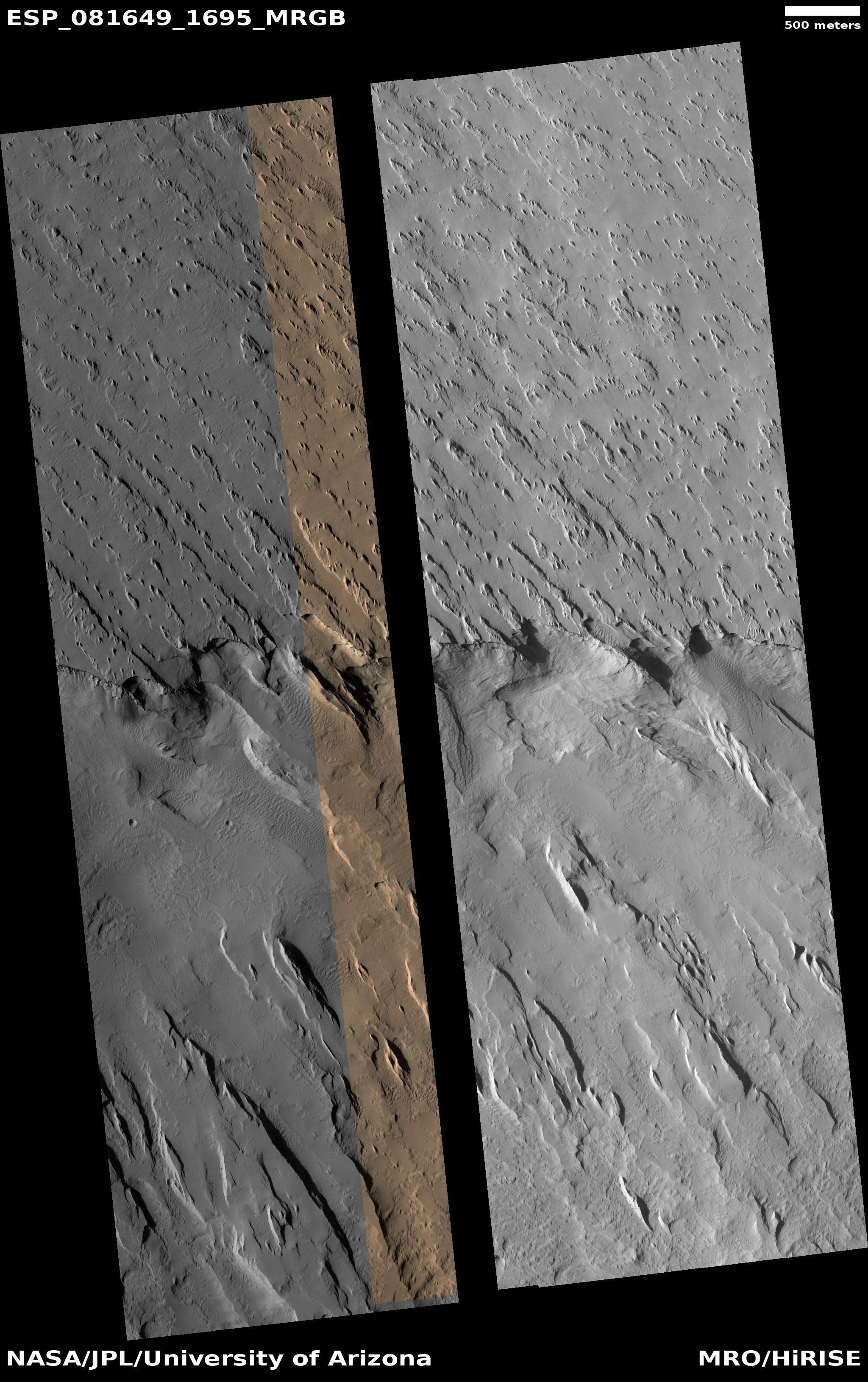
It shows the very typical surface on a high plateau in Mars’ dry tropical regions. The dunes you see here, in this very small slice, cover a region about 80 miles square, with the prevailing winds appearing to consistently blow from the northeast to the southwest and forming these endless striations.

The dunes are made of volcanic ash, and the size of this particular ash field gives us a sense of the past volcanic activity that once dominated the red planet. Once, the atmosphere was filled with ash, which covered the ground across large regions. In the subsequent eons the thin Martian atmosphere has reshaped and piled that ash into giant mounds hundreds of miles across, with the surface striated as we see here.
» Read more

4 comments

Layered volcanic vent on Mars

Layered volcanic vent on Mars
Click for original image.

Cool image time! The picture to the right, rotated, cropped, reduced, and sharpened to post here, was taken on August 31, 2023 by the high resolution camera on Mars Reconnaissance Orbiter (MRO), and shows what the science team labels as a “vent near Olympica Fossae.”

The grade within the fissure is downhill to its center. Outside the vent the grade is downhill to the north and south, with the overall grade sloping to the west as well. Note the layers on each side of the depression. Each indicates another volcanic flood event that laid down another layer of lava. At some point this vent either blew up through those layers, or it had remained opened during all those many events, the lava flowing out and acting like water to erode the layers on the north and the south.

As always, the scale of Martian geology is daunting, as shown by the overview map below.
» Read more

0 comments

Canyons formed from the giant crack that splits Mars

Canyons formed by the giant crack that splits Mars
Click for original image.

Cool image time! The photo to the right, cropped, reduced, and sharpened to post here, was taken on September 22, 2023 by the high resolution camera on Mars Reconnaissance Orbiter (MRO). It shows a complex of north-south trending canyons, with easternmost cliff about 400 feet high (though the full drop to the large canyon on its east is closer to 800 feet).

These canyons however have nothing to do with ice or water flow. They were formed by underground tectonic forces that pushed the ground upward, forced it to split and form cracks. Those cracks in turn produced these canyons. In some cases, such as the depression on top of the central ridge, the formation process probably occurred because fissures formed below ground, causing the surface to sag.

As always, the hiker in me wants to walk up the nose of that ridge and then along its western edge, with the western canyon on my left and that smaller depression on my right.

The larger context of this location is in itself even more spectacular.
» Read more

0 comments

The mining potential on Mars

The mining potential on Mars
Click for original image.

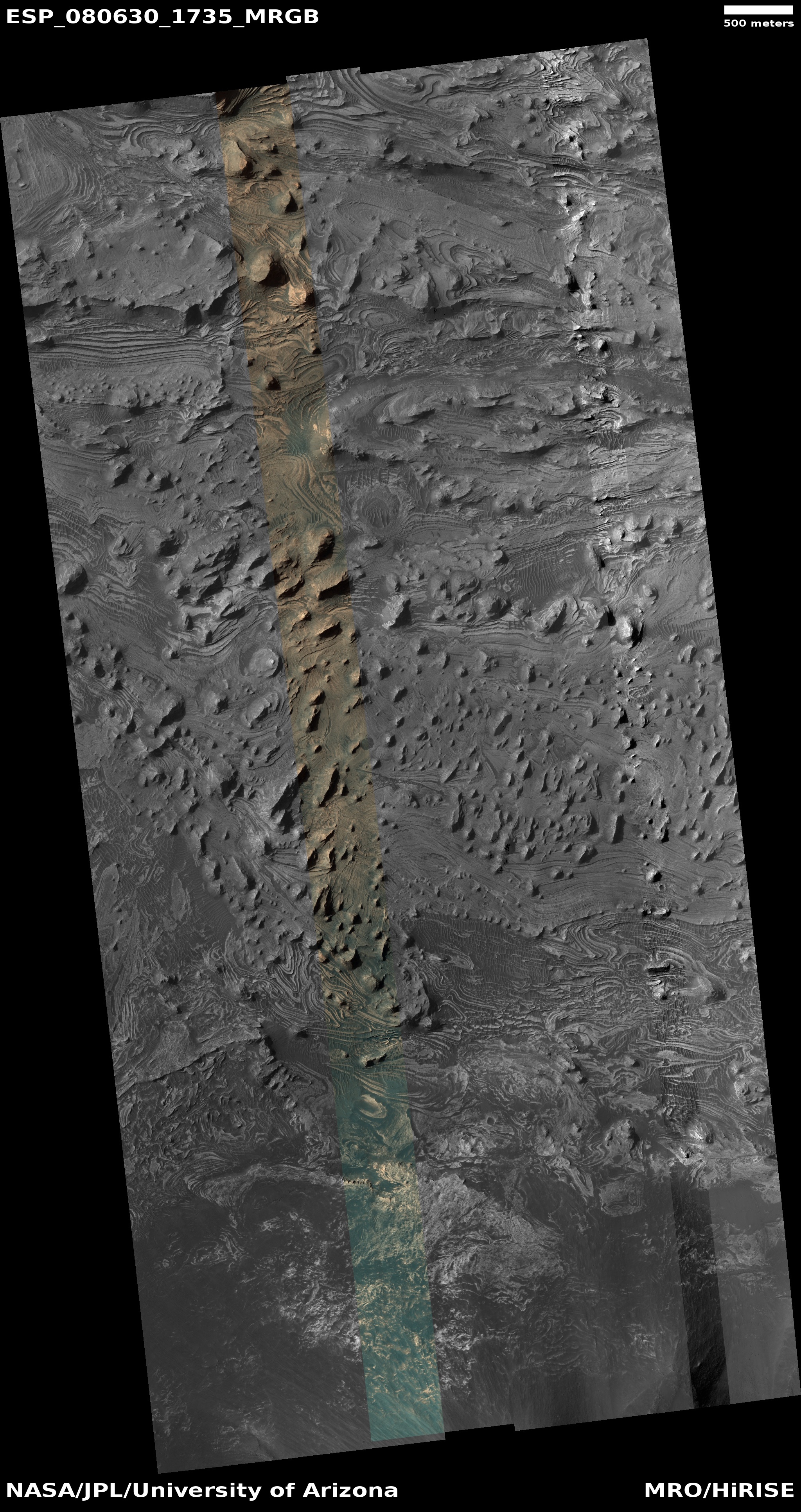
Cool image time! The picture to the right, cropped, reduced, and sharpened to post here, was taken on October 30, 2023 by the high resolution camera on Mars Reconnaissance Orbiter (MRO). Labeled simply as a “terrain sample,” it was probably taken not as part of any specific research project but to fill a gap in the schedule in order to properly maintain the camera’s temperature.

Nonetheless, the larger region where this photo is located is one of great interest to scientists as well as to future explorers. First note the colors. The wide variations between the bright orange of that peak (only a few tens of feet high) and the light orange and aqua-green of the bedrock to the north and south suggest a terrain with a lot of different materials within it.

The location is in the dry equatorial regions, so the swirls visible on the plateaus north and south of that small peak are not related to near surface ice. Instead, this is warped bedrock, with those swirls also suggesting material of a varied nature, exposed to the surface by erosion processes.
» Read more

1 comment

Dunes on the floor of Valles Marineris

Overview map

Dunes on the floor of Valles Marineris
Click for original image.

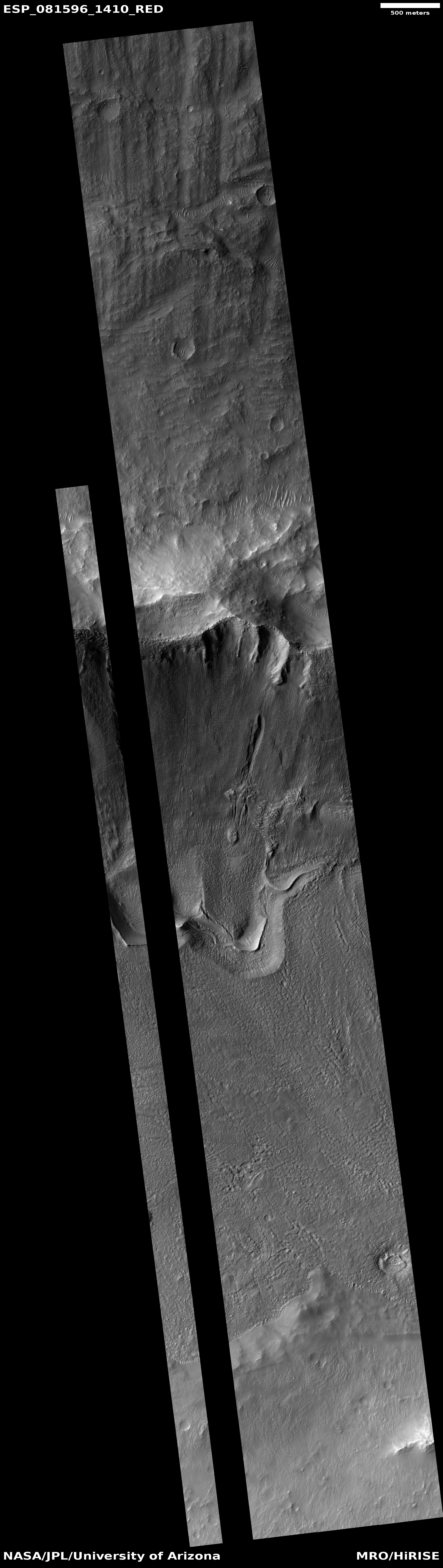
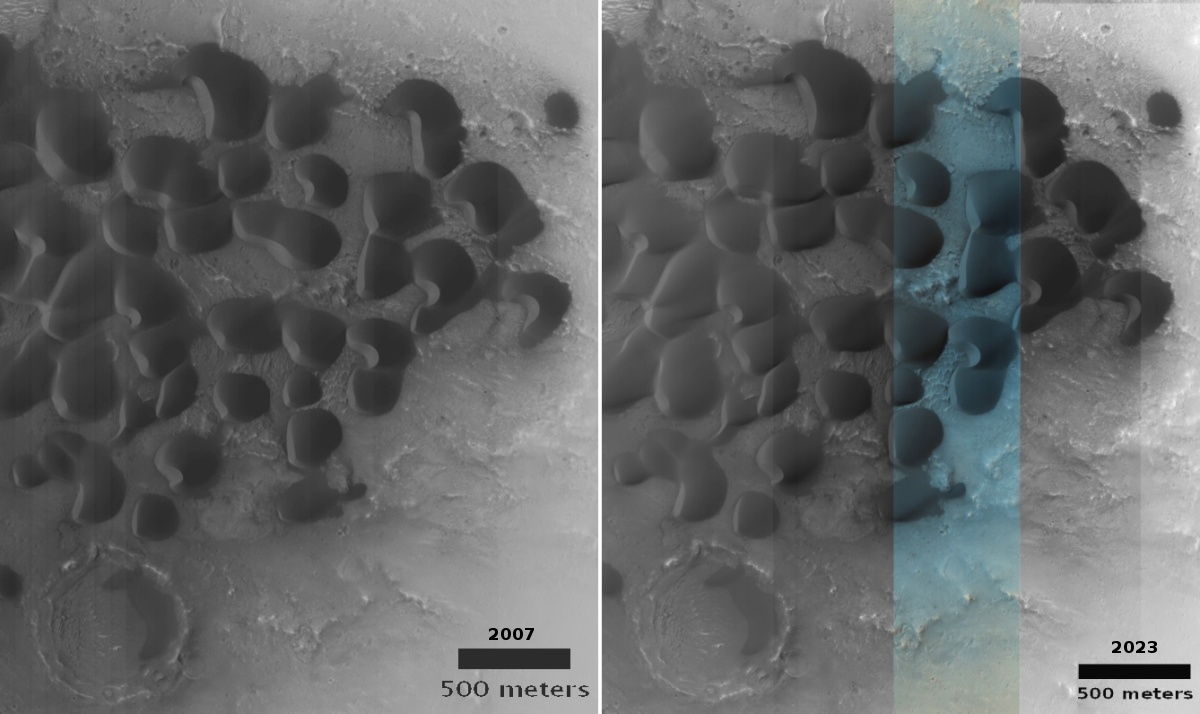
Cool image time! The picture to the right, cropped, reduced, and sharpened to post here, was taken on September 26, 2023 by the high resolution camera on Mars Reconnaissance Orbiter (MRO). It shows a field of scattered elongated dunes on a flat older surface with craters and what appear to be smaller ripple dunes (in the lower left). The large elongated dunes tend to be oriented in an east-west manner, while the older tiny ripple dunes appear to have a north-south orientation.

Very clearly the larger dunes appear to be traveling across that flat older surface, though whether there is any documented movement is unknown. Generally (though there are exceptions) scientists have found most of the dunes on Mars to be either inactive, or if they are moving because of the wind that movement is very tiny per year. In this case there is one dark spot on the dunes, near the center of the picture, where it appears a collapse might have occurred, suggesting recent change.

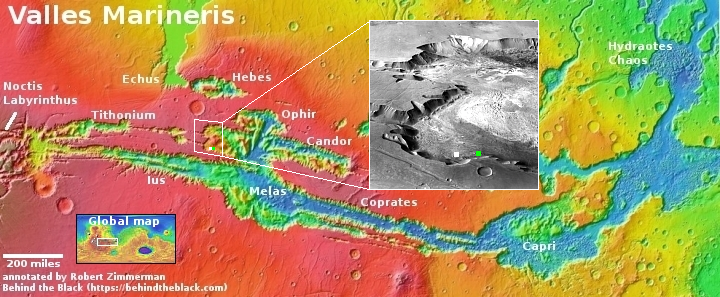
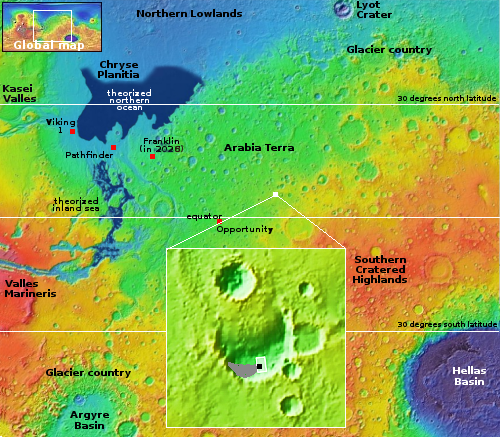
On the center right of the picture is the end point of a long ridgeline extending 10 to 12 miles to the east and rising about 7,300 feet, as shown in the overview map above. The small rectangle in the inset shows the area covered by the photograph.

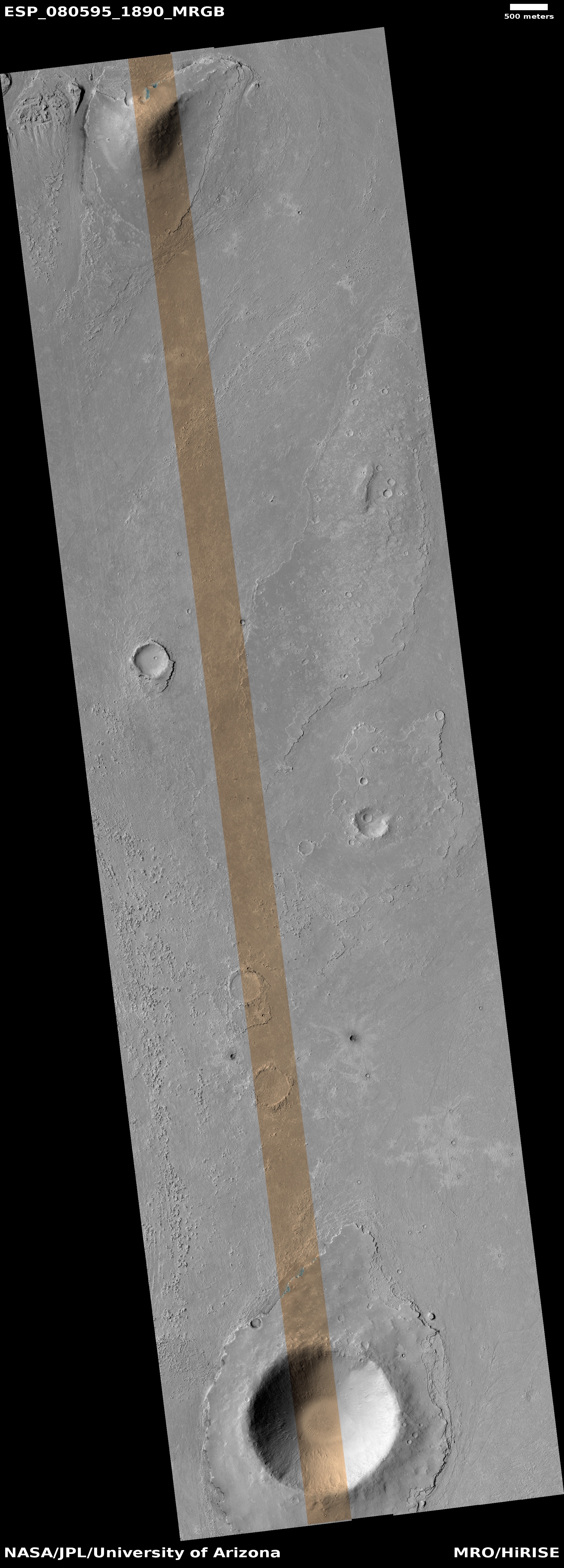
At the base of that ridgeline can be seen a series of terraces descending to the west, suggesting that this hill might be volcanic in nature, with each terrace indicating a separate lava flow. The location is in the dry equatorial regions, so near-surface ice is likely not an explanation.

In the inset the mountain wall to the north is the large mountain chain that bisects this part of Valles Marineris. It overwhelms this small 7,300-foot-high ridge, rising more than 22,000 feet from these dunes with its high point still one or two thousand feet below the rim of Valles Marineris itself.

Once again, the grand scenery of Mars amazes. Imaging hiking a trail along that ridgeline, with the mountains rising far above you to the north and south.

0 comments

First Juno images of Io from December 30th fly-by

Io as seen by Juno on December 30, 2023
For original global image go here. For original of inset go here.

The first raw Juno images taken of the Jupiter moon Io during its close fly-by on December 30, 2023, the closest in more than twenty years, have been released by the science team and citizen scientists have begun processing them.

The global picture to the right, rotated and reduced to post here, was processed by Kevin Gill. The inset of the volcanic mountains near the terminator was processed by Thomas Thomopoulos. As he notes, to obtain better detail he enhanced the colors and image and then zoomed in.

In the inset, note the northeast flows coming off the two mountains near the center. With the lower mountain, this flow appears to lie on top of a larger flow that extended out almost to the mountain to the right.

Io is a planet of continuous volcanic activity. For example, when the global image above was taken, the plume of a volcano eruption was visible on the right horizon, as shown in this version, its exposure adjusted by Ted Stryk. Catching such eruptions on Io is not unusual, considering its continuous volcanic activity generated by the tidal forces the planet undergoes from its orbit around Jupiter. In fact, the very first plume was imaged in 1979 by Voyager 1 during its short fly-by, and proved a hypothesis of such activity that scientists had only published one week earlier.

2 comments

The ancientness of rocks on Mars

Ancient rocks on Mars
Click for original image.

Cool image time! The picture to the right, cropped, reduced, and enhanced to post here, was taken on December 27, 2023 by the high resolution camera on the Mars rover Curiosity. It shows what is a somewhat typical rock found on the ground as Curiosity climbs Mount Sharp in Gale Crater.

Two features stand out. First, the many layers illustrate again the cyclical nature of Martian geology. Many sedimentary events occurred over a long time to create this rock, each cycle putting down a new layer, with some intervening time periods possibly removing layers as well. Such layering has now become evident in both ground photos taken by rovers as well as orbital images.

Second, the delicate nature of some layers indicates the incredibly slow erosion process on Mars, enhanced by the red planet’s one-third gravity. The atmosphere is incredibly thin, less than 0.1% of Earth’s. Yet given time the wind had been able to wear away the edges of this rock. The thin atmosphere and light gravity has also allowed some material to remain in a delicate manner that would be impossible on Earth.

Thus, for these thin flakes to have formed has required a great deal of time. The very nature of this rock speaks of an ancient terrain, shaped slowly by inanimate processes with no active life around to disturb things.

5 comments

Curiosity science team releases movies of Mars from dawn to dusk

Using its front and rear hazard avoidence cameras, the Curiosity science team had the rover take two full sets of images looking in one direction for twelve hours straight in order to create two movies of Mars that show an entire day, from dawn to dusk.

I have embedded both movies below. From the press release:

When NASA’s Curiosity Mars rover isn’t on the move, it works pretty well as a sundial, as seen in two black-and-white videos recorded on Nov. 8, the 4,002nd Martian day, or sol, of the mission. The rover captured its own shadow shifting across the surface of Mars using its black-and-white Hazard-Avoidance Cameras, or Hazcams.

Instructions to record the videos were part of the last set of commands beamed up to Curiosity just before the start of Mars solar conjunction, a period when the Sun is between Earth and Mars. Because plasma from the Sun can interfere with radio communications, missions hold off on sending commands to Mars spacecraft for several weeks during this time.

The first looks forward, into Gediz Vallis, where Curiosity will eventually travel. The second looks back down Mt Sharp and out across the rim of Gale Crater.
» Read more

0 comments

Mapping the major lava flood events in Mars’ volcano country

The volcanic events in Mars' volcano country
Click for original map.

In a paper just released, scientists have used the orbital data from Mars Reconnaissance Orbiter (MRO) to map on Mars forty different past volcanic eruptions of extensive flood lava covering large regions, all within the region I dub “volcano country” because its entire surface seems mostly shaped by flows of lava.

The map above, figure 1 from the paper, shows the study area (within the white rectangle), with its global context and additional information added by me on the right. Most of the largest earthquakes detected by InSight ran from north-to-south down the center of the white box. The named features are all large flood lava events, with the youngest being Athabasca. Within the Cerburus Plains feature the researchers mapped many smaller events which brought the total up to forty. From the abstract:

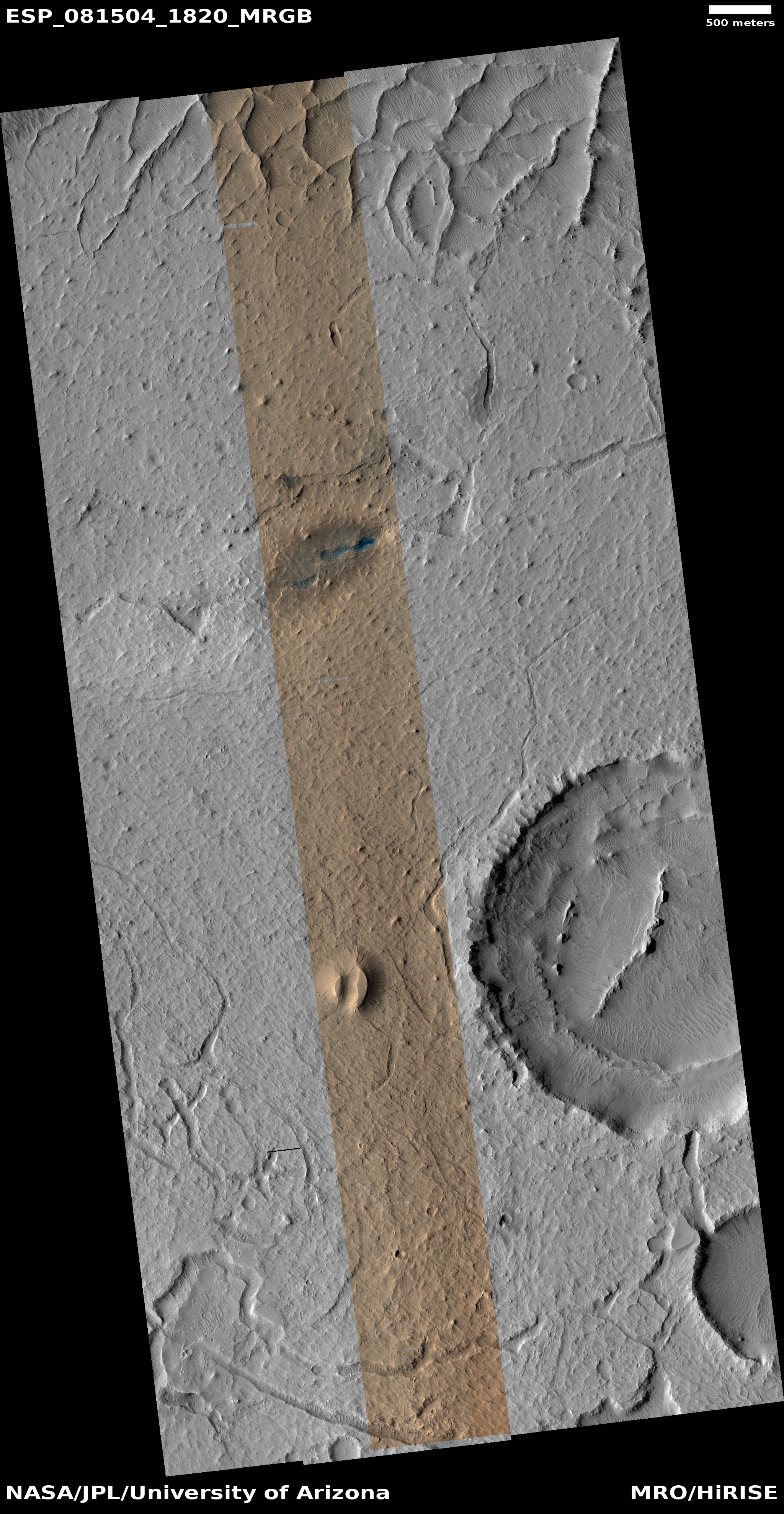
An area almost as large as Europe was investigated. The study revealed the products of more than 40 volcanic events, with one of the largest flows infilling Athabasca Valles with a volume of 4,000 km3. The surface appearance and material properties suggest that Elysium Planitia is composed of basalt, the most common type of lava on Earth. The area also experienced several large floods of water, and there is evidence that lava and water interacted in the past. However, while there could be ice in the ground today, it likely occurs in small patches.

None of these flood lava events involved the gigantic volcanoes that surround this region. Instead, the lava erupted from vents within this region, and then flowed downgrade to flood large areas, sometimes covering over parts of earlier lava floods. All also flowed much faster than lava on Earth, flooding vast regions — comparable to entire countries — often in mere weeks.

0 comments

Juno’s closest image of Europa suggests recent surface activity

Juno's best image of Europa
Click for original image.

Analysis by scientists of the closest image of Europa taken during Juno’s close-fly on September 29, 2022 suggests that a particular strange feature, dubbed the “platypus” due to its shape, might be very young and indicate recent surface activity that could be related to underground liquid water.

That picture, reduced and sharpened to post here, is to the right. It is figure 2 of the paper. The description of this photo from the abstract:

Intricate networks of cross-cutting ridges and lineated bands surround an intriguing 37 km (east-west) by 67 km (north-south) chaos feature with a concentric fracture system, depressed matrix margins, and low-albedo materials potentially associated with brine infiltration. The morphology and local relief of the chaos feature are consistent with formation in the collapse of ice overlying a salt-rich lens of subsurface water. Low-albedo deposits, similar to features previously associated with hypothesized cryovolcanic plume activity, flank nearby ridges. The SRU’s high-resolution view of many types of features in a single image allows us to explore their regional context and greatly improve the geologic mapping of this part of Europa’s surface. The image reveals several relatively youthful features in a potentially dynamic region, providing baselines for candidate locations that future missions can investigate for present day surface activity.

SRU is Juno’s Stellar Reference Unit camera, designed to take pictures using only the low light of Jupiter reflected onto nighttime surfaces of Jupiter’s moons. It took this photo when Juno was only 256 miles above the surface.

This feature will obviously become a prime target for Europa Clipper when it arrives into orbit around Jupiter in April 2030. From this vantage point — safer than continuous exposure to Jupiter’s magnetosphere while in orbit around Europa — the spacecraft will do 44 close-flys of the moon.

0 comments

Isolated mesa on Mars

An Isolated mesa on Mars
Click for original image.

Cool image time! The picture to the right, cropped, reduced, and sharpened to post here, was taken on August 13, 2023 by the high resolution camera on Mars Reconnaissance Orbiter (MRO).

The central butte is about 100 feet high. Not only are its flanks terraced, suggesting sedimentary layers, note the many black dots on its northern slopes. Those dots appear to be many boulders that appear to have rolled down the slopes to settle mostly near the mesa’s base.

The boxwork ridges to the west and south suggest the ground was fractured in some event to produce cracks, which were later filled with material that was erosion resistent. As the terrain was worn away by wind it left these ridges behind.

The prevailing winds in this region are believed to blow mostly to the south, which might explain the parallel ridges south of the mesa. Or not. On this I am guessing entirely.
» Read more

0 comments
1 29 30 31 32 33 55