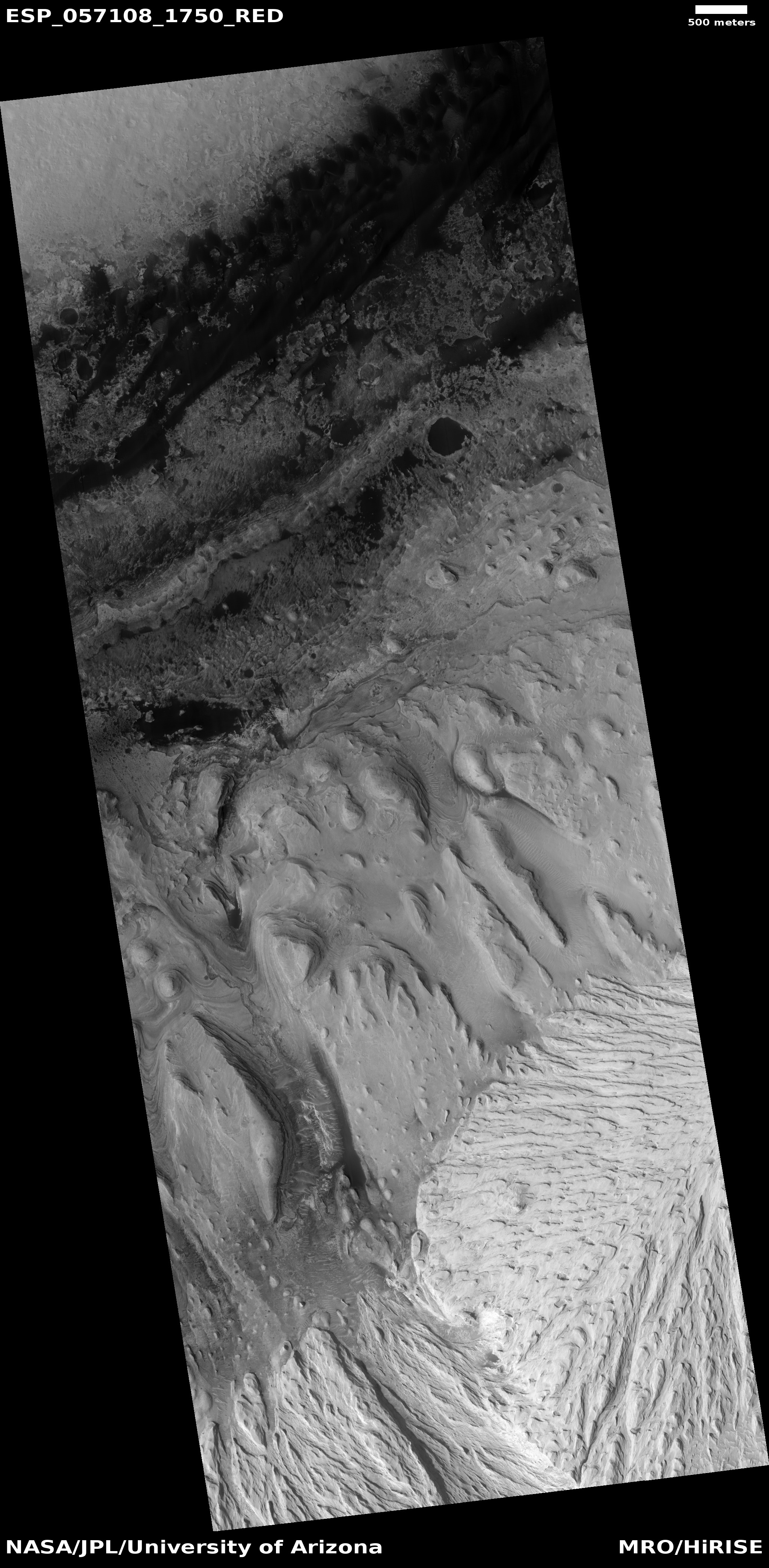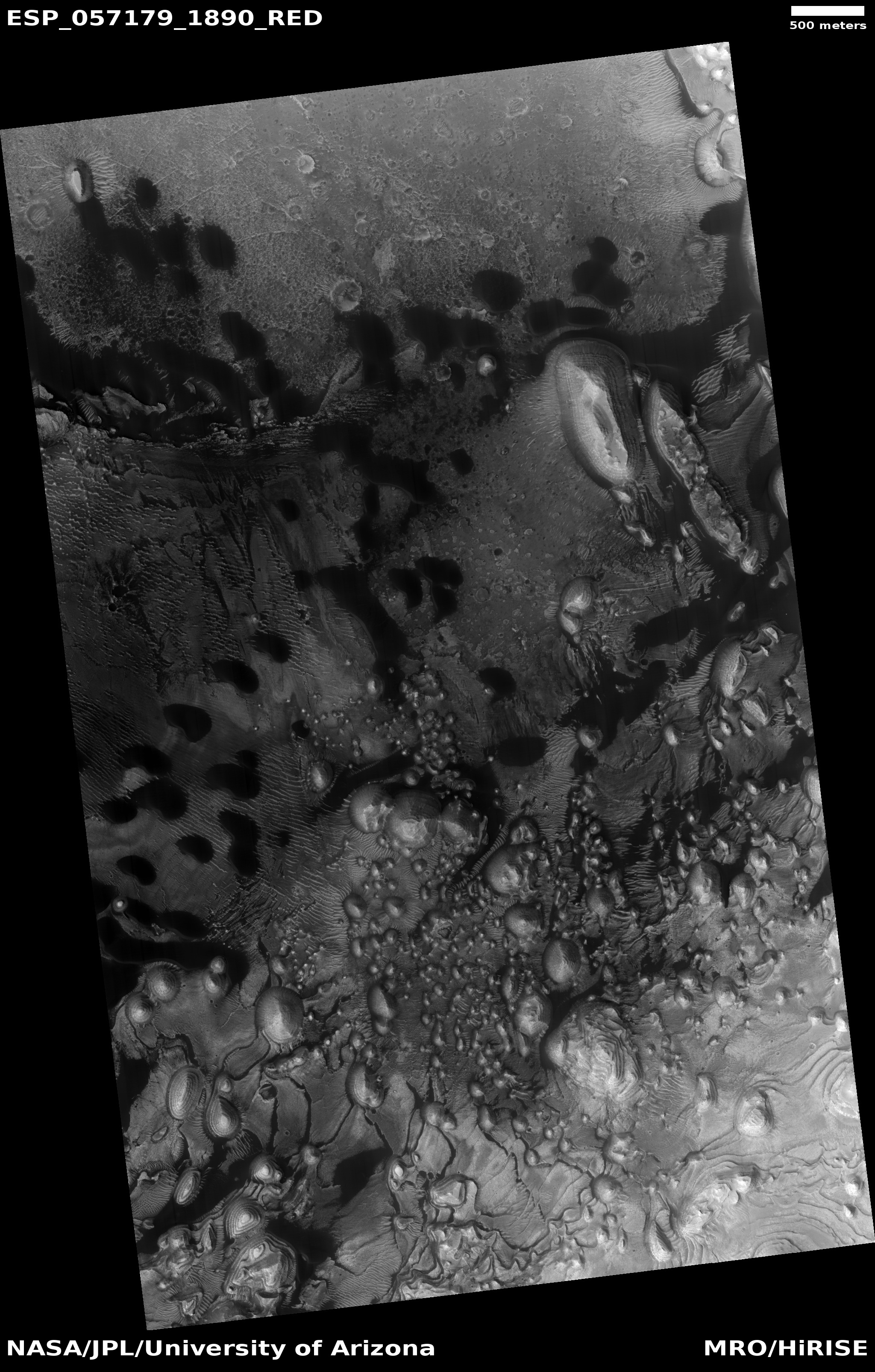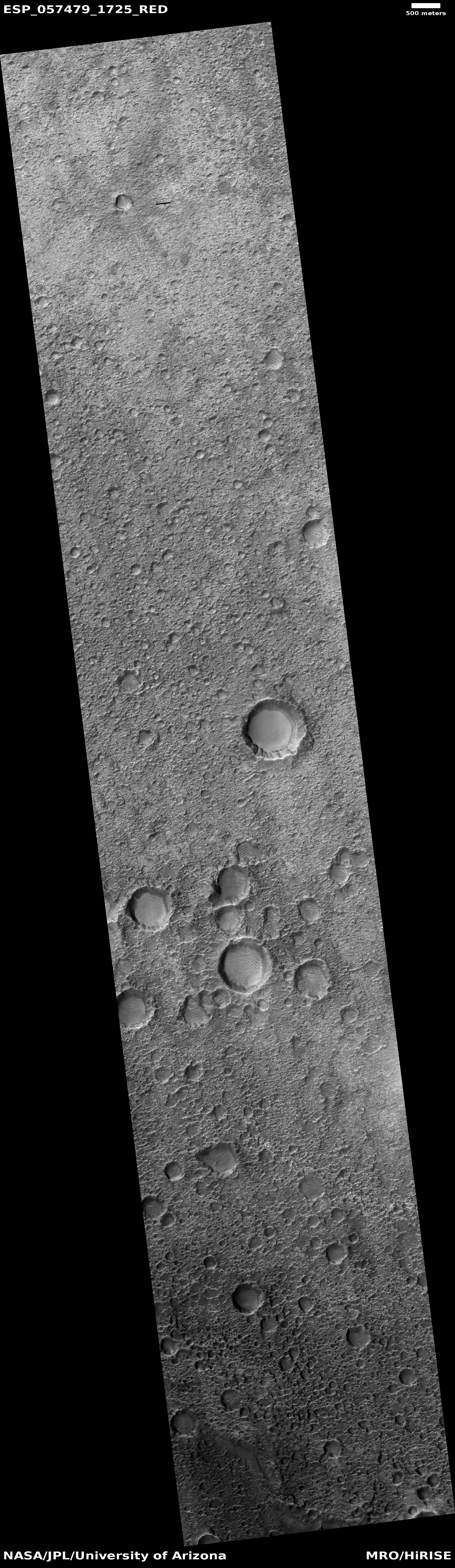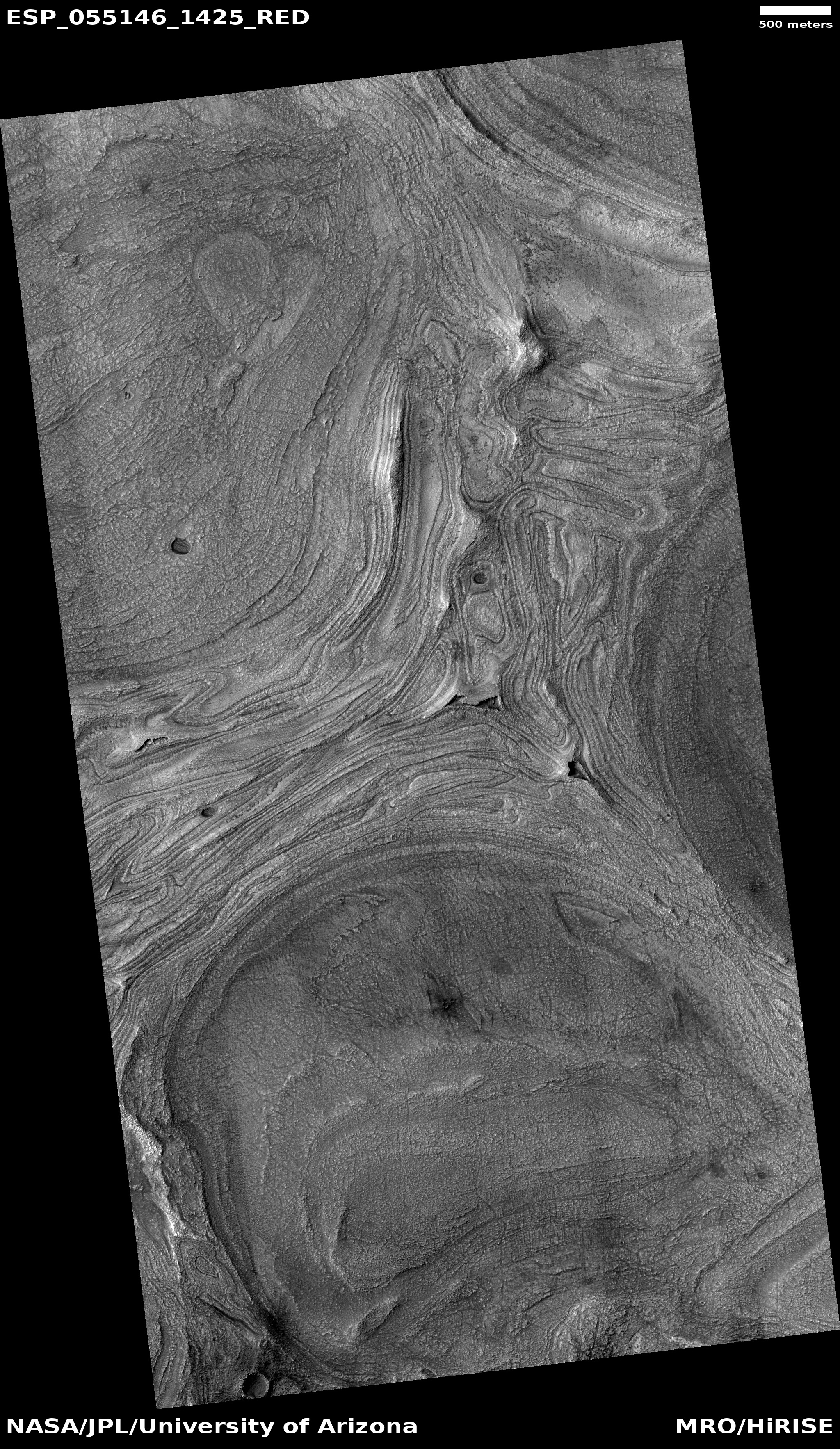
Dried mud cracks on Mars?

Mud cracks on Mars?

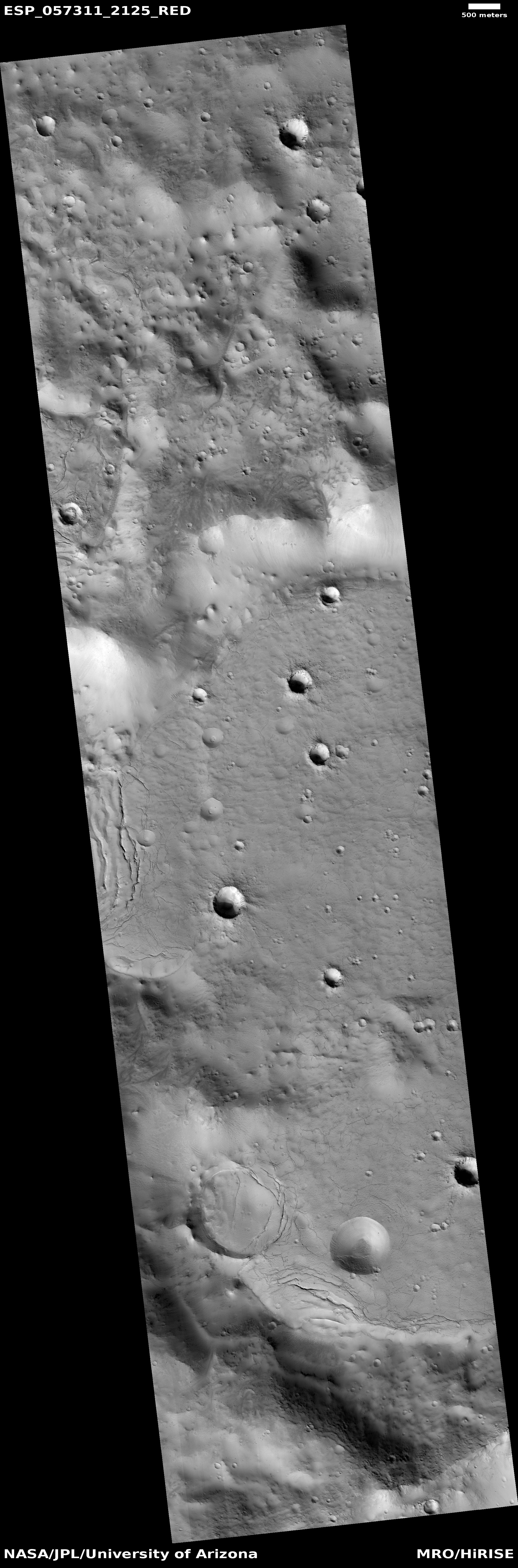
Cool image time! The image to the right, cropped and rotated to post here, was one of the uncaptioned photographs in the December Mars Reconnaissance Orbiter (MRO) image release. If you click on the image you can see the entire photograph. I have cropped the most interesting area, though cracks can be seen in other areas in the image.

What we appear to have here is a darker lower valley filled with dried mud, which over time has cracked as it dried. At its edges there appear to be ripples, almost like one sees on the beach as waves wash the shore. The perimeter slopes even show darker streaks as if the water in some places lapped up the slopes, and in others flowed downward into the valley.

Later, several meteorite impacts occurred, the largest of which produced concentric dried cracks on its outside perimeter. This impact also provides a rough idea of the depth of the mud in this valley.

Mud of course suggests that this lower valley once was filled with water. Was it? It is not possible now to come to a firm conclusion, but this image’s location shown by the red dot in the overview map below and to the right, provides a clue that strengthens this hypothesis.
» Read more

0 comments

Curiosity’s future travels

MRO image of Curiosity's future travels

In the December release of images from the high resolution camera on Mars Reconnaissance Orbiter (MRO), there was one image entitled “Monitor Region Near Curiosity Rover.” To the right is a reduced, cropped, and rotated section of that image, annotated by me to show Curiosity’s future planned route (indicated by the yellow line). If you click on the image you can see the untouched full resolution version.

Curiosity’s journey has not yet brought it onto the terrain shown in this image. (For the overall context of Curiosity’s travels, see Pinpointing Curiosityโ€™s location in Gale Crater.) The rover is right now just off the left edge of the photograph, on the white ridge dubbed Vera Rubin Ridge visible in the uppermost left. This week it completed the last planned drill sampling on that ridge, and it will soon descend off the ridge and begin heading along the yellow route up the mountain. The white dots along its future route are the locations of recurring slope lines, believed to be seasonal seeps of brine coming from below and causing gentle landslides that darken the surface. As you can see, they hope to get very close to the first seep, and will observe the second from across the canyon from a distance of about 1,200 feet.

The peak of Mount Sharp is quite a distance to the south, far beyond the bottom of the photograph. Even in these proposed travels the rover will remain in the mountain’s lowest foothills, though the terrain will be getting considerably more dramatic.

Below is a full resolution section of the image showing the spectacular canyon to the south of that second seep. This is where Curiosity will be going, a deep canyon about 1,500 feet across and probably as deep, its floor a smooth series of curved layers, reminiscent of The Wave in northern Arizona. The canyon appears to show evidence of water flow down its slopes, but that is unproven.
» Read more

0 comments

Dark dunes, wedding cake mesas, and dust-filled gullies

Dark dunes, wedding cake mesas, and dust-filled gullies

Cool image time! The photo on the right, reduced, rotated, and cropped slightly to post here, was taken by the high resolution camera on Mars Reconnaissance Orbiter (MRO) and issued by the spacecraft science team in its December image release.

They didn’t give this image a caption. The release title, “Arabia Terra with Stair-Stepped Hills and Dark Dunes,” significantly understates the wild variety of strange features throughout this terrain. Normally I crop out one section of the photographs I highlight to focus on the most interesting feature, but I couldn’t do it this time. Click on the image to see the full resolution version. Take a look at the complex wedding cake mesas in the lower left. Look also at the streaks of dust that I think are filling the gullies between these hills. In the image’s upper left are those dark dunes, scattered between dust ripples and small indistinct rises and what appears to be a drainage pattern descending to the north. Interspersed with these dunes near the center of the image are several perched crater floors, indicating that the crater impacts happened so long ago that the surrounding terrain had time to erode away, leaving the crater floor hanging like a small plateau.

On the right the two largest mesas rise in even stair-stepped layers that would do the mesas in the Grand Canyon proud.

This could very well be the coolest image I have ever posted. Everywhere you look you see something different, intriguing, and entirely baffling.

Arabia Terra covers the largest section of the transition zone between Mars’s high cratered south and its low flat northern plains, where some scientists believe an intermittent ocean might have once existed. It lies to the east of Valles Marineris, and is crater-filled with numerous intriguing geology, as this image most decidedly illustrates. In this particular case it shows the floor of one of the region’s mid-sized craters.

2 comments

The vast southern highlands of Mars

Small section of Rocky Highlands

Rocky highlands

Cool image time! This week the Mars Reconnaissance Orbiter (MRO) science team made available its monthly release of new images taken by the high resolution camera on Mars Reconnaissance Orbiter (MRO). The image above is just a small cropped section from one of those new images, released under the name “Rocky Highlands.” The image on the right is a cropped and reduced section of the full photograph, with the white box indicating the small section above. If you click on either you can see the full resolution uncropped photograph and explore its complex and rough terrain.

What should immediately strike you looking at the small inset section above is the difficulty anyone is going to have traversing this country. There are no flat areas. Every inch seems to be a broken and shattered collection of ridges, pits, craters, or rippled dunes. And the inset above is only a tiny representation of the entire image, all of which shows the same kind of badlands.

This forbidding place is located in the southern highlands of Mars, north of Hellas Basin and south of the transition zone that drops down to the northern lowland plains. The white cross on the map below indicates the image location, with green representing the transition zone, blue the northern plains, and red/orange the southern highlands..
» Read more

4 comments

The basement of Mars

Hellas Basin ripples

Cool image time! The photo on the right, cropped and reduced to post here, was taken by the high resolution camera of Mars Reconnaissance Orbiter (MRO) on May 2, 2018, and shows some very strange ripples and erosion features in one of the lowest elevation locations on Mars, inside Hellas Basin. If you click on the image you can see the full photograph, at full resolution. There are a lot of strange features here, so make sure you take a look at it. The ripples highlighted in the image are between what appear to be three lower basins, and seem to my eye to be ridges created as liquid ebbed and flowed in the basins, depositing material at the shoreline at repeatedly higher and lower levels.

hellas basin

This particular location is not only in Hellas Basin, but it is also located in the deepest part of Hellas, a curved valley located in the basin’s northwest quadrant, as shown by the darker areas in the overview image to the right. The red boxes are other MRO high resolution images, with the cross indicating where this image is located.

This is the basement of Mars, what could be called its own Death Valley. The difference however is that unlike Death Valley, conditions here could be more amendable to life, as the lower elevation means the atmosphere is thicker. The ripples also suggest that liquid water might have once been here, a supposition supported by other low area images of Hellas Basin, most of which show a flattish dappled surface that to me resembles what one would think a dry seafloor bed would look like. The image in this second link also shows what looks like ghost craters that over time became partly buried, something one would also expect to happen if they were at the bottom of a lake, though this could also happen over time on Mars with wind erosion and the movement of dust.

It is also possible that these features come from lava events, so please take my theorizing here with a great big grain of salt. At the same time, recent results have found evidence of paleo lakes scattered all along the eastern rim of the basin, reinforcing the possibility that these were water filled lakes once as well.

Nonetheless, the ripples in the first image above are truly fascinating, as it is clear that at the highest peaks erosion has ripped those peaks away, leaving behind a hollow shaped by the ripples themselves. These features remind me of some cave features I have seen, where mud gets piled but by water flow, and then is over time covered with a crust of harder calcite flowstone. Later, water then washes out the mud underneath, leaving the curved flowstone blanket hanging in the air.

Here in Hellas Basin it looks like something similar has happened, except that at these peaks the outside crust got broken away, allowing wind to slowly suck out the material underneath, leaving these ripple-shaped pits. Whether it was liquid water or lava that helped create these features, the geology left behind is both beautiful and intriguing. I wonder at the chemical make-up of the crust as well as the materials below. And I especially wonder if there are water sources buried within Hellas Basin.

0 comments

Volcanic rivers on Mars

Granicus Valles

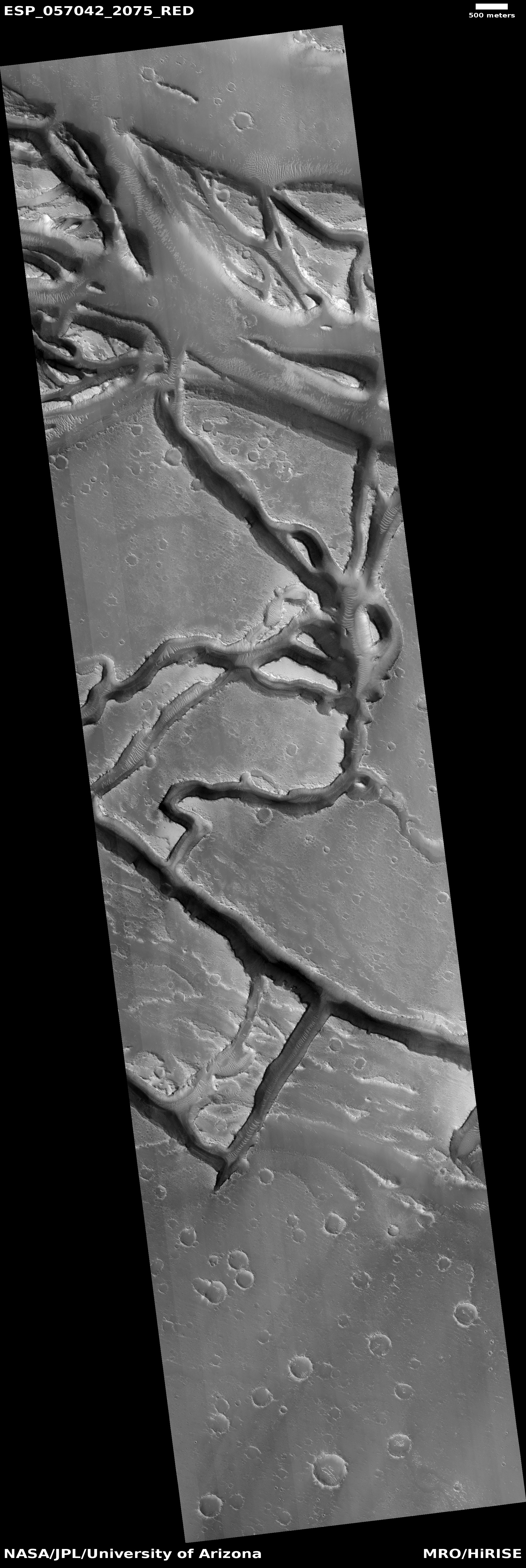
Cool image time! The photo on the right, cropped and reduced to post here, was part of the November image release from the high resolution camera on Mars Reconnaissance Orbiter (MRO). If you click on the image you can see the full resolution picture.

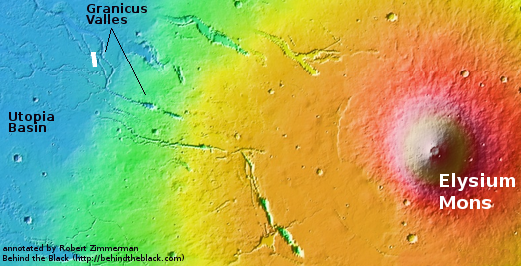
The uncaptioned release webpage is dubbed “Faults in Granicus Valles.” The image itself only shows a small part of Granicus Valles, named after a river in Turkey, that flows down from the estern slopes of the giant volcano Elysium Mons. While far smaller than the four big Martian volcanoes in the Tharsis region to the east and near Marines Valles (which I highlight often), Elysium Mons still outshines anything on Earth at a height of almost 30,000 feet and a width of 150 miles. It sits at about the same northern latitude of Olympus Mons, but all by itself, rising up at the very northern edge of the transition zone between the southern highlands and the northern plains, with the vast Utopia Basin, the second deepest basin on Mars, to the west.

Overview of Elysium Mons and Granicus Valles

Granicus Valles itself is almost five hundred miles long. At its beginning it flows in a single straight fault, but once it enters the northern plains of Utopia Basin it begins to meander and break up into multiple tributaries. The MRO image above shows only a tiny portion in the northern plains, as illustrated by the white box in the overview map to the left.
» Read more

0 comments

More Pits on Mars!

Pits near Arsia Mons

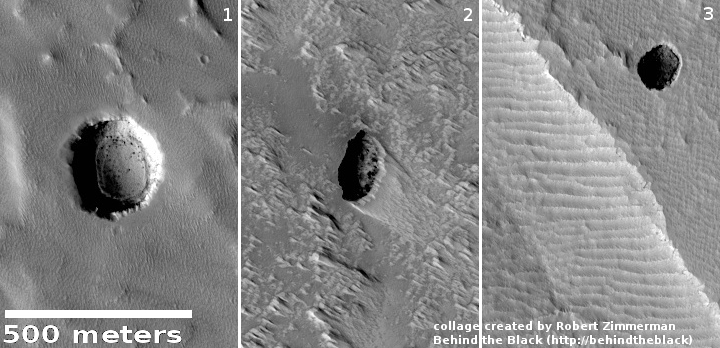
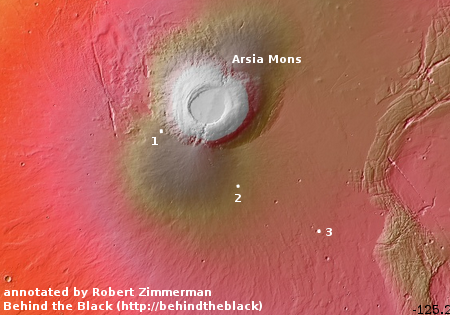
Cool image time! In the November image release from the high resolution camera on Mars Reconnaissance Orbiter (MRO) were three images, dubbed by me in the collage above as number one, number two, and number three, showing pits south of Arsia Mons, the southernmost volcano in the chain of three giant volcanoes to the east of Mars’s largest volcano, Olympus Mons, and to the west of the Marineris Valles valley.

Mars overview showing pit locations

The image on the right provides the geographical context of the three pits. They are all south of the volcano on the vast lava flow plains that surround it. The location of pits #1 and #2 is especially intriguing, on the east and west edges of what appears to be a large lava flow that had burst out from the volcano, leaving a large lava field covering a vast area several hundred miles across just to the south. You can also see a similar large lava field to the north of the volcano. Both fields appear to have been formed when lava poured through the breaks created by the fault that cuts through the volcano from the northeast to the southwest.
» Read more

2 comments

Puzzling fractures on Mars

Fractures on Mars

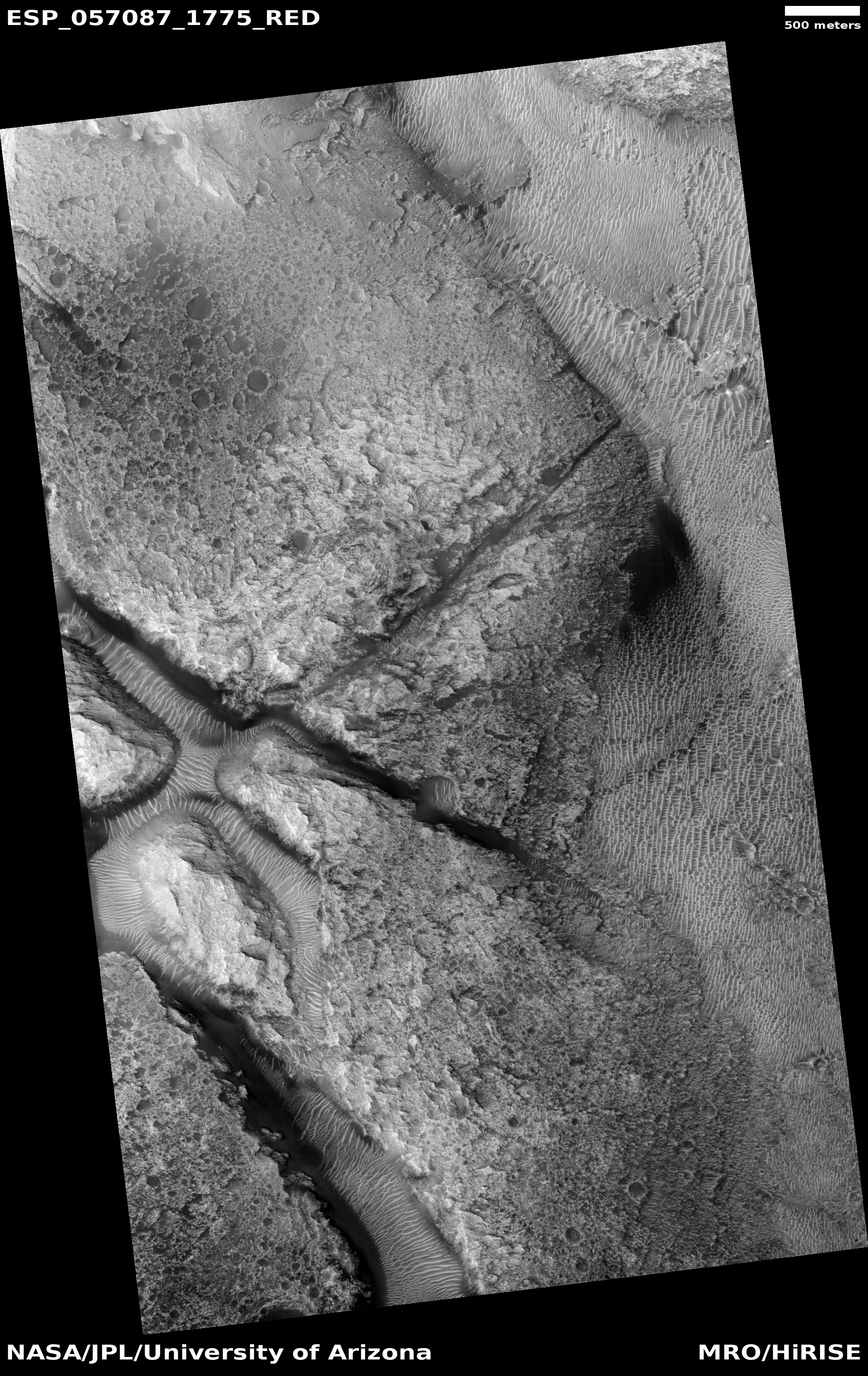
Cool image time! Today the Mars Reconnaissance Orbiter (MRO) science team released another month’s worth of images from the spacecraft’s high resolution camera. The picture on the right, reduced in resolution to post here, was the first image that I took a close look at, and decided it was worth posting immediately. If you click on the image you can see the full resolution version.

This image lacks a caption, but the release webpage is titled “Fractured Crater Floor.” It shows several cross-crossing fissures, some wide enough for dust to gather within into sand dunes. The fractures themselves appear to be cutting across a bulging dome.

My first reaction was to wonder where the heck this crater was on Mars, how big was it, and how dominate were the fractures within its floor. The image itself does not answer any of these questions. The fractures could be filling the floor, or not, and the crater could be small or big. Moreover, its location might help explain the cause of the fractures.

To understand any of the images from MRO it is always important to zoom out to get some context.
» Read more

3 comments

The vast northern plains of Mars

The vast northern plains of Mars

Cool image time! Actually, this image, found in the October image release from the high resolution camera of Mars Reconnaissance Orbiter (MRO), is not that interesting, in its own right. Context is all!

The image on the right is a small section cropped and reduced in resolution from the full image, which you can see by clicking on it. It shows one of the only interesting features in this long image strip, a small mesa sticking out all by itself in a flat featureless plain pockmarked by various small craters.

The release has no caption, though it is entitled “Northern Plains Survey.” The northern plains, while having a lot of interesting features that attract the attention of planetary scientists and thus get photographed at high resolution, is mostly featureless, at least at the resolution of the wide field survey cameras on many Mars orbiters. In order to know what is really there, they need to take high resolution images systematically, of which this image is obviously a part.

Overview image

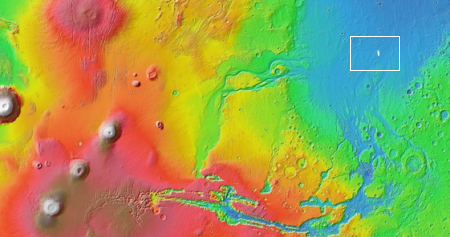
The problem is that there is so much ground to cover. This particular image was taken of a spot in the middle of the plains just to the north of the drainage outlets from Valles Marineris, as shown by the context map to the right. The tiny white spot to the right in the middle of the blue plains north of those drainage outlets is the location of this image.

Detail area of overview map

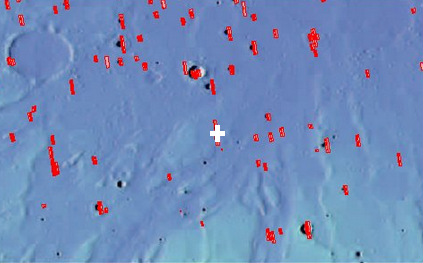
To understand how much ground needs to be covered, to the right is a close-up of the area shown by the white box in the first image above, with red rectangles indicating where MRO has already taken images. The white cross is the subject image. As you can see, most of this immense plain has not yet been imaged. It is almost as if they threw a dart to pick this one location. Most everything around it remains unseen at high resolution. Thus, to understand the geology of this one image is hampered because the surrounding terrain remains unknown, in close detail.

Mars is a big place. It is an entire planet, with the same land surface as the Earth’s continents. It still contains many mysteries and unexplored places. It will take generations to see it all.

1 comment

The steep slumping wall of a Martian volcano caldera

Caldera wall

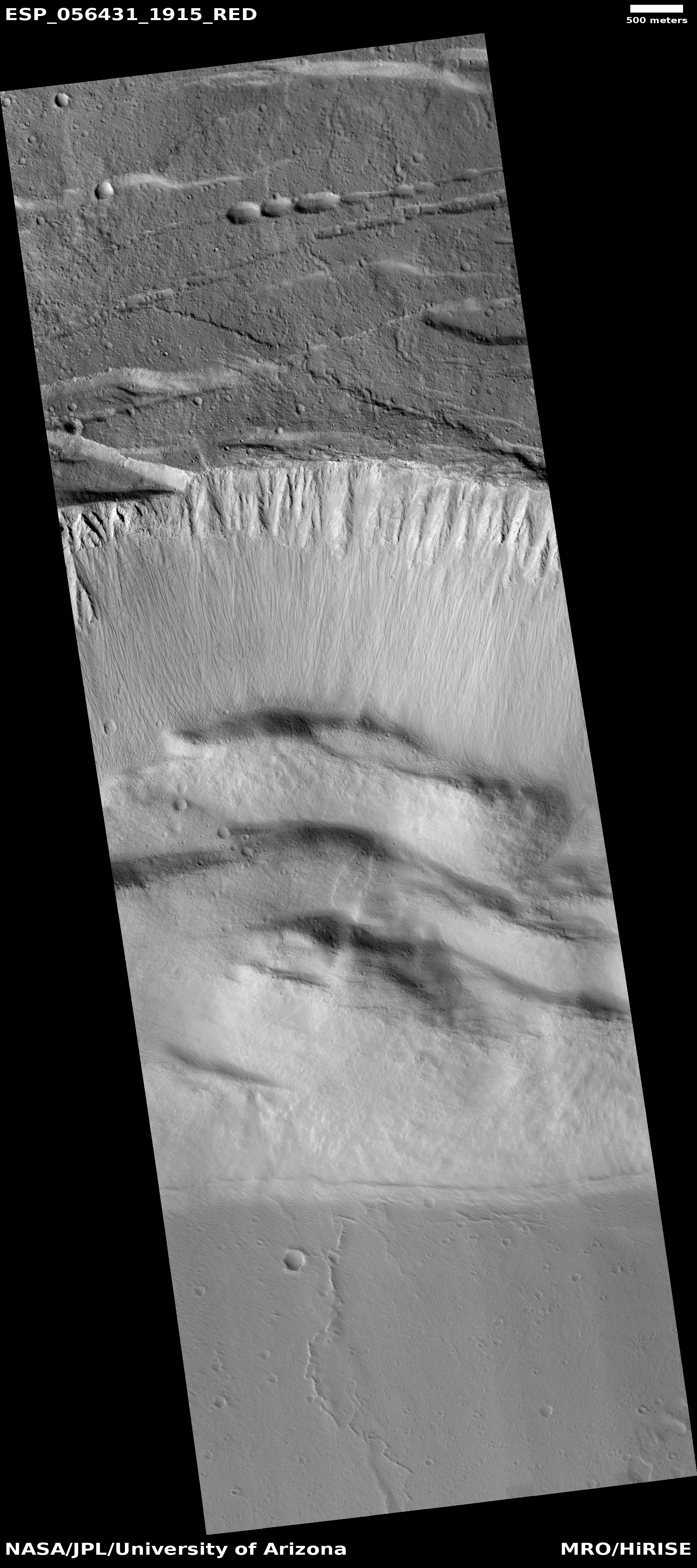
Cool image time. The Mars Reconnaissance Orbiter science team today released a nice captioned image of the steep wall of the caldera of Ascraeus Mons, the northernmost of the three giant volcanoes that lie to the east of Olympus Mons, the biggest volcano of all. The image on the right, reduced and cropped, shows that steep wall, with full image available by clicking on it. The caption from the release focuses on the fluted upper parts of the wall.

We can see chutes carved into the soft dust that has built up on the slope, with some similarities to gully landforms elsewhere on the planet.

More revealing to me is how this image reveals the slumping that is slowing eroding the caldera’s walls while also making that caldera larger. First, the plateau above the cliff shows multiple small cliffs and pit chains, all more or less parallel to the wall. This suggests that the plateau is over time breaking apart and falling into that caldera. Think of it as an avalanche in slow motion, with the upper plateau separating into chunks as sections slowly tilt down toward eventual collapse. As these chunks separate, they cause cracks to form in that plateau, and hence the parallel cliffs and strings of pits.

On the floor of the caldera we can see evidence of past chunks that did fall, piled up in a series terraces at the base of the wall. These are covered with the soft dust that dominates Martian geology. That soft dust also apparently comprises much of the wall’s materials, and almost acts like a liquid as it periodically flows down the wall, producing the chutes at the top of the wall.

The weak Martian gravity here is an important factor that we on Earth have difficulty understanding. It allows for a much steeper terrain, that also allows structurally weaker materials to hold together that would be impossible on Earth.This image gives a taste of this alien geology, on a large scale.

2 comments

Land of swiss cheese and spiders

Swiss cheese on Martian south polar cap

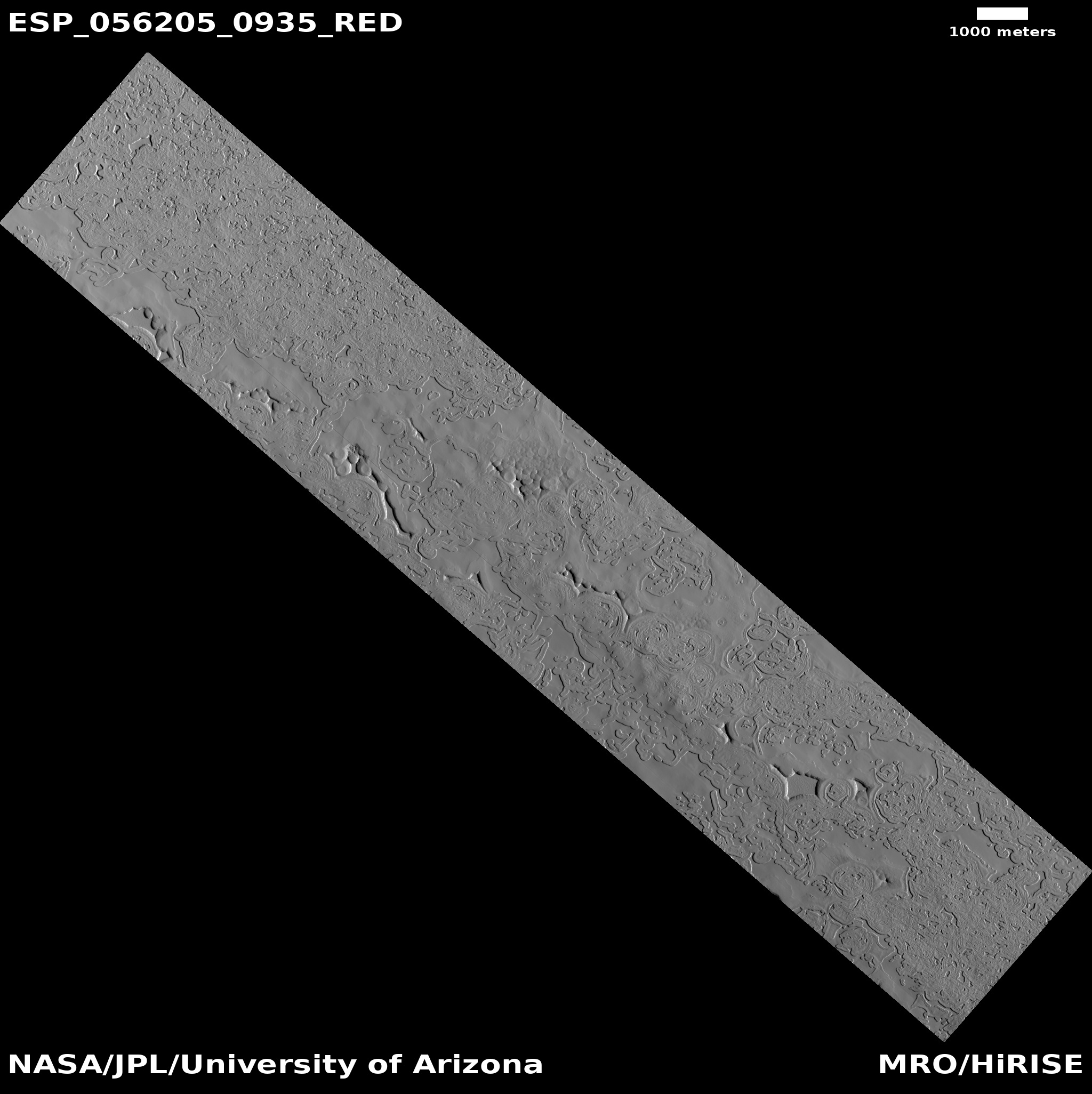
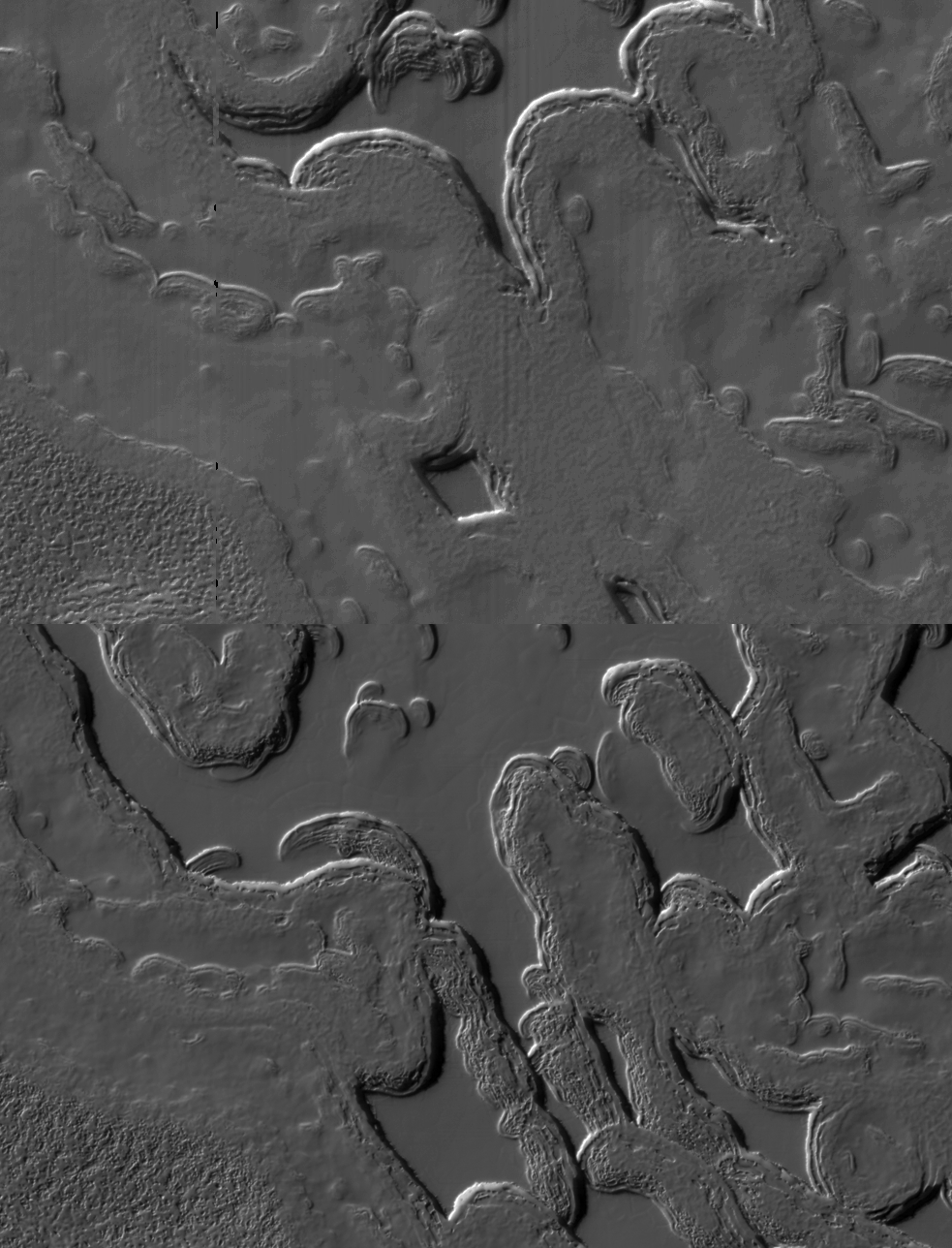
Time for some cool images! In one of their periodic captioned releases of an interesting high resolution image, the Mars Reconnaissance Orbiter (MRO) science team this week released a picture of the strange “swiss cheese” terrain found throughout the Martian southern polar cap. (I have already highlighted in an early post the spiders that form in the south pole as the carbon dioxide evaporates.) The image to the right is a cropped section of that image, which you can see in its entirety if you click on it.

The South Polar residual cap is composed of carbon dioxide ice that persists through each Martian summer. However, it is constantly changing shape.

The slopes get more direct illumination at this polar location, so they warm up and sublimate, going directly from a solid state to a gaseous state. The gas then re-condenses as frost over flat areas, building new layers as the older layers are destroyed.

The captioned link above also included a link to a gif animation showing how this terrain has changed since 2009. The holes have become bigger, their cliffs retreating with time.

The section I highlight above not only shows the retreating swiss cheese dry ice, you can also see ghosts of several buried craters slowly becoming visible as the dry ice evaporates away.

This is only one of many images taken of the south pole by MRO. In the October archive release, I found almost two dozen, and that’s only the images taken during August of this summer. MRO takes images of the south pole regularly to track its changes, though I suspect it took more this summer because the global dust storm blocked imagery in the middle latitudes. Below and to the right is just one of these images, a particularly good illustration of the swiss cheese formation.
» Read more

3 comments

A vent on Mars?

A vent on Mars?

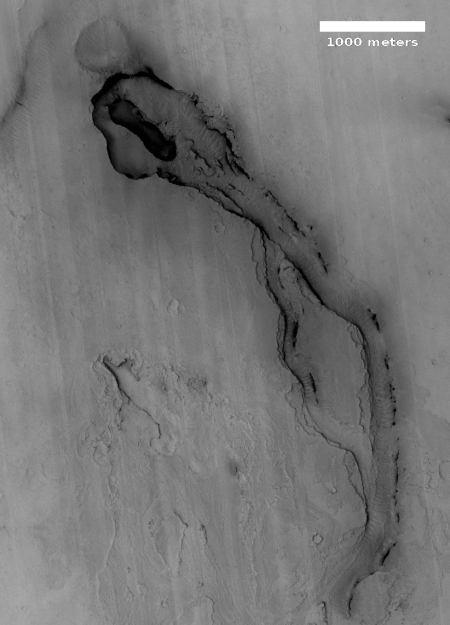
Cool image time! In their exploration of the surface of Mars using Mars Reconnaissance Orbiter (MRO), scientists often image geological features that strongly resemble Earth features. Sometimes, if real, the resemblances are significant, as they indicate important geological activity on Mars that can tell us a lot about the conditions and environment there.

The image on the right, cropped and reduced in resolution to post here, is a good example of this. It was taken by MRO on June 14, 2018, just before the global dust storm obscured the planet’s middle latitudes for most of the summer, and was part of the monthly release of new images from the spacecraft. (If you click on the image you can see the full resolution picture.) The release website, which includes no caption, describes this feature as an “apparent vent,” a determination that certainly seems reasonable. The shadowed dark features suggest an abrupt oblong pit near the edge of a cliff, formed in the center of a collapsed sink. The tear-drop shape of the collapse sink and surrounding darkened areas also suggests that something is venting from it and then blowing away to the east and south, forming the darker stained ground. Some of the dark features to the southeast might also be smaller vents, releasing their own materials into the atmosphere.

The location also reinforces this suggestion, located on the southeast lava slopes of one of Mars’ larger volcanoes, Elysium Mons. This is also a region, dubbed Athabasca Valles, that some planetary scientists believe is one of the youngest lava flows on Mars.

Finally, it appears that the pit here has darkened considerably recently. MRO has taken images of this pit twice previously, in 2008 and 2010, and in both images the pit is much lighter in color, with its sandy dune-covered floor much easier to see. In the new image the floor is now very dark. This might be caused by shadows and the angle of the Sun, but I don’t believe so. It is also clear when comparing all three images that the surrounding area, including the flow to the southeast, has also darkened with time.

All this data suggests that the pit is venting something into the air, and it is settling on the ground to the southeast, blown there by the prevailing winds. Nor is this pit the only such feature in this region. Other images by MRO show a lot of similar dark splotches.

The problem is that this feature is not on Earth but on Mars. Determining what is being vented, and why, is therefore made more difficult. Based on Earth data you would assume this is some form of volcanic vent, releasing gases from below the surface. On Mars that assumption might not hold. We might instead be seeing the venting of any number of possible materials, such as underground water-ice, carrying with it other underground materials and thus darkening the surface.

We also can’t assume that the venting is occurring because of volcanic processes. On Mars the evidence so far gathered suggests that active volcanic activity ceased a very long time ago, even for this very young lava region. The venting is likely caused by something else, a fact that in itself is probably the most significant take-away from these images.

Something appears to be causing an active vent on the surface of Mars. Finding out the root cause of that venting is probably one of the more interesting questions facing researchers who study the Martian surface.

3 comments
1 82 83 84 85 86 90