Circular feature on Mars?

A circular feature on Mars?
Click for full resolution image.

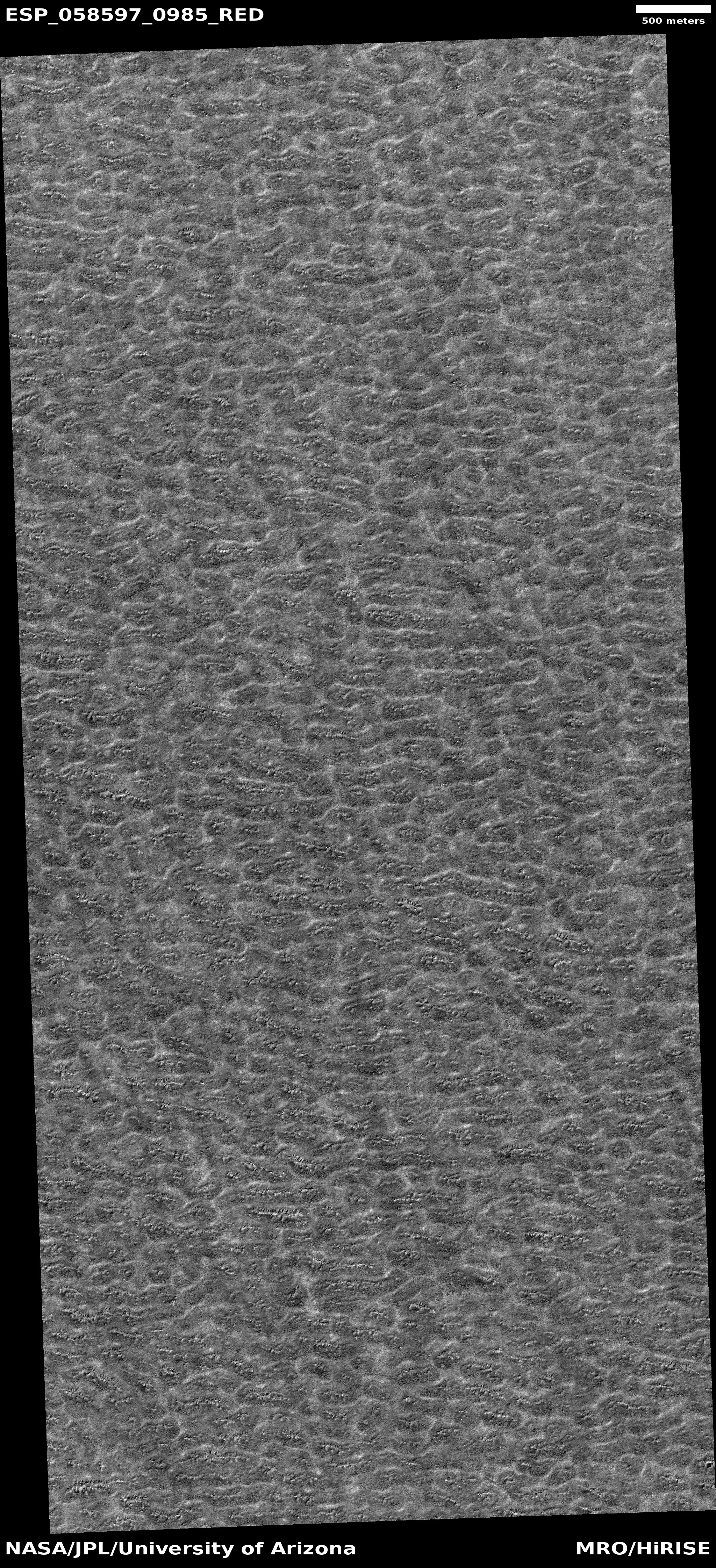
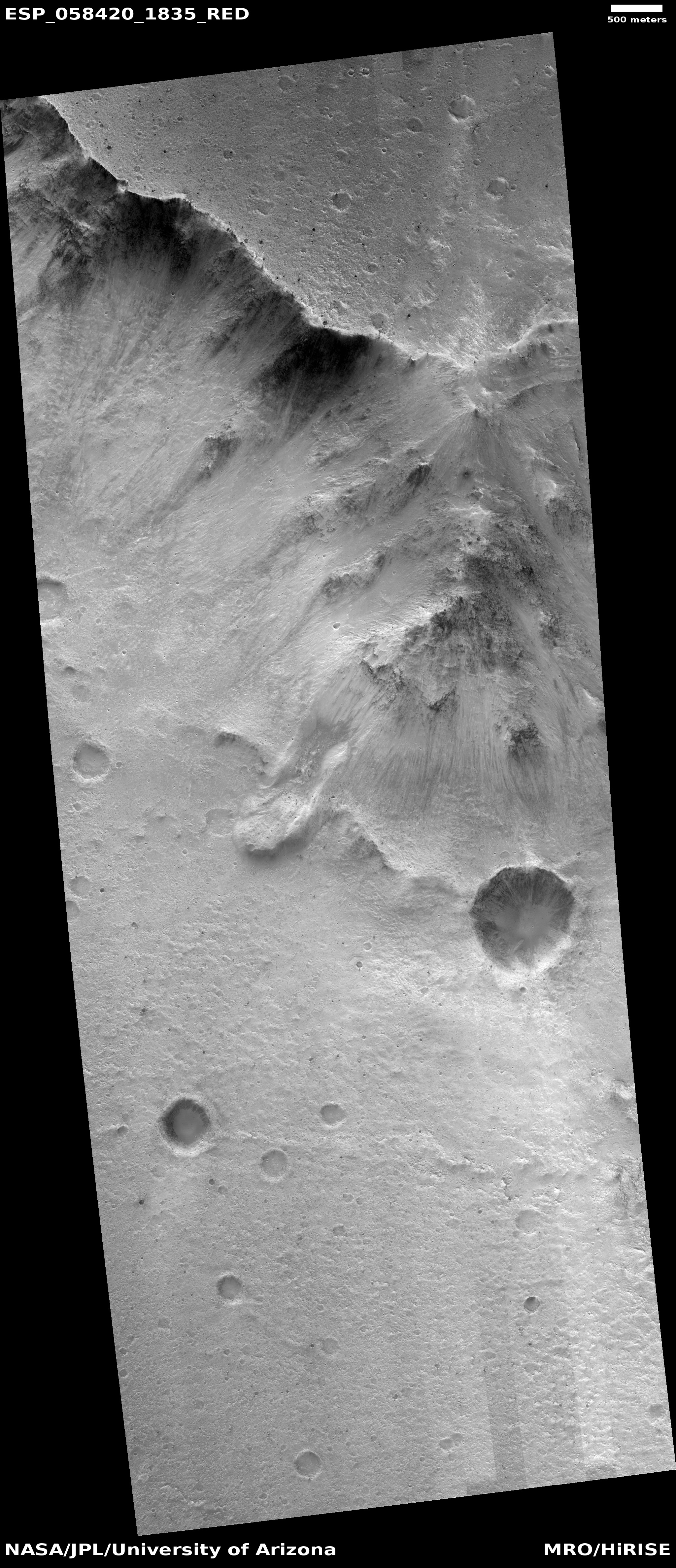
Today’s cool image is cool for two reasons. First and foremost, the image, found in the archive of the high resolution camera of Mars Reconnaissance Orbiter (MRO), is titled “Circular Feature.” On the right is the full image, reduced to post here. I have searched it high and low, at low resolution as well as full resolution, and can find nothing, nothing at all, that invokes a circular feature to me.

This strange terrain is located very close to the southern icecap. If anything, the knobs and features that fill this image remind me of brain terrain, partly obscured by a layer of partly melted snow or frost. Nothing however seems circular in the slightest.

The second reason this image is cool is that it is very representative of its very large surrounding region. For what appears to be several hundred miles in all directions this is all that one can see, in a variety of MRO images, here, here, here, here, here, and here, to show only a few. Ever so often a craterlike feature pops out, like in the last example, but generally the surface continues in this undulating bland manner, endlessly. The only changing aspect is the dark streaks that cut across, likely dust devil tracks made over a long period of time.

Below the fold is a section of the full resolution image, at full resolution. It doesn’t really matter where I took the crop, as anywhere in the full image everything looks pretty much the same. The only slow change that I can perceive is that the surface seems to be descending to the north, with the lighter areas implying the existence of terraces.

Take a look, and try to figure out for yourself what is going on here.
» Read more
4 comments

How fast do things change on Mars?

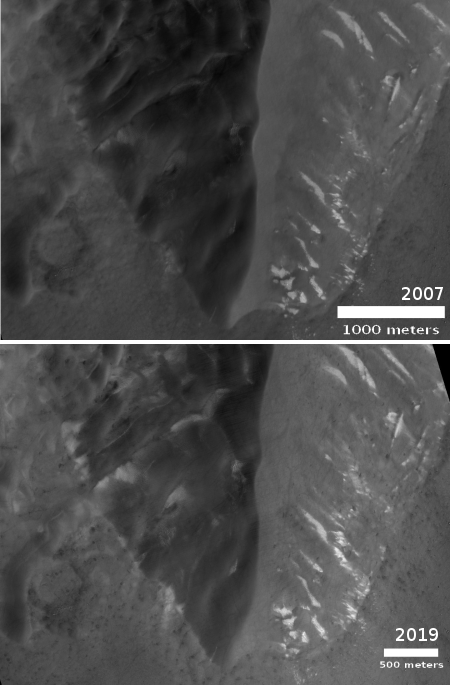
Looking for dune changes on Mars

On Earth, it is assumed that in a period of a dozen years a sand dune would change significantly. Wind and rain and the yearly cycle of the seasons would work their will, reshaping and moving the dune steadily from one place to another.

On Mars, we would be reasonable to expect the same. Yet, this might be a mistake, as illustrated by the two images on the right, taken by cameras on Mars Reconnaissance Orbiter (MRO) a dozen years apart of the same large dune located in a crater far to the south in the planet’s southern highlands. Both images have been cropped and reduced in resolution to show here. For the full images, go here for 2007 and here for 2019.

The top image was taken October 31, 2007 by MRO’s context camera. The bottom image was taken on January 29, 2019 by MRO’s high resolution camera. Though the context camera does not have the resolution of the high resolution camera, the difference is of less significance in this context.

Have things changed? Putting aside lighting differences, it does appear that the white patches have changed slightly in a variety of places. There also might be changes in the small dunes on the left of the image, at the base of the large central dune.

The white patches are probably what interests the scientists who requested the second image. Could this be snow or frost, as is thought to exist in other places? There are studies [pdf] that expect ice to exist inside craters near the south pole. Identifying changes here would help answer this question.

Overall, however, not much is different. Though dunes definitely change on Mars, they do so much more slowly than on Earth. And in some cases what look like dunes are not really dunes at all, but a form of cemented sandstone, exhibiting even fewer changes over long time spans.

I do not know if these dunes are of sand or sandstone. What the two images reveal is that in either case, things do not change on Mars at the same pace as they do on Earth. Even after three Martian years, the thin Martian atmosphere simply doesn’t have the same energy as on Earth, even though it can move things easier in the weak gravity.

While the pole caps of Mars change a lot seasonally, the rest of the planet evolves very slowly. Mars is no longer an active planet like the Earth. It is, in many ways, a dead planet, once alive with activity but now silent and relatively quiet.

0 comments

Fresh crater in Martian northern lowlands

Fresh impact crater in northern lowlands
Click for full image.

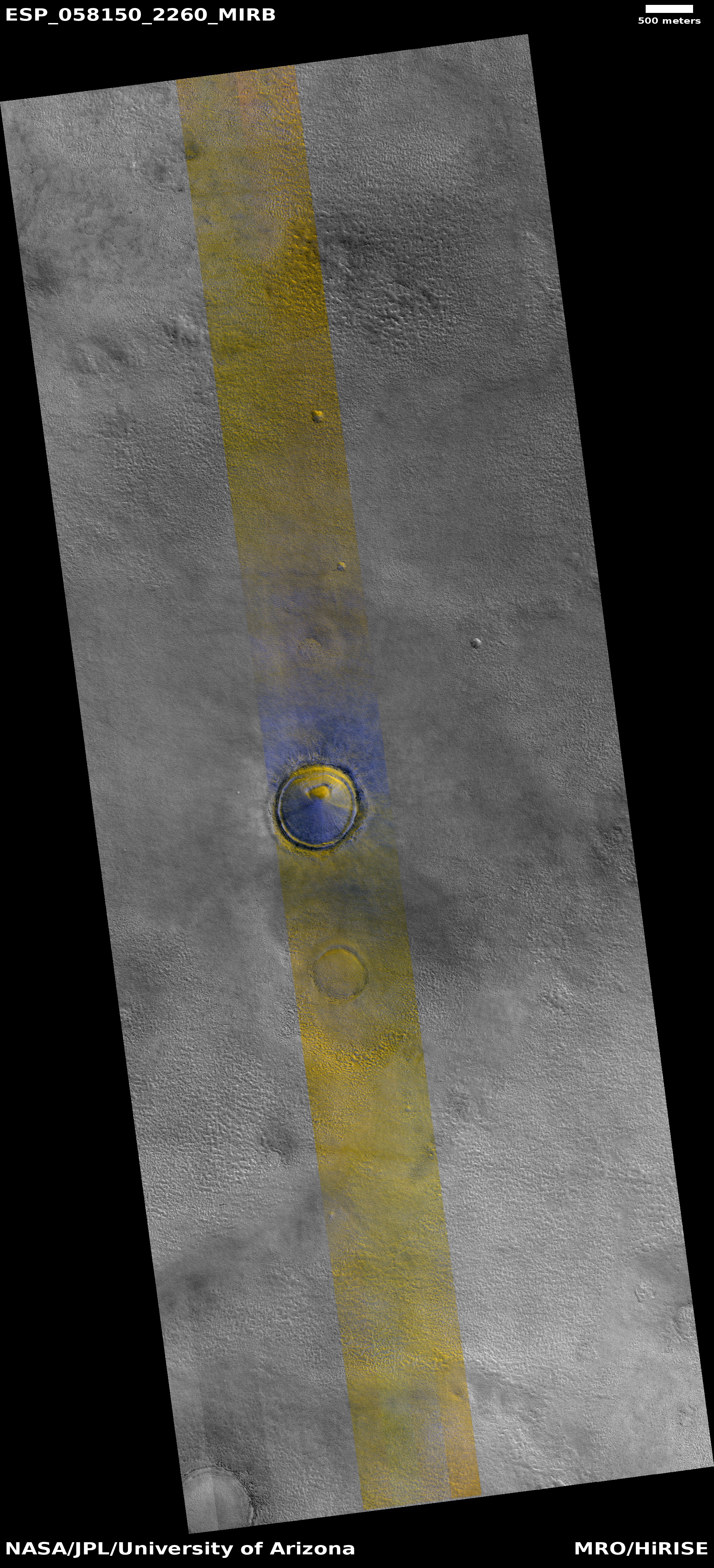
Today’s cool image could be a sequel to yesterday’s. The image on the right, cropped to post here, was one of the many images released from Mars Reconnaissance Orbiter’s (MRO) high resolution camera in March. The release, uncaptioned, calls this a “fresh impact crater.”

In many ways it resembles the craters I posted yesterday, with a splashed look and a crater floor with features that favor the north. Why that divot exists in the northern half of the floor is to me a mystery. The crater floor looks like a sinkhole to me, with material slowly leaking downward at that divot to cause this surface depression. Yet the rim screams impact. And yet, why the double rim? Was this caused by ripples in wet mud when the bolide hit?

Location of fresh impact crater

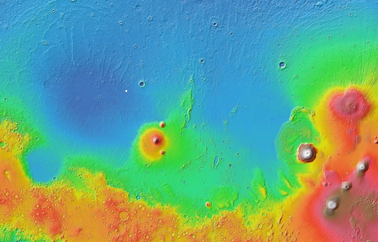
The crater itself is all by itself deep in those northern plains. You can see its location as the tiny white rectangle slightly to the left of the center in the overview image to the right. The giant Martian volcanoes can be seen at the image’s right edge, almost a quarter of a planet away. This is at a very low elevation on Mars, almost as deep as Hellas Basin.

For some fun context, this location is very close to where Viking 2 landed in 1976. The Mars 2020 rover meanwhile will land at this overview image’s left edge, on the western shore of the oval cut into southern highlands at about the same latitude as Olympus Mons, the largest volcano on the right. And InSight and Curiosity sit almost due south, with Curiosity in the yellow in the transition from green to orange, and InSight to the north in the green.

2 comments

The layering at the Martian poles

Layering in the east side of Burroughs Crater
Click for full image.

Layering in the west side of Burroughs Crater
Click for full image.

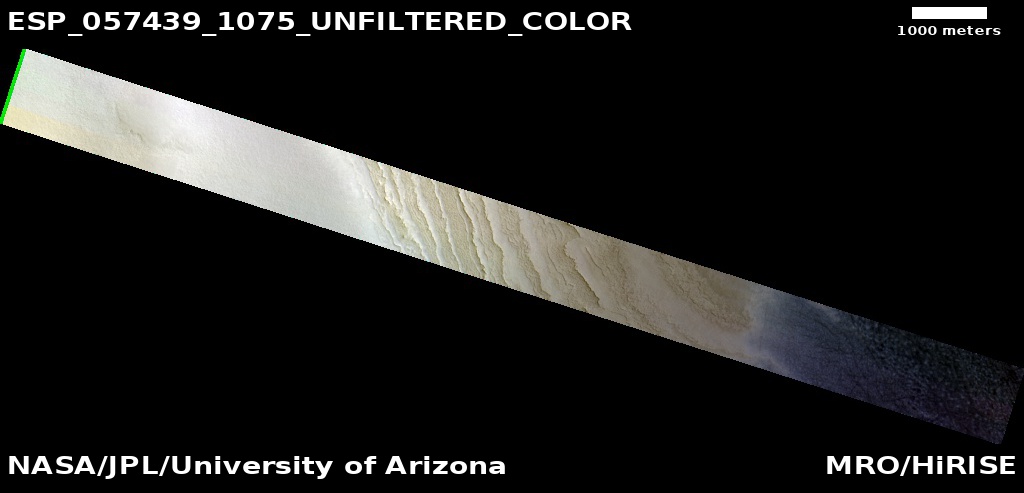
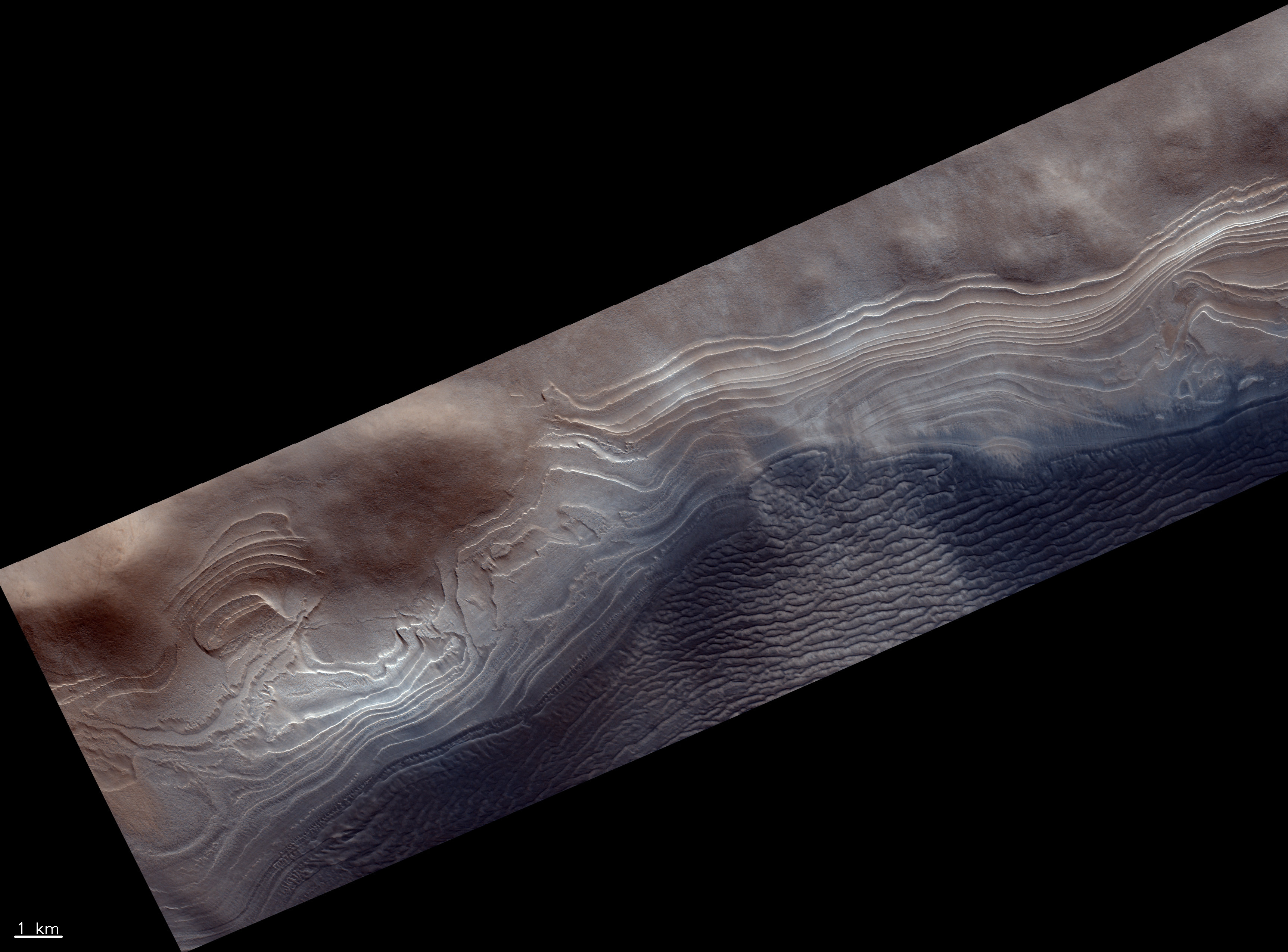
In the past month the science teams of both Mars Reconnaissance Orbiter (MRO) and Trace Gas Orbiter (TGO) have released images showing the strange layering found in Burroughs Crater, located near the Martian south pole.

The top image above is the MRO image, rotated and cropped to post here. To the right is a cropped and reduced section of the TGO image.

Though both images look at the inside rim of the crater, they cover sections at opposite ends of the crater. The MRO image of the crater’s east interior rim, with the lowest areas to the right, while the TGO image shows the crater’s northwest interior rim, with the lowest areas on the bottom. As noted at the TGO image site:
» Read more

0 comments

A gathering of dust devils

Dust devil tracks
Click for full resolution image.

A bunch of cool images! The European Space Agency (ESA) today released more than a dozen Martian images taken by the camera on its Trace Gas Orbiter spacecraft.

In addition to a snapshot of InSight and its landing area, “The images selected include detailed views of layered deposits in the polar regions, the dynamic nature of Mars dunes, and the surface effects of converging dust devils.” The release also included images showing details of two of Mars’ giant volcanoes, Olympus Mons and Ascraeus Mons.

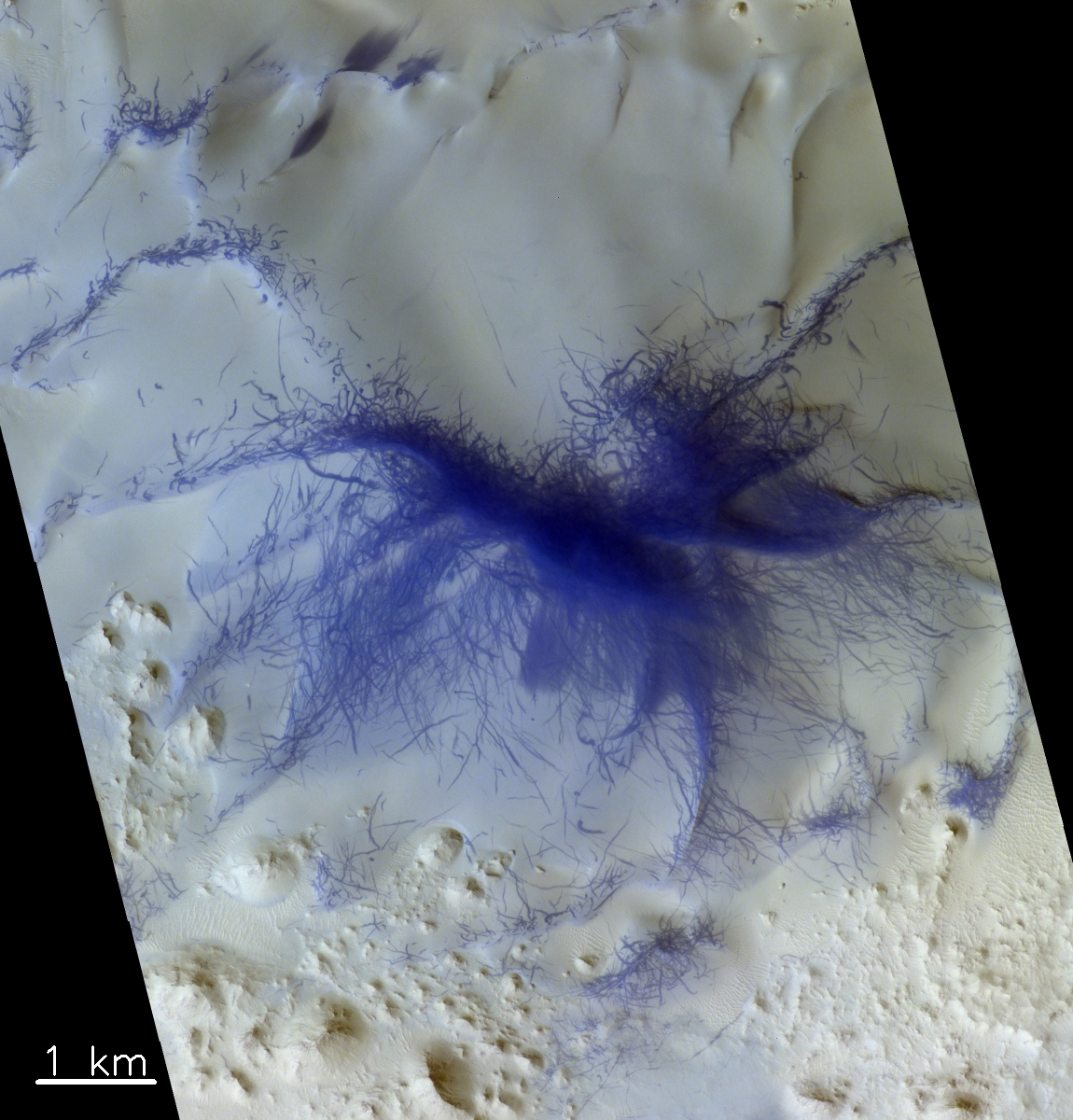
The image I have highlighted to the right, reduced to post here, shows a spot on Mars where for some unknown reason dust devils love to congregate.

This mysterious pattern sits on the crest of a ridge, and is thought to be the result of dust devil activity โ€“ essentially the convergence of hundreds or maybe even thousands of smaller martian tornadoes.

Below is a side-by-side comparison of this image (on the right) with a Mars Reconnaissance Orbiter (MRO) image taken in 2009 (on the left).
» Read more

2 comments

Martian massive landslides

Though scientists have found some evidence of slow erosion and change on the Martian surface, it is today generally inactive. While the weak wind of Mars’ thin atmosphere continues to work its will, and the likely presence of underground frozen water acts to shift the surface shape as the seasons come and go, none of this happens quickly.

Essentially, Mars is a quiet place.

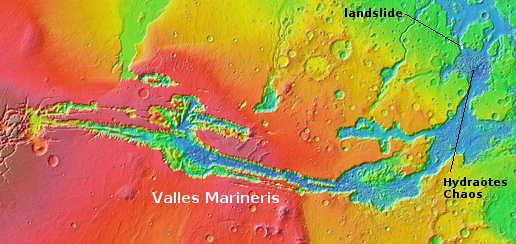
Once however catastrophic events took place, gigantic floods flowing down to the east from the planet’s huge volcanoes to carve out Marineris Valles, the solar system’s largest known canyon. As that water rushed eastward it ripped the terrain apart quickly, creating deep side canyons, drainage valleys, and chopped up regions now dubbed as chaos terrain, multiple mesas separated by numerous fissure-like canyons.

Overview of Marineris Valles and landslide

The overview map on the right shows Valles Marineris and its drainage to the east and north into the vast northern plains of Mars. It also shows the location of one of the largest regions on Mars of chaos terrain, dubbed Hydraotes Chaos, located close to the mouth of this gigantic drainage system more than 2,500 miles long.

Massive Martian landslide
Click for full image.

Recently scientists have used the high resolution camera on Mars Reconnaissance Orbiter (MRO) to begin taking images of the massive landslides on the face of the mesa north of Hydraotes Chaos that was hit directly by these floods. The location of the most immediately interesting of these landslide images is also indicated on this overview image.

To the right is that image, rotated, cropped, reduced, and annotated to post here. The white boxes indicate two full resolution sections that I highlight below at full resolution.

This image shows that full cliff. The total drop from the plateau at the top to the floor where Hydraotes Chaos is located to the south is approximately 8,200 feet, almost exactly comparable to the depth of the north rim of the Grand Canyon.

The image shows numerous evidence of avalanches and erosion, both at its base and at its rim. None of these avalanches likely occurred during those catastrophic floods, but long afterward.
» Read more

0 comments

Brain Terrain on Mars

Brain terrain on Mars
Click for full image.

Cool image time! This week the Mars Reconnaissance Orbiter (MRO) science team featured four new captioned images taken by the spacecraft and released as part of the March image dump. The first, dubbed “The Slow Charm of Brain Terrain,” deserves an immediate post on Behind the Black. To the right is only a small section cropped from the full image. From the caption:

You are staring at one of the unsolved mysteries on Mars. This surface texture of interconnected ridges and troughs, referred to as โ€œbrain terrainโ€ is found throughout the mid-latitude regions of Mars. (This image is in Protonilus Mensae.)

This bizarrely textured terrain may be directly related to the water-ice that lies beneath the surface. One hypothesis is that when the buried water-ice sublimates (changes from a solid to a gas), it forms the troughs in the ice. The formation of these features might be an active process that is slowly occurring since HiRISE [MRO’s high resolution camera] has yet to detect significant changes in these terrains.

Below is a cropped section of the full image, rotated and reduced to post here.
» Read more

1 comment

Waterlike Martian lava flows

Flowing like water
Click for full image.

Each month the Mars Reconnaissance Orbiter (MRO) science team highlights with captions about four out of the 300-500 new images released that month.

Of the four captioned images in February, the first was entitled “Almost Like Water,” and focused on the waterlike nature of the lava flow. The image on the right is a cropped and annotated section of that featured photograph, with the yellow arrows indicating the flow directions.

The lava appears to have flowed smoothly around obstructions, almost like water, forming streamlined islands. In the southern part of this image, a branch of the flow diverts around a small crater, and eventually rejoins the main part of the flow. [Visible in the full photograph] Irregular-shaped ring structures appear on the northern end and are related to the volcanic activity that formed the flows.

You can see an example of one of those islands near the top of the above image.

This is hardly the only MRO image showing such flows. In fact, the February image release included a bunch, some of the more intriguing of which I highlight below. These lava flows are seen in many different places on Mars, in a wide variety of geological settings, facts that suggest that volcanic activity was once very widespread and ubiquitous on Mars.
» Read more

0 comments

Another batch of caves/pits found on Mars

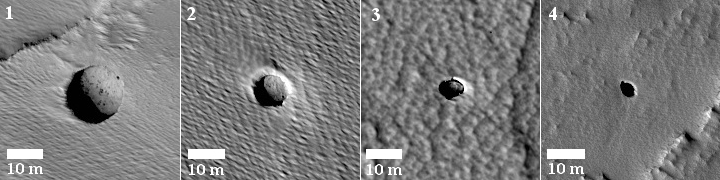
Four new pits on Mars

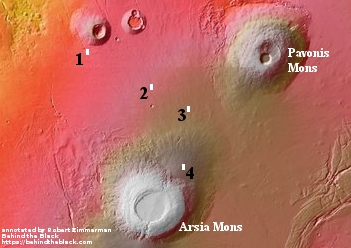
Overview of February 2019 pits

In the past year the monthly image releases from the high resolution camera on Mars Reconnaissance Orbiter (MRO) archive have frequently included newly discovered pit entrances. Each time I have written posts highlighting these new pits, in June, July, November 2018 and January 2019. In fact, this is happening so frequently I could almost label it a monthly update!

The November release imaged three pits found on the southern flanks of Arsia Mons. The January 2019 release found several north of the volcano, two of which are very close to the two middle new pits highlighted above. The February release, which is the focus of this post, included four more pits, shown above, all located north and west of Arsia Mons, as shown in the overview map to the right.

Pits 2 and 3 above appear to belong to a cluster of pits all located in the general area between Arsia and Pavonis Mons. (You can see their uncaptioned releases here and here.) Most sit alone on a flat somewhat featureless plain. Sometimes there are flow features nearby, but each pit usually seems to sit unique and unrelated to these other faint features.

Pit 1 is very intriguing in that it sits amid a very long chain of pits and canyons, all aligned, as shown in the image below and to the right.
» Read more

0 comments

Rover update: February 20, 2019

Summary: Curiosity in the clay unit valley. Opportunity’s long journey is over. Yutu-2 creeps to the northwest on the Moon’s far side.

For the overall context of Curiosity’s travels, see my March 2016 post, Pinpointing Curiosityโ€™s location in Gale Crater.

For the updates in the past year go here. For a full list of updates before February 8, 2018, go here.

Curiosity

Curiosity's view to the east on Sol 2316
Click image for full resolution version

Overview of Curiosity's future travels
Click image for original image

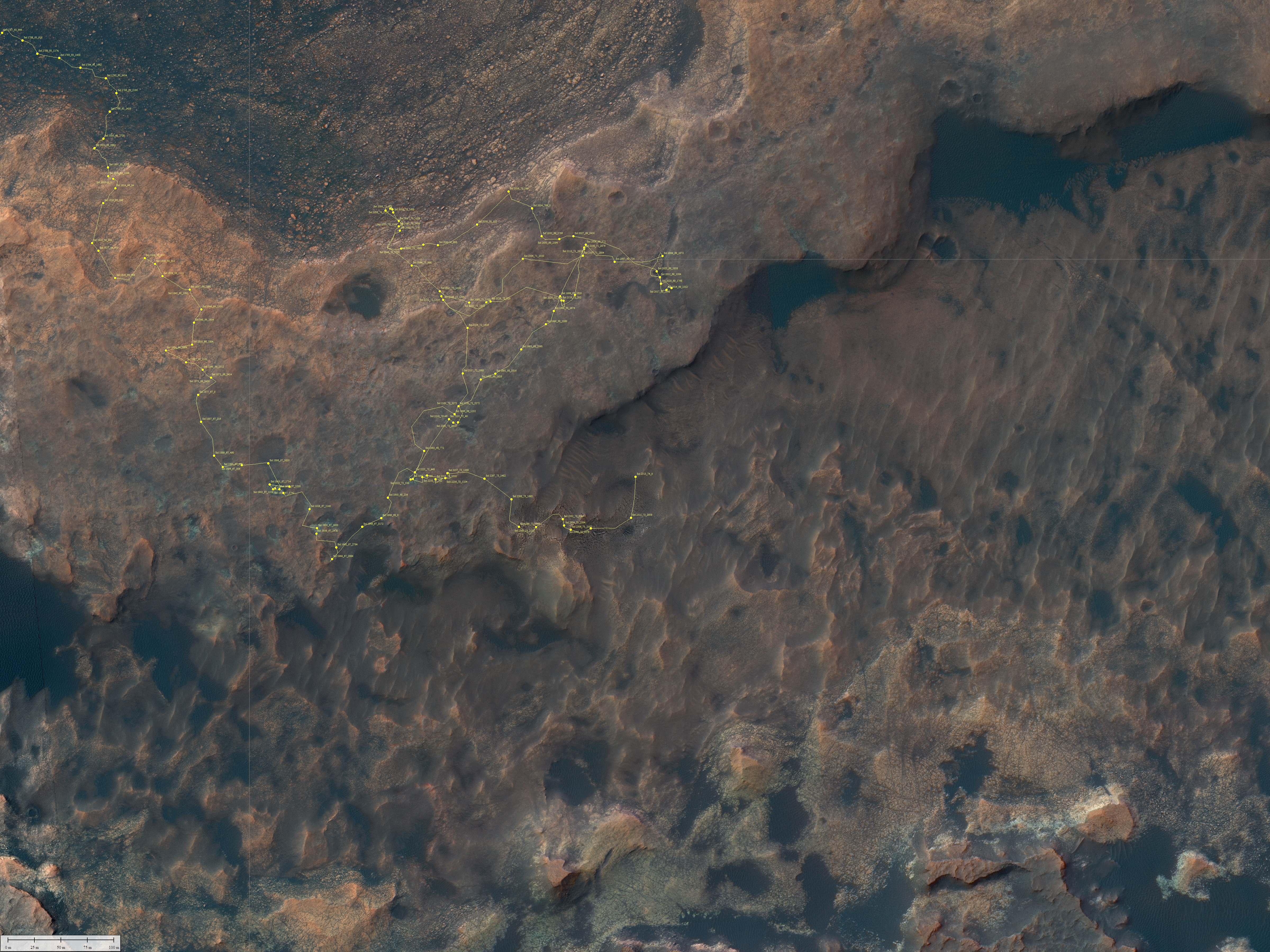
Since my January 22, 2019 update, Curiosity finally drove down off of Vera Rubin Ridge into a valley between the ridge and the lower slopes of Mt Sharp. The Mars Reconnaissance Orbiter (MRO) overview on the right has been annotated by me to show the rover’s travels (shown by the yellow dotted line), with its proposed route indicated by the red dotted line. The yellow lines indicate approximately the terrain seen in the panorama above. The panorama was created from images taken on Sol 2016.

The valley that Curiosity is presently traversing is dubbed “the clay unit” or “the clay-bearing unit” by the geologists, based on its make-up determined from orbital data. So far they have found this terrain to be “some of the best driving terrain we’ve encountered in Gale Crater, with just some occasional sandy patches in the lee of small ridges.” Initially they had problems finding any rocks or pebbles large enough for the instruments to use for gathering geological data. For the past week or so, however, they have stopped at “bright exposure of rock” where some bedrock was visible, giving them much better material to work with.
» Read more

1 comment

A river valley floor on Mars

Overview of Reull Valles region

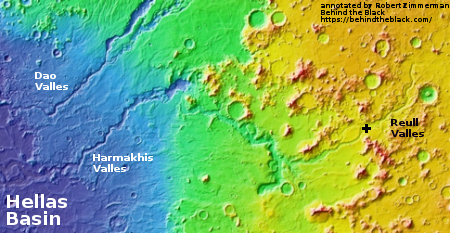
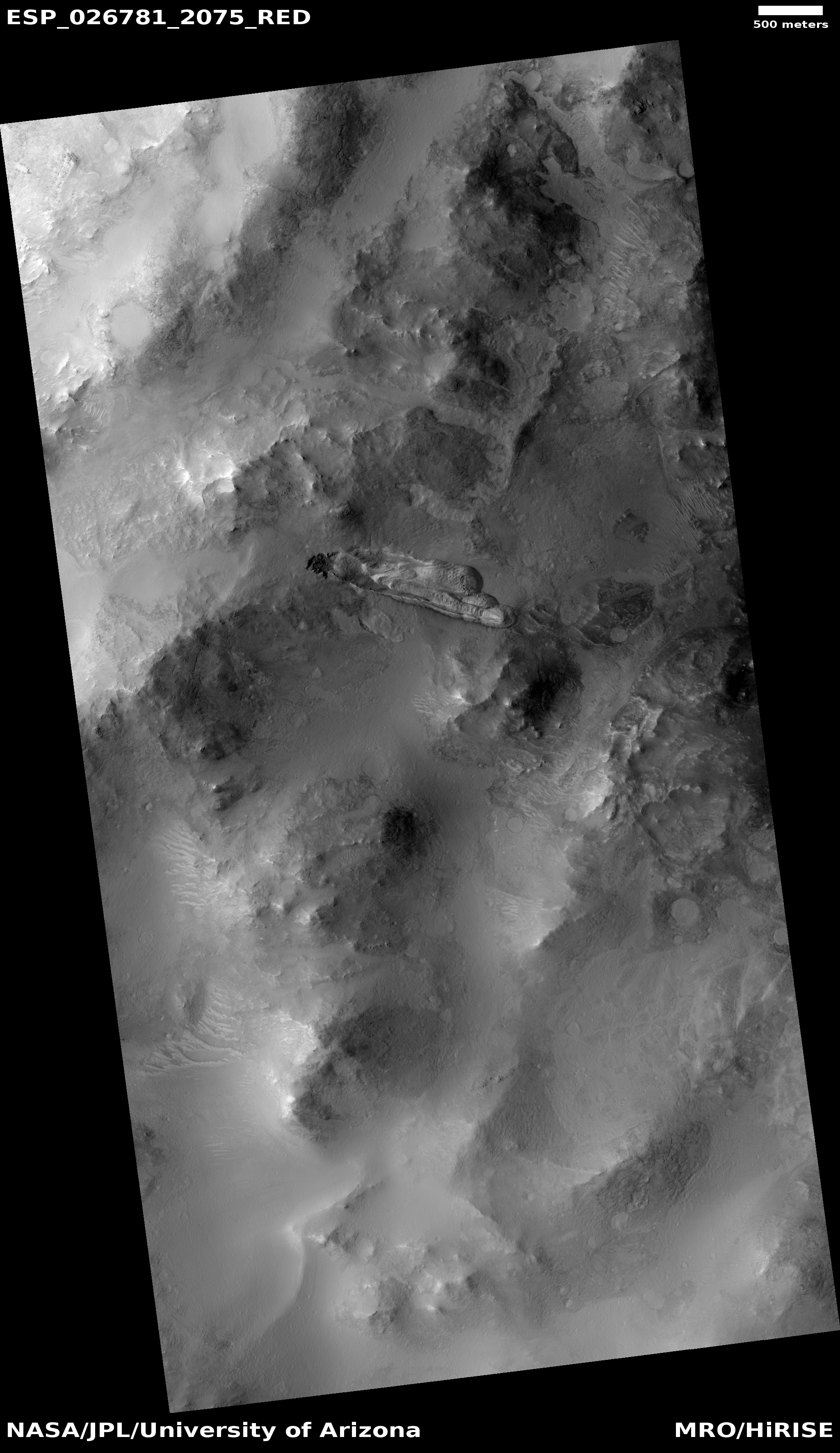
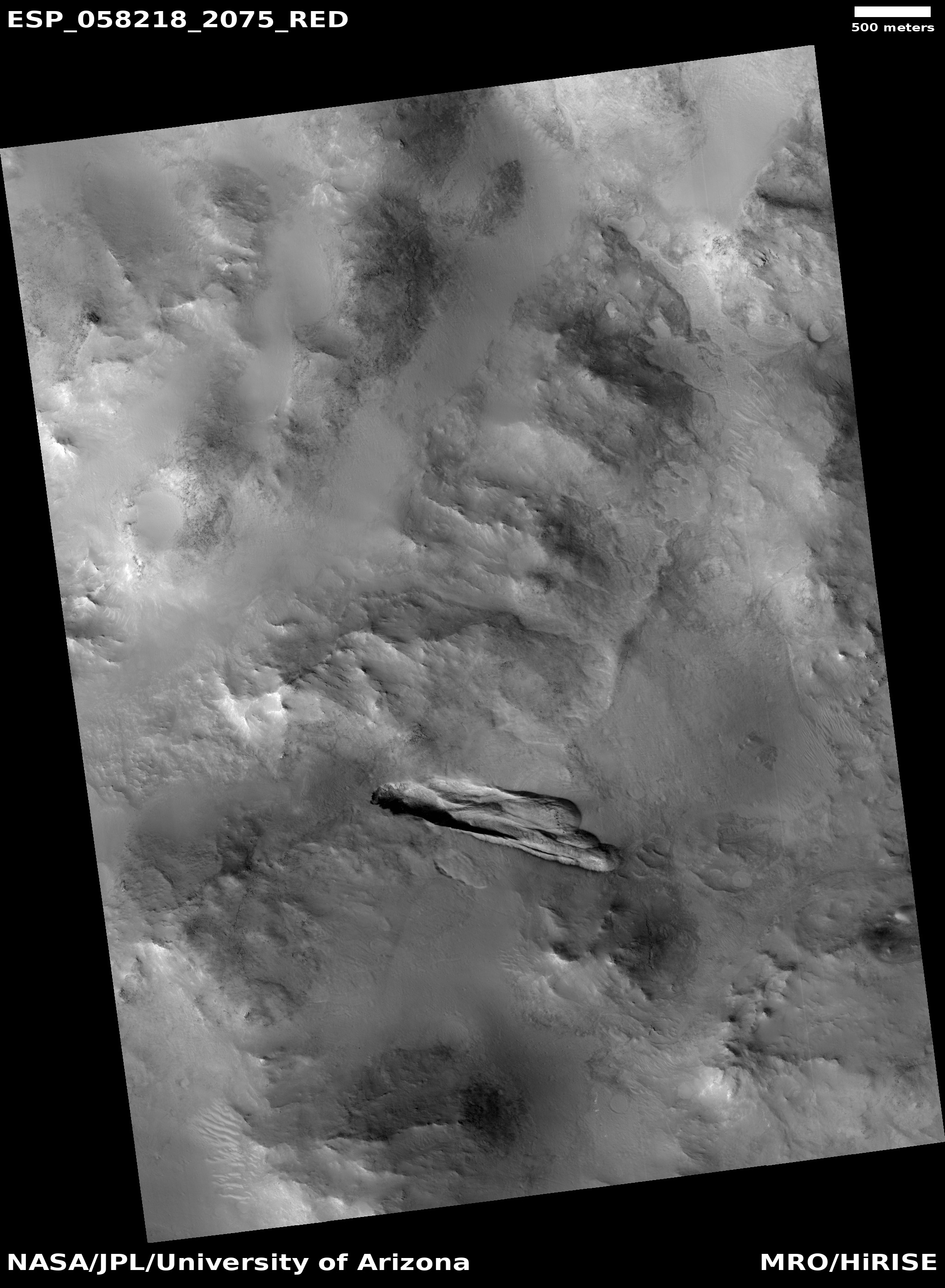
Today’s cool image focuses in on a Mars Reconnaissance Orbiter (MRO) uncaptioned photograph taken of the valley floor of Reull Vallis, a meandering canyon that drains into Hellas Basin, the bottom of Mars.

The image on the right is not that photograph. Instead, it is an overview of the area surrounding it. The image location is indicated by the black cross, dead center within the floor of Reull Vallis itself. This valley, as well as Dao and Niger to the northwest but lower in elevation are all thought to have been formed from flowing water, all of which apparently drained from the east and to the west into Hellas Basin.

This last detail is very important and bears repeating before looking at today’s subject image. The river that formed Reull Vallis flowed from the east to the west. Now for that picture.
» Read more

0 comments

Monitoring a fresh-looking Martian landslide

2012 image of Martian landslide
Click for full image

2018 image of Martian landslide
Click for full image

Time for two cool images! To the right are two images taken by the high resolution camera on Mars Reconnaissance Orbiter (MRO), the top one taken in April 2012, and the bottom taken in December 2018. Both have been cropped and reduced slightly in resolution to post here.

The second image is trying to answer, in only a small way, one of the most fundamental questions of the Martian environment: How fast does it change? The images from orbit have periodically seen evidence of new impacts. MRO images have tracked dust devil tracks. And we know that somehow water, ice, wind and volcanic activity have eroded and reshaped the surface over eons.

What we don’t know truly and with detail is the pace of these changes, with any accuracy. The pace of some things over time seems obvious. For example, Mars’s inactive but gigantic volcanoes suggest that once volcanism was very active, but over time has ceased so that today it is unclear if any is occurring. Similarly, the geological evidence suggests that in the far past water flowed on the surface, producing catastrophic floods. Now that liquid water is all but gone, and this erosion process as ceased.
» Read more

0 comments
1 80 81 82 83 84 90