Perseverance’s most recent view of Jezero Crater

Panorama by Perseverance, Sol 130, July 2, 2021
Click for full resolution.

Overview map
Click for interactive map.

Cool image time! The panorama above, reduced to post here, is made from two navigation camera images on the Mars rover Perseverance, found here and here.

The map to the right, taken from the “Where is Perseverance?” website and annotated further by me, shows with the yellow lines what I think (but am not sure) is the area seen in the panorama.

The navigation cameras on Perseverance are more wide angle than the navigation cameras on Curiosity, in order to cover a larger area. They thus produce a slight fisheye distortion, illustrated by the curve of the horizon.

The large mountain in the center right is likely the crater rim. You can also see the knobs to the left as indicated on the overview map. The rover is now about halfway to the southernmost planned spot it is expected to reach within the floor of Jezero Crater, which is about a half to three quarters of a mile further south.

The terrain seems quite desolate and barren, which of course is no surprise, because that is what it is like on all of the surface of Mars. No plant life, just rocks and dirt. While Curiosity is now in the mountains, Perseverance remains on the crater floor, so the points of interest (from the mere tourist’s perspective) are small or far away.

1 comment

Al-Amal detects Martian aurora

Aurora on Mars

The United Arab Emirates Al-Amal Mars orbiter has detected evidence of a Martian aurora that would be visible at night for short periods.

The ultraviolet images to the right have been reduced slightly to post here.

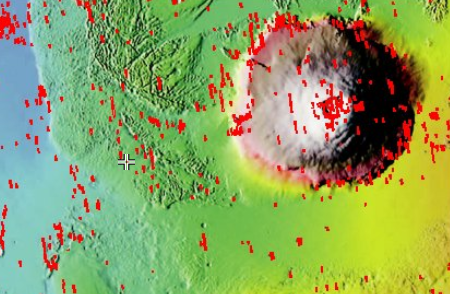
These three images of atomic oxygen emission at a wavelength of 103.4 nm from the planet Mars were obtained by the Emirates Mars Ultraviolet Spectrometer instrument on 22 April, 23 April, and 06 May 2021 respectively. The full set of data collected during these observations include far and extreme ultraviolet auroral emissions which have never been imaged before at Mars. The beacons of light that stand out against the dark nightside disk are highly structured discrete aurora, which traces out where energetic particles excite the atmosphere after being funneled down by a patchy network of crustal magnetic fields that originate from minerals on the surface of Mars.

Though Mars does not have a magnetic field, it is believed that sections of the planet’s crust are magnetized, and under the right conditions can guide the charged particles from the Sun’s solar wind to the night side to hit the atmosphere where they break up and produce the aurora. Because there is no magnetic field however the particles are not guided by the field lines to the poles, but to different spots at all latitudes, depending on circumstances.

1 comment

Scientists solve methane data conflict on Mars

Using the methane detector on the rover Curiosity scientists now think they have solved the mystery why Curiosity has detected methane in the atmosphere near the surface while Europe’s Trace Gas Orbiter fails to detect any methane at all.

[Planetary scientist John E. Moores from York University in Toronto], as well as other Curiosity team members studying wind patterns in Gale Crater, hypothesized that the discrepancy between methane measurements comes down to the time of day they’re taken. Because it needs a lot of power, TLS [Curiosity’s methane detector] operates mostly at night when no other Curiosity instruments are working. The Martian atmosphere is calm at night, Moores noted, so the methane seeping from the ground builds up near the surface where Curiosity can detect it.

The Trace Gas Orbiter, on the other hand, requires sunlight to pinpoint methane about 3 miles, or 5 kilometers, above the surface. “Any atmosphere near a planet’s surface goes through a cycle during the day,” Moores said. Heat from the Sun churns the atmosphere as warm air rises and cool air sinks. Thus, the methane that is confined near the surface at night is mixed into the broader atmosphere during the day, which dilutes it to undetectable levels. “So I realized no instrument, especially an orbiting one, would see anything,” Moores said.

Immediately, the Curiosity team decided to test Moores’ prediction by collecting the first high-precision daytime measurements. TLS measured methane consecutively over the course of one Martian day, bracketing one nighttime measurement with two daytime ones. With each experiment, SAM sucked in Martian air for two hours, continuously removing the carbon dioxide, which makes up 95% of the planet’s atmosphere. This left a concentrated sample of methane that TLS could easily measure by passing an infrared laser beam through it many times, one that’s tuned to use a precise wavelength of light that is absorbed by methane.

“John predicted that methane should effectively go down to zero during the day, and our two daytime measurements confirmed that,” said Paul Mahaffy, the principal investigator of SAM, who’s based at NASA’s Goddard Space Flight Center in Greenbelt, Maryland. TLS’ nighttime measurement fit neatly within the average the team had already established. “So that’s one way of putting to bed this big discrepancy,” Mahaffy said.

While this explains the data conflict, it does not yet explain where the methane is coming from. It is suspected it is coming from underground, but why and from what is still unclear. Nor do scientists yet understand why it doesn’t accumulate enough in the atmosphere for Trace Gas Orbiter to detect it. Something is causing the methane to break up sooner than expected.

1 comment

Dust covering solar panels threatens to end InSight mission

The InSight science team has revealed that the amount of dust that presently covers the solar panels on the Mars lander has now reduced their available power by about 80%, and if a dust devil doesn’t soon blow the dust off they will have to shut the spacecraft down sometime in the next ten months.

“The dust accumulation on the solar arrays has been considerable. We have about 80% obscuration of the arrays,” said Bruce Banerdt, principal investigator for the InSight mission at NASA’s Jet Propulsion Laboratory (JPL) in Southern California, according to SpaceNews.

Banerdt showed the impact of the declining power levels during a June 21 meeting of NASA’s Mars Exploration Program Analysis Group. When InSight landed near the Martian equator in November 2018, he said, the robot was generating roughly 5,000 watt-hours of power. Today that level is less than 700 watt-hours.

None of this is a surprise. Both the Opportunity and Spirit rovers faced the same problems. Both however were able to recover because periodically a dust devil would fly over the rover and clear the dust from the solar panels.

InSight however has not so far been lucky. While it has seen many nearby dust devils with its camera, none has come close enough to sweep the solar panels clean.

As the power has declined they have shut off various systems in order to keep the lander’s prime instrument, its seismometer, operating continuously. Engineers have also been using the scoop on the lander’s robot arm to try to dislodge some of the dust, with only a very very limited success. If the panels are not cleared soon, however, engineers will eventually be forced to shut everything down.

7 comments

Paisley terrain on Mars

paisley terrain on Mars
Click for full image.

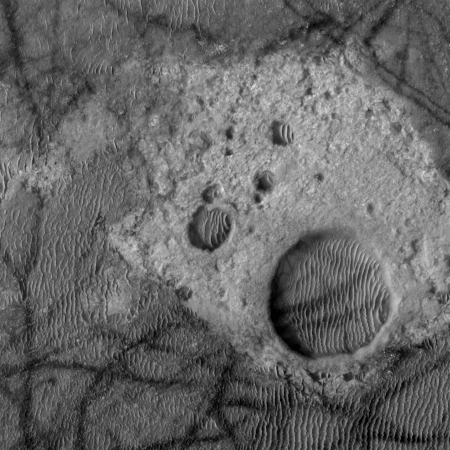
Cool image time! The photo to the right, cropped and reduced to post here, is actually a somewhat old image from the high resolution camera on Mars Reconnaissance Orbiter (MRO). It was taken more than a decade ago, on December 28, 2010, and featured as a captioned image one month later. I post it now because it was recently featured as MRO’s picture of the day, and thought it deserved a new look. As the caption from 2010, written by planetary scientist Alfred McEwen, noted,

Remember those paisley shirts during the summer of love in 1967? If so, this terrain may look somewhat familiar.

How did this terrain really form? One theory is that it’s a landslide deposit, perhaps associated with draining an ancient lake.

The overview map below might help make sense of this theory.
» Read more

1 comment

Scientists question existence of liquid water lake under Martian south pole

The uncertainty of science: A re-analysis of the ground-penetrating radar data that suggested there was a liquid water lake under the Martian south pole has found that it might not be liquid water at all, but either “clays, metal-bearing minerals, or saline ice.”

The abstract can be read here.

The radar data, obtained by the European orbiter Mars Express, definitely shows a layer of bright reflection suggesting a layer of something different below the icecap. The research team decided to find out if other things besides liquid water could cause the difference.

They were able to determine what level of electric conductivity the material below the ice would need to have to match the observed signal from MARSIS. Then, they identified materials that are both conductive and present on Mars including clays, metal-bearing minerals and saline ice. “Salty ice or conductive minerals at the base of the ice sheet are less flashy, but are more in line with the extremely cold temperatures at Mars’ poles,” Bierson said.

While not explicitly excluding a liquid brine, the results open new potential explanations for the observed strong radar reflections, some of which do not require liquid brine beneath the Martian south polar ice cap.

Nothing is proven, one way or another. This research has simply underlined the uncertainty of the liquid water claim. We simply do not know what caused the bright radar reflection. All we know for certainty is that it is there.

7 comments

China releases more images & videos from Zhurong

Zhurong panorama looking north, June 27, 2021
Click for full image.

Overview map
Click for full image.

China today released a new panorama as well as several videos taken by its Mars rover Zhurong.

The videos show the rover’s landing as well as two short videos taken from the remote camera it had dropped off shortly after deployment from its lander, the first showing the rover moving away and the second showing it turning in place.. China also released sound recorded during that deployment, as the rover rolled down the ramps. The sound was of course enhanced, but it does allow scientists to learn something about the atmosphere of Mars.

The image above is a cropped section from the panorama. The map to the right, taken on June 11th by the high resolution camera on Mars Reconnaissance Orbiter (MRO), has been annotated by me to show the area I think is seen by this section of that panorama, looking due north. (For a higher resolution version that clearly shows the rover’s tracks since leaving the lander, go here.)

5 comments

Many of Mars’ geological mysteries, all in one photo

Knobs, streaks, and lava channels on Mars
Click for full image.

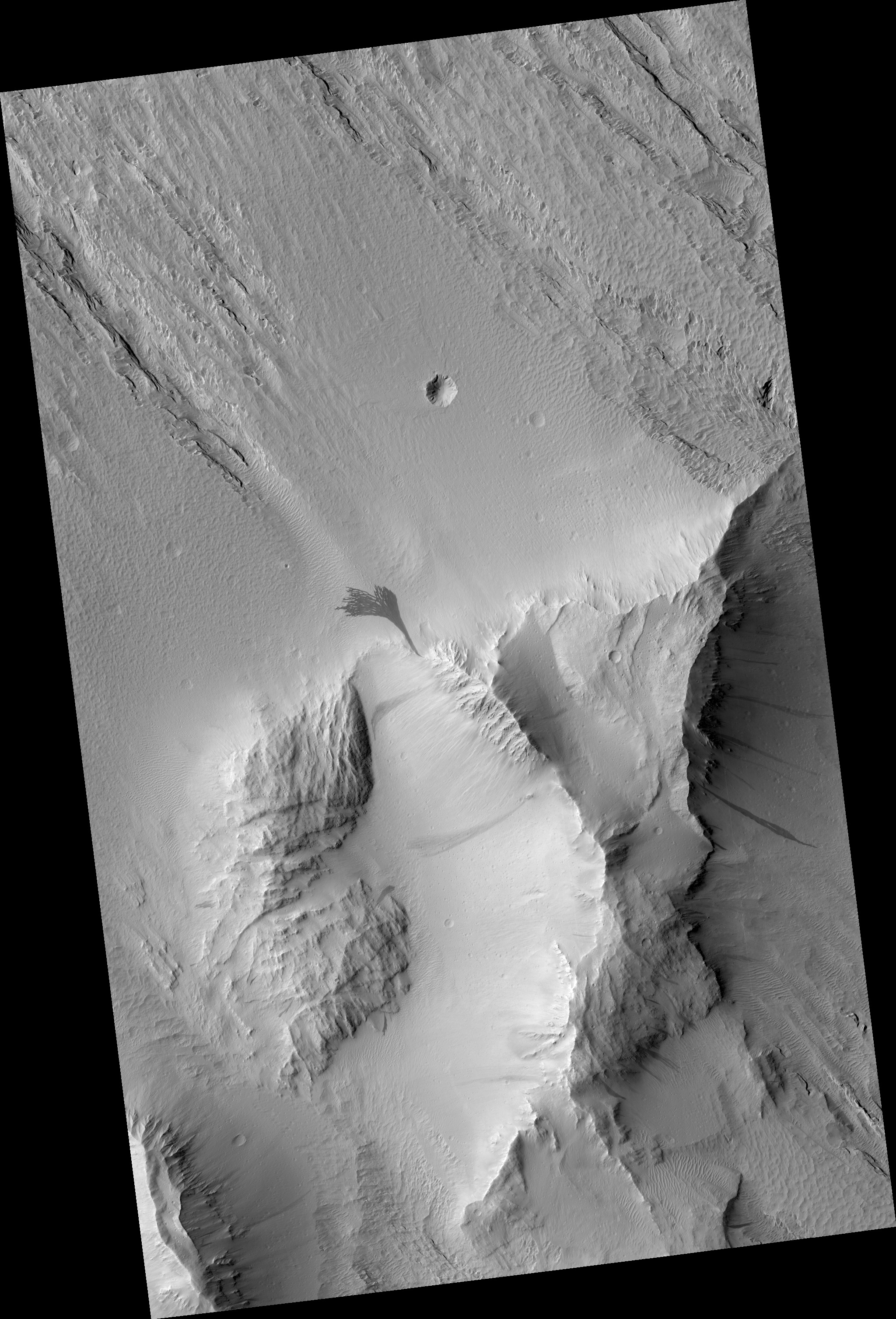
Today’s cool image is fun because it contains a plethora of Martian mysteries, all packed into a very small space. The photo to the right was taken on April 29, 2021 by the high resolution camera on Mars Reconnaissance Orbiter (MRO). I have rotated, cropped, and reduced it to post here.

The uncaptioned picture was labeled “Small Channel Winding between Knobs in Tartarus Colles.” The knobs, which can be seen on either side of the thin channel within the canyon, are actually a major Martian puzzle. Tartarus Colles has a lot of them, and planetary geologists are not really sure how they formed. One 2009 paper [pdf] suggested that the cones were formed by the violent interaction of lava and ice. This earlier paper [pdf] hypothesized that both water and lava had to be flowing over the surface at the same time, producing the steam and the energy that popped the lava cones, kind of like the small convection bubbles seen when tomato sauce simmers.

The scientific literature however is not deep, and there appears to be much uncertainty about this conclusion.

The photo however contains other major Martian puzzles.
» Read more

0 comments

Curiosity’s mountainous view

Curiosity's view uphill on June 23, 2021
Click for full resolution panorama. Note: Navarro Mt is about 450 feet high.

The travels of Curiosity at the base of Mount Sharp continue. In the past week, since my last update on June 16th, the rover has moved west past the entrance to Gediz Vallis to now sit at the base of Raphael Navarro Mountain, as shown by the panorama above. To get a sense of how far the rover has traveled in the past week, compare this panorama with the one posted then. It is also clear now that they are slowly returning to their planned route, and will not push up into Gediz Vallis as I speculated in that post.

The panorama is created from three photos taken by Curiosity’s navigation camera, found here, here, and here.

The map below the fold gives the context.
» Read more

0 comments

Chinese official outlines that country’s Mars exploration plan

The new colonial movement: According to an official from China’s prime rocket manufacturer, China is now beginning to plan for the manned exploration of Mars.

Wang Xiaojun, head of the state-owned China Academy of Launch Vehicle Technology (CALT), outlined the plans in his speech themed “The Space Transportation System of Human Mars Exploration” at the Global Space Exploration Conference (GLEX 2021) via a virtual link, the academy told the Global Times on Wednesday.

After reviewing the successful mission of the Tianwen-1 probe mission, the country’s first interplanetary exploration that achieved a successful orbiting, landing and roving the Red Planet all in one go, Wang introduced the three-step plan for future Mars expedition.

At the primary stage, or the technology preparation phase, androids will be launched whose mission include a Mars sample return mission and the exploration of a Mars base site. Next will be a manned Mars mission, and the building of a Mars base will be carried out. The third stage will be attempting shuttling large scale Earth-Mars cargo fleet and large scale development of the Red Planet.

The timetable for such mission launches will be 2033, 2035, 2037, 2041 and 2043, among others, the academy said.

While this is very far in the future, you can’t make it happen if you don’t get started early. China’s government is clearly looking at getting started, and appears to be following the same timetable approach it did for its space station. They began planning it about a decade ago, and are now launching and assembling it.

China’s decision to aim for Mars proves that the competition to get there is heating up considerably, and is likely their response to Elon Musk’s determined effort to make it possible.

8 comments

Ingenuity completes 8th flight, moving south with Perseverance

Perservance's location, June 17, 2021
Click for interactive map.

On June 21, 2021 the Mars helicopter Ingenuity successfully completed its eighth flight, leapfrogging south past the rover Perseverance.

During the flight, Ingenuity remained aloft for 77.4 seconds, flew 525 feet (160 meters), and landed about 440 feet (133.5 m) away from its companion, the Perseverance rover, according to a tweet from NASA’s Jet Propulsion Laboratory in California, which operates the helicopter.

The map to the right, annotated by me from the interactive map provided by the Perseverance team, shows the helicopter’s approximate new position, labeled #8 in green. The other green numbers show its previous landing spots after earlier flights.

The white line shows Perseverance’s travels through June 17th. The yellow dashed line shows their planned route over the next few months. Perseverance was just slightly north of Ingenuity on that date. It has likely traveled further south since then.

0 comments

Zhurong’s travels during first three weeks on Mars

Zhurong's travels through June 11th
Click for full image.

The science team for the high resolution camera on Mars Reconnaissance Orbiter (MRO) today released a new image showing the path that China’s rover , Zhurong, has taken from its landing on May 14th through June 11th.

The photo to the right, cropped and reduced to post here, is that photo. If you look close you can see the rover’s track skirting the edge of the bright blast mark put on the surface by the lander’s engines during touchdown. Though my scale bar is approximate, it does show that in those four weeks the rover traveled about 150 to 200 feet. However, half of that distance was crossed in the five days from June 6th to June 11th (as shown by the two different MRO images at these links), which means the pace is picking up.

The rover’s nominal three-month mission ends in mid-August, only two months from now. However, none of us should be surprised if the mission gets extended for as long as the rover continues to function.

2 comments
1 94 95 96 97 98 212