Nissan reveals prototype lunar rover

Capitalism in space: Nissan today unveiled its first prototype design of an unmanned lunar rover, built for the Japanese space agency JAXA.

Nissan Motor Co. unveiled Thursday a prototype of a lunar rover co-developed with Japan’s space exploration agency that will employ the automaker’s motor control technology to maneuver across the Moon’s loose terrain. The automaker said it aims to make the rover capable of traversing the undulating Moon surface smoothly by applying technology developed for use in its roadgoing electric vehicles such as the Leaf and Ariya.

The picture of the prototype at the link is, to put it mildly, not impressive. It uses rubber tires, and is really nothing more than a control box attached to four tires.

JAXA apparently also has Toyota working on a competitive project. The competition should therefore eventually produce something worthwhile.

2 comments

NASA awards Intuitive Machines another contract to deliver science instruments to Moon

Capitalism in space: NASA yesterday awarded Intuitive Machines its third contract to use its Nova-C lander to deliver four science instruments in 2024 to an unusual geological feature on the Moon.

The investigations aboard Intuitive Machines’ Nova-C lander are destined for Reiner Gamma, one of the most distinctive and enigmatic natural features on the Moon. Known as a lunar swirl, Reiner Gamma is on the western edge of the Moon, as seen from Earth, and is one of the most visible lunar swirls. Scientists continue to learn what lunar swirls are, how they form, and their relationship to the Moon’s magnetic field.

…Intuitive Machines will receive $77.5 million for the contract and is responsible for end-to-end delivery services, including payload integration, delivery from Earth to the surface of the Moon, and payload operations. This is Intuitive Machines’ third task order award, the first of which is a delivery to Oceanus Procellarum on the Moon during the first quarter of 2022. This award is the seventh surface delivery task award issued to a CLPS partner.

Below is the present schedule for these commercial unmanned lunar landers:

  • 2022: Astrobotic to deliver 11 instruments to the crater Lacus Mortis.
  • 2022: Intuitive Machines to deliver 6 payloads to Oceanus Procellarum.
  • 2022: Intuitive Machines to deliver a drill and two instruments to the lunar south pole.
  • 2023: Firefly to deliver 10 instruments to Mare Crisium.
  • 2023: Masten to deliver nine instruments to the lunar south pole region.
  • 2023: Astrobotic to deliver VIPER rover to lunar south pole region.
  • 2024: Intuitive Machines to deliver 4 payloads to Reiner Gamma.

No one should be surprised if some of these landers fail. The goal of this program is to jumpstart a commercial industry of private lunar landers, which is why NASA is awarding so many contracts. Some will fail. Some will succeed. In the end both NASA and the general public will have several competing options for landing payloads on the Moon.

0 comments

NASA IG: Artemis manned lunar landing will likely not happen in ’25

IG's estimate of SLS's per launch cost

According to a new NASA inspector general report released today [pdf], because of numerous technical, budgetary, and management issues, the planned Artemis manned lunar landing now set for 2025 is likely to be delayed several years beyond that date. From the report’s summary:

NASA’s three initial Artemis missions, designed to culminate in a crewed lunar landing, face varying degrees of technical difficulties and delays heightened by the COVID-19 pandemic and weather events that will push launch schedules from months to years past the Agency’s current goals. With Artemis I mission elements now being integrated and tested at Kennedy Space Center, we estimate NASA will be ready to launch by summer 2022 rather than November 2021 as planned. Although Artemis II is scheduled to launch in late 2023, we project that it will be delayed until at least mid-2024 due to the mission’s reuse of Orion components from Artemis I. … Given the time needed to develop and fully test [SpaceX’s Starship lunar lander] and new spacesuits, we project NASA will exceed its current timetable for landing humans on the Moon in late 2024 by several years. [emphasis mine]

Gosh, it sure didn’t long for my prediction from last week — that the new target date of ’25 was garbage — to come true.

Today’s report also states that it does not expect the first test launch of SLS to occur in February ’22, as NASA presently predicts, but later, in the summer of ’22. It then notes that the next SLS launch, meant to be the first manned launch of SLS and Orion and presently scheduled for late ’23, will almost certainly be delayed to mid-’24. And that’s assuming all goes well on the first unmanned test flight.

While the report lauds SpaceX’s fast development pace, it also does not have strong confidence in SpaceX’s ability to get its Starship lunar lander ready on time, and believes that NASA could see its completion occurring from three to four years later than planned.

The report also confirms an August 2021 inspector general report about NASA’s failed program to develop lunar spacesuits, stating that its delays make a ’24 lunar landing impossible.

The report states that Gateway is well behind schedule, and will likely not be operational until ’26, at the earliest. While the present plan for that first manned lunar landing does not require Gateway, Gateway’s delays and cost overruns impact the overall program.

Finally, the report firmly states that the per launch cost of SLS is $4.1 billion, a price that will make any robust lunar exploration program utterly unsustainable.

Before the arrival of Trump, NASA’s original plan for SLS and Gateway called for a manned lunar landing in 2028. The Trump administration attempted to push NASA to get it done by ’24. This inspector general report suggests to me that this push effort was largely wasted, that NASA’s Artemis program will likely continue to have repeated delays, announced piecemeal in small chunks. This has been the public relations strategy of NASA throughout its entire SLS program. They announce a target date and then slowly over time delay it in small amounts to hide the fact that the real delay is many years.

Expect this same pattern with the manned lunar landing mission. They announce a delay of one year from ’24 to ’25. After a year they will then announce another delay to ’26. A year later another delay to ’27. And so forth.

15 comments

NASA admits manned lunar landing can’t happen before ’25

NASA administrator Bill Nelson admitted today that the goal of landing Americans back on the Moon by 2024 was impossible, and that the agency has now delayed that target date one year to 2025.

Nelson attempted to blame the delay on Blue Origin’s lawsuit against NASA for its award of the manned lunar lander contract to SpaceX.

He blamed the shifting timeline on a lawsuit over the agency’s moon lander, to be built by SpaceX, and delays with NASA’s Orion capsule, which is to fly astronauts to lunar orbit. “We’ve lost nearly seven months in litigation, and that likely has pushed the first human landing likely to no earlier than 2025,” Mr. Nelson said, adding that NASA will need to have more detailed discussions with SpaceX to set a more specific timeline.

This however is a bald-faced lie. The Trump 2024 deadline was never realistic. Moreover, delays in SLS and Orion have been continuous and ongoing for years, all of which made a ’24 landing quite difficult and if attempted extremely unsafe. Even as it is, trying this mission by ’25 is risky, especially if it depends on SLS. Moreover, as the article notes, how SLS, Orion, and SpaceX’s Starship will team up to get this mission — designed by a committee — to and from the Moon remains exceedingly unclear.

With great confidence I predict that if the lunar mission depends on SLS in any manner, it will not launch in ’25 either.

9 comments

Landing site chosen for Intuitive Machines Nova-C lunar lander

NASA scientists have now chosen the landing site for the privately built Nova-C lunar lander, built and designed by Intuitive Machines, that late next year will carry three science instruments to a ridge close to Shackleton Crater near the Moon’s south pole.

NASA data from spacecraft orbiting the Moon indicate this location, referred to as the “Shackleton connecting ridge,” could have ice below the surface. The area receives sufficient sunlight to power a lander for roughly a 10-day mission, while also providing a clear line of sight to Earth for constant communications. It also is close to a small crater, which is ideal for a robotic excursion.

These conditions offer the best chance of success for the three technology demonstrations aboard. This includes the NASA-funded Polar Resources Ice-Mining Experiment-1 (PRIME-1) – which consists of a drill paired with a mass spectrometer – a 4G/LTE communications network developed by Nokia of America Corporation, and Micro-Nova, a deployable hopper robot developed by Intuitive Machines.

One of the goals of the mission is to drill down three feet to see if ice can be detected. Another is to simply test this engineering to better refine it for the many other unmanned lunar missions that will follow in the next few years.

2 comments

SpaceIL issues contract for construction of Beresheet-2

SpaceIL, the nonprofit that designed Israel’s first lunar mission, Beresheet-1, has now contracted for the construction of Beresheet-2, which instead of being a single large lander will an orbiter and two small landers.

Israel Aerospace Industries (IAI) was the prime contractor for Beresheet, the lander it built for the nonprofit organization SpaceIL, one of the competitors of the former Google Lunar X Prize. Beresheet attempted to land on the moon in April 2019, but its main engine shut down prematurely during its descent, causing the spacecraft to crash. A later analysis found that one of two inertial measurement units on the spacecraft shut down during its descent, and the process of restarting it caused resets in the lander’s avionics that caused the engine to shut down.

After some initial uncertainty about its future plans, SpaceIL is moving ahead with a Beresheet 2 mission, and will once again have IAI build the spacecraft.

The article at the link focuses on the new design of Beresheet-2 (two landers and an orbiter), but that is old news, announced back in December 2020. That IAI has begun work however means SpaceIL has obtained the cash to pay it, possibly from the Israeli-UAE deal that was announced on October 20th.

That October 20th announcement did not mention a transfer of funds or Beresheet-2, but when SpaceIL revealed its plans for Beresheet-2 in December 2020, the nonprofit also said it was seeking financial support from the UAE. I suspect that support has come through.

1 comment

Solid dry ice in Moon’s permanently shadowed craters?

Stable dry ice at Moon's south pole
Click for full figure.

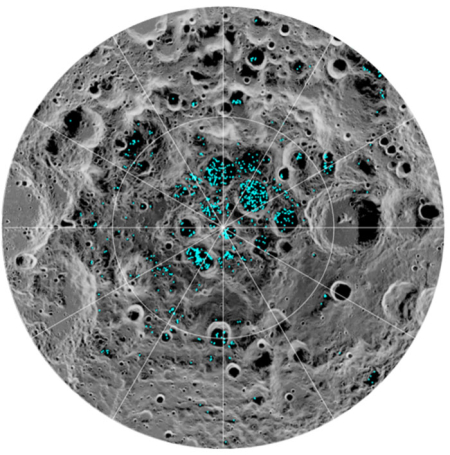
Using eleven years of data from Lunar Reconnaissance Orbiter (LRO), scientists think they have identified small areas in the Moon’s permanently shadowed interiors of some polar craters where the temperatures are always cold enough for dry ice (solid carbon dioxide) to be stable.

The map to the right, cropped and reduced to post here, is Figure 2 of the paper. It shows the areas at the south pole where stable dry ice is thought possible. The darker blue/purple are colder and thus are expected to have less sublimation. From the abstract:

Carbon-bearing species would be essential for sustained robotic or human presence on the Moon, for use in rocket fuel and biological materials. Various volatiles can be cold-trapped in permanently shadowed craters near the lunar poles. The existence of carbon dioxide cold traps has previously been surmised, but the required temperatures are near the lowest surface temperatures that have been reliably measured. Extensive and improved analysis of 11 years of orbital surface temperature measurements establishes the existence of carbon dioxide cold traps on the Moon, which potentially host high concentrations of solid carbon dioxide. Large CO2 cold traps are rare, however, and the geographic concentration of the resource will have policy implications. [emphasis mine]

The paper also adds in its conclusion that these regions are likely going to be of high value, and will thus likely be prime settlement and mining targets by everyone. As they note, “That this resource is highly concentrated geographically has implications for the governance of the lunar surface.”

5 comments

Firefly approves design of its unmanned lunar lander

Capitalism in space: Firefly has completed and approved the design of its unmanned lunar lander, and will now begin construction with a launch date targeting 2023.

Firefly said Monday that it has completed the “critical design review” phase of its program to develop a lunar lander. This means the company can now proceed to build and order components for the “Blue Ghost” spacecraft and begin its assembly. Firefly aims to launch the spacecraft as the primary payload on a Falcon 9 rocket in the fall of 2023.

NASA is sponsoring the mission as part of its Commercial Lunar Payload Services Program, through which it pays private companies to deliver scientific experiments to the Moon. NASA is paying $93.3 million for this Blue Ghost mission, which will carry 10 payloads down to the Mare Crisium lunar basin in September 2023.

In the next three years a plethora of commercial unmanned lunar landers have scheduled flights, all bringing both NASA science as well commercial payloads to the lunar surface. All are being designed and built by private companies. Expect some to fail. Some however will succeed, and will thus establish themselves as the go-to companies if you want to put a payload on the Moon.

0 comments

Australia to build unmanned lunar rover for NASA

NASA and Australia have signed a deal whereby Australia will provide an unmanned lunar rover on which NASA will put its science instruments, with the package taken to the Moon by a commercial lander.

As part of the agreement, a consortium of Australian businesses and research organizations will develop a small rover that can operate on the lunar surface. The rover would have the ability to pick up and transfer lunar regolith (broken rock and dust) to a NASA-operated in-situ resource utilization (ISRU) system on a commercial lunar lander. Such a rover could fly to the Moon as early as 2026.

While this agreement helps widen the competition in the commercial unmanned planetary aerospace industry, it does so by helping the industry of another country. This policy fits the general philosophy of the Democratic Party and the Biden administration, which generally focuses on aiding other countries before the U.S.

Posted on the road to Phoenix.

14 comments

Yutu-2 and Chang’e-4 successfully complete another lunar day on the Moon

According to China’s state-run press, its lunar rover Yutu-2 and the lander Chang’e-4 have now successfully completed another lunar day on the far side of the Moon, with both still functioning well.

Yutu-2 has traveled a total of 839.37 meters, or about 2,753 feet. They are aiming for a location that is still about 3,400 feet away. Based on the rover’s travel pace, about 100 feet per lunar day, it will take them about another two or four years to get there.

2 comments

Landing site chosen for VIPER lunar rover

Overview map

NASA has now chosen the landing site for its VIPER rover, in a relatively flat area about 85 miles from the Moon’s south pole and near the western edge of Nobile Crater (pronounced No-BEEL-e).

The white rectangle on the overview map to the right shows the landing zone. The green cross on the rim of Shackleton Crater marks the South Pole. The red outlines inside craters are regions that are believed to be permanently shadowed, and thus locations that might have water ice within them. Additionally, the data suggests there are a handful of small areas inside craters within the landing zone that might also have ice.

From the press release:

The area VIPER will study in the Nobile region covers an approximate surface area of 36 square miles (93 square kilometers), 10 to 15 miles (16 to 24 km) of which VIPER is expected to traverse through during the course of its mission. During this time, the rover will visit carefully chosen areas of scientific interest that will provide further insight into a wide array of different kinds of lunar environments. The VIPER team will look to characterize ice and other resources in these areas using VIPER’s sensors and drill.

The mission’s planned lifespan is presently set at 100 days. While the Moon’s day/night is 28 days long, the rover will likely see little darkness, since at this very high latitude the Sun will simply circle the sky near the horizon.

2 comments

China’s Chang’e-5 orbiter returning to lunar space

The new colonial movement: In a somewhat bold move, Chinese engineers appear to now be shifting the Chang’e-5 orbiter so that it will be able to return to lunar space to fly past the Moon.

The orbiter, one of four distinct Chang’e-5 mission spacecraft, delivered a return module containing 1.731 kilograms of lunar samples to Earth Dec. 16 before firing its engines to deep space for an extended mission.

The Chang’e-5 orbiter later successfully entered an intended orbit around Sun-Earth Lagrange point 1, roughly 1.5 million kilometers, in March. There it carried out tests related to orbit control and observations of the Earth and Sun.

New data from satellite trackers now suggests Chang’e-5 has left its orbit around Sun-Earth L1 and is destined for a lunar flyby early September 9 Eastern time.

This data comes not from China but from amateur astronomers who specialize in tracking satellites.

The fly-by could provide the spacecraft the velocity it needs to reach near Earth asteroid Kamo’oalewa, which China has said it is targeting for a 2024 sample return mission. Such a reconnaissance will help them design the sample return mission.

2 comments
1 39 40 41 42 43 94