Yutu-2 sets new longevity record for lunar rover

China’s Yutu-2 lunar rover has now set a new longevity record for any rover on the Moon, beating the 10.5 month record set by the Soviet Union’s Lunokhod 1 rover in 1970-1971.

Lunokhod 1 traveled about 6.5 miles, or about 34,000 feet, during its operation. Chinese engineers have been more cautious, moving Yutu-2 only about 1,132 feet in the same time period.

The Chinese rover is still operating, though relatively little data has been released from it. At the moment it has been placed in its hibernation mode as it makes it through its twelfth lunar night.

0 comments

Chang’e-4 and Yutu-2 complete 12th lunar day

Chinese engineers have put both Chang’e-4 and Yutu-2 into dormant mode after completed their twelve lunar day on the far side of the Moon.

The article from the Chinese state-run press provides very little information, other than telling us that Yutu-2 traveled 345 meters, written in a way to imply that was the distance the rover traveled in this last lunar day. I think that is wrong, however. Based on the distances traversed during previous lunar days, and that the rover had traveled a total of 290 meters at the end of its tenth lunar day, I think this new number is the total distance traveled.

The article also does not say what the consequences will be for these two spacecraft now that the priority of their communications relay has shifted from communications to being a radio telescope.

It could be that the consequences will be minor, considering that both spacecraft are in sleep mode during the lunar nights and for high noon of the lunar day. During those periods the relay satellite could be devoted full time to radio astronomy and have no impact on the lander and rover.

Unfortunately China has not said.

0 comments

Crash site of Vikram found

Vikram impact point
Click for full image.

Using a mosaic of Lunar Reconnaissance Orbiter (LRO) images, citizen scientist Shanmuga Subramanian located on the Moon the debris and impact point for India’s Vikram lander that crashed there in September, an identification that has since been confirmed by LRO scientists.

The image on the right, reduced to post here, has been modified by the scientists to bring out the features that changed before and after the impact.

After receiving this tip the LROC team confirmed the identification by comparing before and after images. When the images for the first mosaic were acquired the impact point was poorly illuminated and thus not easily identifiable. Two subsequent image sequences were acquired on 14, 15 October and 11 November. The LROC team scoured the surrounding area in these new mosaics and found the impact site (70.8810°S, 22.7840°E, 834 m elevation) and associated debris field. The November mosaic had the best pixel scale (0.7 meter) and lighting conditions (72° incidence angle).

The debris first located by Shanmuga is about 750 meters northwest of the main crash site and was a single bright pixel identification in that first mosaic (1.3 meter pixels, 84° incidence angle). The November mosaic shows best the impact crater, ray and extensive debris field. The three largest pieces of debris are each about 2×2 pixels and cast a one pixel shadow.

No word yet on what this new information reveals about Vikram’s failure.

2 comments

China unfolds Dutch radio antennas on lunar relay satellite

Chinese engineers have unfolded and activated the Dutch radio antennas on Queqiao, their lunar relay satellite orbiting the Moon, an action that had been delayed because the lander Chang’e-4 and rover Yutu-2 had both exceeded their nominal mission on the surface.

The Chinese satellite was previously mainly seen as a communications satellite. However, the Chinese moon mission has by now achieved its primary goals. Consequently, the Chinese have redefined the satellite to be a radio observatory. As such, the Netherlands-China Low Frequency Explorer is the first Dutch-Chinese space observatory for radio astronomy.

Marc Klein Wolt, Managing Director of the Radboud Radio Lab and leader of the Dutch team, is happy: “Our contribution to the Chinese Chang’e 4 mission has now increased tremendously. We have the opportunity to perform our observations during the fourteen-day-long night behind the moon, which is much longer than was originally the idea. The moon night is ours, now.”

If Queqiao is now dedicated to being a radio antenna full time during the lunar night, I wonder if this means the Chinese are shutting down Chang’e-4 and Yutu-2. Up to now both spacecraft have only operated during the lunar night, which suggests that was the only time they could relay data. It is possible that data relay could take place at other times, and that the lander and rover can function autonomously, but I have my doubts.

Both Chang’e-4 and Yutu-2 functioned for twelve lunar nights, four times longer than planned, so shifting gears on Queqiao to do radio astronomy is not unreasonable. Unfortunately, the lack of transparency from China leaves us in the dark about the fate of Chang’e-4 and Yutu-2.

0 comments

Chang’e-4 and Yutu-2 begin 12th lunar day

Chinese engineers have reactivated both their lunar lander, Chang’e-4, and its rover, Yutu-2, for their twelve lunar day on the far side of the Moon.

The lander woke up at 5:03 p.m. Thursday (Beijing Time), and the rover, Yutu-2 (Jade Rabbit-2), awoke at 0:51 a.m. the same day. Both are in normal working order, according to the Lunar Exploration and Space Program Center of the China National Space Administration.

No word on where Yutu-2 will be sent over then next two weeks.

Posting was light during the day today because Diane and I were on a hike that I needed to do for the upcoming planned second edition of my hiking guidebook, Circuit Hikes of Southern Arizona. My boss (me) allowed me to go, since this hike was not pure pleasure, but reconnaissance for one of my books.

0 comments

India confirms details of Vikram’s crash on Moon

India’s government has finally officially admitted that its Vikram lunar lander crashed in September.

In a written answer to a question posed to the Department of Space in Lok Sabha, Minister of State in the Prime Minister’s Office (PMO) Jitendra Singh said the “reduction in velocity” of the Vikram lander during the final phase of its descent on the moon’s surface “was more than the designed value”. As a result, Vikram “hard-landed” on the moon “within 500 metres of the designated landing site”, he said.

…“The first phase of descent was performed nominally from an altitude of 30 km to 7.4 km above the moon surface. The velocity was reduced from 1,683 m/s to 146 m/s. During the second phase of descent, the reduction in velocity was more than the designed value. Due to this deviation, the initial conditions at the start of the fine braking phase (final phase below 7.4 km altitude) were beyond the designed parameters. As a result, Vikram hard-landed within 500 m of the designated landing site,” the minister said in a written answer in the Lok Sabha.

Except for the detail that they think Vikram landed within 500 meters of its planned landing site, this answer really doesn’t tell us much new. It was very obvious during the landing that the spacecraft was traveling too fast as it began its final braking phase, and that it then descended much too fast thereafter.

In fact, the couched language and the unwillingness so far of ISRO, India’s space agency, to provide a detailed report on the failure does not reflect well on them. This kind of cutting edge engineering requires a hard kind of intellectual honesty. They have so far not shown that kind of honesty in their response to this failure.

5 comments

NASA expands list of companies certified to bid on lunar launch/payload contracts

Capitalism in space: NASA today announced that it is expanding the list of companies eligible to bid on lunar launch/payload contracts from 9 to 14.

From the NASA press release:

NASA has added five American companies to the pool of vendors that will be eligible to bid on proposals to provide deliveries to the surface of the Moon through the agency’s Commercial Lunar Payload Services (CLPS) initiative.

The additions, which increase the list of CLPS participants on contract to 14, expand NASA’s work with U.S. industry to build a strong marketplace to deliver payloads between Earth and the Moon and broaden the network of partnerships that will enable the first woman and next man to set foot on the Moon by 2024 as part of the agency’s Artemis program.

…These five companies, together with nine companies selected in November 2018, now are eligible to bid on launch and delivery services to the lunar surface. [emphasis mine]

The added companies are SpaceX, Blue Origin, Ceres Robotics, Sierra Nevada, Tyvak Nano-Satellite Systems.

I have highlighted the most important word in this press release, which is most interestingly buried to make it as little noticed as possible. The addition of SpaceX to this list and the mention that the program has now added the ability to for the companies to bid on launch contracts means that NASA’s goal here is to create a situation where it can replace SLS with a bidded contract to private industry that will costs far less and can launch frequently and on time, features that SLS is completely incapable of, and SpaceX can provide easily and reliably. This analysis by me is further reinforced in that Boeing, the builder of SLS, was not included in this list, even though only last week that company offered SLS to NASA in a wider array of launch configurations, for exactly this purpose.

If NASA had made this fact too obvious it might upset certain people in Congress (I’m talking to you Richard Shelby R-Alabama) who are wedded to SLS and its wasteful pork spending in their home states and districts.

The fact remains however that eventually SLS is going to go away. The Trump administration appears very wedded to its Artemis program to get back to the Moon by 2024, and it is apparently discovering that to make that landing happen the administration needs better alternatives.

3 comments

Lunar Reconnaissance Orbiter locates crashed Chinese orbiter

Before and after images showing Longjiang-2 impact site

Lunar Reconnaissance Orbiter (LRO) has located the Chinese microsat lunar orbiter Longjiang-2, which was sent to impact the Moon in August 2019 after it completed its technology demonstration mission.

The image above shows the before and after of the location, with the satellite’s remains visible as indicated by the arrow.

Through a careful comparison of pre-existing NAC images, the LROC team was able to locate a new impact crater (16.6956°N, 159.5170°E, ±10 meters), a distance of only 328 meters from the estimated site! The crater is 4 meters by 5 meters in diameter, with the long axis oriented southwest to northeast. Based on proximity to estimated crash coordinates and the crater size, we are fairly confident that this new crater formed as a result of the Longjiang-2 impact.

The picture of the impact site might not be very impressive, but remember, this satellite only weighed about a hundred pounds. The engineering however is impressive, on all counts. First, the Chinese built a tiny cubesat that reached lunar orbit and operated there for more than a year, during which it even took a picture of the Earth. Second, the engineering team of LRO was able to find this tiny impact site for such small spacecraft in less than four months.

0 comments

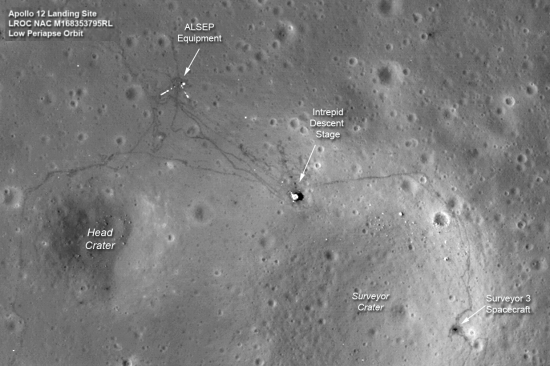
Celebrating Apollo 12

The Apollo 12 landing site on the Moon
Click for the full resolution image.

Fifty years ago today Apollo 12 was launched, landing on the Moon several days later to become the second manned mission to land on another world.

To celebrate that achievement, let’s review a few of the mission’s high points. The image to the right, cropped and reduced to post here, shows that landing site, the lunar module Intrepid, the various tracks for the two moon-walks Pete Conrad and Alan Bean took, and the unmanned Surveyor-3 probe. The image was taken by Lunar Reconnaissance Orbiter late in 2011 and released to the public in 2012. To really see some detail you will look at the full resolution version by clicking on the image. Or you can explore the landing even more thoroughly at the original release site.

First, there was Pete Conrad’s point blank landing. They wanted to land close enough to Surveyor 3 so that the two astronauts would be able to walk over to it during a spacewalk. He did this perfectly, bringing Intrepid down only 600 feet away. They were thus able to recover the probe’s scoop, camera, television cable, and other assorted parts. Once back on Earth the big discovery was that a single bacterium, Streptococcus mitis, had survived the journey from Earth and was still alive upon its return. Scientists theorized its survival occurred because prior to launch it had been freeze-dried during prelaunch vacuum tests.

Second, there were Pete Conrads’s first words upon stepping off the lunar module. As the third man to walk on the Moon and also one of the shortest Apollo astronauts, he won a bet with a French reporter, who did not believe he had the freedom to say whatever he wanted as his first words, by saying, “Whoopee! Man, that may have been a small step for Neal, but it’s a long one for me!”

Third, the astronauts installed the second seismometer on the Moon, which functioned for eight years.

Fourth, they brought back 75 pounds of material, which showed that while the Ocean of Storms was a mare lava field like the Sea of Tranquility, it had formed 500 million years more recently.

Fifth and most important, Apollo 12 proved that the Apollo 11 landing was not a fluke, that the engineering behind the Saturn 5 rocket, the Apollo capsule, and the lunar module, was sound. With courage and determination and a little clever re-engineering, those vehicles had been capable of taking humans anyway in the solar system. It is a shame we never took advantage of that possibility.

Hat tip to Mike Nelson for reminding me to post this.

8 comments

India targets Nov 2020 for new lunar lander mission

The new colonial movement: Sources inside India’s space agency ISRO yesterday revealed that they are now working to build and fly another lunar lander/rover, dubbed Chandrayaan-3, with a target launch date of November 2020, only one year from now.

Isro has formed multiple committees — an overall panel and three sub-committees — and held at least four high-level meetings since October. The new mission will include only a lander and rover, as the Chandrayaan-2 orbiter is functioning well. On Tuesday, the overview committee met with the agenda of reviewing the configuration of Chandrayaan-3. It also looked into the recommendations of various sub-committees on propulsion, sensors, overall engineering, navigation and guidance.

The Chandrayaan-2 orbiter had provided the propulsion capabilities to get the Vikram lander (with rover) to lunar orbit earlier this year, only to have the lander fail shortly before touchdown. To do this new mission without an orbiter will require adding a propulsion unit to the rover/lander. They are also looking at strengthening the lander’s legs to better resist a high velocity landing.

Kudos to ISRO for moving so quickly. There is no reason a replacement lander/rover should take years to build. They already know what to do, they need only do it again, with upgrades designed to avoid the failure in September.

0 comments

Chandrayaan-2 releases more lunar images

3D view of Lindbergh Crater by Chandrayaan-2
Click for full image.

The Chandrayaan-2 science team today released several new images from the spacecraft, while also showcasing their ability to use those images to produce 3D oblique simulations, as shown to the right. This oblique view of Lindbergh Crater was created from an overhead view using computer software that estimated the elevations from the image.

The spacecraft’s high resolution camera can resolve objects as small as sixteen feet across, which is the best resolution yet for any lunar orbiter.

No word yet on whether they have been able to find and image their failed Vikram lander.

0 comments

Boeing proposes manned lunar lander that bypasses Gateway

Capitalism in space: Boeing today announced its bid to build a manned lunar lander for NASA’s Artemis program, with its lander launched to go directly to the Moon rather than stopping at the proposed Lunar Gateway lunar space station.

The company said its “Fewest Steps to the Moon” proposal, submitted for NASA’s Human Landing Services program, minimized the number of launches and other “mission critical events” needed to get astronauts to the surface of the moon. “Using the lift capability of NASA’s Space Launch System Block 1B, we have developed a ‘Fewest Steps to the Moon’ approach that minimizes mission complexity, while offering the safest and most direct path to the lunar surface,” Jim Chilton, senior vice president for space and launch at Boeing Defense, Space and Security, said in a company statement.

The two-stage launched would launch on the enhanced Block 1B version of the rocket, which uses the more powerful Exploration Upper Stage (EUS), and go into lunar orbit. It would either rendezvous with the lunar Gateway or directly with an Orion spacecraft, where astronauts would board it for a trip to the lunar surface. The lander is designed to be launched as a single unit, rather than in separate modules that would be aggregated at the Gateway. The lander also doesn’t require a separate transfer stage to maneuver from a near-rectilinear halo orbit to low lunar orbit, as some other designs have proposed.

This approach, the company said in a statement, reduces the number of mission critical events, such as launches and dockings, to as few as five. Alternative approaches, Boeing claims, require 11 or more such events. [emphasis mine]

Boeing is essentially proposing a plan that makes Gateway unnecessary, a bidding ploy that very well might work with the Trump administration, which has already reduced Gateway’s initial construction to speed up its attempt to get to the Moon by 2024.

More important, Boeing’s proposal makes it very clear how unnecessary Gateway is, and how that boondoggle actually slows down our effort to return to the Moon. This is great news, for several reasons. First it shows that Boeing, one of the old big contractors that historically has depended on government dollars, is now publicly stating that it is not in favor of Gateway. This in turn makes it more politically acceptable for politicians to take this position. Expect more public advocacy against building Gateway.

Second, it shows that Boeing is trying to sell SLS. It wants Congress to appropriate more launches, and by showing Congress a cheaper way to use it the company is hoping legislators will buy into their proposal. SLS might be an exceedingly expensive rocket, but Gateway only makes it worse. Boeing is showing the world that there is a better and cheaper way to do things.

This also suggests that Boeing is recognizing the competition coming from SpaceX and others that might kill SLS, and is now trying to make SLS more competitive. While I am not a fan of SLS, if this proposal indicates an effort by Boeing is finally to make SLS more efficient and affordable I can only celebrate. The rocket has capabilities that are unique, and if its cost can be reduced in any way that can only benefit the U.S. effort to compete in the exploration and settlement of the solar system.

6 comments
1 51 52 53 54 55 94