NASA to send new rover to lunar south pole

NASA today announced that it is building a lunar rover that it will send to the lunar south pole, with a target launch date of December 2022.

About the size of a golf cart, the Volatiles Investigating Polar Exploration Rover, or VIPER, will roam several miles, using its four science instruments — including a 1-meter drill — to sample various soil environments. Planned for delivery to the lunar surface in December 2022, VIPER will collect about 100 days of data that will be used to inform the first global water resource maps of the Moon.

This rover appears to be a traditional NASA project, designed, built, and managed by various NASA agencies that also subcontract the work out to private contractors. As the press release says,

VIPER is a collaboration within and beyond the agency. VIPER is part of the Lunar Discovery and Exploration Program managed by the Science Mission Directorate at NASA Headquarters. Ames is managing the rover project, leading the mission’s science, systems engineering, real-time rover surface operations and software development. The hardware for the rover is being designed by the Johnson Space Center, while the instruments are provided by Ames, Kennedy, and commercial partner, Honeybee Robotics. The spacecraft lander and launch vehicle that will deliver VIPER to the surface of the Moon, will be provided through NASA’s Commercial Lunar Payload Services (CLPS) contract, delivering science and technology payloads to and near the Moon. [emphasis mine]

The highlighted words however indicate where this project differs from the past. The launch vehicle and lander are not being designed and built by NASA. They will be provided by commercial vendors.

0 comments

Israel still aims for second attempt to land on Moon

According to an official with Israel’s government-owned aerospace manufacturer, Israel is still planning a second Beresheet mission to land an unmanned probe on the Moon, despite the failure of Beresheet earlier this year.

But despite the hard landing, Israel has no intent to stop chasing the moon, Hayun said. (Shortly after the crash, the SpaceIL organization behind the mission suggested it would target a different destination than the moon; it’s unclear what will happen on that front.) The team behind Beresheet has mostly stayed on, he said during his presentation, and they intend to fly a new version of the lander within two or 2.5 years.

The successor spacecraft would include some design tweaks meant to increase the mission’s odds of landing softly. New versions will carry upgraded computers and, unlike the original Beresheet spacecraft, will be armed with an obstacle-avoidance system for landing. But Israel’s future landers will still be compact and still work with rideshare launches, Hayun said.

As much as I sincerely hope this happens, I am somewhat skeptical. First of all, a number of key Israeli engineers left SpaceIL to form a partnership with the U.S. company Firefly. Second, this presentation appears to have been very vague on where they intend to get their funding. If anything, it appears to be a sales effort to find that money.

1 comment

India releases first radar images from Chandrayaan-2

Radar image from Chandrayaan-2
Click for full image.

India yesterday released the first radar images produced by its lunar orbiter, Chandrayaan-2, the best such images yet produced by any spacecraft. As their press release notes:

Synthetic Aperture Radar (SAR) is a powerful remote sensing instrument for studying planetary surfaces and subsurface due to the ability of the radar signal to penetrate the surface. It is also sensitive to the roughness, structure and composition of the surface material and the buried terrain.

Previous lunar-orbiting SAR systems such as the S-band hybrid-polarimetric SAR on ISRO’s Chandrayaan-1 and the S & X-band hybrid-polarimetric SAR on NASA’s LRO [Lunar Reconnaissance Orbiter], provided valuable data on the scattering characterisation of ejecta materials of lunar impact craters. However, L & S band SAR on Chandraayan-2 is designed to produce greater details about the morphology and ejecta materials of impact craters due to its ability of imaging with higher resolution (2 – 75m slant range) and full-polarimetric modes in standalone as well as joint modes in S and L-band with wide range of incidence angle coverage (9.5° – 35°). In addition, the greater depth of penetration of L-band (3-5 meters) enables probing the buried terrain at greater depths. The L & S band SAR payload helps in unambiguously identifying and quantitatively estimating the lunar polar water-ice in permanently shadowed regions.

The image on the right, cropped and reduced to post here, is from one of the two images released. The brighter areas indicate rougher terrain as well as the location of ejecta from the crater, some of which is below the surface and is not obvious in optical images.

1 comment

Bhabha Crater at dawn

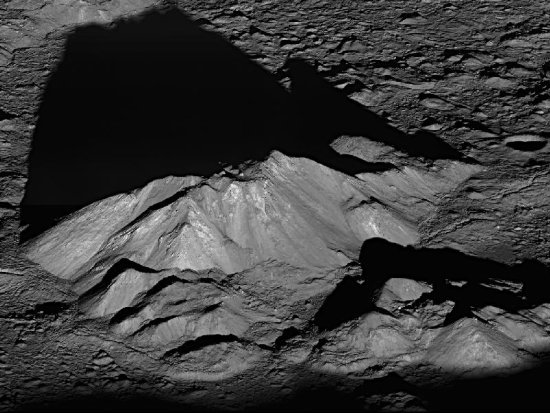
Central peaks of Bhabha Crater at dawn

Cool image time! The Lunar Reconnaissance Orbiter (LRO) science team have released a beautiful oblique image of Bhabha Crater, located on the Moon’s far side, taken just as dawn was breaking over the crater’s central peaks.

The image to the right is a section of that picture, showing the central peaks near the bottom with the western rim of the 50-mile-wide crater at the top. The giant shadows of those central peaks can be seen extending across the floor of the crater and against that western rim. The photograph was taken on August 28, 2019 from an altitude of about 45 miles. The area of the central peaks in daylight is estimated to be about nine miles across.

The LRO science team releases a new press release image about once every two weeks. I suspect that they hoped this release would have shown the location of India’s Vikram lander. As they are as yet unable to find it, they instead provided us this cool image instead.

If you go to the link you can use their viewer to view and explore this very very large image. For example, if you zoom into those central peaks you can actually see small boulders scattered across their rounded tops.

0 comments

LRO’s 2nd attempt to find Vikram comes up empty

In their second attempt to find India’s failed lunar lander Vikram, the science team of Lunar Reconnaissance Orbiter (LRO) were unsuccessful in spotting it.

A project scientist of Nasa’s LRO mission confirmed that the space agency’s second attempt to locate Vikram had come up empty. “The Lunar Reconnaissance Orbiter imaged the area of the targeted Chandrayaan-2 Vikram landing site on October 14 but did not observe any evidence of the lander,” Noah Edward Petro, the project scientist told news agency PTI.

Petro explained that Nasa compared the images shot by the LRO on October 14 with an image of the same area before Vikram’s landing. Nasa used a technique that would help it spot any signs of impact on the lunar surface indicating Vikram’s possible location. However, the images revealed nothing.

“It is possible that Vikram is located in a shadow or outside of the search area. Because of the low latitude, approximately 70 degrees south, the area is never completely free of shadows,” John Keller, deputy project scientist of Nasa’s LRO mission, explained while speaking to news agency PTI.

Based on the data obtained during the landing attempt, it appeared that Vikram should have crashed within a relatively small target area. That they haven’t seen it yet suggests that it landed within a shadowed area that will take time for the Sun to reach, if ever, or that it is farther away that expected, which implies that during landing much more went wrong than presently believed.

2 comments

Chang’e-4 and Yutu-2 awake for 11th lunar day

Engineers have reactivated both Chang’e-4 and Yutu-2 to begin normal operations on their eleventh lunar day on the far side of the Moon.

As is usual for these reports from the state-run official media in China, the article provides little information. However, this article today from space.com provides an update on the “gel-like” material that Yutu-2 spotted in August.

While gaining the attention of the Yutu 2 team, the material does not appear altogether mysterious, as claimed by Chinese media.

Clive Neal, a lunar scientist at the University of Notre Dame in Indiana, told Space.com that the new image reinforces the previous suggestion that the material is broadly similar in nature to a sample of impact glass found during the Apollo 17 mission in 1972.

…Dan Moriarty, NASA Postdoctoral Program fellow at the Goddard Space Flight Center in Greenbelt, Maryland, has analyzed and processed the image, seeking clues as to its precise nature. While this compressed image lacks a lot of the useful information a raw image would contain, Moriarty said he could gain insights by adjusting parameters. “The shape of the fragments appears fairly similar to other materials in the area. What this tells us is that this material has a similar history as the surrounding material,” Moriarty said. “It was broken up and fractured by impacts on the lunar surface, just like the surrounding soil.

Overall, Yutu-2 has traveled about 950 feet or 290 meters westward from Chang’e-4 since it began roving at the start of the year.

0 comments

Blue Origin partners with Lockheed Martin, Northrop Grumman, Draper to build lunar lander

At a science conference yesterday Jeff Bezos announced that Blue Origin has formed a partnership with Lockheed Martin, Northrop Grumman, and Draper to propose building a manned lunar lander for NASA.

In the first major update on the company’s lander program since May, Bezos said Blue Origin has assembled a “national team” of aerospace contractors to develop, build and fly the three-stage spacecraft, which is based on Blue Origin’s previous work on the Blue Moon landing system.

“Blue Origin is the prime contractor, Lockheed Martin is building the ascent stage, Northrop Grumman is building the transfer element and Draper is doing the GNC (guidance, navigation and control),” Bezos said Tuesday at the International Astronautical Congress in Washington. “We could not ask for better partners. Blue Origin, in addition to being the prime, is going to build the descent element.”

Blue Origin is competing for a NASA contract to develop a crewed lunar lander, or Human Landing System, for the Artemis program, which aims to return astronauts to the surface of the moon by the end of 2024.

This partnership reminds me of the way the aerospace industry functioned before the arrival of SpaceX. No one would compete. Instead, they would meet like a cartel and divvy up the work so that everyone had a share. The result was that very little new stuff got built, and over time the entire industry began to die.

The goal of this partnership now seems aimed at Congress and convincing legislators (especially the Democrats who control the House) to drop their opposition to Trump’s 2024 Moon proposal and fund it. Whether this will work remains unknown, and will likely have to wait until after the results of the 2020 election.

Meanwhile, it is very interesting that Blue Origin is the prime contractor, considering how very very little Blue Origin has so far achieved in space. I wonder if Bezos has committed some of his personal capital to this venture (more than $2.8 billion cash intended for his space ventures), and doled it out to Lockheed Martin, Northrop Grumman, and Draper as an incentive to become subcontractors.

Bezos’ presentation also provided an update on Blue Origin’s BE-7 engine, designed as part of this lunar lander. It appears however that he said nothing about the BE-4 engine that the company is building for both ULA’s Vulcan rocket and its own New Glenn rocket. Except for one update in August, there has been little said about this engine in about a year and a half. As this engine is key to the entire company’s financial future, this silence makes me continue to wonder if it has issues.

4 comments

Ice suspected in both old and young lunar craters

The uncertainty of science: New research of the craters where ice is suspected to exist on the Moon suggests that the ice is found in both young and old craters, which also suggests both that it comes from multiple sources and that some has been deposited more recently.

The majority of the reported ice deposits are found within large craters formed about 3.1 billion years or longer ago, the study found. Since the ice can’t be any older than the crater, that puts an upper bound on the age of the ice. Just because the crater is old doesn’t mean that the ice within it is also that old too, the researchers say, but in this case there’s reason to believe the ice is indeed old. The deposits have a patchy distribution across crater floors, which suggests that the ice has been battered by micrometeorite impacts and other debris over a long period of time.

If those reported ice deposits are indeed ancient, that could have significant implications in terms of exploration and potential resource utilization, the researchers say. “There have been models of bombardment through time showing that ice starts to concentrate with depth,” Deutsch said. “So if you have a surface layer that’s old, you’d expect more underneath.”

While the majority of ice was in the ancient craters, the researchers also found evidence for ice in smaller craters that, judging by their sharp, well-defined features, appear to be quite fresh. That suggests that some of the deposits on the south pole got there relatively recently. “That was a surprise,” Deutsch said. “There hadn’t really been any observations of ice in younger cold traps before.”

If there are indeed deposits of different ages, the researchers say, that suggests they may also have different sources. Older ice could have been sourced from water-bearing comets and asteroids impacting the surface, or through volcanic activity that drew water from deep within the Moon. But there aren’t many big water-bearing impactors around in recent times, and volcanism is thought to have ceased on the Moon over a billion years ago. So more recent ice deposits would require different sources — perhaps bombardment from pea-sized micrometeorites or implantation by solar wind.

I must emphasize that there is much uncertainty here. Most fundamental is the fact that at this moment we still really do not have a solid confirmation of the presence of ice in these permanently shadowed craters, only orbital data that suggests the presence of hydrogen, which scientists believe can only be there if it is locked in water molecules. This is not yet proven however.

It is intriguing however the evidence suggests ice in both young and old craters. This implies either some on-going process to put water there, or a series of specific but different events over time.

0 comments

SpaceX wins launch contract for NASA privately-built lunar lander

Intuitive Machines, one of the three companies awarded NASA contracts to build unmanned lunar landers, has awarded SpaceX the launch contract for its planned 2021 mission.

The Houston-based company’s first robotic Nova-C lander will carry up to 220 pounds, or 100 kilograms, of payloads to the moon’s surface. Launch and landing are scheduled for July 2021, according to Trent Martin, vice president of aerospace systems at Intuitive Machines.

Intuitive Machines previously stated plans to launch the first Nova-C mission on a SpaceX rocket, but Martin said in an interview Wednesday that the company held a “fully open competition” among multiple launch service providers before signing a contract for a Falcon 9 launch.

In a statement, Intuitive Machines said it “ultimately selected SpaceX for its proven record of reliability and outstanding value.” The company said the Nova-C mission will take off from pad 39A at NASA’s Kennedy Space Center in Florida. [emphasis mine]

That “outstanding value” almost certainly was the lowest price by far offered by any rocket company, a reality that continues to bring SpaceX business while taking market share from everyone else.

1 comment

NASA solicits proposals for manned lunar landers

NASA yesterday issued its final solicitation for proposals for private companies to build its manned lunar landers, with one major change resulting from comments to their earlier preliminary announcements.

Those comments resulted in some modifications intended to streamline the process and give companies more flexibility. One of the biggest is that NASA will no longer require lunar landers to dock with the lunar Gateway to serve as a staging point, at least for initial missions to the lunar surface.

“The agency’s preferred approach to a lunar landing is for the crew in the Orion spacecraft and the uncrewed human landing system to launch separately and meet in lunar orbit at the Gateway, which is critical to long-term exploration of the moon,” the agency said in a Sept. 30 statement about the solicitation. “NASA wants to explore all options to achieve the 2024 mission and remains open to alternative, innovative approaches.” [emphasis mine]

If these landers, using Orion, bypass Gateway in getting to the lunar surface, then there will literally be no reason to build that lunar station. NASA knows this, which is why they spent a lot of time hiding this fact by touting the requirement that any proposal must be designed to eventually dock with Gateway. The agency has been using Gateway to garner support on Capital Hill for its manned program, since the project will take decades to build and thus create a lot of jobs while generally taking few risks in space. (Politicians love this kind of space jobs program.) NASA now probably fears a pushback from both Congress and the big contractors building SLS and Gateway, and want to defuse that.

Nonetheless, this decision signals the Trump administration’s desire to get itself an off ramp from SLS and Gateway. Since NASA plans on issuing two lander contracts, I think they hope to issue one using Gateway, and one that does not. This way, when (not if) Gateway is delayed, they will still be able to fly manned lunar missions.

Yesterday’s solicitation also set a fast deadline for submissions, one month.

2 comments

LRO scientists release image of Vikram landing site

Overview of Vikram landing area
Click for full image.

The Lunar Reconnaissance Orbiter (LRO) science team yesterday released their high resolution image taken of the area where it is believed India’s lunar lander Vikram crashed.

The image to the right is not that image, but an oblique overview showing where that landing region is, the center of which is indicated by the white cross. Vikram was aiming for this flat region between the Simpelius N and Manzinus C craters.

In releasing the image, the scientists explained what they thought were the reasons they have so far failed to find Vikram.

We note that it was dusk when the landing area was imaged and thus large shadows covered much of the terrain, perhaps the Vikram lander is hiding in a shadow. The lighting will be favorable when LRO passes over the site in October and LROC will attempt to image the lander at that time.

You can explore the actual image at the link. It is quite large, though their viewer there allows you to zoom in and move about, inspecting each grid area very closely. As they note, there are a lot of shadowed areas.

LRO’s high resolution camera can see objects as small as Vikram, even if broke up somewhat on landing. The key for discovery will be timing. LRO will have to pass over at a time when the lander is not in shadow.

UPDATE: Below the fold is a side-by-side comparison of this region, with mid-day on the left and the dusk LRO image on the right, created by Rex Ridenoure of Ecliptic Enterprises.and graciously provided to me.
» Read more

1 comment
1 52 53 54 55 56 94