FAA initiates new prelaunch air space clearance system

FAA has now begun using a new prelaunch air space clearance system that is intended to shorten the time airplane travel is disturbed by the scheduled launch of a rocket.

[The FAA] developed the Space Data Integrator (SDI) tool to reduce how long ATO must close airspace around space launches and reentries. The system is voluntary. SpaceX, Blue Origin, Firefly, and the Alaska Aerospace Corporation are current partners. SDI was first used operationally for SpaceX’s Transporter-2 launch last week and is being used for the SpaceX-22 Cargo Dragon reentry today.

…Space operators now are voluntarily sharing telemetry data including vehicle position, altitude and speed, as well as data if the vehicle deviates from its expected flight path. Asked when additional companies might join, Monteith said he would have to defer to ATO to answer that question.

…Using the automated SDI system coupled with “time-based procedures and dynamic windows,” the FAA expects to be able to shorten airspace closures “from an average of more than four hours per launch to just more than two hours” and eventually less.

The article makes no mention whether this new system will allow the FAA to shrink the closure areas as well, which was Elon Musk’s main complaint after SpaceX’s Transporter-2 launch near the end of June was scrubbed seconds before launch when a helicopter slipped into that airspace. As Musk wrote in a tweet,

Unfortunately, launch is called off for today, as an aircraft entered the “keep out zone”, which is unreasonably gigantic. There is simply no way that humanity can become a spacefaring civilization without major regulatory reform. The current regulatory system is broken.

I suspect there is discussion to reduce the size of the closure areas, but I also suspect that the FAA is resisting industry calls to do so.

1 comment

SpaceX launch scrubbed because airplane strayed into what Musk calls “an unreasonably gigantic” launch zone.

Capitalism in space: Yesterday a SpaceX Falcon 9 launch was scrubbed mere seconds before launch because an airplane had been detected inside the government’s keep-out zone.

The scrub was called by the range officer at T-11 seconds. SpaceX will attempt the launch again today.

Musk immediately blasted the size of that keep-out zone, which was established decades ago at the very beginnings of the space race and has not been adjusted as launch technology has improved.

“Unfortunately, launch is called off for today, as an aircraft entered the ‘keep out zone,’ which is unreasonably gigantic,” Musk tweeted Tuesday afternoon. “There is simply no way that humanity can become a spacefaring civilization without major regulatory reform. The current regulatory system is broken.”

Musk has successfully forced the range to accept new technology that simplifies launches, makes it possible for them to occur faster with less time in-between, and requires fewer range officials monitoring the launch. He is now pushing them to rethink the size of the range, which is likely much larger than now necessary, as Musk claims, because not only are rockets more reliable, their programming is more precise.

The article at the link also notes as an aside at the end another Musk tweet, that SpaceX’s Starlink network now has 70,000 customers and hopes to have 500,000 within a year. More on that story here.

3 comments

Study proposes new radiation standards in space

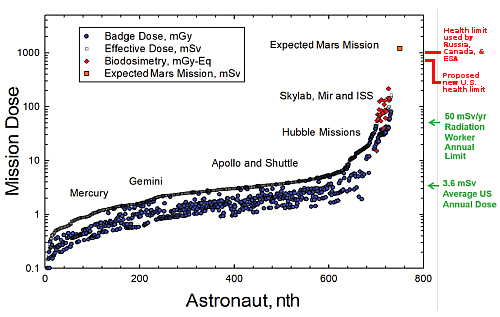
Health limits of radiation for space missions

A new report issued today from the National Academies of Science is recommending that NASA adopt a new health standard for limiting the exposure of astronauts to radiation during long space missions. The new standard, based on a maximum accumulative dosage of 600, is indicated by the figure to the right, taken from the report [pdf] and annotated to show both the new recommendation as well as the standards used by other space-faring nations.

The key result of this change is expressed in the report in this one sentence:
» Read more

6 comments

Japan passes law protecting property rights in space

Japan’s legislature on June 15th approved a new law designed to protect the ownership of the resources private entities extract for profit in space.

Japan’s legislation is similar to provisions in the Commercial Space Launch Competitiveness Act, passed by the U.S. Congress and signed into law by President Obama in 2015. That law grants U.S. companies rights to resources that they extract, but not property rights to celestial bodies, which would run afoul of the Outer Space Treaty. Luxembourg and the United Arab Emirates have since passed similar legislation.

All four countries are signatories of the Artemis Accords, which endorses the ability to extract and use space resources. “The Signatories affirm that the extraction of space resources does not inherently constitute national appropriation under Article II of the Outer Space Treaty, and that contracts and other legal instruments relating to space resources should be consistent with that Treaty,” the accords state.

Both Russia and China oppose such legislation, as well as the Artemis Accords, which have now been signed by eleven countries.

What this growing alignment of opposing sides means for future space operations by private companies is unclear, though it suggests these two countries will not honor those private property rights, which in turn suggests this legal disagreement is eventually going to lead to physical conflict in space.

4 comments

FAA, local Texas DA, and environmental group out to get SpaceX and Starship

Two news articles today suggest that a number of government officials, environmental groups, and some news media are beginning to team up to damage SpaceX and hinder its ability to succeed.

First we have this Verge article, aimed at suggesting that SpaceX violated its launch license and ignored FAA warnings not to launch during a December 9th test flight of the eighth Starship prototype.

Minutes before liftoff, Elon Musk’s SpaceX ignored at least two warnings from the Federal Aviation Administration that launching its first high-altitude Starship prototype last December would violate the company’s launch license, confidential documents and letters obtained by The Verge show. And while SpaceX was under investigation, it told the FAA that the agency’s software was a “source of frustration” that has been “shown to be inaccurate at times or overly conservative,” according to the documents.

The article generally takes the side of the FAA, suggesting that SpaceX was lax and nonchalant about the risks relating to weather and launch conditions, and proceeded with its launch even though FAA officials thought it unsafe. It also quotes Wayne Monteith, the head of the FAA’s space division, blasting SpaceX for showing “a concerning lack of operational control and process discipline that is inconsistent with a strong safety culture,” claiming that FAA software showed a risk to nearby buildings and homes should the rocket explode in the air.

However, buried far down in the article it also notes,
» Read more

23 comments

SpaceX in FCC filing outlines first orbital flight plan for Starship

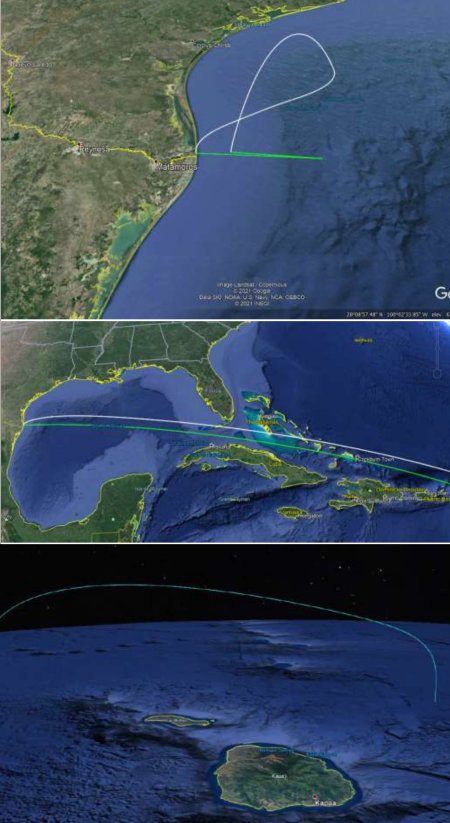
The flight plan for Starship's first orbital flight
Click for full images.

Capitalism in space: This week SpaceX filed the flight plan for the first orbital flight of its Starship/Superheavy rocket, taking off from Boca Chica and landing in the Pacific Ocean near Hawaii.

The images to the right are from the filing, which also states:

The Starship Orbital test flight will originate from Starbase, TX. The Booster stage will separate
approximately 170 seconds into flight. The Booster will then perform a partial return and land in the Gulf of Mexico approximately 20 miles from the shore. The Orbital Starship will continue on flying between the Florida Straits. It will achieve orbit until performing a powered, targeted landing approximately 100km (~62 miles) off the northwest coast of Kauai in a soft ocean landing.

No date is listed as yet, though the filing suggests they are aiming for a launch before the end of the year. It also appears that though both Starship and Superheavy will make controlled vertical landings, both will target locations in the ocean. It could be that SpaceX plans to place its two refurbished oil rigs at both of those locations, but this is not stated in the filing.

Achieving this flight before the end of the year remains a serious hill to climb, though if any company could do it, SpaceX is the most likely.
» Read more

8 comments

Firefly raises $75 million in investment capital

Capitalism in space: Firefly announced today that it has raised an $75 million in investment capital, with plans for a future fund-raising round aimed at bringing in another $300 million following the inaugural launch of its Alpha rocket.

The launch itself has been delayed several times, from December and March. It now appears they are targeting mid-June.

The company claims the delays were caused by two factors, the failure of a subcontractor to deliver on time the flight termination system, and the company taking longer than expected to prepare its launchpad at Vandenberg.

On a positive note, the company received its FCC launch license a few weeks ago, which had been held up due to security concerns over the company’s former main investor, Ukrainian billionaire Max Polykov. It appears that when Polykov sold off much of his stock so that he no longer controls the company, this eliminated the security concerns.

1 comment

FAA approves next three Starship test flights with prototype #15

Capitalism in space: In a statement today the FAA announced that it has approved next three test flights of SpaceX’s Starship prototype #15.

From the statement:

The FAA has authorized the next three launches or the SpaceX Starship prototype. The agency approved multiple launches because SpaceX is making few changes on the launch vehicle and relied on the FAA’s approved methodology to calculate the risk to the public. The FAA authorized the launches on Wednesday, April 28.

This likely means that SpaceX will try a flight tomorrow.

3 comments

Starship prototype #15 completes 2nd static fire test, waits FAA approval for flight

Capitalism in space: SpaceX’s 15th Starship prototype completed its second static fire test in three days yesterday, and is presently poised to do its first test flight.

The scheduled road closures in Boca Chica suggest that they are aiming for either April 30th, May 1st, or May 2nd. However, it also appears they are awaiting FAA approval, which could be why they did a second static fire test. They can’t fly so rather than do nothing they reconfigured that second static fire to test the landing burn.

Musk returned to Twitter to state that this was a header tank test and that all looked good. This could mean Monday’s test was a launch static fire while Tuesday’s test was more of a landing burn static fire as the header tanks are used to supply landing propellants.

It also appears that SpaceX has had its flight application sitting at the FAA for about a week, with no action. Thus, it is the federal bureaucracy that appears to be slowing things down at this moment.

0 comments

Momentus losing contracts due to security concerns

Capitalism in space: The orbit tug company Momentus appears to be losing some of its contracts because of security concerns that have delayed FAA approvals of its launch licenses and forced the cancellation of flights.

The company delayed the launch of its first Vigoride vehicle, which was to fly on a SpaceX rideshare mission in January, because it could not complete a payload review by the Federal Aviation Administration’s Office of Commercial Space Transportation in time. Momentus said that the FAA could not approve the payload “due to national security and foreign ownership concerns regarding Momentus raised by the DoD during an interagency review.”

Momentus now hopes to launch that first Vigoride mission on another Falcon 9 rideshare mission in June. The company said the FAA is still working on that interagency review that is being held open by the Defense Department. The review needs to be completed by the end of May for the company to keep its slot on that June launch.

The company has also lost a contract with Lockheed Martin, which though the reasons have not been stated probably relates to the same issue.

That issue apparently is the company’s former chief executive Mikhail Kokorich and its co-founder Lev Khasis and his wife. To address these concerns, Kokorich has stepped down, and the Khasis have put their shares in the company in a voting trust and will divest them within three years.

All does not appear lost however. Momentus Vigoride tug is presently the only option available for cubesats that need an upper stage to move them to different orbits, and it appears that neither Lockheed Martin nor its other customers are entirely abandoning it. They are simply playing safe, standing back, and waiting until the security issues are resolved and the FAA gives its approval.

3 comments

NASA’s choice of Starship proves government now fully embraces capitalism in space

Five years ago, before Donald Trump had even announced he was running for president, before Elon Musk had proposed his Starship/Superheavy rocket, and even before SpaceX had successfully begun to dominate the launch market, Jerry Hendricks at the Center for for New American Security (CNAS) asked me to write a policy paper on the state of the American launch industry, providing some background and more importantly, some recommendations that policy makers in Washington, dependent on that launch industry, could use as guidance in the coming years.

CNAS is a Washington, D.C., think tank that was founded in the middle-2000s by two political Washington insiders, one a Democrat and the other a Republican, with a focus on foreign policy and defense issues and the central goal of encouraging bi-partisan discussion. Hendricks’ area of focus was defense and aerospace matters, and at the time he thought the changes being wrought by SpaceX’s with its partly reusable Falcon 9 rocket required in-depth analysis. He had heard my many reports on this subject on the John Batchelor Show, and thought I could provide him that analysis.

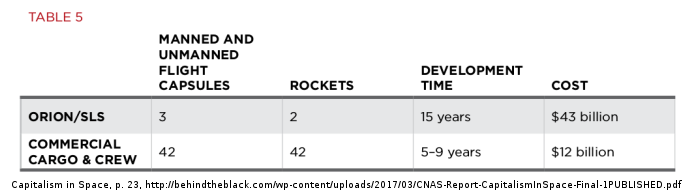
The result was my 2017 policy paper, Capitalism in Space: Private Enterprise and Competition Reshape the Global Aerospace Launch Industry. In it I reviewed and compared what NASA had been getting from its parallel rocket programs, the government-designed and owned Space Launch System (SLS) rocket versus the privately-designed commercial rockets of SpaceX and Orbital ATK (now part of Northrop Grumman). That review produced this very simple but starkly revealing table:

SLS vs Commercial space

From this data, combined with my extensive knowledge as a historian of American history and culture, resulted in the following fundamental recommendations:
» Read more

13 comments

Mask madness even as scientists confirm once again their uselessness

Even as a just published new study has shown once again the utter uselessness of masks to limit the spread of respiratory diseases like COVID-19, the control freaks of our now largely oppressive society are clamping down with new totalitarian rules requiring masks to be worn at all times, no matter what.

First let ‘s look at the study, which was published by the National Center for Biotechnological Information government website, a branch of the National Institute for Health. From the paper:

The physical properties of medical and non-medical facemasks suggest that facemasks are ineffective to block viral particles due to their difference in scales. According to the current knowledge, the virus SARS-CoV-2 has a diameter of 60 nm to 140 nm [nanometers (billionth of a meter)], while medical and non-medical facemasks’ thread diameter ranges from 55 µm to 440 µm [micrometers (one millionth of a meter), which is more than 1000 times larger. Due to the difference in sizes between SARS-CoV-2 diameter and facemasks thread diameter (the virus is 1000 times smaller), SARS-CoV-2 can easily pass through any facemask. In addition, the efficiency filtration rate of facemasks is poor, ranging from 0.7% in non-surgical, cotton-gauze woven mask to 26% in cotton sweeter material. With respect to surgical and N95 medical facemasks, the efficiency filtration rate falls to 15% and 58%, respectively when even small gap between the mask and the face exists.

Clinical scientific evidence challenges further the efficacy of facemasks to block human-to-human transmission or infectivity. A randomized controlled trial (RCT) of 246 participants [123 (50%) symptomatic)] who were allocated to either wearing or not wearing surgical facemask, assessing viruses transmission including coronavirus. The results of this study showed that among symptomatic individuals (those with fever, cough, sore throat, runny nose etc…) there was no difference between wearing and not wearing facemask for coronavirus droplets transmission of particles of >5 µm. Among asymptomatic individuals, there was no droplets or aerosols coronavirus detected from any participant with or without the mask, suggesting that asymptomatic individuals do not transmit or infect other people. This was further supported by a study on infectivity where 445 asymptomatic individuals were exposed to asymptomatic SARS-CoV-2 carrier (been positive for SARS-CoV-2) using close contact (shared quarantine space) for a median of 4 to 5 days. The study found that none of the 445 individuals was infected with SARS-CoV-2 confirmed by real-time reverse transcription polymerase.

There is a lot more in the study. Read it all. It shows, based on extensive research, that even when worn properly masks are relatively useless in stopping viral diseases. And since as mandated no one ever uses them properly, they end up becoming likely collectors of pathogens instead, at the very spot where people breath, thus contributing to the spread of infection.

The study also documented the numerous physiological and psychological costs caused by the forced continuous use of masks, from restricting oxygen to causing people to become socially isolated.

The paper’s conclusion:
» Read more

37 comments

New calls for reworking or replacing Outer Space Treaty

Yesterday there were two different public statements calling for the international community to either amend or replace the Outer Space Treaty, one an op-ed in the U.S. and the other a statement by the head of Russia’s space agency.

At first glance these announcements seemed hopeful, especially because the op-ed, written by one of the authors of a just released new study [pdf] by a defense-oriented Washington think tank, made part of its focus the need to encourage commercial activities in space.
» Read more

5 comments

Starship #11 debris fuels environmentalist opposition

They’re coming for you next: The debris that fell as far as five and a half miles away when SpaceX’s Starship #11 prototype exploded just before landing on March 30th has increased the already vocal opposition from various environmentalist activists of the space project.

Environmental organizations such as the Sierra Club, the Friends of Wildlife Corridor, and concerned citizens in the environmental research field have expressed their dissent about the SpaceX activities at Boca Chica.

Chris Sandoval, a science teacher in Brownsville with degrees in Wildlife and Fisheries and Ecotoxicology, has put forth a research paper explaining the possible effects of SpaceX activity in the surrounding natural habitats and economic consequences as a result of their expansion in the region.

Sandoval says research would show that contamination from rocket fluids would harm wildlife in the surrounding area. “Contaminants such as those of hydrocarbons are able to kill aquatic life, both vertebrate and invertebrate, at very low concentrations, especially when it’s in a semi-enclosed area as the Lagunas are,” explained Sandoval.

And yet, none of these claims seem to apply to the government-run spaceports in Florida and California, both of which are also surrounded by wildlife refuges. Why is that? Why do these environmentalists have a particular opposition to the spaceport of this private company, but none or little opposition to the government’s? Could it be that what they really oppose is private enterprise, and are using the environment as a tool to destroy it?

I should add, according to the U.S. Fish and Wildlife Service that manages this refuge, SpaceX has been working closely with them on mitigating the damage, which in the end I suspect will be quite minimal. The ecology is far stronger than these environmentalist like to portray it. What SpaceX did hardly compares to the damage a hurricane would cause, and that is not an unusual event at this Gulf coast location.

Whether this environmental opposition to SpaceX will result in any major delays or obstacles remains to be seen. Under a Trump administration I would not be too concerned. Under today’s Democratic Party Biden administration, who knows? The tendency of Democrats is to regulate, and to use their power to squeeze others. So far that has not yet happened aggressively in connection to SpaceX, though there have been signs that the Biden administration is interested in increasing the regulatory roadblocks SpaceX must face. We will only have to wait and see.

Above all this increases the urgency for SpaceX to shift as soon as possible its Starship and Super Heavy test flights to the two oil-rigs it purchased and are refitting as floating launch and landing platforms. Once the bulk of those test flights are far away, out in the ocean, the political clout of these protesters will be minimized.

16 comments

SpaceX in Starlink negotiations with the Philippines

Capitalism in space: SpaceX and a major internet company based in the Philippines have been in negotiations about offering Starlink to its citizens.

US tech billionaire Elon Musk’s Space Exploration Technologies Corp (SpaceX) is in talks to bring broadband satellite services to the Philippines through a partnership with fibre internet tycoon Dennis Anthony H Uy of Pampanga.

Representatives from SpaceX and Uy’s Converge ICT Solutions Inc met on multiple occasions to discuss a potential venture, a source with direct knowledge of the matter told Philippine Daily Inquirer.

SpaceX apparently can’t just set up business to compete with this company, probably because it has deep ties in the government that can block it. Converge probably wants a cut, along with I suspect a number of Philippine politicians.

No deal has so far been made, but Starlink would be ideal in the more rural locations of the Philippines.

0 comments

SpaceX and Amazon in cat-fight over internet satellite constellations

Capitalism in space: Even as SpaceX is rolling out the internet service from its growing Starlink satellite constellation while Amazon’s own Kuiper constellation languishes in development, the two companies are in a battle over the orbits of their respective constellations.

SpaceX CEO Elon Musk took to Twitter on Tuesday, as his company works to persuade Federal Communications Commission officials that it should allow SpaceX to move some of its Starlink satellites to lower altitudes than originally planned.

Jeff Bezos’ Amazon has been among companies that have disputed SpaceX’s request, on the grounds that the modification would interfere with other satellites.

“It does not serve the public to hamstring Starlink today for an Amazon satellite system that is at best several years away from operation,” Musk said in a tweet.

Amazon responded to Musk’s comment in a statement to CNBC. “The facts are simple. We designed the Kuiper System to avoid interference with Starlink, and now SpaceX wants to change the design of its system. Those changes not only create a more dangerous environment for collisions in space, but they also increase radio interference for customers. Despite what SpaceX posts on Twitter, it is SpaceX’s proposed changes that would hamstring competition among satellite systems. It is clearly in SpaceX’s interest to smother competition in the cradle if they can, but it is certainly not in the public’s interest,” an Amazon spokesperson said.

SpaceX in its own response to the FCC has noted “that Amazon representatives have had ’30 meetings to oppose SpaceX’ but ‘no meetings to authorize its own system,’ arguing that the technology giant is attempting ‘to stifle competition.'”

Both companies appear to have a point. Amazon is planning its system under an agreed-to arrangement where its orbits would not conflict with SpaceX’s. To permit SpaceX to change the deal and expand its orbital territory into Amazon’s threatens their system.

At the same time, that Amazon has been so slow to launch its system is something the FCC will not take kindly to. Companies get FCC licensing approval on the condition that they deliver within a certain time frame. Amazon appears to be taking a bit too much time, and SpaceX is trying to take advantage of this fact.

I suspect the FCC will deny SpaceX’s request, but will also tell Amazon that it had better start launching its satellites soon, or else the FCC will change its mind and give SpaceX that orbital territory.

Overall, the slowness of Amazon to launch Kuiper seems to fit the operational pace of Jeff Bezos’ other space company, Blue Origin. Lots of talk, but relatively little action. At some point the talk has to stop and Bezos’ companies have got to start delivering.

20 comments

Fauci admits to lying in his public statements about COVID-19

Our corrupt and dishonest government experts: Dr. Anthony Fauci, director of the National Institute of Allergy and Infectious Diseases (NIAID) since 1984, has now admitted that he changed his estimates of the required level of herd immunity needed to stop the epidemic based not on any science but on poll numbers and on “his gut feelings.”

In a Christmas Eve interview with the New York Times, Fauci acknowledged he had offered a lower estimate of the level of herd immunity necessary to stop the COVID-19 pandemic because he thought Americans would be discouraged by hearing his true thoughts on the issue.

He recently raised his estimate on the herd immunity threshold “partly based on new science,” the newspaper reported, “and partly on his gut feeling that the country is finally ready to hear what he really thinks.”

Fauci himself told the paper that he had withheld the higher estimates because polling results made him think such estimates would be viewed unfavorably. “When polls said only about half of all Americans would take a vaccine, I was saying herd immunity would take 70 to 75 percent,” he told reporter Donald McNeil. “Then, when newer surveys said 60 percent or more would take it, I thought, ‘I can nudge this up a bit,’ so I went to 80, 85.”

Fauci admitted that scientists “really don’t know what the real number is,” though he himself estimated that the “real range is somewhere between 70 to 90 percent.”

“But, I’m not going to say 90 percent,” he added, because “doing so might be discouraging to Americans,” according to the Times. [emphasis min]

The highlighted words tell us everything we really need to know about this fraud. He is not only a liar, he is an ignorant liar who cloaks that ignorance by loud declarations based not on knowledge but his own political goals.

Why are we still listening to this idiot? More important, why does he still have a job? Such dishonesty and two-timing should have gotten him fired instantly.

That he is still employed in such a powerful post and is still relied on by others in the media and government for guidance tells us much about the corruption and dishonesty of both those institutions. They support his lying, because it has also served their corrupt political purposes.

51 comments

Nationwide analysis suggests masks increased the spread of COVID-19

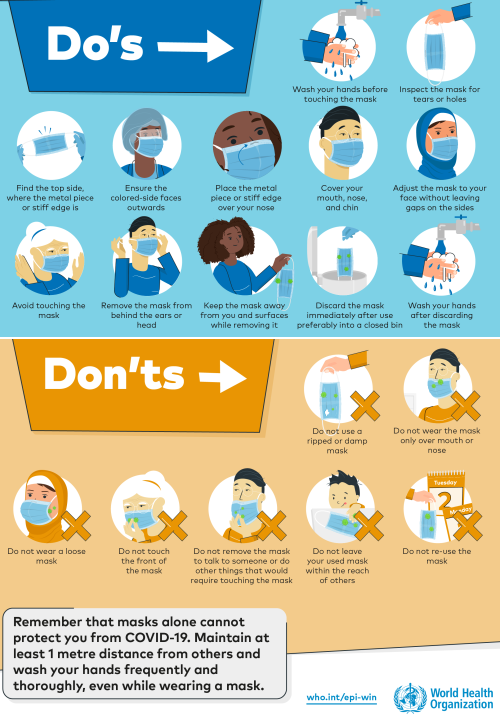
WHO's do's and don't's for mask use
For the full images, go here and here.

A analysis of all fifty states suggests the mandate to wear masks might have actually increased the spread of COVID-19 rather than reduced it.

They studied the number of cases over a 229-day period from May 1 through Dec. 15 and divided the results of the two study groups by days with mask mandates and days without mask mandates. The non-mandate data group includes both states that never had a mandate and those that did at some point, but data set included only the days they did not have a mask mandate.

The results: When comparing states with mandates vs. those without, or periods of times within a state with a mandate vs. without, there is absolutely no evidence the mask mandate worked to slow the spread one iota. In total, in the states that had a mandate in effect, there were 9,605,256 confirmed COVID cases over 5,907 total days, an average of 27 cases per 100,000 per day. When states did not have a statewide order (which includes the states that never had them and the period of time masking states did not have the mandate in place) there were 5,781,716 cases over 5,772 total days, averaging 17 cases per 100,000 people per day.

The reverse correlation between periods of masking and non-masking is remarkable.

That’s right. With mandates in place states say 10 more cases per 100K population. [emphasis mine]

It is very important to make it clear that this result has many uncertainties. It also is probably telling us more about the widespread improper use of masks that the mandates encourage and in fact literally require than the usefulness of masks when used properly.

Under the mandates, everyone uses and reuses the same mask, wearing it continuously for hours, or if not, putting it on and off and storing it in an unsanitary manner in-between. People also touch the mask continuously, and allow it to get wet and dirty without a second thought.

As the above WHO graph (that I have repeatedly posted) bluntly notes, doing this actually makes the mask a pathogen bomb that you wear on your face. The data of the above report reinforces this fact. That this reality has also been documented by scientific research and common sense for more than a century should also carry some weight as well. Sadly, in today’s society it does not.

I have repeatedly agreed that it is likely true that if everyone wore the right kind of masks, and wore them properly, for short periods and only when exposed to a symptomatic individual or when symptomatic themselves and in the presence of others, than maybe, maybe, masks would have a benefit. (Note that the data now confirms that only symptomatic individuals can infect others, and that if you have no symptoms you are almost certainly not going to spread the disease to others.)

Right now, mask mandates are likely causing more harm than good, and are really nothing more than feel-good nonsense that are being imposed by the petty dictators and control freaks of our society not to reduce the spread of disease but to increase the spread of their totalitarian power. If you go along, than you deserve the oppression you are certainly going to experience in the coming years.

As well as the increased likelihood that you will also get sick.

41 comments

The coming purge

Hitler's purge in 1934, the night of long knives
Hitler’s violent purge of his opponents in 1934: The Night of Long Knives.

I have just finished reading The Memo: 20 years inside the deep state fighting for America first. Written by military intelligence and national security expert Richard Higgins, it described his long and mostly fruitless effort in Washington to make our foreign military policy more effective.

In 2016, in desperation, he allied himself with Donald Trump, hoping that a victory by this very unconventional outsider might finally put Higgins in a position of some control.

It did not work out that way. At first the established players in Washington blocked his appointment. Eventually he managed to get an assignment at the National Security Council (NSC), but at a lower ranking than initially promised. Worse, the make-up of that council remained largely controlled by Democratic Party holdovers. As Higgins described things at the NSC in the first year after Trump’s inauguration:
» Read more

36 comments

Regulators coming after SpaceX’s Boca Chica facility and Starship

Capitalism in space? New FAA documents suggest that government regulators are not happy with the rapid and spectacular development by SpaceX of its Super Heavy/Starship rocket at Boca Chica, Texas, and are eager to impose restrictions and delays.

The issue revolves around revisions to SpaceX’s original FAA approval for its work at Boca Chica because the company has switched from flying Falcon 9 and Falcon Heavy rockets to developing and flying Starship and Super Heavy. While the FAA has been cooperative in issuing the necessary revisions, other agencies have raised red flags.

But the most important document of the bunch is the written reevaluation signed by the FAA on May 22. The file spans 26 pages, was required for SpaceX to receive its suborbital launch license from the FAA on May 28, and incorporates concerns from state and federal environmental agencies.

In the reevaluation, the Texas Parks and Wildlife Department and the US Fish and Wildlife Service took issue with several aspects of SpaceX’s plans and ongoing activities. Those criticisms targeted the “fluid nature” of the company’s construction projects, excessive road closures to Boca Chica Beach (which Brownsville locals prize), around-the-clock work that may affect nocturnal threatened or endangered species, prototype explosions, and sprawling wildfires the company has triggered.

The FAA responded to each concern in the document, ultimately determining “there are no significant environmental changes, and that all pertinent conditions and requirements of the prior approval have been met or will be met” with SpaceX’s suborbital test-flight plans.

However, SpaceX does not yet have the FAA’s go-ahead to launch any Starships to orbit from Boca Chica.

In its replies to concerns noted by other agencies — some of which call for a new EIS [environmental impact statement], which could take years to complete (an eternity in Musk time) — the agency repeatedly noted it is working with SpaceX to draft an “environmental review” of those plans.

Should Joe Biden and the power-hungry and controlling Democrats take control of the executive branch of the federal government, expect the FAA’s desire to help SpaceX to quickly end.

27 comments
1 23 24 25 26 27 105