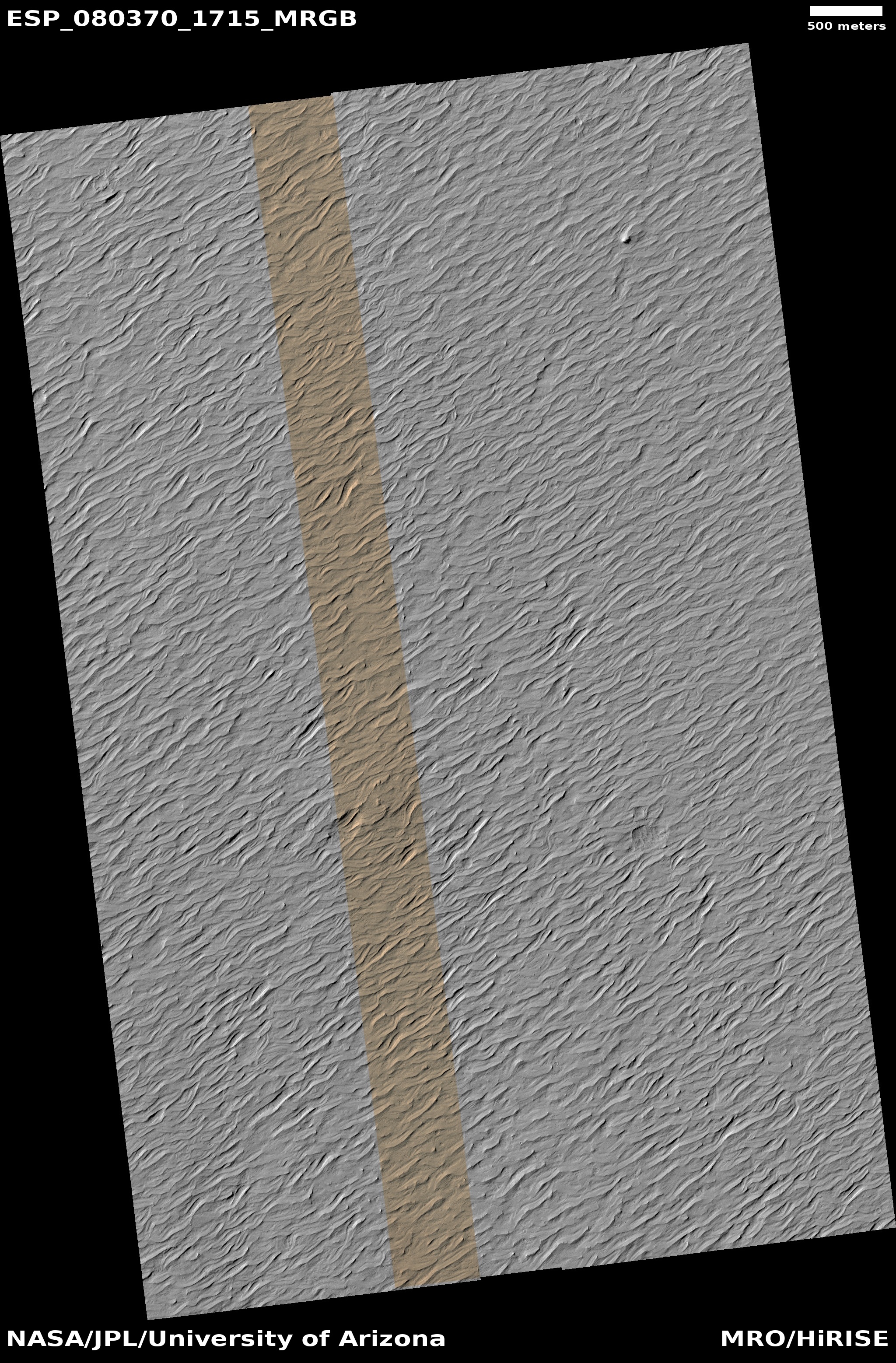
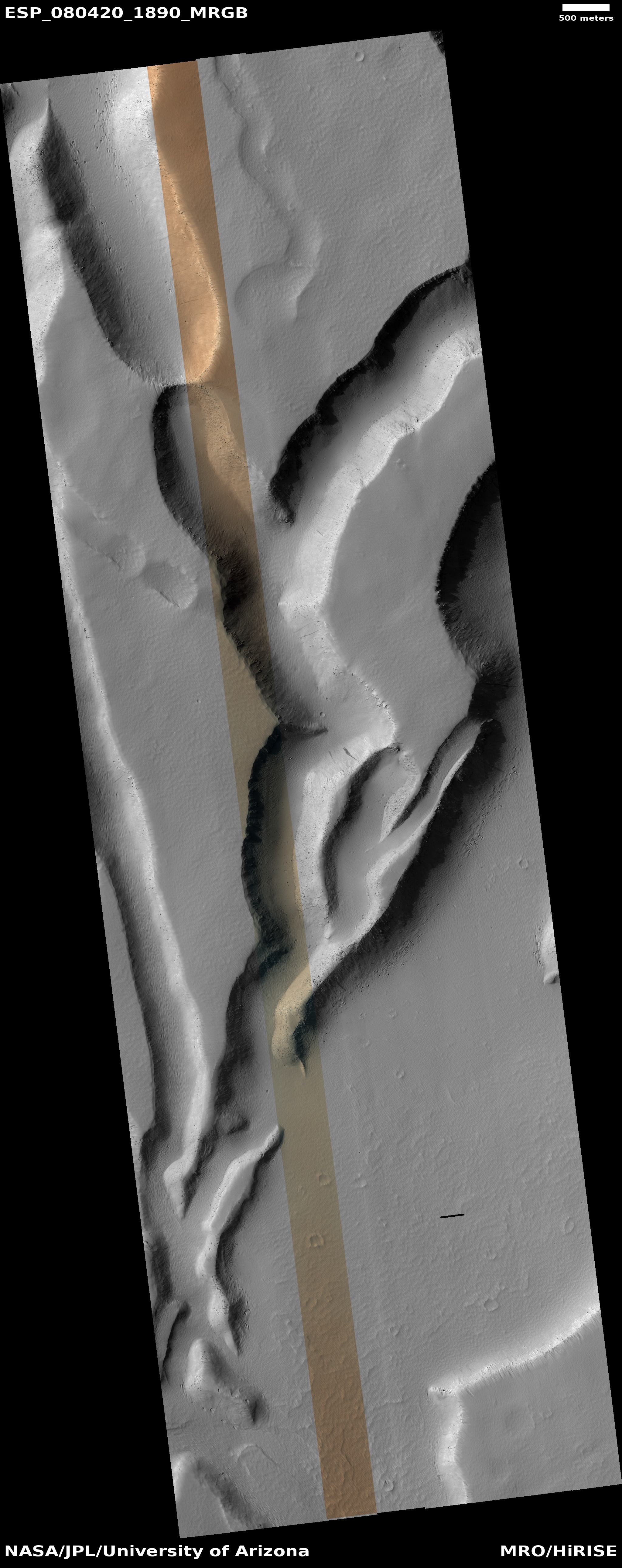
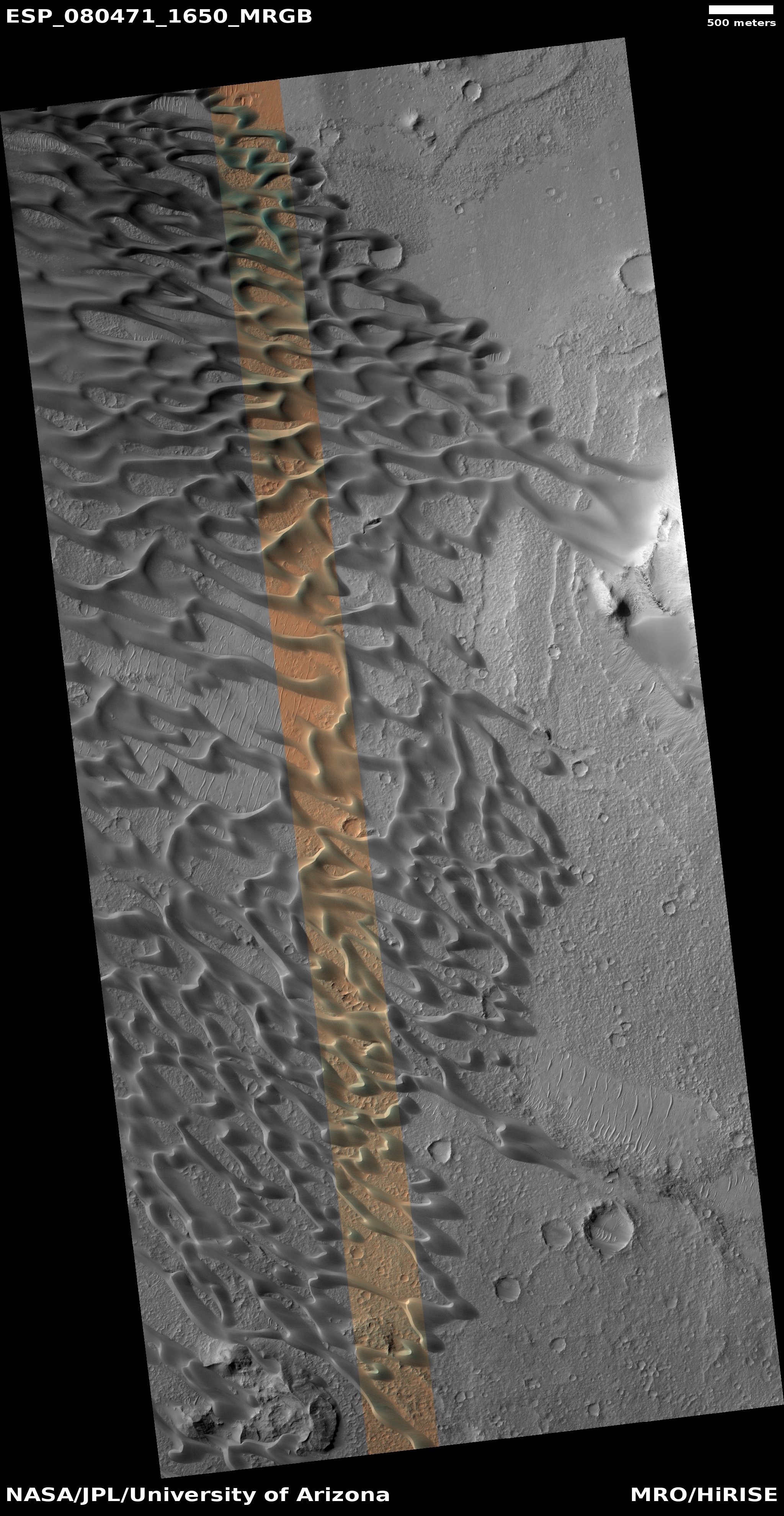
The pimpled floor of Isidis Basin on Mars

The pimpled floor of Isidis Basin on Mars
Click for original image.

Cool image time! The picture to the right, cropped, reduced, and sharpened to post here, was taken on May 21, 2024 by the high resolution camera on Mars Reconnaissance Orbiter (MRO). Labeled merely as a “terrain sample,” it was likely taken not as part of any specific research project but chosen by the camera team to fill a gap in the camera’s schedule in order to maintain its proper temperature.

When they do this they try to pick a target that is somewhat interesting, though it is not always possible. In this case it appears they succeeded in capturing a location filled with lots of puzzling stuff, including low 60-to-80-foot-high mesas with either flat- or hollow-tops, shallow craters that appear almost buried, and other craters that appear so deep and shadowed that it is even possible these are skylights into underground caves.

In between these features the flat landscape has a scattering of ripple dunes, all oriented in the same direction and thus implying that the prevailing winds are or were blowing from the northeast to the southwest.
» Read more

0 comments

EPA to NASA: We intend to regulate how you dispose ISS, and that’s only the start

The FAA to SpaceX
The EPA and its supporters to the American space industry:
“Nice industry you got here. Sure would be a shame if
something happened to it.”

It appears the Environmental Protection Agency (EPA) and a number of activist groups are now lobbying for the right to regulate whether anything in orbit can be de-orbited into the oceans, beginning with how NASA plans to dispose of the International Space Station (ISS) when the station is de-orbited into the ocean sometime before 2030.

The U.S. Environmental Protection Agency (EPA) is evaluating how the disposal of the International Space Station into the ocean will need to be regulated but has not shared the details of any specific concerns or aspects of regulation. “EPA’s Office of Water is coordinating with the Office of General Counsel on this complex issue. The agency does not have a timeline for this evaluation,” EPA spokeswoman Dominique Joseph told SpaceNews.

“Sixty-six years of space activities has resulted in tens of thousands of tons of space debris crashing into the oceans,” said Ewan Wright, a Ph.D. candidate at the University of British Columbia and a junior fellow of the Outer Space Institute, an interdisciplinary group of experts working on emerging space sustainability issues.

While Wright is later quoted as saying that disposal in the ocean is “the least worst option,” the article at the link includes quotes from several other academics, all claiming that such an option must be stopped at all costs, because it threatens to “cause great damage” to the ocean. These “experts” make this claim by comparing ISS’s de-orbit with the dumping of old ammunition from World War I as well as plastic forks now.
» Read more

27 comments

Viewing Comet Tsuchinshan-ATLAS when it enters the evening sky

Link here. For those living in the northern hemisphere, Comet Tsuchinshan-ATLAS will be bright and visible to the naked eye just after sunset beginning tomorrow.

“As soon as October 11th, ambitious comet spotters may pick up the comet during twilight just above the western horizon,” says Sky & Telescope Contributing Editor Bob King. “Binoculars will help you see the comet throughout its appearance.”

About 40 minutes after sunset on Friday, find a spot with a good view down to the western horizon. The first thing that will catch your eye will be the bright planet Venus, the Evening Star — that’s your starting point. Hold your fist out at arm’s length; the comet is about 2½ fists to Venus’s right. The comet will still look tiny in Friday’s twilight — like a hazy star with a small tail — and will set while twilight is still in progress.

Comet Tsuchinshan-ATLAS (pronounced choo-cheen-SHAHN) will remain visible for the next ten days, with the best viewing likely from October 13th to October 16th.

5 comments

Jupiter’s Great Red Spot appears to jiggle like Jello on a 90-day cycle

Jupiter as seen by Hubble over time
Click for original image.

Using the Hubble Space Telescope to photograph Jupiter’s Great Red Spot repeatedly over a four month period from December 2023 to March 2024 scientists have detected a 90-day cycle in which the spot oscillated in shape, shaking like Jello.

“While we knew its motion varies slightly in its longitude, we didn’t expect to see the size oscillate. As far as we know, it’s not been identified before,” said Amy Simon of NASA’s Goddard Space Flight Center in Greenbelt, Maryland, lead author of the science paper published in The Planetary Science Journal. “This is really the first time we’ve had the proper imaging cadence of the GRS. With Hubble’s high resolution we can say that the GRS is definitively squeezing in and out at the same time as it moves faster and slower. That was very unexpected, and at present there are no hydrodynamic explanations.”

The four images to the right are some of those observations. For a full movie showing the changes over ninety days, go here.

The scientists also predict that though the spot has been shrinking for decades, they expect that shrinkage to stop once the spot size no longer extends beyond the jet stream band within which it sits. At that point the different jet streams in the upper and lower bands will hold the spot in place and its size will stabilize.

0 comments

The bad consequences to the bad COVID policies in 2020 continue to pile up

Lysenko with Stalin
Trofim Lysenko (on the left), preaching to Stalin as he destroyed
Soviet plant research by persecuting anyone who disagreed with him,
thus causing famines that killed millions. He is now the role model for
today’s entire government health community.

Three stories this week illustrate once again that not only did none of the governmental actions imposed by our “betters” during the COVID panic in 2020 work, they are now resulting in long term harm across large populations.

First there was a study of 1.7 million children that found a marked increase in serious heart problems in children who got the jab.

Their research confirmed a large body of evidence showing links between the COVID-19 shots and myocarditis and pericarditis, particularly in adolescents. The research also confirmed that even in 2021, when the vaccine was first authorized for children and teens, that age group did not face a high risk for COVID-19-related serious outcomes, including death or the need for emergency care, hospitalization or critical care.

You can read the paper here [pdf]. Fortunately, the study also found no deaths in either group from these heart conditions, and that new heart ailments among the jabbed children were rare. Nonetheless, the study found solid evidence that the jab caused some harm while doing little to prevent COVID. As noted in the first link:
» Read more

10 comments

Monitoring a changing spot on Mars

Monitoring a changing landscape on Mars
Click for original image.

Cool image time! The picture to the right, cropped, reduced, and sharpened to post here, was taken on July 18, 2024 by the high resolution camera on Mars Reconnaissance Orbiter (MRO). Based on its label, “Dark Filamentary Streak Year-Round Monitor Site in Promethei Terra,” it was apparently taken as part of a long-term project to monitor the changes that occur at this particular spot on Mars.

This monitoring began in 2008, not long after MRO began science operations. In that first image, taken in the Martian autumn, almost the entire terrain was covered with dust devil tracks, all running more-or-less parallel to each other in a northwest-to-southeast direction.

That unusual tiger-striped landscape prompted later monitoring. However, a follow-up photo in 2010, also in autumn, showed practically no dust tracks here at all. Another image, taken in 2011 during the Martian summer, showed new dust devil tracks, but instead of being aligned as in 2008, the tracks went in all directions, with only a hint of alignment to the southeast.
» Read more

1 comment

Astronomers find another galaxy that shouldn’t be there in the early universe

REBELS-25
Click for original image.

The uncertainty of science: Using ground-based telescopes, astronomers have identified a galaxy only 700 million years after the Big Bang that is far more organized and coherent in shape and structure than thought possibly that soon after the theorized creation of the universe.

The galaxy in question is dubbed REBELS-25. It is at a red shift of z=7.31, which means that it is from a time when the universe was only 700 million years old. The earliest galaxies ever seen are only a few hundred million years older.

REBELS by name rebel by nature. This odd galaxy has stumped astronomers because it shows evidence of an ordered structure and rotation. It may even have a central elongated bar and spiral arms, though further observation is needed to confirm these structures.

This is in contrast to the small, messy, lumpy and chaotic norm for galaxies of a similar age. “According to our understanding of galaxy formation, we expect most early galaxies to be small and messy looking,” says co-author Jacqueline Hodge, an astronomer at Leiden University in the Netherlands.

You can read the published paper here [pdf]. The picture to the right shows this galaxy as seen by the Atacama Large Millimeter/submillimeter Array (ALMA) in Chile.

The consensus view of the early universe said there would not have been enough time for such a structured galaxy to form. And yet as astronomers use the improved astronomical instrumentation of our time to look deeper and deeper at that early universe, they keep finding things — like this galaxy — that defy that consensus view.

The answer to this mystery remains unknown, and is likely not yet answerable with the data we presently have. The data we do have however is beginning to suggest that scientists might have to begin looking at fundamentally different theories as to the inital formation of the universe. The Big Bang might still work, but if so it might require a major rewrite.

6 comments

Curiosity’s upcoming travel route

Curiosity's upcoming route
Click for original image.

Overview map
Click for interactive map.

Cool image time! The panorama above, cropped and annotated to post here, was taken on October 6, 2024 by the right navigation camera on the Mars rover Curiosity. It looks south, down the slopes of Mount Sharp and across Gale Crater, the distant crater rim barely visible through the dusty air twenty to thirty miles away.

The overview map to the right provide the context. The blue dot marks Curiosity’s present position. The yellow lines the approximate area covered by the panorama. The red dotted line indicates the rover’s planned route, with the white dotted line the path it has recently traveled.

As you can see, the rover has moved up onto a higher terrace surrounding the Texoli butte, and will now travel downhill a bit to skirt around its northern nose. From there, the science team plans to send the rover westward, traversing along the contour lines on the side of Mount Sharp. Along the way it will lose more elevation, but eventually, after passing several parallel north-south trending canyons, it will finally turn south into one canyon to resume its climb up the mountain.

To review the rover’s journey, Curiosity during its dozen years on Mars has traveled just over 20 miles and climbed about 2,500 feet. The peak of Mount Sharp however is still about 26 miles away and about 16,000 feet higher. Getting there will probably take at least three more decades, which is possible since the rover uses a nuclear power source similar to that used by the two Voyager interplanetary probes, now functioning in space for almost a half century.

In fact, it would not surprise me if the first human Mars colonies are established while Curiosity is still working, and that in its later years it sends its data to that colony directly (via an orbiting relay satellite), rather than beaming it back to Earth.

3 comments

Scientists: both liquid water and ice shaped Gale Crater

The uncertainty of science: Using isotope data from instruments on the Mars rover Curiosity, scientists have found evidence that suggests that both liquid water as well as glacial ice helped shape the present geology in Gale Crater.

The paper proposes two formation mechanisms for carbonates found at Gale. In the first scenario, carbonates are formed through a series of wet-dry cycles within Gale crater [involving intermittent liquid water]. In the second, carbonates are formed in very salty water under cold, ice-forming (cryogenic) conditions in Gale crater [involving glacial ice].

“These formation mechanisms represent two different climate regimes that may present different habitability scenarios,” said Jennifer Stern of NASA Goddard, a co-author of the paper. “Wet-dry cycling would indicate alternation between more-habitable and less-habitable environments, while cryogenic temperatures in the mid-latitudes of Mars would indicate a less-habitable environment where most water is locked up in ice and not available for chemistry or biology, and what is there is extremely salty and unpleasant for life.”

…The heavy isotope values in the Martian carbonates are significantly higher than what’s seen on Earth for carbonate minerals and are the heaviest carbon and oxygen isotope values recorded for any Mars materials. In fact, according to the team, both the wet-dry and the cold-salty climates are required to form carbonates that are so enriched in heavy carbon and oxygen.

What I glean from this report is that the evidence that ice played the dominant role continues to build, but since it counters the liquid water theories that scientists have favored for decades they are reluctant to shift entirely to it. It also suggests the geological processes on Mars were far more complex than proposed (no surprise!), and that some mixture of both processes was likely.

This paper is of course merely a newly proposed hypothesis, and therefore its conclusions should be considered only with great skepticism.

0 comments

SpaceX launches Europe’s Hera asteroid mission

SpaceX today successfully launched the European Space Agency’s (ESA) Hera asteroid mission to the binary asteroid Didymos and Dimorphos, its Falcon 9 rocket lifting off from Cape Canaveral.

The first stage completed its 23rd rocket, but was not recovered in order to maximum the fuel used to send Hera on its proper route. The fairings completed their 13th and 19th flights respectively.

Hera will do a follow-up rendezvous with the binary asteroids to get a close-up look at the consequences of the Dart impact back in 2022 of Dimorphos.

The leaders in the 2024 launch race:

96 SpaceX
44 China
11 Russia
11 Rocket Lab

American private enterprise now leads the rest of the world combined in successful launches 113 to 67, while SpaceX by itself now leads the entire world, including American companies, 96 to 84.

For SpaceX, this launch ties the record the company set last year for the number of launches of a private company in a single year, and it did so in just more than three-quarters of the year. The company’s goal of 144 launches in 2024 remains possible, assuming the federal government stopped blocking its operations. For example, the FAA granted the company permission for this one launch, but maintained its grounding of further launches because an upper stage did not land safely in the ocean in the exact right spot.

0 comments

Frozen Martian eddies at the confluence of two glacier rivers

Frozen eddies at the confluence of two glacial rivers
Click for original image.

Cool image time! The picture to the right, rotated, cropped, reduced, and sharpened to post here, was taken on July 3, 2024 by the high resolution camera on Mars Reconnaissance Orbiter (MRO).

The science team labels the photo as capturing a “contact near Reull Vallis,” a 1,000-mile-long Martian canyon that flows down the eastern slopes of Hellas Basin, the death valley of Mars.

What I see isn’t a geological contact but a complex jumble of odd-shaped depressions and mesas, surrounded by an eroded surface that seems squashed and deformed by some process. If this is all we had to go on, I would simply label this as another “What the heck?” image on Mars and move on. However, the larger context of the overview map helps explain it all, at least as best as we can explain using orbital data.
» Read more

0 comments

Engineers set new laser communications record to asteroid probe Psyche

Psyche-Earth laser communications record
Click for original graphic.

As part of a continuing test program, engineers have set a new long distance laser communications record, exceeding 290 million miles, by successfully using a laser to send communicate with the asteroid probe Psyche from Earth.

The graph to the right, not to scale, shows the orbital configuation of the laser record. It appears however that little actual data was sent in this last test. It merely demonstrated that a link could be established. An actual data transfer record by laser occurred in June.

On June 24, when Psyche was about 240 million miles (390 million kilometers) from Earth — more than 2½ times the distance between our planet and the Sun — the project achieved a sustained downlink data rate of 6.25 megabits per second, with a maximum rate of 8.3 megabits per second. While this rate is significantly lower than the experiment’s maximum, it is far higher than what a radio frequency communications system using comparable power can achieve over that distance.

The high data rates promised by laser communications will significantly improve deep space operations. Most especially, the ability to get data back in much larger packets more quickly will reduce the antenna bottleneck on Earth that limits the number of missions as well as the data can be returned daily. More missions will be able to fly, and scientists and engineers will get their results faster.

2 comments
1 59 60 61 62 63 729