Amazon commits almost $20 million more to expanding its satellite production facility

Amazon yesterday revealed it is going to spend an addition $19.5 million to expand its satellite production facility at the Kennedy Space Center in Florida in order to overcome the long multi-year delay in getting production started.

The company said Aug. 22 the investment will support a secondary, 3,900-square-meter support facility at the site, which would help accelerate launch cadence amid a looming regulatory deadline to deploy half the constellation by July 2026. The building would join a 9,300-square-meter satellite processing facility Amazon announced last year at Kennedy’s runway-equipped Launch and Landing Facility, bringing total investment in the site to nearly $140 million.

The company hopes to open this additional facility by next year. It will need it, because its FCC license for its Kuiper internet constellation — conceived to be similar to SpaceX’s Starlink — requires it to launch half of the constellation of 3,200+ satellites by 2026 and have the entire constellation in orbit by 2029. Meeting that first deadline will be challenging at this point, though the company hopes to be launching frequently in the next few years. It has contracts to launch satellites 46 times on ULA rockets (8 on Atlas-5 and 36 on Vulcan), 27 times on Blue Origin’s New Glenn, 18 times on ArianeGroup’s Ariane-6, and 3 times on SpaceX’s Falcon-9. To provide payloads for those launches however it will need to be able to quickly build a lot of satellites, and that’s what this additional investment is for.

It must be noted again that the Kuiper constellation was first proposed by Amazon at almost the exact same time as Elon Musk proposed his Starlink constellation. SpaceX now has several thousand satellites in orbit and is earning several billion dollars per year from several million signed up customers. Amazon in comparison has only launched two test satellites and zero operational satellites in that same time frame.

2 comments

Norway approves spaceport license for Andoya

Proposed spaceports surrounding Norwegian Sea

The Norwegian government announced yesterday that the Andoya spaceport that has been used for decades for suborbital test launches, has been given a spaceport license to conduct orbital launches from the site.

According to a statement from the Norwegian ministry, the license allows the spaceport to conduct up to 30 launches a year, including four during overnight hours. Those launches, to be overseen by the Civil Aviation Authority of Norway, can take place on azimuths between 280 and 360 degrees, supporting missions primarily to polar and sun-synchronous orbits.

The German rocket startup Isar Aerospace already has a 20-year lease to conduct orbital launches from Andoya, and hopes to do the first orbital test launch of its Spectrum rocket there. According to the Norway government, the first launch is planned for this year, but that likely will only be a suborbital test, not a full orbital launch. Of the three rocket startups from Germany, Isar is the only one that has not yet done any engine tests (as far as we know) or suborbital test launches of its rocket engine or design. Hyimpulse has done a suborbital test launch from an Australian spaceport, and Rocket Factory Augsburg have done numerous tests both in Germany and at the Saxaford spaceport. This license to Andoya will likely signal the start of those public tests by Isar.

A fourth European rocket startup, PLD from Spain, is presently prepping its own launchpad in French Guiana, and hopes to conduct its own first orbital test launch next year.

Until this week it appeared that Rocket Factory was in the lead to be the first European rocket startup to attempt an orbital launch. That changed when the rocket’s first stage was destroyed during a static fire launchpad engine test earlier this week. Right now it is not clear who is in the lead.

2 comments

Rocket Factory identifies cause of failure during rocket static fire test

According to Rocket Factory Augsburg, its investigation into the explosion during the first full nine-engine static fire test of its RFA-1 rocket earlier this week has identified the cause of the failure.

In an update on LinkedIn on 22 August, RFA COO Dr. Stefan Brieschenk announced that the company had completed an initial internal review. In what Dr. Brieschenk describes as “very preliminary” findings, he explains that the company has identified an “oxygen fire in one of the turbopumps” as the root cause of the incident. “That engine and that turbopump have run before without issues, wrote Dr. Brieschenk. “Eight engines ignited. We had multiple back-up and safety systems in place that were supposed to shut everything down – but things did not align on Monday as planned.”

As he notes, this is very preliminary. The company probably still does not know why the fire occurred in that turbopump, and it will need to find out in order to fix the problem. And without that fix, it is almost certain the UK’s Civil Aviation Authority (CAA) will not issue the company a launch license when a new first stage is built and delivered to the Saxavord spaceport in the Shetland Islands where the launch is planned.

All in all, expect a delay of at least one year before that launch can occur. Base on the CAA’s past history, that delay could easily extend to two years.

0 comments

Starliner decision expected tomorrow, August 24

According to a NASA update today, the agency will hold “an internal Agency Test Flight Readiness Review” to discuss whether to return Starliner manned or unmanned on Saturday morning, August 24, 2024 and then hold a press conference immediately afterward to discuss the results of that review.

What makes this review and press conference different from all previous Starliner reviews and conferences is that NASA administrator Bill Nelson will attend.

NASA Administrator Bill Nelson and leadership will hold an internal Agency Test Flight Readiness Review on Saturday, Aug. 24, for NASA’s Boeing Crew Flight Test. About an hour later, NASA will host a live news conference at 1 p.m. EDT from the agency’s Johnson Space Center in Houston.

The only reason a politico like Nelson would participate in such proceedings is because he has taken control of the decision-making process, and will make the decision himself. The review is likely to educate him as best as can be done in this short time, and he will then decide whether the two astronauts who launched on Starliner, Butch Wilmore and Suni Williams, will return on it in the next week or so, or will stay on board ISS until February 2025 and return on the next Dragon crew capsule scheduled to launch to ISS in late September.

Nelson might have decided to get involved on his own, but I am certain that if so it was strongly “encouraged” by officials above him in the White House. There is an election coming up, and the risks involved in using Starliner to return the astronauts must be weighed in connection not just with its engineering concerns but with its political ramifications also.

Nelson’s decision will also provide us a strong indication of a future Harris administration’s attitude toward space.

8 comments

Chinese scientists find method to extract water from Chang’e-5 lunar samples

Proposed concept for extracting water from lunar regoilth
Proposed concept for extracting water from
lunar regoilth

Chinese scientists have found that by heating Chang’e-5 lunar samples to 1,700 degrees Fahrenheit it is possible to extract a significant amount of water. From the paper’s abstract:

FeO and Fe2O3 are lunar minerals containing Fe oxides. Hydrogen (H) retained in lunar minerals from the solar wind can be used to produce water. The results of this study reveal that 51–76 mg of H2O can be generated from 1 g of LR [lunar regolith] after melting at temperatures above 1200 K. This amount is ∼10,000 times the naturally occurring hydroxyl (OH) and H2O on the Moon. … Our findings suggest that the hydrogen retained in LR is a significant resource for obtaining H2O on the Moon, which are helpful for establishing scientific research station on the Moon.

A video in Chinese (hat tip BtB’s stringer Jay) that describes this research can be found here. (If any of my readers understands Chinese and can provide a translation of this video’s narration, I would be very grateful.) It includes an artist’s rendering (screen capture to the right) showing how such a system on the Moon could work to extract water from the soil. Sunlight would be focused by a lensed mirror into a glass-domed container, heating the ground. The water would evaporate, condense on the glass and be sucked into a tube that would transfer it to a water tank.

This design is of course very simple and preliminary. According to Jay, “They need to heat the soil to 1000℃ (1832°F) to get the iron oxide in the lunar soil to split, the oxygen combines with hydrogen to make water and iron (melting point of iron is about 1500℃). You will need a nuclear reactor to produce that much power for an inductive furnace to get that hot. Doing the calculation, it would take about 245kw to heat up a metric ton of dirt in one hour to a 1000℃ degrees. It could be done slower over 24 hours at 10kw.”

Despite the technical difficulties getting such equipment operational on the Moon, that this research suggests water can be produced practically anywhere on the lunar surface is signficant. It suggests that even if no easily accessible water ice is found in the permanently shadowed craters at the poles, lunar bases still have viable options for obtaining water, and they don’t have even be at the poles.

8 comments

China launches communications satellite

China today successfully launched a new communications satellite, its Long March 7A rocket lifting off from its coastal Wenchang spaceport.

A short clip showing the launch can be found here. (Hat tip to BtB’s stringer Jay.)

The leaders in the 2024 launch race:

83 SpaceX
35 China
10 Rocket Lab
9 Russia

American private enterprise still leads the rest of the world combined in successful launches 98 to 53, while SpaceX by itself still leads the entire world combined, including American companies, 83 to 68.

0 comments

New port for big cruise ships dropped in Florida because it threatens space operations

A plan to build a new terminal in Port Canaveral for the large cruise lines has now been dropped because the constant arrival and departure of those ships would hinder launches from both Cape Canaveral as well as the Kennedy spacport.

On Aug. 2, Florida Department of Commerce Secretary J. Alex Kelly and Florida Department of Transportation Secretary Jared Perdue expressed dismay about cruise-terminal plan changes that could affect the space industry. Kelly and Perdue, in a letter, said that unless the port returns to earlier plans for the berth, the Department of Transportation will shift investments to other seaports and spaceports, and the Department of Commerce will halt funding for Port Canaveral projects.

These threats were enough to cause the port to drop its plans.

This story strongly suggests that the Florida state government views the future income from spaceport operations to far exceed that of the tourist cruise business, and does not wish the latter to interfere with the former’s growth in any way.

1 comment

Proposed commercial spaceport in Nova Scotia teams up with Voyager Space

The proposed commercial spaceport in Nova Scotia that was first proposed by the company Maritime Launch Services in 2017 has now signed a partnership deal with the space station company Voyager Space.

Voyager, through its Exploration Segment, will provide comprehensive engineering, design and fabrication support to Maritime Launch, leveraging more than six decades of combined aerospace and defense technology experience. Voyager will bring its decades of commercial spaceflight engineering, manufacturing, and operations capabilities to provide engineering design and development and buildup of select portions of the launch site on behalf of Maritime Launch. Voyager will work alongside Maritime Launch to analyze launch client requirements and integrate them into the current site layout.

Maritime’s original plan had been to provide a launch location and rocket (produced by a Ukrainian company). Satellite companies would sign with both for launch services. The invasion of the Ukraine by Russia in 2022 killed that arrangement. So did red tape, as the Canadian government only passed a law allowing spaceports to make deals with international partners at the start of August.

It appears Maritime has realized that without that rocket partner, it needs another experienced partner to help build the spaceport itself and make sure launches by many different rocket companies are done safely. It has now hired Voyager to do this, since that company is leading the Starlab space station consortium that includes many very experienced companies, including Lockheed Martin, Northrop Grumman, Airbus, Mitsubishi, and the European Space Agency.

1 comment

First SLS/Orion manned mission faces new delays because of Orion heat shield issues

Orion's damage heat shield
Damage to Orion heat shield caused during re-entry in 2022,
including “cavities resulting from the loss of large chunks”

Because the damage to the heat shield on the Orion capsule that flew around the Moon in late 2022 remains somewhat unexplained, NASA is considering delaying the next SLS/Orion mission, presently planned for September 2025 and intended to be the first Artemis flight to carry humans and take them around the Moon.

The heat shield, already installed at the base of the Orion spacecraft, will take the brunt of the heating when the capsule blazes through Earth’s atmosphere at the end of the 10-day mission. On the Artemis I test flight in late 2022, NASA sent an Orion spacecraft to the Moon and back without a crew aboard. The only significant blemish on the test flight was a finding that charred chunks of the heat shield unexpectedly stripped away from the capsule during reentry as temperatures increased to nearly 5,000° Fahrenheit (2,760° Celsius).

The spacecraft safely splashed down, and if any astronauts had been aboard, they would have been fine. However, the inspections of the recovered spacecraft showed divots of heat shield material were missing.

Two years later, despite extensive investigation and analysis, it appears NASA has not yet identified the root cause of the damage. The ablative material used on Orion was similar (though not identical) to the material used successfully on numerous other heat shields since the 1960s, yet it did not perform as expected.

NASA is presently facing three options. Do nothing and fly the next mission as planned, with four astronauts. It could rethink the trajectory used during re-entry, though this would likely not change things significantly unless the astronauts don’t go around the Moon as planned. Or it could change the heat shield itself.

The first two options are very risky, considering the unknowns. The latter involves a major delay of at least two years.

A decision must be made soon however. To meet the agency’s schedule it must begin stacking SLS’s two solid-fueled strap-on boosters next month. Those boosters have a limited life expectancy originally estimated to be one year. In the first unmanned Artemis test flight in 2022, NASA because of other delays stretched that life span to two years, and had no problems with the launch. If it stacks the boosters now and then has to delay for two more years to redesign Orion’s heat shield, those boosters will have been stacked for three years when launched.

Considering how seriously NASA is taking the issues with Starliner, which are likely not as serious as a heat shield that doesn’t work reliably, it would seem insane for NASA to launch Orion manned without fixing its own problem. And yet, for more than two decades NASA has consistently not demanded the same safety standards for SLS that it has demanded for the private commercial rocket startups. We shall see if this pattern now persists.

I continue to believe that the first Artemis lunar landing will not take place before 2030 (at least six years behind schedule). This heat shield dilemma only strengthens that prediction.

14 comments

The massive scale of Mars’ biggest canyon

Overview map

The south rim of Valles Marineris
Click for original image.

Cool image time! The picture to the right, rotated, cropped, reduced, and sharpened to post here, was taken on May 24, 2024 by the high resolution camera on Mars Reconnaissance Orbiter (MRO). Labeled merely a “terrain sample” by the camera team, it was likely taken not as part of any particular research project, but to fill a gap in the picture-taking schedule in order to maintain the camera’s proper temperature.

When the camera team needs to do this, they try to pick interesting targets within the required timeframe. Sometimes they succeed, sometimes not. In today’s example, they succeeded quite well. As shown by the overview map above, this picture captures (as indicated by the rectangle) the top of the southern rim of Valles Marineris, the biggest canyon on Mars and quite possibly the biggest in the entire solar system.

For scale, the drop from the rim to the low point in this picture is about 9,000 feet. That’s a 1,000 feet more than the drop from the north rim of the Grand Canyon to the canyon bottom at the Colorado River. In Valles Marineris however our descent has barely begun. To get to the bottom of the southern canyon here you still need to drop 15,000 more feet, for a total descent of 24,000 feet, an elevation change similar to most of the mountains in the Himalayas.

Nor are you yet at the bottom. If you climb over the ridge of 18,000-foot-high mountains that bisect Valles Marineris at this point, you can drop down even further, to a depth 31,000 feet below the southern rim.

Mount Everest is just over 29,000 feet high, which means if placed inside Valles Marineris is peak would still sit 2,000 feet below the rim.

The photo itself highlights part of the erosion process that formed Valles Marineris. This is the dry tropics, so no water was involved in shaping this terrain for many eons. Instead, what appear to be flows within the hollows is alluvial fill, material that over time breaks off and rolls downhill, filling the slopes below. Erosion will grind this material into smaller particles, so given enough time it flows almost like sand.

0 comments

Pragyan data confirms theory that the Moon’s surface was once largely covered with molten lava oceans


Vikram as seen by Lunar Reconnaissance Orbiter.
Click for interactive map. To see the original
image, go here.

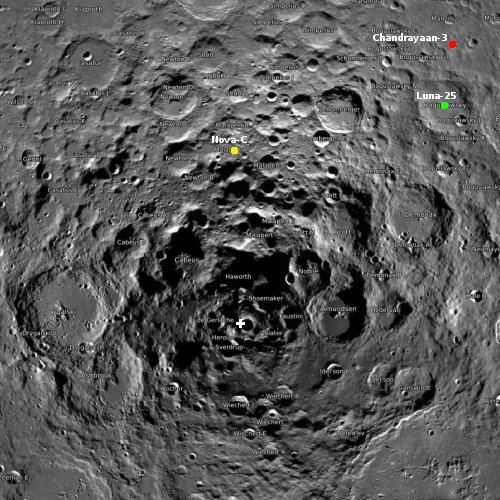
Data from India’s Pragyan lunar rover that landed in the high southern latitudes of the Moon in August 2023 has now confirmed the theory that the Moon’s surface was once largely covered with molten lava oceans.

Santosh Vadawale, an X-ray astronomer at the Physical Research Laboratory in Ahmedabad, India, and his colleagues analysed radiation data collected by the APXS [one of Pragyan’s instruments], and used this information to identify the elements in the regolith and their relative abundances, which, in turn, revealed the soil’s mineral composition. The team found that all 23 samples comprised mainly ferroan anorthosite, a mineral that is common on the Moon. The results were reported in Nature today.

“It’s sort of what we expected to be there based on orbital data, but the ground truth is always really good to get,” says Lindy Elkins-Tanton, a planetary scientist at Arizona State University in Tempe.

Previous landers obtained similar results. However, the Chandrayaan-3 samples are the first from the subpolar region: previous landers visited equatorial and mid-latitude zones. Together, this suggests that the composition of the regolith is uniform across the Moon’s surface.

These results are no surprise, but they confirm the global nature of the Moon’s early molten history. More important, they demonstrate that India now has the capability to send landers and rovers to other planets that are also capable of doing real research.

0 comments

Astroscale signs deal with JAXA to de-orbit old rocket upper stage

abandoned upper stage, taken by ADRAS-J
Click for original image.

The Japanese orbital tug startup Astroscale has now signed the final deal with Japan’s space agency JAXA to de-orbit the old H2A rocket upper stage that the company is presently flying a demonstration rendezvous and proximity mission dubbed ADRAS-J.

The photo to the right was taken by ADRAS-J in the spring, shortly after it rendezvoused with the stage. The data from this demo mission has not only shown Astroscale’s spacecraft can autonomously rendezvous and fly in close formation to the stage, the stage itself is in excellent condition after fifteen years in space.

The ADRAS-J follow-on active debris removal spacecraft, ADRAS-J2, will similarly attempt to safely approach the same rocket body through [rendezvous and proximity operations], obtain further images, then remove and deorbit the rocket body using in-house robotic arm technologies.

If successful, Astroscale will have the capability to offer this surface to others, both governments and private concerns, thus making the removal of space junk a viable business. Until the past decade, most upper stages ended up in orbit where they remain for long periods. There are a lot of such older stages. Some end up burning up in the atmosphere harmlessly, while others break up in orbit and produce a lot of debris that is a threat to other spacecraft. Astroscale’s mission here will demonstrate the ability to remove such stages.

0 comments
1 205 206 207 208 209 1,329