SpaceX ups fund-raising effort from one to two billion

Capitalism in space: SpaceX has apparently raised $2 billion during an on-going investment capital round, double what the company had initially expected.

This means that SpaceX has now raised $4 billion in private investment in the last year, the bulk of which the company says it is devoting to Starship. However, they have also said that for this most recent round some of the monies will go to making their Starlink satellite internet constellation operational. With 595 satellites already in orbit, and good testing ongoing, it appears a lot of investors want to get in on the game.

8 comments

NASA targets October 23rd for next manned Dragon flight

Capitalism in space: NASA and SpaceX yesterday announced that they have now set October 23rd as the earliest launch date for next manned Dragon flight.

The mission will carry Crew Dragon commander Michael Hopkins, pilot Victor Glover, and mission specialist Shannon Walker, all of NASA, along with Japan Aerospace Exploration Agency (JAXA) mission specialist Soichi Noguchi for a six-month science mission aboard the orbiting laboratory following launch from Launch Complex 39A at NASA’s Kennedy Space Center in Florida.

They had previously said they were aiming for a late September launch, but this extra delay allows them to better coordinate with other traffic to and from ISS, while also giving them an extra month to review the data from the first manned flight, just completed.

0 comments

SpaceX begins first tests of Starship’s thermal tiles

Link here. They have already flown some tiles on both a Dragon cargo flight as well as Starhopper’s one flight. They are now accelerating the work by testing the installation of a lot of hexagon-shapped tiles directly onto the steel hull of the Starship prototypes. From the article:

Behind the scenes, SpaceX is assuredly performing extensive laboratory-style tests with tiles and an agreement signed with NASA Ames Research Center confirmed that the company is using the facility’s arcjet to physically simulate the conditions of orbital-velocity reentry. Tests on the scale of a full Starship, however, are an entirely different story.

The first signs of large-scale heat shield installation testing appeared on July 9th when local resident and photographer Andrew Goetsch (Nomadd) captured photos of a test coupon covering half of an entire steel Starship ring. In April 2020, CEO Elon Musk confirmed on Twitter that the current design involved affixed heat shield tiles directly to Starship’s steel hull with steel studs. It’s unclear how exactly the company is installing steel studs directly onto the ~4mm (0.15 in) thick skins of a pressure vessel or if an off -the-shelf solution was available but Nomadd’s July 9th photos explicitly show the process required to refine the settings on the mystery stud installer.

The article has some good pictures. Expect to see a lot of these tiles on the surface of future prototypes.

9 comments

Endeavour at Cape, being prepped for next flight

Capitalism in space: Endeavour, SpaceX’s Dragon capsule that was the first to fly two astronauts to ISS, has now arrived at the company’s facility at Cape Canaveral, where it will be inspected, refurbished, and prepped for its next manned flight in the the spring of 2021.

SpaceX teams at Cape Canaveral will remove the exterior panels from the Crew Dragon spacecraft, and begin inspections to assess how the spacecraft weathered its 64-day space mission, according to Benji Reed, SpaceX’s director of crew mission management. “We want to make sure that we kind of dig deep and understand everything that’s gone on with this vehicle, make sure we’re really ready to go, and then do some of the aspects of the refurbishment,” Reed said. “There are some things that we will replace, some things that are standardly replaced, some things that we want to upgrade based on lessons learned, or that were already planned in work.”

SpaceX will still need to build a new trunk for each Crew Dragon mission. The trunk is an unpressurized module mounted to the rear of the Crew Dragon capsule, providing electrical power with solar arrays, and radiators to maintain steady temperatures inside the spaceship.

I guarantee the company will use what it learns in this inspection to improve later Dragon manned capsules. Right now they plan on from 5 to 10 flights per capsule. Since their contract right now only calls for six flights, that likely means the company only needs to build at most three to cover this NASA contract. However, NASA is certain to extend that contract, since six flights will only cover about two to three years, and ISS will be manned longer than that. Moreover, SpaceX has at least two tourist flights booked, so that calls for additional capsules as well.

Either way, we must shift our thinking. These might only be Dragon capsules, but they each get a name because each will fly more than once. It is thus appropriate to use that name instead of just calling them Dragon.

10 comments

SpaceX prepares sixth Starship prototype for hop

Capitalism in space: Having moved its fifth Starship prototype back to its facility at Boca Chica for repairs to its legs following its first light, SpaceX is simultaneously preparing its sixth Starship prototype for its own hops.

They plan more short hops to smooth out the launch process, aiming for the ability to do several per day, followed later by a much higher altitude hop. Expect the next hop within about two weeks.

14 comments

SpaceX to build resort near Boca Chica

Capitalism in space: SpaceX is seeking to hire a manager to lead the design and construction of a resort near Boca Chica for future spaceport customers.

The job posting seeks a manger to “oversee the development of SpaceX’s first resort from inception to completion,” with the ultimate aim of turning Boca Chica into a “21st century Spaceport.” That would include overseeing the entire design and construction process, as well as getting all necessary work permits and regulatory approvals, and completing the ultimate build of the facility.

Makes perfect financial sense, assuming Starship does eventually fly. Customers will need and expect a nice place to stay before and after their flights, and SpaceX has the land and is best positioned for providing it. And even if Starship doesn’t fly, during the rocket’s development there is money to be made providing tourists the best viewpoint for watching test flights, while also creating a source of profit independent of actual flight.

3 comments

Air Force terminates development contracts to ULA, Blue Origin, Northrop Grumman

In awarding ULA and SpaceX exclusive launch rights for all launches through 2026, the Air Force also decided to end prematurely the development contracts to ULA, Blue Origin, and Northrop Grumman aimed at helping these companies develop new rockets.

An issue at hand is the termination of the Launch Service Agreement contracts that the Air Force awarded in October 2018 to Blue Origin and Northrop Grumman, as well as to ULA. The purpose of the agreements was to help Phase 2 competitors pay for launch vehicle development and infrastructure. Blue Origin received $500 million; Northrop Grumman $792 million and ULA $967 million. The funds were to be spread out through 2024, and the Air Force from the beginning said the LSAs would be terminated with those companies that did not win a Phase 2 procurement contract.

Despite political pressure to not end the LSAs, the agreements will be terminated, Assistant Secretary of the Air Force for Acquisition Will Roper said Aug. 7 during a video conference with reporters. “We will work with those two companies to determine the right point to tie off their work under the LSA agreements,” Roper said. The intent of the LSAs “was to create a more competitive environment leading into Phase 2,” he said. “The point is not to carry them indefinitely.”

LSA funds supported the development of Blue Origin’s New Glenn rocket and Northrop Grumman’s OmegA launch vehicle. ULA will continue to receive funds for its Vulcan Centaur vehicle.

Almost immediately after the award of these contracts was announced in 2018, ULA and Blue Origin announced one year delays in the development of Vulcan and New Glenn. Apparently, meeting the additional requirements of military’s bureaucracy in exchange for getting the cash slowed development.

Now they won’t be getting a large part of that cash, making the decision to take it a deal with the devil. The delay in development has definitely hurt both companies in their competition with SpaceX. First, it likely has raised the cost and complexity of their new rockets, making it harder to compete in price. Second, the delay has given SpaceX more time to grab more customers while improving its own rockets.

SpaceX initially protested not getting a share of this development money, but has subsequently chosen to no longer pursue such government money for Starship because it doesn’t want itself hampered by obtuse government officials and their mindless requirements.

Meanwhile, Northrop Grumman’s Omega rocket is almost certainly dead. That company took the old big space company approach, structuring development around government cash. Without it there is no R&D money at Northrop Grumman to continue work. Furthermore, Omega was designed to serve only once customer, the military. Without any launch contracts there are no customers for Omega, especially because it likely has too high a launch price.

13 comments

Air Force limits future launch bidding to SpaceX and ULA

The Air Force today announced that it decided, after more than a year of discussions and negotiations, to limit bidding on all launch contracts for the next five years to only SpaceX and ULA, thus restricting competitive bidding on those contracts.

The awards represent the second phase of the military’s National Security Space Launch program, which is organized by the Air Force’s Space and Missile Systems Center in Los Angeles, California. Four companies — Elon Musk’s SpaceX, ULA, Northrop Grumman and Jeff Bezos’ Blue Origin — bid for the contracts, with the military set to spend about $1 billion per year on launches.

The NSSL awards represent nearly three dozen launches, scheduled between 2022 and 2026. ULA won 60% of the launches, and SpaceX won the remaining 40%.

The award blocks Northrop Grumman and Blue Origin from bidding on these contracts. Expect a lawsuit from these two companies demanding that they have the right to bid, just as SpaceX did several years ago when the Air Force tried to maintain ULA’s monopoly on bidding.

On a very common sense level, this approach by the Air Force (its space operations soon to be taken over by the Space Force) makes little sense. Why restrict bidding? Both Blue Origin or Northrop Grumman expect to have their new rockets operating commercially in the next two years. They should have the right to bid on military launches. The competition will strengthen the launch market, reduce the costs to the military, and give it more redundancy and flexibility.

Based on my research, the only real reason I have ever been able to find for the Air Force’s desire to do this is their inability to deal with their paperwork should more than two bids be received.

12 comments

SpaceX launches more Starlink satellites

Capitalism in space: SpaceX tonight successfully put two commercial satellites for another customer plus another 57 of its own Starlink satellites into orbit, using a Falcon 9 rocket that was reusing a first stage flying for the fifth time.

This brings the total number of Starlink satellites now in orbit to 595. They also successfully landed the first stage, making it now available for a sixth flight.

19 China
12 SpaceX
9 Russia
4 ULA

The U.S. has retaken the lead from China in the national rankings, 20 to 19.

7 comments

SpaceX and ULA get launch contracts from SES

Capitalism in space: The satellite communications company SES yesterday announced the award of new launch contracts to both SpaceX and ULA.

It appears that the contract was for one launch from each company, each putting up two satellites. Previously SES’s satellites were generally too large for either the Atlas 5 or the Falcon 9 to launch two at one time. This suggests that the satellite company is slimming down the design of its satellites.

1 comment

Fifth Starship prototype flies!

Starship #5 in flight
Shortly after take-off.

Right after landing
Right after landing.

Shortly after landing
After the smoke has cleared.

Capitalism in space: SpaceX’s fifth Starship prototype today successfully completed a 150 meter hop at its Boca Chica facility in Texas, landing vertically.

I have embedded a video of the flight below the fold.

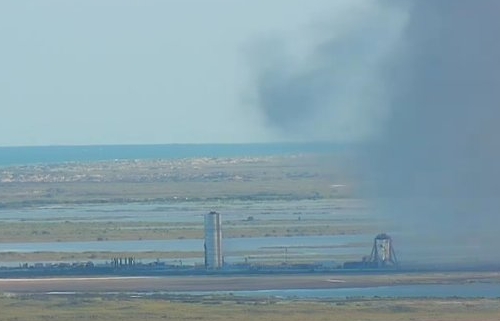
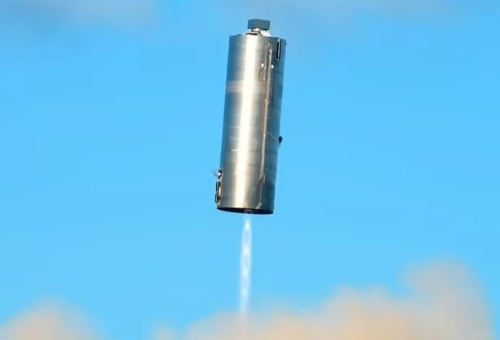
The screen capture to the right shows it in flight. It is canted slightly because its one Raptor engine was not centered at its base but offset.

The next image shows the prototype standing vertical on the ground to the left of Starhopper, which flew one year ago. All told the flight lasted only about a minute.

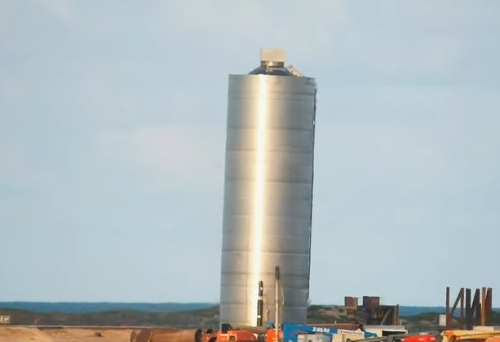
The final image shows a close-up of the prototype after the smoke has cleared. Why it is canted on the ground is not clear. Its legs are not visible (they apparently are relatively small), so it is hard to say whether one buckled or not.

The launch platform might have sustained damage but they have another ready to go. It is even conceivable that they could fly this prototype again, though they already have prototype #8 waiting in the wings.

Regardless, expect SpaceX to keep its fast development pace going. I would not be surprised if they attempt another test flight in less than two weeks.

Screen captures courtesy of the LabPadre live stream.
» Read more

18 comments

Starship hop today?

UPDATE: They are close to trying again. If you refresh your screen, you will now have two iterations of the live stream. This will allow you to have two cameras visible at the same time, You can show the main “nerdie” camera on one, with their commentary, and show the wider “sapphire” camera on the second. You pick cameras by clicking on the camera icon in the menu bar at the bottom of the screen.

UPDATE: First attempt apparently aborted. No word yet if they will attempt again today.

UPDATE: Scrubbed on August 3rd, attempting again on August 4th.

Capitalism in space: SpaceX’s Starship team has scheduled the first 500 foot hop of the fifth Starship prototype today, after canceling yesterday’s attempt.

The window for Starship SN5’s 150m hop debut now stretches from 8am to 8pm CDT (13:00-01:00 UTC) on Monday, August 3rd. It’s currently unknown if SpaceX will offer its own live coverage of the test flight but several unofficial streams will likely be available from NASASpaceflight.com, LabPadre, SPadre, and more. Stay tuned for updates!

I have embedded LabPadre’s live stream below the fold, if you wish to run it in the background. They will have commentary when they note a “pad clear” signal.
» Read more

8 comments

Endeavour safely splashes down

Splashdown of Endeavour

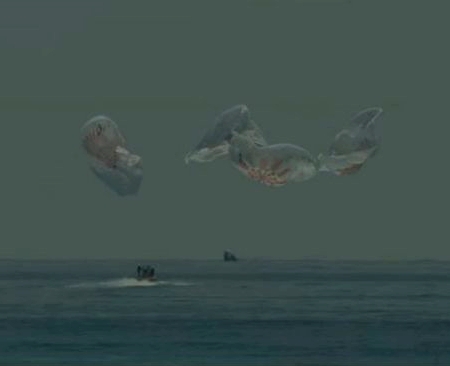
Capitalism in space: SpaceX’s Endeavour Dragon capsule has successfully splashed down in the Gulf of Mexico, returning two humans back to Earth safely after completing the first two month long manned commercial space mission.

If you go to the live stream to watch recovery operations, note that the boats and ships and persons involved are all property and employees of SpaceX. This is entirely an operation of the private company. The government is not involved, other than NASA’s justified monitoring as SpaceX’s customer.

One cool tidbit for the future. Endeavour is scheduled to fly again, in the spring of 2021. On that flight will be Megan McArthur, the wife of astronaut Bob Behnken, and she will likely sit in the same place he did on his flight.

31 comments

Starship fifth prototype set for first 500 foot hop

Capitalism in space: SpaceX fifth Starship prototype has passed all of its static fire tests and is now ready for its first flight, a 500 foot vertical hop.

That hop should occur within days.

I have embedded a nice video that summarizes well all of the work being done right now at SpaceX’s Boca Chica facility in Texas, including the construction of large assembly buildings for both Starship and Super Heavy.
» Read more

7 comments

Manned Dragon return on August 2nd threatened by weather

Capitalism in space: The splashdown of SpaceX’s first manned Dragon capsule Endeavour on August 2nd is now threatened by weather.

Isaias officially became a named tropical storm on Wednesday night, when its wind speeds exceeded 39 mph. The storm could affect several landing areas just as Endeavour is supposed to reenter Earth’s atmosphere, deploy its parachutes, and splash into the Atlantic Ocean or Gulf of Mexico.

Three of the seven landing zones that SpaceX and NASA prescribed for the test mission, called Demo-2, lie within the “cone of probability” for the storm’s path. Those splashdown sites are located off the coasts of Cape Canaveral, Daytona, and Jacksonville, according to NASA. A July 30 map shows NASA and SpaceX’s landing zones for the Crew Dragon Demo-2 mission amid the estimated path and conditions of Tropical Storm Isaias. The outer-edge green shows a 5-10% chance of sustained tropical storm-force winds. Google Earth; NOAA; NASA; Business Insider

Depending on how large the storm grows and how nasty weather conditions become, mission managers may scrub the undocking and landing attempt. Steep waves, rain, lightning, low clouds, poor visibility (for helicopters to fly the astronauts from a SpaceX recovery boat back to land), or even winds stronger than about 10 mph can trigger a “no-go” decision.

At the moment they are go for undocking on August 1st and splashdown the next day, but that could change depending on how the weather changes.

1 comment

NASA announces third Dragon flight crew

NASA today announced four-person Dragon flight crew for that spacecraft’s third flight in the spring, the second official operational flight.

NASA astronauts Megan McArthur and Shane Kimbrough will join JAXA’s Akihiko Hoshide and ESA’s Thomas Pesquet on that flight, which will follow Crew-1 currently scheduled for sometime in late September after Demo-2 concludes. This is a regular mission, meaning the crew will be staffing the International Space Station for an extended period – six months for this stretch, sharing the orbital research platform with three astronauts who will be using a Russian Soyuz spacecraft to make the trip.

Pesquet will be the first European to fly on Dragon. McArthur however is more interesting, in that this will be her first spaceflight in more than a decade. She had previously flown only once before, in 2009 on the last Hubble repair mission. She is also the wife of Bob Behnken, who is on ISS right now having flown on the first Dragon manned mission now preparing for its return to Earth on August 2nd.

The long gap in flights was certainly due to the shuttle’s retirement. Why she didn’t fly on a Soyuz is a question some reporter should ask her at some point.

9 comments

Watching the splashdown of the first manned Dragon capsule

Capitalism in space: NASA yesterday released its broadcast schedule for watching the undocking from ISS and the splashdown of SpaceX’s first manned Dragon capsule, carrying two American astronauts.

The schedule includes preliminary press conferences, the undocking, the splashdown, and the post-recovery press conference, all centered around the planned August 2nd return.

5 comments

SpaceX to raise another billion in private investment capital

Capitalism in space: SpaceX is now in the process of raising another billion dollars in private investment capital in order to fund both its Starlink and Starship projects.

Space Exploration Technologies, Elon Musk’s reusable rocket venture, is in talks to raise $1 billion in series N funding at a valuation of $44 billion, according to documents reviewed by CNBC. SpaceX plans to use the funding to make its Starlink satellite broadband service operational, and to conduct suborbital and orbital test flights of its Starship and SuperHeavy booster launch vehicle.

Up to now SpaceX has raised just under $2 billion in private capital, which they had said was devoted solely to developing Starship. The company had also said that it was developing Starlink with in-house funds. It appears that — having gotten almost 400 satellites in orbit (with many more coming) — they are now willing to seek outside help to make the Starlink system operational, because this situation allows SpaceX to negotiate the best deal with any investor.

It must also be emphasized that SpaceX is developing Starship/Super Heavy entirely from private funds, not government subsidies. This lack of government funds also means a lack of government oversight, which gives SpaceX complete freedom during development. Government oversight would only slow things down and likely prevent the company from innovating.

Instead, it is free to build the first completely reuseable rocket that also happens to be as powerful as a Saturn 5. And it will do it for less total than NASA has and will spend each year on SLS, for more than twenty years.

21 comments

Dragon update for the ongoing and next mission

Two stories today provide an update of the overall schedule and status of SpaceX’s manned Dragon capsule, both now and into the future.

First, they are preparing for the return of Bob Behnken and Doug Hurley from ISS on August 2nd. Prior to return they will use the station’s robot arm to inspect the capsule’s heat shield to make sure it did not sustain any damage during its two months in space. Such inspections will be standard procedure on future flights, something NASA did not do on shuttle flights until after the Columbia failure.

It is unlikely there is any damage, but making this inspection is plain common sense. If the heat shield has been damaged, the astronauts can stay on board ISS until the next Dragon arrives, which can then bring them home.

Second, NASA and SpaceX have worked out a tentative schedule for that next Dragon manned launch, now set for sometime in late September. The agency wants a bit of time to review the full results of the first demo mission before flying a second.

Based on all that has happened so far, it now appears unlikely that the agency will find anything that prevents that late September flight.

1 comment
1 82 83 84 85 86 144