NASA confirms May target date for first manned Dragon flight

Capitalism in space: In announcing today it is beginning media accreditation for SpaceX’s first manned Dragon flight to ISS, the agency confirmed earlier reports from SpaceX that they are now aiming for a mid-to-late May launch.

Much can change before then. COVID-19 could get worse, shutting down all launches. The engine failure on yesterday’s successful Falcon 9 launch could require delays.

However, right now, things look good for May, which will be the first time since 2011 that Americans will launch from American soil on an American-built rocket, an almost ten year gap that has been downright disgraceful. Thank you Congress and presidents Bush and Obama! It was how you planned it, and is also another reason we got Trump.

2 comments

SpaceX launches another sixty Starlink satellites

Capitalism in space: SpaceX today successfully launched another sixty Starlink satellites into orbit, using a reused first stage for the fifth time, the first time they have done this. They also for the first time reused the fairing, for the second time. All told, the cost for this launch was reduced by approximately 70% by these reuses.

However, during launch one 1st stage Merlin engine shut down prematurely, the first time since 2012. You can see the consequence of this during the re-entry burn. After the burn, the rocket seems far more unstable then normal. Soon after the video cut out, and they must have missed the drone ship upon landing, making it a failure. They intend to do a full investigation before their next launch.

The leaders in the 2020 launch race:

5 China
5 SpaceX
3 Russia
2 Arianespace (Europe)

The U.S. now leads China 8 to 5 in the national rankings.

One additional detail: At the beginning of their live stream, they touted Starship/Super Heavy, and put out a call for engineers to apply to work for SpaceX.

The launch is embedded below the fold.
» Read more

5 comments

Falcon 9 aborts automatically at T minus 0

A SpaceX launch attempt today to put sixty more Starlink satellites into orbit aborted at T minus Zero when the rocket’s computer software shut things down just after the engines began firing.

I have embedded the video below the fold. According to the broadcast, they had “a condition regarding engine power,” suggesting that one or more of the Merlin engines did not power up as expected and the computers reacted to shut the launch down because of this.

Not surprisingly, they have not yet announced a new launch date.
» Read more

9 comments

Manned Dragon mission targeted for May

Capitalism in space: According to one SpaceX official, they are now aiming for a May target date for their first manned Dragon mission to ISS, even as they will maintain a launch pace of one to two launches per month.

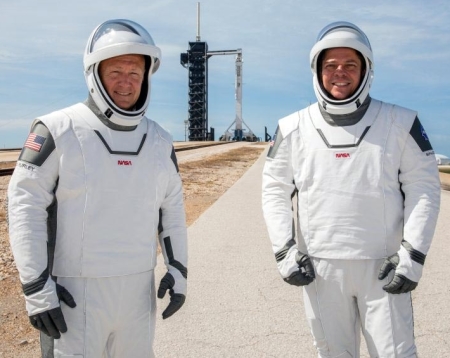
SpaceX president and chief operating officer Gwynne Shotwell [said] that she expects at least one to two launches per month in the near future, whether they be for customers or for SpaceX’s own internet-satellite constellation, Starlink. “And we are looking at a May timeframe to launch crew for the first time,” Shotwell continued. That launch, called Demo-2, will send NASA astronauts Bob Behnken and Doug Hurley to and from the International Space Station (ISS) aboard SpaceX’s Crew Dragon capsule.

At that pace SpaceX will complete between 12 to 24 launches for the year. They had predicted they would complete 21, so this is in line with that prediction.

1 comment

The last cargo Dragon to berth with ISS using robot arm

Astronauts yesterday used the robot arm on ISS to berth SpaceX’s cargo Dragon freighter, the last time a Dragon capsule will be berthed to the station in this manner.

The successful supply deliver marked the 20th time a SpaceX Dragon cargo capsule has arrived at the space station since May 2012. The mission, known as CRS-20 or SpaceX-20, also the final flight of SpaceX’s first-generation Dragon spacecraft, which the company is retiring in favor of a new Dragon capsule designed to dock directly with the space station without needing to be captured by the robotic arm.

I could put this another way that is more embarrassing to NASA. After twenty flights, the agency has finally admitted that SpaceX can design a spacecraft that can do automatic dockings, and is now willing to allow it.

That of course is a gross simplification. Nonetheless, the successful unmanned demo flight last year of SpaceX’s crew Dragon, docking directly with ISS, has proven SpaceX can do it. And since that crew Dragon is essentially the same design for SpaceX’s future cargo Dragons, it makes sense to shift from robot-arm-berthing to direct docking for all future Dragon flights.

3 comments

SpaceX raises $500 million for Starship, twice the amount planned

Capitalism in space: In a just completed fund-raising round, SpaceX raised twice the investment capital proposed, $500 million instead of $250 million.

These funds are in addition to the $1.33 billion raised previously. And according to the SpaceX official in charge of their Starlink satellite constellation, most of this money is not for Starlink:

While SpaceX expects it will cost about $10 billion or more to build the Starlink network, [vice president Jonathan] Hofeller said the company’s fundraising so far has largely not been directed to the Starlink division, as “we’ve been able to fund the development of Starlink primarily from our internal businesses.” He declared the company is in a “different position” in how it raises funds compared to other companies that are building satellite networks. “That’s why, in general, we’ve been very quiet about what we’re doing because we don’t need to go out and raise money for this particular venture,” Hofeller said.

This means the $1.83 billion raised is almost certainly all for developing Starship/Super Heavy.

Can SpaceX build this new heavy lift completely reusable rocket for that price? Considering that it cost them $500 million to develop Falcon Heavy, and that much of the engineering work from that will be applicable for the new rocket, I am willing to bet that they can.

My prediction is further reinforced by the company’s recent activities testing Starship’s tanks at Boca Chica, Texas. Only two weeks after a test to failure (resulting in some spectacular fireworks), the company has apparently successfully completed new tank tests on the next prototype.

In other words, they blew up a prototype, were able to clean up the mess, redesign what failed, and test it successfully, in only two weeks. To say such a pace would be impossible for NASA and its big space contractors like Boeing is probably the biggest understatement I’ve ever made.

This success should not make anyone think that the challenge of building Starship/Super Heavy will be easy or fast. This effort will be cutting edge engineering that in many ways will be beyond that edge. SpaceX is guaranteed to have further test failures along the way. Their pace, management approach, and track record however shows that the company knows how to deal with such issues, and will thus be able to proceed to completion.

17 comments

SpaceX successfully launches cargo Dragon to ISS

Capitalism in space: SpaceX tonight successfully launched a cargo Dragon freighter to ISS.

This is the third flight for this Dragon capsule. It was also the last flight of the company’s first generation Dragon capsules. The company also successfully landed the first stage, which was on its second flight. This was the fiftieth time they have successfully done this. I have embedded the launch video below the fold.

The leaders in the 2020 launch race:

4 China
4 SpaceX
2 Arianespace (Europe)
2 Russia

The U.S. now leads China 7 to 4 in the national rankings.
» Read more

4 comments

Axiom and SpaceX sign deal for flying commercial tourists to ISS

Capitalism in space: Axiom, the commercial company that already has an agreement with NASA to build its own commercial modules for ISS, has signed an agreement with SpaceX to use its crew Dragon capsule to ferry one professional and three tourists to ISS, as soon as the second half of 2021.

The private crew members will spend at least eight days on the orbiting research platform, allowing them to enjoy “microgravity and views of Earth that can only be fully appreciated in the large, venerable station,” Axiom said in a statement.

Axiom said Thursday it has signed a contract with SpaceX to transport a commander “professionally trained” by Axiom and three private astronauts to the space station on a Crew Dragon spacecraft. The mission could take off as soon as the second half of 2021, Axiom said.

This is SpaceX’s second commercial customer for its Dragon capsule. Two weeks ago it signed a deal with Space Adventures to fly four tourists on a crew Dragon for up to five days.

3 comments

Explosion during static fire test of SpaceX’s Starship-SN1 prototype

Capitalism in space: It appears that about two seconds into a static fire engine test tonight of SpaceX’s Starship-SN1 prototype, something went wrong, there was an explosion, the prototype suddenly lifted into the air and then crashed to the ground in a bigger explosion.

The video below shows the event three times. We shall have to await word from SpaceX as to what happened. So far it appears that no one was hurt.

23 comments

Falcon Heavy wins launch contract for NASA’s Psyche asteroid mission

Capitalism in space: NASA today awarded the launch contract for its Psyche asteroid mission, set to launch in July 2022, to SpaceX’s Falcon Heavy rocket.

The total bid price was $117 million, which according to the release includes “the launch service and other mission related costs.” Though this is higher than the normal price SpaceX charges for a Falcon Heavy launch ($100 million), it is far lower than the typical price of a ULA launch. Furthermore, Falcon Heavy has more power, so it can get the spacecraft to the asteroid faster.

0 comments

SpaceX proposing big launch rate increase in Florida

Capitalism in space: According to documents filed with the FCC, SpaceX is planning a big increase in the number of launches from its two launchpads in Florida in the next few years.

SpaceX projects performing 38 launches from Florida in 2020, 30 from SLC-40 and eight from LC-39A. By 2023, the company projects as many as 70 launches, 50 from SLC-40 and 20 from LC-39A, an annual rate that holds steady through 2025. The vast majority would be Falcon 9 launches, although it expects as many as 10 Falcon Heavy launches a year, all from LC-39A.

These numbers include both Dragon cargo and crew launches, Starlink satellite launches, and a variety of other commercial customers, including launches into polar orbits, something that in the past was reserved for Vandenberg on the west coast, not Florida. The launch estimates are also likely high, as they come from an environmental assessment. SpaceX probably wants to get clearance for this many launches, just in case things go far better than expected. They will likely do less, though I would not be surprised if the numbers are still record-setting.

In addition, the documents outline SpaceX’s plans to build a mobile launch tower to accommodate national security payloads that must be installed on their rocket vertically. Falcon Heavy could provide this service, but right now its payloads get installed horizontally.

0 comments

Starship moved to launch site

Capitalism in space: SpaceX’s Starship-SN1 prototype has been transported to its launch site at Boca Chica in preparation for a series of tests prior to its first launch hop, hopefully to a height of 12 miles.

Whether SN01 is still destined for flight, it’s safe to say that Starship SN01 tank testing could begin in a matter of days — SpaceX currently has early-morning roadblocks indicative of such testing scheduled from February 29th to March 2nd. SpaceX is likely to kick off by filling SN01 with water to check its tanks for leaks, followed by liquid nitrogen – chemically neutral but still incredibly cold. After that, SN01 would likely graduate to Raptor engine installation and a wet dress rehearsal (WDR) with liquid oxygen and methane before moving on to a static fire attempt, if all goes well.

I have embedded below the fold a fifteen minute video showing the transport operation. The pace is slow, so I suggest playing it at 2x normal speed, using the settings.

My immediate thought in watching this video is that SpaceX’s mobile transport vehicle certainly cost far less than the two mobile launchers NASA built for SLS (for a cost of about a billion dollars). In fact, SpaceX’s entire Starship development program will likely cost less than what NASA spent on just its mobile launchers.

» Read more

15 comments

SpaceX gets approval for Starship/Super Heavy factory in LA

Capitalism in space: Having abandoned plans to build its Starship/Super Heavy rocket factory at the Port of Los Angeles in 2019, SpaceX has changed its mind and now gotten approval for the factory from the LA City Council.

First announced in March 2018 and abandoned for about a year beginning in March 2019, SpaceX has refreshed plans to build giant rocket parts in a California port, simplifying aspects of the original proposal and relying heavily on the fact that steel is far easier to handle than carbon fiber. Now, the company wants to refurbish and repurpose a number of old abandoned buildings already present at Port of LA Berth 240, effectively replicating a somewhat smaller version of the Starship production facilities SpaceX is in the middle of building in South Texas.

With Los Angeles Harbor Commission and City Council approvals both safely in hand, SpaceX’s Port of LA Starship is now officially a question of “when”, not “if”. When the concept first popped back into the public discourse late last month, it came alongside a report from CNBC reporter Michael Sheetz that SpaceX wanted to start building Starship parts as few as 90 days after it reapproached Port officials.

The speed in which SpaceX is moving here is very typical for the company. Bodes well for real test flights both this year and next.

6 comments

NASA leaning towards long-duration flight for 1st Dragon mission

Capitalism in space: According to one former astronaut as well as a review of photos of the training being given to the astronauts who will fly on SpaceX’s first manned Dragon flight, this Space News article thinks that NASA will make that first flight a long-duration mission.

This Dragon demo mission is officially still planned as a short mission, no more than two weeks. To extend it requires additional training, which the photos appear to show, and would thus delay its launch by as yet an unspecified time period.

The article also cites a third reason NASA is now favoring the long-duration option: The issues with Boeing’s manned Starliner capsule:

Another factor in any decision to extend Demo-2 is the status of the other commercial crew vehicle, Boeing’s CST-100 Starliner. That vehicle flew an uncrewed test flight in December, but software problems during the flight, including one which shortened the mission and prevented a docking with the ISS, have raised questions about whether a second uncrewed test flight will be needed. An investigation into those problems is expected by the end of this month.

Even if NASA decides a second uncrewed test flight of Starliner is not needed, a review of all of the spacecraft’s one million lines of code, and other reviews, is likely to delay a crewed test flight of the spacecraft. NASA and Boeing had previously agreed to make that test flight a long-duration mission, with NASA astronauts Mike Fincke and Nicole Mann and Boeing astronaut Chris Ferguson performing space station training in addition to that for the Starliner itself.

The delay in Boeing’s long duration mission leaves a gap in the schedule for maintaining crews on ISS. Flying Dragon long-duration would help solve that.

11 comments

SpaceX seeking $250 million more in investment capital

Capitalism in space: According to anonymous sources, SpaceX is once again seeking more investment capital, this time totaling $250 million.

Last year the company raised $1.33 billion. While not as much as the personal cash that Jeff Bezos has raised for Blue Origin by selling his personal Amazon stock, it has been enough for SpaceX to accomplish far more. Not only is the company about to launch its first manned mission, it has quickly begun assembling its Starlink internet constellation in orbit, while pushing forward on Starship construction.

5 comments

SpaceX signs deal to fly four tourists on Dragon

Capitalism in space: SpaceX has signed a deal with the space tourism company Space Adventures to fly four tourists on a single crew Dragon flight.

The private spaceflight company founded by billionaire Elon Musk has signed an agreement with the U.S. space tourism company Space Adventures to launch up to four passengers on an orbital trip aboard a Crew Dragon space capsule. The mission would last up to five days and could launch as early as late 2021, Space Adventures representatives told Space.com.

The trip will not go to ISS, but remain free-flying in orbit.

Essentially, Space Adventures, which flew all its previous space tourists on Russian Soyuz capsules and has two more such flights scheduled in 2021 to ISS, is now adding the American company SpaceX to its staple. This gives them two places they can buy flights, which gives them some bargaining room to get prices down.

This is exactly what I hoped would happen if NASA stopped building spacecraft and instead bought its rides from privately built and owned capsules. Owned by SpaceX and built for profit, crew Dragon is not limited to only serving NASA’s needs. They can sell it to others to make more money. Here they are doing so.

I also would not be surprised if SpaceX reuses the Dragon capsules used on NASA flights for these tourist flights. NASA doesn’t want reused capsules, yet, so SpaceX will be accumulating once-used capsules capable of flying again. I bet they will use them here.

32 comments

SpaceX launches 60 more Starlink satellites; 1st stage landing fails

Capitalism in space: SpaceX this morning successfully launched sixty more Starlink satellites, raising the number in the constellation to 300.

However, though the launch was successful, the first stage, on its fourth flight, failed to land successfully on the drone ship in the Atlantic. Watching the live stream, it appeared from a whiff of smoke on the edge of the screen that the booster missed the target by only a short distance. This is the first time this has happened since 2015 2018 (correction from reader).

That this first stage landing failure is the news story illustrates how far they have come..

The standings in the 2020 launch race:

3 China
3 SpaceX
1 Arianespace (Europe)
1 Rocket Lab
1 Russia
1 Japan
1 ULA
1 Northrop Grumman

In the national rankings the U.S. now leads China 6 to 3.

9 comments

Dragon capsule for first manned mission shipped to Florida

Capitalism in space: SpaceX yesterday shipped to Florida the Dragon capsule it will use for its first manned mission, now set for sometime between April and June.

No official word yet on any specific launch date, though there are reports that they are targeting May 7.

In that same story at the second link a NASA official admitted that one of the big issues is filling out the paperwork.

“Even though it sounds mundane, there is a load of paper that has to be verified, and signed off, and checked to make sure we’ve got everything closed out,” [said chief of human spaceflight Doug Loverro.] “It is probably one of the longest things in the tent to go ahead and do. It’s underappreciated but critically important. You’ve got to make sure you’ve done everything you need to do along the way.”

Properly documenting what you are doing is always essential, but if you over do it you raise costs unnecessarily while simultaneously delaying things. And isn’t it interesting that both of these issues — budget overruns and scheduling delays — have been systemic on all of NASA’s projects for decades?

Furthermore, while good documentation can help prevent problems and help you figure out what went wrong, when things go wrong, doing more of it will not further reduce problems or failures. If anything, too much paperwork will likely increase mistakes by focusing workers on the wrong things. This seems to be one of NASA’s problems in recent years.

Regardless, it does look like that first privately built launch will happen in mere months. The one decision remaining that could legitimately delay it would be if NASA decides to make it a longer mission, requiring more training for its astronauts.

12 comments

SpaceX hires Bill Gerstenmaier as consultant

SpaceX has hired NASA’s former manager of its human exploration program, Bill Gerstenmaier, as a consultant working with their “reliability team.”.

It appears that SpaceX wants to take advantage of Gerstenmaier’s expertise on human spaceflight as it is about to begin manned Dragon flights. It also appears that Musk wants to return a favor as well, as Gerstenmaier was likely the main person behind the decision to award SpaceX its initial Dragon cargo contract in December 2008. Musk has said repeatedly that this decision in many ways saved his company.

Overall, a wise decision by SpaceX. In his later years at NASA, Gerstenmaier lost sight of the importance of budget and schedule in his management of SLS and Orion, leading to his ouster. However, his knowledge of human spaceflight and the political mechanics needed to do it with NASA is unsurpassed. SpaceX will definitely benefit from this hire.

7 comments
1 84 85 86 87 88 141