No sunspots for the first time in two years

For the first time since July 17, 2014, and only the second time since 2011 at the beginning of the solar maximum, the Sun was blank today, with no sunspots visible on its surface.

I expect the next monthly update of the solar cycle will arrive early next week, and though I expect it will show a slight increase during the past month, it will also show that the ramp down to solar minimum is continuing unabated.

0 comments

Computer simulation models Sun’s magnetic field during grand minimum

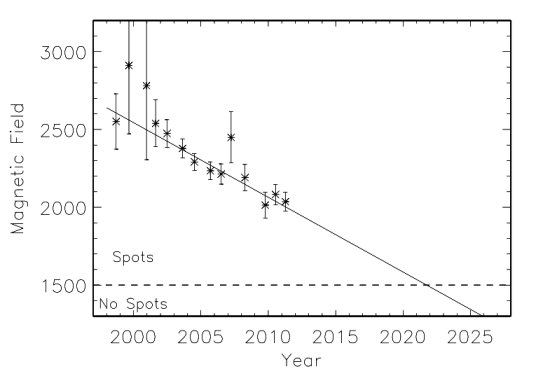
The uncertainty of science: A computer simulation, run for six months on a supercomputer, suggests that during grand minimums in the Sun’s solar cycle, when there are no sunspots for decades, its magnetic field remains strong but descends into the star’s interior.

I think this statement by the leader of the science team is most informative:

‘The Sun as such is impossible to replicate on present-day computers – or those of the near future – due to its strong turbulence. And indeed we are not claiming that this modelling would really be the Sun. Instead, it is a 3D construction of various solar phenomena by means of which the star that runs our space climate can be better understood,’ Käpylä explains.

6 comments

Sunspot activity crashes

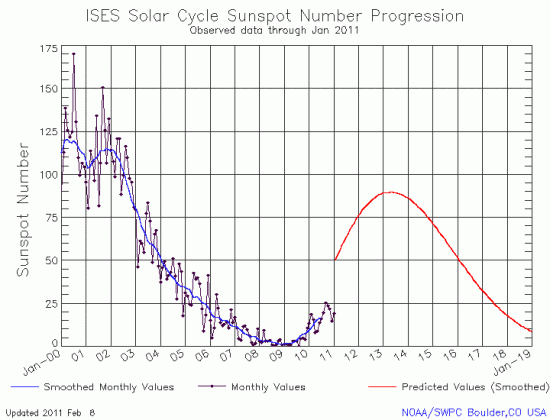
The monthly NOAA update of the solar cycle was released yesterday, showing the Sun’s sunspot activity in April. It is annotated and posted below.

April 2016 Solar Cycle graph

The graph above has been modified to show the predictions of the solar science community. The green curves show the community’s two original predictions from April 2007, with half the scientists predicting a very strong maximum and half predicting a weak one. The red curve is their revised May 2009 prediction.

After four months of steady decline matched exactly with the low prediction from 2007 (the lower green line curve), in April sunspot activity plummeted to the lowest level seen since January 2011.

This decline shouldn’t surprise anyone. The now ending solar maximum has been the weakest in a century and, as noted here, it is now more than a year since the last X-class solar flare, the most powerful kind, with this solar maximum seeing only 45 X-class events, compared to 126 during the previous solar maximum.

As I have noted repeatedly, the big question now is what will happen during the next solar cycle. Will we get another weak solar cycle or will the sun’s sunspot activity recover? Or will sunspots vanish and will the sun enter a grand minimum, with no sunspots for decades? At the moment no one knows, though some solar scientists favor the latter.

2 comments

Pluto’s solar wind interaction more like a planet’s

Data from New Horizons has found that Pluto, in its interaction with the solar wind, behaves more like a planet than a comet.

Previously, most researchers thought that Pluto was characterized more like a comet, which has a large region of gentle slowing of the solar wind, as opposed to the abrupt diversion solar wind encounters at a planet like Mars or Venus. Instead, like a car that’s part gas- and part battery-powered, Pluto is a hybrid, the researchers say. “This is an intermediate interaction, a completely new type. It’s not comet-like, and it’s not planet-like. It’s in-between,” McComas said. “We’ve now visited all nine of the classical planets and examined all their solar wind interactions, and we’ve never seen anything like this.”

…Pluto continues to confound. Since it’s so far from the sun – an average of about 5.9 billion kilometers (3.7 billion miles) – and because it’s so small, scientists thought Pluto’s gravity would not be strong enough to hold heavy ions in its extended atmosphere. But, “Pluto’s gravity clearly is enough to keep material sufficiently confined,” McComas said. Further, the scientists found that very little of Pluto’s atmosphere is comprised of neutral particles converted to electrically charged ions and swept out into space.

As I’ve written previously, we simply don’t know enough yet about planets to come up with a reasonable definition. As far as I’m concerned, Pluto will remain a planet until we do.

3 comments

The sunspot decline continues

NOAA’s monthly update of the solar cycle was released today, showing the Sun’s sunspot activity in March. It is annotated and posted below.

March 2016 Solar Cycle graph

The graph above has been modified to show the predictions of the solar science community. The green curves show the community’s two original predictions from April 2007, with half the scientists predicting a very strong maximum and half predicting a weak one. The red curve is their revised May 2009 prediction.

For the fourth month in a row the change in the graph is so small you almost need a magnifying glass to see it. Despite this, the decline remains remarkably steady, tracking precisely the decline predicted by the low prediction of the 2007 predictions (indicated by the smaller green line curve).

Recently the number of sunspots has dropped enough that I suspect we are not far the moment when we will once again begin to see days where the Sun is blank of sunspots, a situation last seen in 2010 near the end of the previous solar minimum. When that happens, it will herald the beginning of the next solar minimum.

6 comments

Monthly Solar Cycle update

NOAA released on Monday its monthly update of the solar cycle, showing the Sun’s sunspot activity in February. I am once again posting it here on Behind the Black, as I have done monthly since 2010.

February 2016 Solar Cycle graph

The graph above has been modified to show the predictions of the solar science community. The green curves show the community’s two original predictions from April 2007, with half the scientists predicting a very strong maximum and half predicting a weak one. The red curve is their revised May 2009 prediction.

The change in this month’s graph is so small that you will have to look real close to see it. Essentially, the February sunspot activity dropped only a tiny amount from January’s numbers, though it did drop. As such the decline from solar maximum continues to track perfectly the decline predicted by the low prediction of the 2007 predictions. This prediction success should not be taken very seriously, however, since that same prediction expected the solar maximum to begin two years earlier than it actually did.

0 comments

Big solar storm not so big

The uncertainty of science: A new analysis of the the 1859 giant solar storm, the first ever detected and dubbed the Carrington event after the scientist who discovered it, suggests that its strength was not global as previously believed, and that it only effected a few spots on Earth.

Up until now the Carrington event has been considered the strongest solar storm to ever hit the Earth, and has been used by the solar satellite industry as a wedge to demand funding for solar warning satellites, claiming that if a similar storm was to ever hit the Earth again without warning, it would destroy civilization as we know it. This new data suggests that this threat has been over-stated.

Why am I not surprised?

1 comment

The long decline to solar minimum

On Monday NOAA released its monthly update of the solar cycle, showing the Sun’s sunspot activity in January. As I have done every month since 2010, I am posting it here with annotations to give it context.

What strikes me about this month’s continuing and steady decline in sunspots is how much it illustrates the long and steady nature of the ramp down to solar minimum, even for cycles that are very active. If you look at the ramp down during the previous solar cycle on the graph below the fold, it took four full years to reach solar minimum from a comparable sunspot level to what we have today.
» Read more

4 comments

Sunspot decline continues

NOAA’s monthly update of the solar cycle, showing the Sun’s sunspot activity in December, was posted earlier this week, and I am posting it here, as I do every month, with annotations to give it context.

The decline in sunspots continues, tracking closely the rate of decline predicted by the 2007 and 2009 predictions (the lower green curve and the red curve) but the overall solar maximum has been far shorter and less powerful than predicted.
» Read more

0 comments

Solar ramp down jumps slightly

My original post about NOAA’s October update to its monthly tracking of the Sun’s sunspot cycle contained an incorrect graph. For reasons I do not understand, the first graph they posted did not include the data for September, thus creating for me the illusion that little had changed in September. I am now posting the correct graph here, below the fold, with annotations to give it context.

In September numbers showed a slight jump in sunspot activity, though once again nothing so significant as to change the overall trends. Moreover, the correction doesn’t change what I wrote previously in any way: the rate of decline seems to have transitioned down from the 2009 prediction (red curve) to the 2007 weak prediction (lower green curve). This doesn’t real mean much, as the sunspot number can still vary up and down considerable before we reach solar minimum in two or three years.

» Read more

0 comments

Ramp down in sunspots continues

Correction! For reasons I do not understand, the graph below, originally posted on the NOAA website, was incorrect and was changed several days after I posted my piece below. See this post for the correct graph and analysis.

The uncertainty of science: On Monday NOAA posted its monthly update of the solar cycle, showing the Sun’s sunspot activity in September. Once again I post it here, below the fold, with annotations to give it context.

For the third month in a row the sunspot count dropped a tiny amount, lingering at about the same number as the previous two months. Moreover, the rate of decline seems to have transitioned down from the 2009 prediction (red curve) to the 2007 weak prediction (lower green curve). This doesn’t real mean much, as the sunspot number can still vary up and down considerable before we reach solar minimum in two or three years.

» Read more

0 comments

Decline to solar minimum

Last week NOAA posted its monthly update of the solar cycle, showing the Sun’s sunspot activity in August. As I have done every month since 2010, I am posting it here, below the fold, with annotations to give it context.

The sunspot count continued its decline, though dropping only a small amount. Regardless, the decline continues at a rate far faster than predicted or is usual during the ramp down from solar maximum. If this rate of decline should continue, we will reach solar minimum sometime late in 2017, two years earlier than predicted (as indicated by the red curve).

» Read more

3 comments
1 15 16 17 18 19 32