China’s Long March 5 rocket successfully launches

In what appeared to be a picture perfect launch, China’s most powerful rocket, the Long March 5, successfully placed a test communications satellite into orbit.

This success follows two previous launch failures in 2016 and 2017, and a redesign of the rocket’s first stage engines that caused a two year delay in China’s space program. It now opens the door for China’s entire manned and planetary program, as they require the Long March 5 (or variations thereof) to lift their space station modules and all their planetary probes. I have embedded an english broadcast of the launch below the fold. The launch is about 54:00 minutes in.

The leaders in the 2019 launch race:

32 China
21 Russia
13 SpaceX
8 Arianespace (Europe)

China now leads the U.S. 32 to 27 in the national rankings.

At this point there is only remaining one launch for this year that is publicly scheduled, from Russian.
» Read more

1 comment

Landslide primary win for Netanyahu

In a primary election today for the leadership of the conservative Israeli Likud Party, in advance of another general election on March 2nd, Benjamin Netanyahu won a landslide victory over his party challenger.

The primary election saw 49% of all Likud party members show up to vote in spite of the stormy weather, a slight increase over the last time a primary election was held by the Likud. Of the nearly 60 thousand people that cast a ballot, 72.5% did so for the incumbent Netanyahu and 27.5% for his challenger Gideon Sa’ar.

Netanyahu’s win was expected, but the landslide proportions of it were not and thus the primary challenge itself had most assuredly worked to Netanyahu’s advantage. It reaffirmed his complete hold over the Likud party and gave him a reason to re-energize his base ahead of the March 2nd general election.

While the article touts the election victory as an indication that Likud’s position is strong in the coming election, I would not be so sure. This is the third general election in Israel in less than a year, all because the voters have refused to chose a clear leader. Though they have favored the conservative parties, those parties have not been able to form a government because one party refuses to join a coalition that includes the orthodox religious parties.

Meanwhile, Netanyahu faces a court fight, as he is under indictment and there is the possibility that the high court in Israel will rule that under those conditions he cannot form a government.

0 comments

China has a shortfall of jet engines

Apropos of the engine problems on the Long March 5, it is reported today that China has a serious manufacturing shortage of the jet engines it needs for its new stealth fighters and bombers.

Aviation website Alert 5 spotted a stock-exchange filing by the Hebei subsidiary of China’s Central Iron & Steel Research Institute. The filing including production projections for military engines for the next decade, and reveals some startling shortfalls. Production and development gaps could result in the latest Chinese warplanes flying with older engine models, including imported Russian motors that might be underpowered and unreliable. The mismatch between airframes and engines could be a drag on the overall performance of Chinese military aircraft.

Perhaps the biggest shortfall is in the production of WS-15s and WS-19s, the custom motors respectively for J-20 stealth fighters and FC-31 export stealth fighters. “Data provided by Hebei Cisri Dekai Technology Co. Ltd. shows a maximum of only five WS-15 and WS-19 engines each year from 2020 ‘til 2026,” Alert 5 reported.

Apparently China will be flying these jets and bombers using inadequate Russian engines for the next five to eight years, as the country’s own industry seems unable to make them.

9 comments

A minor eruption on the Sun

How about another cool image, this time a movie taken by Solar Dynamics Orbiter (SDO) back in August 13, 2018 of what they call a minor eruption on the surface of the Sun.

Because the movie is a somewhat large file, I have embedded it below the fold. Or you could go here to see a higher resolution version. This is the description by the SDO science team:

This close-up of the Sun from a two-hour period on Aug 13, 2018 shows a minor eruption of charged particles rising up and twisting about before falling back into the Sun. Imaged in extreme ultraviolet light, these kinds of events are difficult to see except when they occur along the sun’s edge, also known as the limb. At its peak the plasma rises several times the diameter of Earth. [emphasis mine]

» Read more

2 comments

Giant scallops on Mars

Scallops on Mars
Click for full image.

It’s a slow news week, with the too much partying only real space news today the expected third launch of China’s Long March 5 rocket (supposedly scheduled for this morning but so far no word). (To my gentle reader: For some reason I have been losing a day during this whole week, always thinking that Christmas was on Thursday and that today was Friday. Thus my error in thinking the Long March 5 flight was today. It is tomorrow morning. Forgive me for my absent-mindedness.) So let’s look at a cool image!

The photo on the right, cropped and reduced to post here, was taken my the high resolution camera on Mars Reconnaissance Orbiter (MRO) on October 8, 2019. Entitled “Scalloped Depressions in Utopia Planitia,” it shows a strangely eroded surface in the northern lowlands of Mars, where an intermittent ocean might have once existed.

The location of these scallops is shown to the right.

Location of scallops in Utopia Planitia

I have taken the same overview map used from two recent cool image posts, showing how these scallops relate in location to the strange crater in Utopia Planitia as well as the glacial-surrounded mesa in Protonilus Mensae.

In caves, scallops like this form from water or wind flow, but when they do, they are all oriented the same way. Here the scallops are at different orientations, terracing down from the center of the image. In this case it appears that scientists believe [pdf] the formation process is related to the sublimation of underground ice at this location.

According to [one hypothesis] scallop formation should be ongoing at the present time. Sublimation of interstitial ice could induce a collapse of material, initially as a small pit, then growing southward because of greater solar heating on the southern side. Nearby scallops would coalesce together as can be seen to have occurred.

What is most cool is that the geologists think the process that forms these scallops is related to the same processes that cause the formation of the swiss cheese landforms in the south polar regions.

1 comment

A Christmas Carol

An afternoon pause: As I have done for several years on Christmas day, I bring you the classic 1951 version of Charles Dickens’ A Christmas Carol, starring Alastair Sim. To my mind this movie is still by far the best adaption of the book. It is also a truly wonderful movie.

As I wrote last year,

Dickens did not demand the modern version of charity, where it is imposed by governmental force on everyone. Instead, he was advocating the older wiser concept of western civilization, that charity begins at home, that we as individuals are obliged as humans to exercise good will and generosity to others, by choice.

It is always a matter of choice. And when we take that choice away from people, we destroy the good will that makes true charity possible.

Enjoy, and have a Merry Christmas!

3 comments

Repost: The real meaning of the Apollo 8 Earthrise image

I wrote this essay last year, to celebrate the fiftieth anniversary of the Apollo 8 mission to the Moon. I think it worth reposting, especially because stories about Apollo 8 still refuse to show the Earthrise image as Bill Anders took it. Note that they took the picture on Christmas Eve, not Christmas day.
———————————————
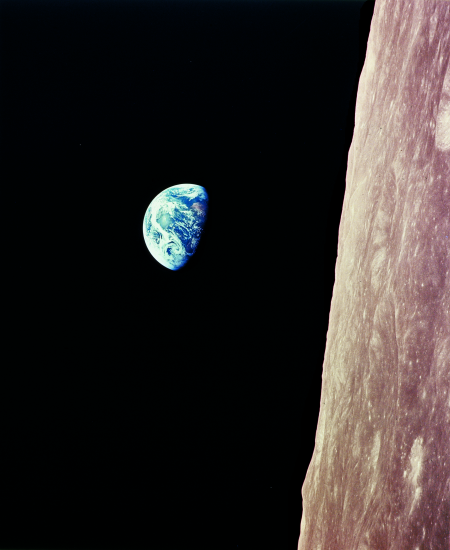
Earthrise, as seen by a space-farer

Today is the fiftieth anniversary of the moment when the three astronauts on Apollo 8 witnessed their first Earthrise while in orbit around the Moon, and Bill Anders snapped the picture of that Earthrise that has been been called “the most influential environmental picture ever taken.”

The last few days have seen numerous articles celebrating this iconic image. While all have captured in varying degrees the significance and influence of that picture on human society on Earth, all have failed to depict this image as Bill Anders, the photographer, took it. He did not frame the shot, in his mind, with the horizon on the bottom of the frame, as it has been depicted repeatedly in practically every article about this image, since the day it was published back in 1968.

Instead, Anders saw himself as an spaceman in a capsule orbiting the waist of the Moon. He also saw the Earth as merely another space object, now appearing from behind the waist of that Moon. As a result, he framed the shot with the horizon to the right, with the Earth moving from right to left as it moved out from behind the Moon, as shown on the right.

His perspective was that of a spacefarer, an explorer of the universe that sees the planets around him as objects within that universe in which he floats.

When we here are on Earth frame the image with the horizon on the bottom, we immediately reveal our limited planet-bound perspective. We automatically see ourselves on a planet’s surface, watching another planet rise above the distant horizon line.

This difference in perspective is to me the real meaning of this picture. On one hand we see the perspective of the past. On the other we see the perspective the future, for as long humanity can remain alive.

I prefer the future perspective, which is why I framed this image on the cover of Genesis: the Story of Apollo 8 the way Bill Anders took it. I prefer to align myself with that space-faring future.

And it was that space-faring future that spoke when they read from Genesis that evening. They had made the first human leap to another world, and they wished to describe and capture the majesty of that leap to the world. They succeeded beyond their wildest dreams.

Yet, they were also still mostly Earth-bound in mind, which is why Frank Borman’s concluding words during that Christmas eve telecast were so heartfelt. He was a spaceman in a delicate vehicle talking to his home of Earth, 240,000 miles away. “And from the crew of Apollo 8, we close with good night, good luck, a Merry Christmas, and God bless all of you — all of you on the good Earth.” They longed deeply to return, a wish that at that moment, in that vehicle, was quite reasonable.

Someday that desire to return to Earth will be gone. People will live and work and grow up in space, and see the Earth as Bill Anders saw it in his photograph fifty years ago.

And it is for that time that I long. It will be a future of majesty we can only imagine.

Merry Christmas to all, all of us still pinned down here on “the good Earth.”

8 comments
1 2 3 4 156