FAA required SpaceX to up its insurance for Starhopper test

The FAA’s office that regulates commercial space required SpaceX to increase its insurance coverage for this week’s Starhopper test to $100 million, thirty three times higher than their coverage for the previous Starhopper hops.

Lots of information at the link, though in summary it all makes perfect sense.

There are a number of likely reasons the federal regulator required SpaceX to boost its insurance coverage, says George Nield, a former FAA associate administrator who led its Office of Commercial Space Transportation (OCST) for more than a decade.

One is that Tuesday’s launch took Starhopper hundreds of feet higher than in July; during the prior flight, SpaceX’s vehicle only went about 60 feet (18 meters) up before landing. “The higher you want to go, the more propellant you’re going to have to load, and the more propellant you load, the bigger the boom if it were to explode,” Nield told Business Insider prior to Tuesday’s launch.

More importantly, their Boca Chica launch site is only a mile and a half from a small village of about twenty people, much closer than any other launchpad in the world. How SpaceX will manage this issue should they wish to test fly their fullscale Starship prototype from this site I really do not know. It could be that they won’t, and will confine all test flights to Kennedy, where they are also building a second Starship prototype.

2 comments

Kennedy Space Center prepares for hurricane

In preparation for the possibility of Hurricane Dorian’s arrival next week, the Kennedy Space Center is shutting down, including moving the giant mobile launcher vehicle, with the SLS launch tower on it, indoors to protect both.

The agency on Wednesday moved its hulking Apollo-era crawler-transporter out to Launch Complex 39B in order to bring the massive Mobile Launcher inside for the storm. That deployment must be made promptly because the crawler-transporter travels at just 1 mph (1.6 km/h).

The launch tower itself is 400 feet (122 meters) tall, which makes it a clear hazard in the high winds of a hurricane. NASA decided today (Aug. 29) that Dorian is threatening enough to merit moving the launch tower into Kennedy’s cavernous 52-story Vehicle Assembly Building for safety.

Their caution makes sense. Expect NASA to also announce that this two week delay in work will cause them several months more in delays to the SLS program. That has been their pattern over the years.

3 comments

ISS atmosphere issue?

Though NASA and Roscosmos both say the crews are in no immediate danger, alarms on ISS have indicated an issue with the oxygen levels on the station.

“The crew and the space station are in no immediate danger and are continuing normal operations,” the spokesperson said. “The overall atmosphere inside the station remains will below the O2 concentration limits. Teams are working to identify the root cause of the issue,” he added.

This report states that the problem is “the high oxygen content in the air in the Russian Zvezda module.”

If the problem was a drop in atmospheric pressure, the issue would likely be more serious, and suggest a repeat of the 2018 leak caused by a hole drilled in a Soyuz capsule. That the problem instead is high oxygen levels, suggests something more benign.

0 comments

OSIRIS-REx’s four candidate landing sites

The OSIRIS-REx engineering team has released a short video that flies over in close-up, showing the spacecraft’s four candidate sites on the asteroid Bennu, one of which will be where they will do a touch-and-go sample grab.

They continue to accumulate data on the four sites, all of which pose issues and risks because of nearby boulders and the looseness of Bennu’s rubble pile make-up.

Though all the sites are being considered, my sources in the industry suggest that the two dubbed Sandpiper and Nightingale are being favored. I like Osprey, because it is inside a crater and looks clear, but then, what do I know?

0 comments

Russia’s Rockot launches military geodesic satellite

Russia today used its re-purposed ballistic missile, Rockot, to launch the second in a two-satellite constellation of military geodesic satellites, designed to more accurately map the Earth’s gravitational field.

This launch puts Russia in the lead in the annual race for most launches for the first time since 2018. It also gives them more launches for the year than they had predicted. Both facts demonstrate that their launch industry is showing a recovery from the problems experienced in 2016, when they discovered corruption in one of their main rocket engine companies, requiring the recall of all engines.

The leaders in the 2019 launch race:

14 Russia
13 China
10 SpaceX
6 Europe (Arianespace)
4 India
4 Rocket Lab
4 ULA

The U.S. still leads Russia in the national rankings, 19 to 14.

0 comments

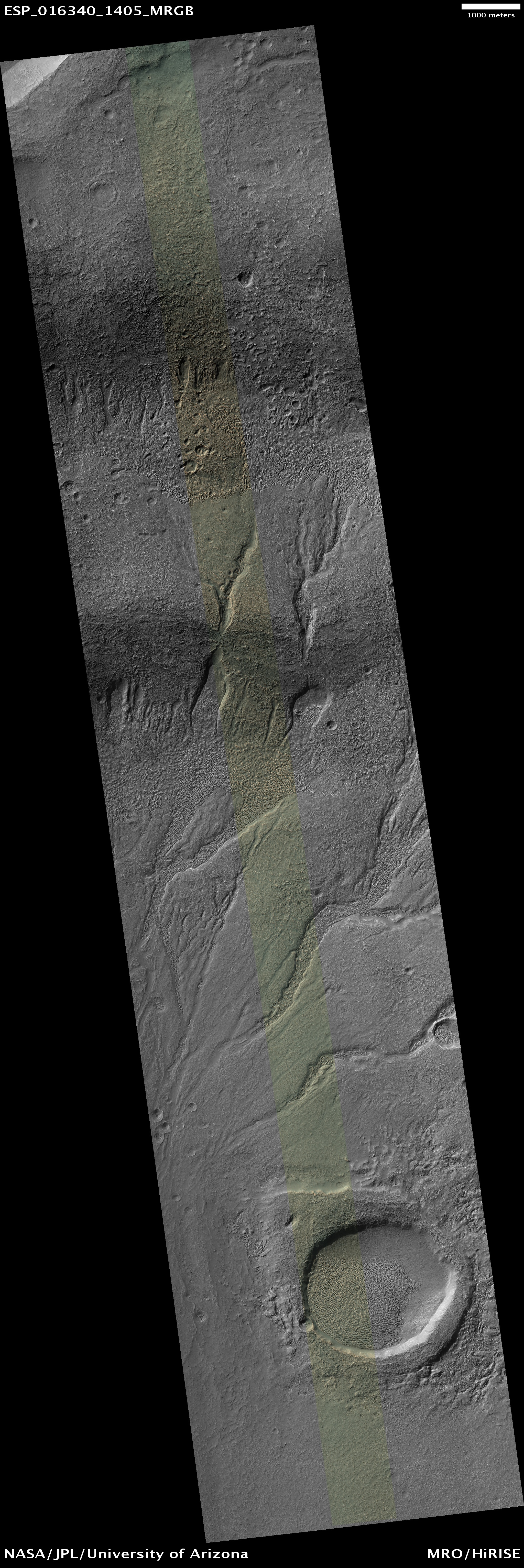
Cliff collapse on Mars

Cliff collapse on Mars
Click for full image.

Cool image time! The photograph to the left, rotated, cropped, and reduced to post here, was found in the August image release of the high resolution camera on Mars Reconnaissance Orbiter (MRO).

This was an uncaptioned image, with a title “Cataract and Grooves in Kasei Valles.” Kasei Valles is the giant canyon north of Marineris Valles. Though it is not as well known or maybe as dramatic, it is about as long and vast as its more famous southern canyon. It also has some very intriguing features, including what I consider to so far be the pit on Mars with the highest priority for exploration.

The image on the right shows the result when a giant section of this cliff face broke off and collapsed into the canyon. It also shows that the collapse occurred a long time ago. Not only are there newer craters on the collapse debris, the breakdown at the cliff base looks well eroded, as if many eons have passed since it piled up there.

When this section broke off however it was a very big event. The width of the collapse is about a mile across, with its depth about 600 feet. The height of the cliff is approximately 3000 feet, give or take a few hundred feet. Thus the chunk that broke off was about 600 feet wide, 5,000 feet long, and about 3,000 feet high. That’s one very big rock.

0 comments

Apparent Iran launch failure

Just released satellite photos showing fire and smoke at an Iranian launchpad suggest that a rumored attempt by Iran this week to launch a satellite into orbit resulted instead in a launchpad failure.

[S]atellite images by Planet Labs Inc. showed a black plume of smoke rising above a launch pad there, with what appeared to be the charred remains of a rocket and its launch stand. In previous days, satellite images had shown officials there repainted the launch pad blue.

On Thursday morning, half of that paint apparently had been burned away. “Whatever happened there, it blew up and you’re looking at the smoldering remains of what used to be there,” said David Schmerler, a senior research associate at the Middlebury Institute of International Studies.

Schmerler told The Associated Press that the images of the space center suggested that the rocket either exploded during ignition or possibly briefly lifted off before crashing back down on the pad.

In July Iranian officials had said they would do three launches this year, with a communications satellite launch expected before the end of the summer. It would appear that this failure is of that launch.

6 comments

Space Command to launch today

The military today will initiate a new military office dubbed the Space Command, thereby consolidating its space operations into one office.

U.S. Air Force Gen. John Raymond will serve as the first head of Space Command (SPACECOM). At launch, Raymond will lead 87 active units handling operations such as missile warning, satellite surveillance, space control and space support, Gen. Joseph Dunford said at a meeting of the National Space Council earlier this month.

The rest of the linked article is focused on the politics of Trump’s desire to turn this command into a new branch of the military, a Space Force, while facing opposition in Congress and the Pentagon. The goal however from the beginning was to end the scattershot nature of the military’s space bureaucracy, and it appears, on the surface, that the Space Command has done this.

Whether things stand as they are however is doubtful. Creating a new military branch is a wonderful opportunity for Washington power-brokers to find ways to spend money. For example, some estimates have said that the new Space Force could cost $1 to $2 billion more. You think these thieves and crooks in Washington will be able to resist that?

Of course, there really is no reason for this new agency to cost so much extra. In fact, the Space Command as created now probably adds nothing to the budget, and in fact probably has the chance to save money. And it even makes the military’s space operations more robust and efficient.

I therefore expect the powers-that-be in Washington to move to change that.

1 comment

Comey skips free

The law is only for little people: Despite a damning Justice Deparment inspector general report that concluded that James Comey had violated the law and broke FBI rules by leaking classified information when he was FBI director, the Justice Department has decided not to prosecute him.

“We conclude that Comey’s retention, handling, and dissemination of certain Memos violated Department and FBI policies, and his FBI Employment Agreement,” reads DOJ watchdog head Michael Horowitz’s report.

The watchdog office said Comey broke FBI rules by giving a memo containing unclassified information to his friend Daniel Richman with instructions to share the contents with a reporter. The office also said Comey failed to notify the FBI after he was fired that he had retained some of the memos in a safe at home. Comey wrote a series of memos about conversations with President Trump he said unnerved him. Comey has stated he wanted to make a record of the interactions because he was concerned President Trump might later lie about them.

Attorney General William Barr will not prosecute the fired FBI director over his wrongdoings.

We are no longer a nation of laws, but of corrupt power and banana republic backroom deals. By aligning himself with the Democratic Party, Comey has obtained that get-out-of-jail card that all Democrats hold. No matter what laws they break, no one in Washington will ever prosecute them, especially if they are in positions of power and are popular commentators on mainstream liberal press outlets like CNN.

Be a Republican, or a conservative, or even an ordinary citizen, however, and be prepared for the entire legal book to be thrown at you instantly, should you even jaywalk.

16 comments

NASA Inspector General to Congress: Free Europa Clipper from SLS

In a letter to Congress on August 27, 2019, NASA’s inspector general has called for Congress to immediately abandon the legal requirement it imposed on Europa Clipper to fly on NASA’s SLS rocket, thereby allowing NASA to choose any commercial rocket to launch the spacecraft.

The letter [pdf] is amazingly blunt.

[W]e write to highlight an issue at NASA that we believe requires immediate action by Congress. Language in NASA’s appropriation legislation requires the Agency to launch a satellite to Europa, a moon of Jupiter, in 2023 on the yet-to-be-completed Space Launch System (SLS) rocket. However, because of developmental delays and, more significantly, NASA’s plans to use the first three SLS rockets produced for its Artemis lunar program, an SLS will not be available until 2025 at the earliest. Consequently, if completed on its projected schedule, the approximately $3 billion dollar Europa spacecraft (known as “Europa Clipper”) will need to be stored for at least 2 years at a cost of $3 to $5 million per month until an SLS becomes available. NASA recently added $250 million in Headquarters-held reserves to the project to address these storage and related personnel costs.

Congress could reduce risks to both the Europa mission and Artemis program while potentially saving taxpayers up to $1 billion by providing NASA the flexibility in forthcoming fiscal year (FY) 2020 appropriations legislation to determine the most cost effective and timely vehicle to launch the Europa Clipper mission in 2023 or whenever the satellite is completed.

As blunt as the letter is, the wording above is also very careful to hide the fact that the $1 billion savings will come, not from avoiding the launch delay, but from buying a private commercial launch vehicle (estimated launch cost about $100 million) versus using SLS (estimated launch cost of $1 billion to $4 billion).

Will Congress take this advice? It should, though I am pessimistic. Our Congress has not shown much interest in doing the smart thing when it comes to SLS for about a decade. Why should things change now?

1 comment
1 47 48 49 50 51 156