NASA’s choice of Starship proves government now fully embraces capitalism in space

Five years ago, before Donald Trump had even announced he was running for president, before Elon Musk had proposed his Starship/Superheavy rocket, and even before SpaceX had successfully begun to dominate the launch market, Jerry Hendricks at the Center for for New American Security (CNAS) asked me to write a policy paper on the state of the American launch industry, providing some background and more importantly, some recommendations that policy makers in Washington, dependent on that launch industry, could use as guidance in the coming years.

CNAS is a Washington, D.C., think tank that was founded in the middle-2000s by two political Washington insiders, one a Democrat and the other a Republican, with a focus on foreign policy and defense issues and the central goal of encouraging bi-partisan discussion. Hendricks’ area of focus was defense and aerospace matters, and at the time he thought the changes being wrought by SpaceX’s with its partly reusable Falcon 9 rocket required in-depth analysis. He had heard my many reports on this subject on the John Batchelor Show, and thought I could provide him that analysis.

The result was my 2017 policy paper, Capitalism in Space: Private Enterprise and Competition Reshape the Global Aerospace Launch Industry. In it I reviewed and compared what NASA had been getting from its parallel rocket programs, the government-designed and owned Space Launch System (SLS) rocket versus the privately-designed commercial rockets of SpaceX and Orbital ATK (now part of Northrop Grumman). That review produced this very simple but starkly revealing table:
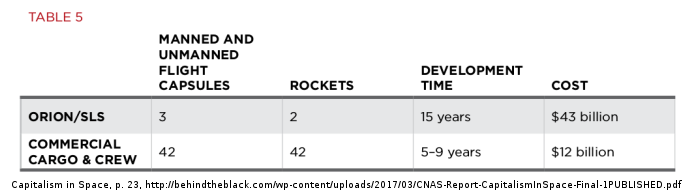
SLS vs Commercial space

From this data, combined with my extensive knowledge as a historian of American history and culture, resulted in the following fundamental recommendations:
» Read more

13 comments

Study: U.S. mortality rates suggest background radiation actually beneficial

The uncertainty of science: According to a new study by researchers at Ben-Gurion University in Israel of mortality rates across the entire United States, people that live in regions of higher background radiation have lifespans on average 2.5 years longer.

Background radiation is an ionizing radiation that exists in the environment because of natural sources. In their study, BGU researchers show that life expectancy is approximately 2.5 years longer among people living in areas with a relatively high vs. low background radiation. Background radiation includes radiation emanating from space, and radiation from terrestrial sources. Since the 1960s, there has been a linear no-threshold hypothesis guiding policy that any radiation level carries some risk. Hundreds of billions of dollars are spent around the world to reduce radiation levels as much as possible.

…According to BGU Professors Vadim Fraifeld and Marina Wolfson, along with Dr. Elroei David of the Nuclear Research Center Negev, lower levels of several types of cancers were found when the radiation levels were on the higher end of the spectrum rather than on the lower end. Among both men and women, there was a significant decrease in lung, pancreatic, colon and rectal cancers. Among men, there were additional decreases in brain and bladder cancers. There was no decrease in cervix, breast or prostate cancers or leukemia.

Their data “covered the entire US population of the 3139 US counties, encompassing over 320 million people,” according to their paper’s abstract.

Up until now the assumption has been that any radiation is bad, based not on research but on assumptions gained by the negative consequence of exposure to high radiation. There has been no good data on the consequences of low level background radiation, because it is so hard to gather. The time frames are long and the numbers small, all of which causes the impact of background radiation to be overwhelmed by other factors. This study’s statistical use of the entire U.S. population is an attempt to overcome these obstacles.

This study is statistical, which means it found a correlation between higher radiation and longer lifespans. Correlation however does not prove causation. The study found no direct evidence that humans health benefits from background radiation. We should therefore take these results with a large grain of salt.

At the same time, their extremely large database is quite telling, and adds some weight to their conclusion.

9 comments

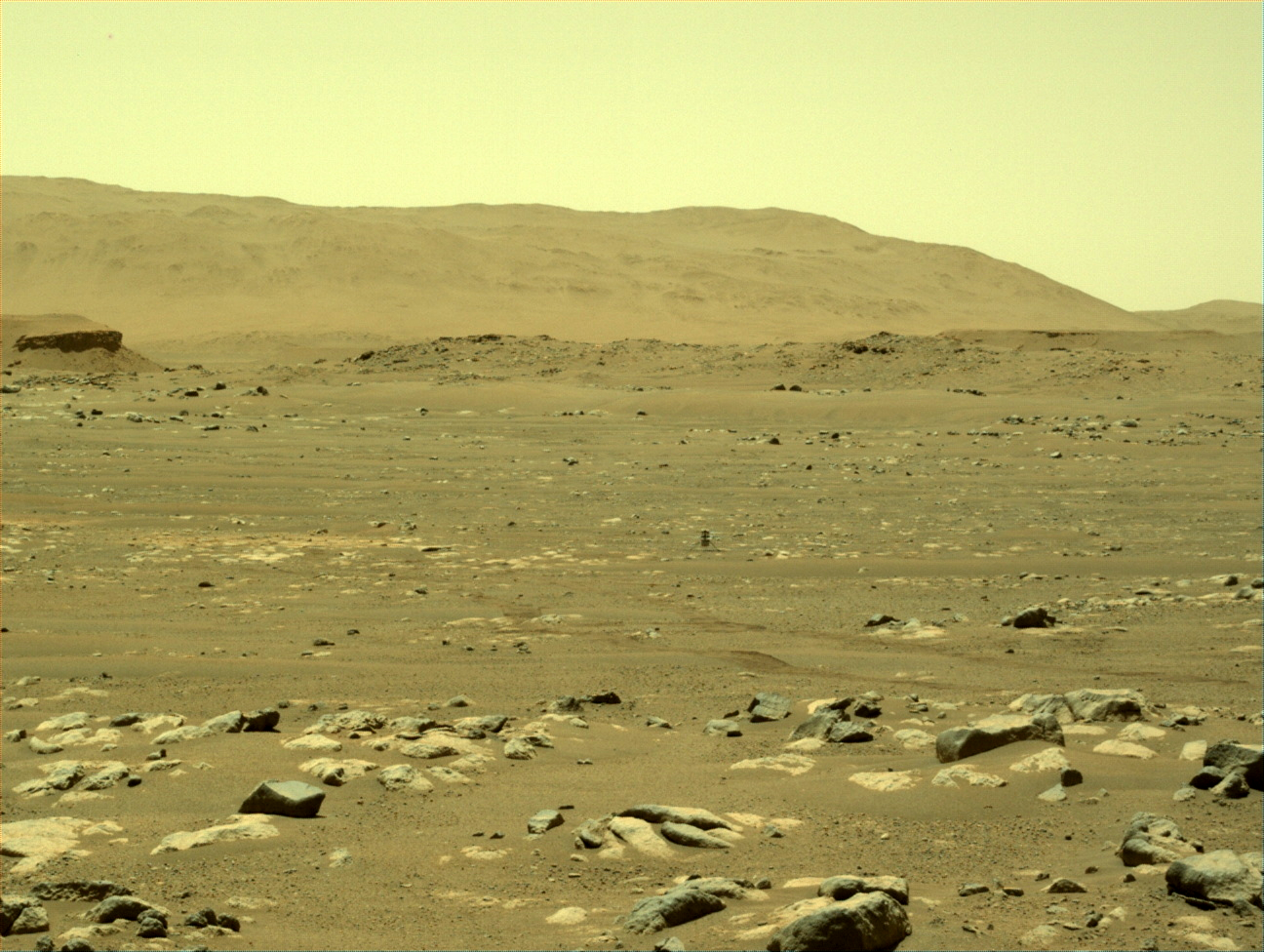
Video of Ingenuity’s flight, taken by Perseverance

JPL yesterday released a short one minute long video created from images taken by the high resolution mast camera on Perseverance.

You can view the animation here.

Stitched together from multiple images, the mosaic is not white balanced; instead, it is displayed in a preliminary calibrated version of a natural-color composite, approximately simulating the colors of the scene as it would appear on Mars.

6 comments

Amazon signs ULA’s Atlas 5 for first 9 Kuiper satellite launches

Capitalism in space: Amazon today announced that it has signed a launch contract with ULA to use its Atlas 5 rocket for the first 9 Kuiper satellite launches.

The announcement did not say when these flights will take place, nor how many Kuiper satellites will be on each. Amazon’s license with the FAA requires that it launch half its 3,200 satellite constellation by ’26. Also ULA intends to retire the Atlas 5 in only a few years, replacing it with its Vulcan rocket. This suggests that the launches will occur in the next three years.

They better. Starlink is already going operational, and OneWeb is about to. Plus several other internet constellations are in the pipeline. If Amazon wishes to compete it needs to get those satellites in orbit as quickly as possible. Internet customers don’t generally change their servers easily, tending to stick with whom they’ve got. If Starlink and OneWeb scoop up all the best low-hanging internet fruit Amazon will find itself facing an uphill battle getting customers.

The article revealed one tidbit of interest. Rajeev Badyal, Amazon’s VP of technology for the Kuiper project, was one of the managers Elon Musk fired from his Starlink project in 2018 after realizing that that management team was moving far too slowly for his tastes. It appears Jeff Bezos then hired Badyal to run Kuiper.

1 comment

Mask madness even as scientists confirm once again their uselessness

Even as a just published new study has shown once again the utter uselessness of masks to limit the spread of respiratory diseases like COVID-19, the control freaks of our now largely oppressive society are clamping down with new totalitarian rules requiring masks to be worn at all times, no matter what.

First let ‘s look at the study, which was published by the National Center for Biotechnological Information government website, a branch of the National Institute for Health. From the paper:

The physical properties of medical and non-medical facemasks suggest that facemasks are ineffective to block viral particles due to their difference in scales. According to the current knowledge, the virus SARS-CoV-2 has a diameter of 60 nm to 140 nm [nanometers (billionth of a meter)], while medical and non-medical facemasks’ thread diameter ranges from 55 µm to 440 µm [micrometers (one millionth of a meter), which is more than 1000 times larger. Due to the difference in sizes between SARS-CoV-2 diameter and facemasks thread diameter (the virus is 1000 times smaller), SARS-CoV-2 can easily pass through any facemask. In addition, the efficiency filtration rate of facemasks is poor, ranging from 0.7% in non-surgical, cotton-gauze woven mask to 26% in cotton sweeter material. With respect to surgical and N95 medical facemasks, the efficiency filtration rate falls to 15% and 58%, respectively when even small gap between the mask and the face exists.

Clinical scientific evidence challenges further the efficacy of facemasks to block human-to-human transmission or infectivity. A randomized controlled trial (RCT) of 246 participants [123 (50%) symptomatic)] who were allocated to either wearing or not wearing surgical facemask, assessing viruses transmission including coronavirus. The results of this study showed that among symptomatic individuals (those with fever, cough, sore throat, runny nose etc…) there was no difference between wearing and not wearing facemask for coronavirus droplets transmission of particles of >5 µm. Among asymptomatic individuals, there was no droplets or aerosols coronavirus detected from any participant with or without the mask, suggesting that asymptomatic individuals do not transmit or infect other people. This was further supported by a study on infectivity where 445 asymptomatic individuals were exposed to asymptomatic SARS-CoV-2 carrier (been positive for SARS-CoV-2) using close contact (shared quarantine space) for a median of 4 to 5 days. The study found that none of the 445 individuals was infected with SARS-CoV-2 confirmed by real-time reverse transcription polymerase.

There is a lot more in the study. Read it all. It shows, based on extensive research, that even when worn properly masks are relatively useless in stopping viral diseases. And since as mandated no one ever uses them properly, they end up becoming likely collectors of pathogens instead, at the very spot where people breath, thus contributing to the spread of infection.

The study also documented the numerous physiological and psychological costs caused by the forced continuous use of masks, from restricting oxygen to causing people to become socially isolated.

The paper’s conclusion:
» Read more

37 comments

Spring arrives on the northern polar cap of Mars

Buzzell dunes and pedestal crater near the Martian north polar ice cap
Click for full image.

Cool image time! It is now spring in the northern hemisphere of Mars, and the first bits of sunlight are finally reaching its north polar ice cap. During the winter, as happens each Martian year, that polar cap of water ice gets covered by a thin mantle of dry ice no more than six feet thick. Moreover, this mantle doesn’t just cover the ice cap, it extends south as far as about 60 degrees latitude, covering the giant sea of dunes that surrounds the ice cap.

When spring comes that mantle begins sublimate away, with its base first turning to gas. When the pressure builds up enough, the gas breaks out through the frozen mantle’s weakest points, usually the crest or base of dunes or ridges, leaving behind a dark splotch caused by the material thrown up from below that contrasts with the bright translucent dry ice mantle.

Each year for the past decade scientists have been using the high resolution camera on Mars Reconnaissance Orbiter (MRO) to monitor this sublimation process. The photo above, taken on February 24, 2021 and cropped, enlarged, and brightened to post here, marks the start of this year’s monitoring program. Dubbed informally “Buzzell” by Candice Hansen of the Planetary Science Institute in Arizona, it shows dunes with a round pedestal crater just right of center. Though almost everything when this picture was taken is still covered by that dry ice mantle, in the lower left is a single splotch, the first breakout of CO2 gas that marks the beginning of the annual disappearance of this dry ice.

Last Martian year I repeatedly posted images of Buzzell to illustrate this annual process. The second image below was taken on April 4, 2019, at about the same comparable time in spring.
» Read more

0 comments

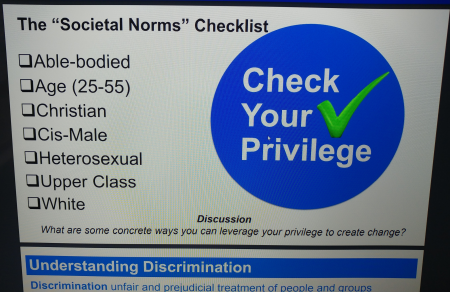
Today’s blacklisted American: Anyone who is white, Christian, or male at Cigna

Cigna training presentation
According to Cigna’s training, these are bad things.

They’re coming for you next: Company documents as well as interviews have confirmed that the health insurance company Cigna actively discriminates against whites in its hiring practices, as well as runs training sessions using Critical Race Theory that aims at making all whites, males, and Christians ashamed of what they are, because by definition such people are automatically racist bigots.

The original story is here. From the first link:
» Read more

23 comments

Boeing confirms next Starliner unmanned demo flight delayed until August

Capitalism in space: Boeing on April 17th confirmed what had already been rumored, that the second unmanned demo flight to ISS of Starliner, its manned capsule, has been delayed until August.

In a statement, Boeing said that the company and NASA are projecting the uncrewed Orbital Flight Test (OFT) 2 mission will take place in August or September. That date is “supported by a space station docking opportunity and the availability of the United Launch Alliance Atlas V rocket and Eastern Range.”

Boeing had been working toward a launch of OFT-2 in late March or early April. However, by early March, NASA officials acknowledged that was no longer likely because of delays from the replacement of avionics units on the spacecraft that were damaged by a power surge during ground tests, as well as power outages in the Houston area caused by a winter storm in February that interrupted software testing.

They still hope to make the first manned demo flight before the end of the year, assuming the summer unmanned flight goes as planned.

For Boeing, the sooner they get this capsule operational, the sooner it can start earning money by flying commercial flights. At the moment the delays have meant that SpaceX is getting all that business, with two private flights already scheduled and rumors that it will win a flight from the UAE as well. Furthermore, other commercial competitors are on the horizon, including both China and India.

15 comments

Starship prototype #15 readying for flight, possibly tomorrow

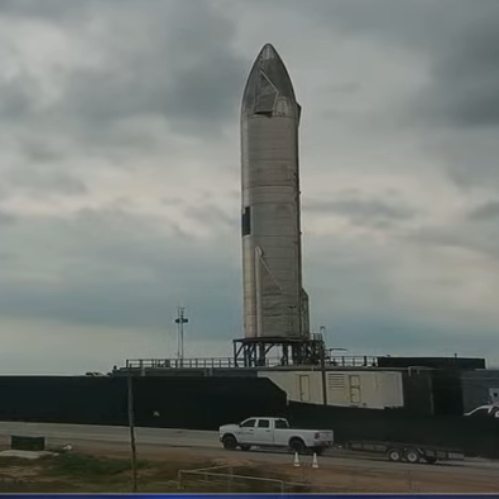
Starship #15 on launchpad
Screen capture from Labpadre launchpad live stream.

Capitalism in space: SpaceX’s 15th prototype of its Starship upper stage, is preparing to do a static fire test today, with its first test flight possibly as soon as tomorrow, though at present the FAA has not given its approval.

They have done tank tests already, and installed three upgraded Raptor engines yesterday. This spacecraft is a major upgrade from the previous prototypes, and SpaceX probably plans to eventually fly it higher and farther than the previous prototypes. Though no details about those flight plans has yet been released, the first flight will almost certainly repeat the previous flights, going up about ten miles, flipping sideways to simulate a controlled atmospheric descent, and then uprighting itself and landing vertical on the landing pad. Hopefully the upgrades will result in the first truly clean landing with this prototype.

Though the FAA under the Biden administration has seemed eager to flex its bureaucratic muscles and slow development, that NASA has chosen this vehicle as the one that will take astronauts to and from the Moon will put pressure on it to not slow things down too much.

4 comments

Ingenuity flies!

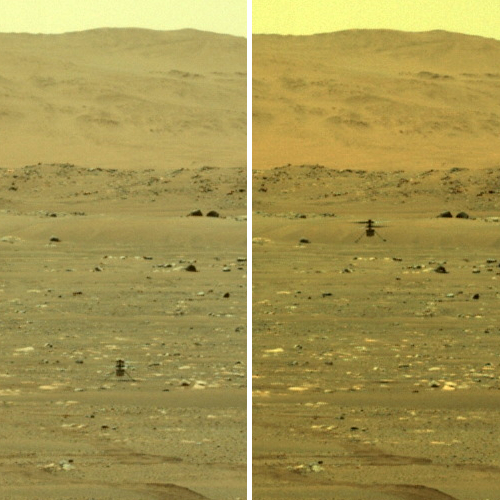
Ingenuity takes off!
For full images go here and here.

The first autonomous flight of the helicopter Ingenuity on Mars successfully took place early this morning, according to JPL engineers.

NASA has pulled off the first powered flight on another world. Ingenuity, the robot rotorcraft that is part of the agency’s Perseverance mission, lifted off from the surface of Mars on 19 April, in a 40-second flight that is a landmark in interplanetary aviation. “We can now say that human beings have flown a rotorcraft on another planet,” says MiMi Aung, the project’s lead engineer at the Jet Propulsion Laboratory (JPL) in Pasadena, California.

As shown by the two images taken by Perseverance above, the first flight was very simple. The helicopter simply rose about 10 feet, hovered for about 30 seconds as it swiveled 90 degrees, and then carefully descended back down. I have also embedded the video that JPL scientists have created compiling by high resolution Perseverance images below the fold.

Four more flights will next be attempted in the coming weeks.

Four further flights, each lasting up to 90 seconds, are planned in the coming weeks. In these, Ingenuity is likely to rise up to 5 metres [16 feet] above the surface and travel up to 300 metres [1000 feet] from the take-off point. Each successive flight will push Ingenuity’s capabilities to see how well the drone fares in Mars’s thin atmosphere, which is just 1% as dense as Earth’s.

» Read more

16 comments

The rovers’ view of Mars

The view from the top of Mont Mercou
Click for higher resolution. For original images, go here and here.

Some cool images to savor from Mars! Above is a panorama from Curiosity, created by me from two images taken by the rover’s left navigation camera today, April 18, 2021. The view is southwest towards the canyon regions where Curiosity will be heading in the coming months. Note the roughness of the ground. Travel is going to be tricky from here on out.

The photo was taken from the top of Mont Mercou, the 20-foot high outcrop that the rover spent several weeks studying at the cliff’s base. The Curiosity science team is presently preparing to drill into the bedrock at the top.

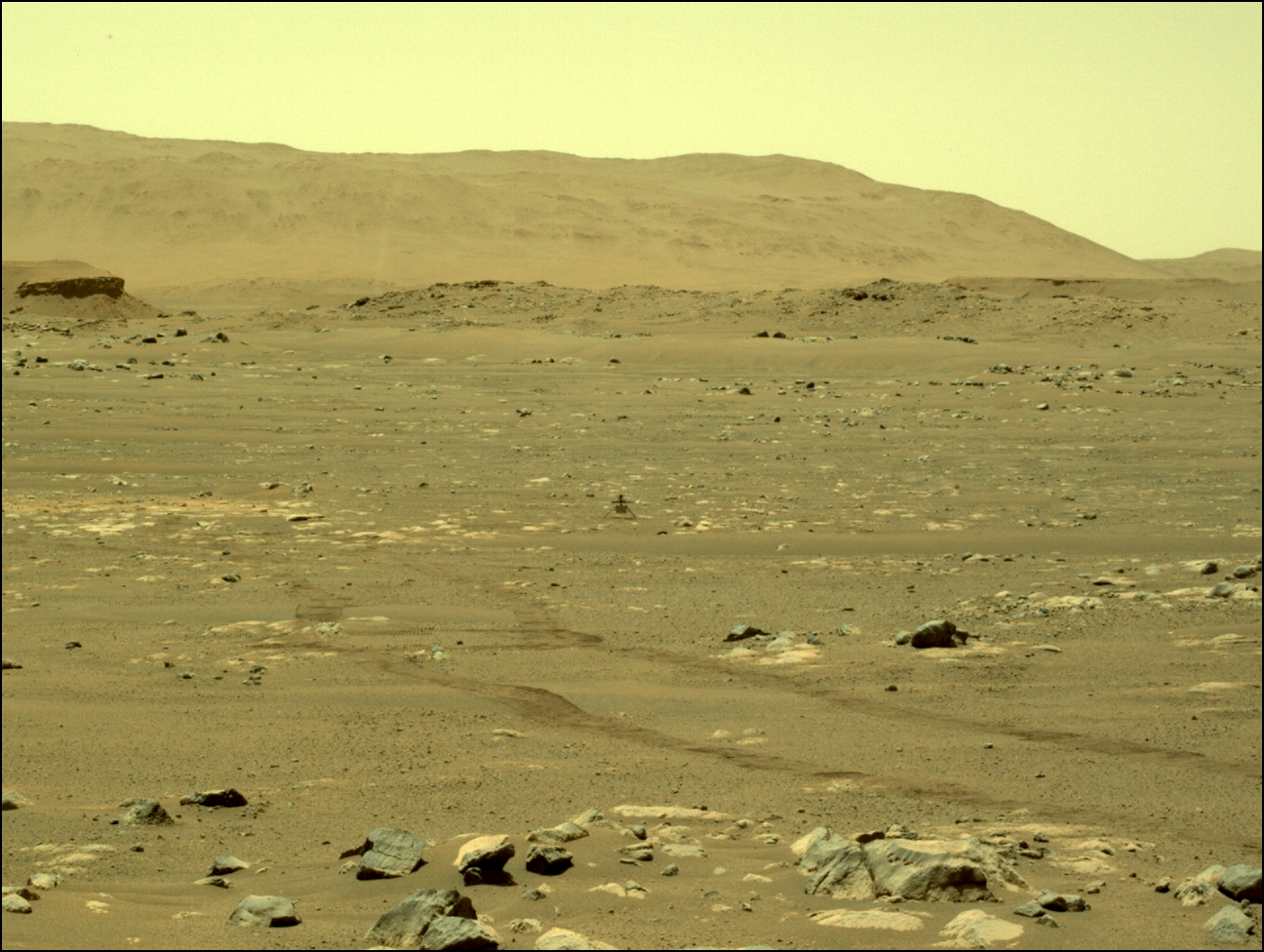
Ingenuity on the floor of Jezero Crater
Click for full image.

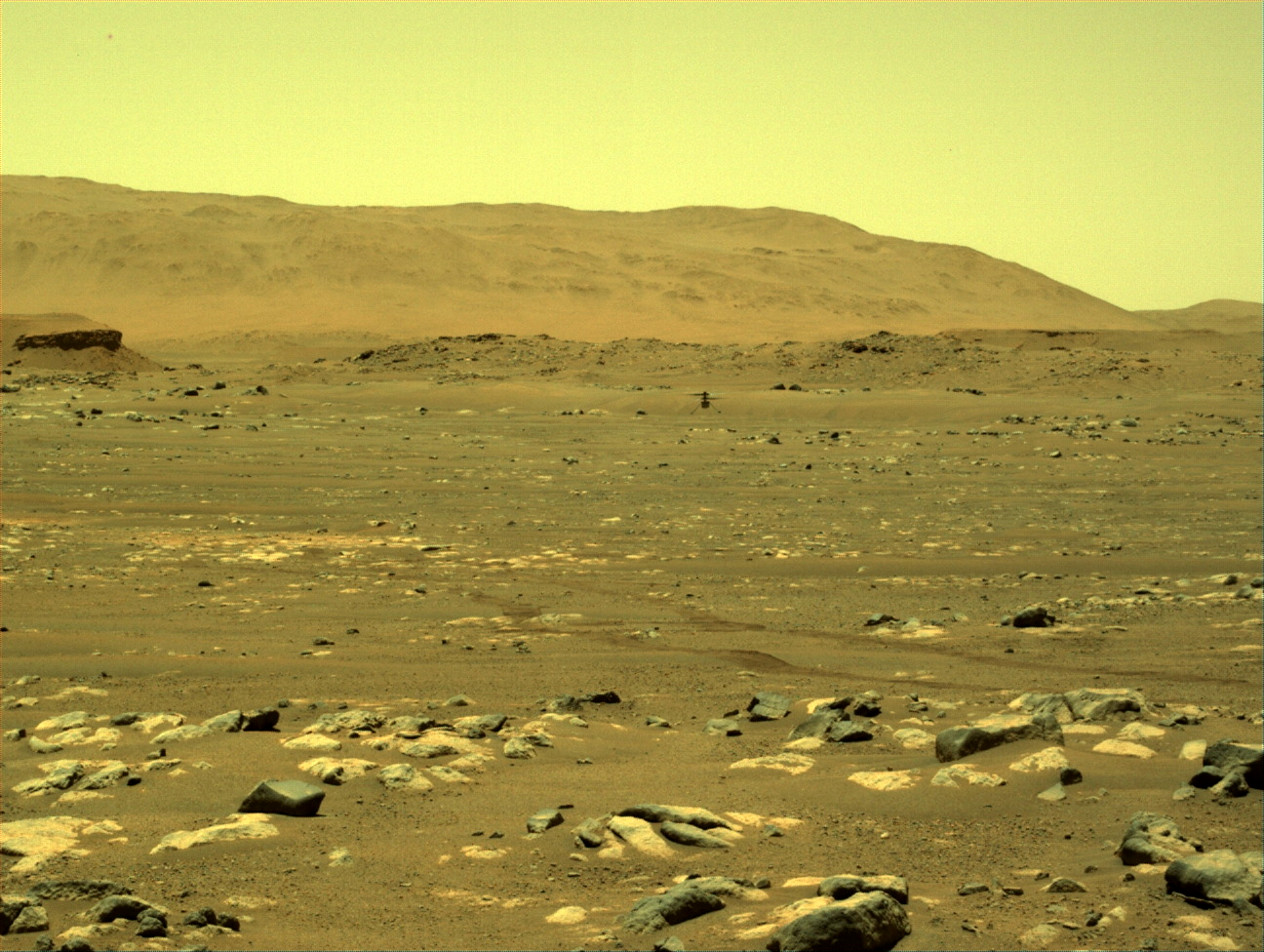
The photo to the right, reduced to post here, was taken by Perseverance on April 13, 2021, and looks west across the floor of Jezero crater. The high mountains in the distance are the crater’s rim. The low and much closer hill is the delta that is the rover’s primary geological target.

In the center of the picture is the helicopter Ingenuity. You can also see the tracks of Perseverance’s wheels just below it.

This will be the rover’s vantage point when Ingenuity attempts its first test flight in the early morning hours of April 19, 2021. The helicopter will head to the right once it lifts off.

2 comments
1 117 118 119 120 121 167