SpaceX successfully launches Indonesian broadband satellite

SpaceX yesterday successfully launched an Indonesian broadband satellite, using its Falcon 9 rocket lifting off from Cape Canaveral.

The first stage completed its twelfth flight, landing on a drone ship in the Atlantic. The fairing halves completed their seventh and ninth flights respectively.

The leaders in the 2023 launch race:

41 SpaceX
23 China
8 Russia
5 Rocket Lab

American private enterprise now leads China 46 to 23 in the national rankings, and the entire world combined 46 to 39, with SpaceX by itself still leading the rest of the world, excluding other American companies, 41 to 39.

3 comments

Rocket Lab completes first suborbital test launch of its Electron rocket

As part of its contract for providing the Defense Department with a testbed for hypersonic testing, Rocket Lab on June 17, 2023 successfully completed the first suborbital test launch of its Electron rocket.

The HASTE suborbital launch vehicle is derived from the Companyโ€™s Electron rocket but has a modified Kick Stage for hypersonic payload deployment, a larger payload capacity of up to 700 kg / 1,540 lbs, and options for tailored fairings to accommodate larger payloads, including air-breathing, ballistic re-entry, boost-glide, and space-based applications payloads. By leveraging the heritage of Rocket Labโ€™s low-cost Electron โ€“ the worldโ€™s most frequently launched commercial small launch vehicle โ€“ HASTE offers true commercial testing capability at a fraction of the cost of current full-scale tests.

Because of its military nature, Rocket Lab’s press release was generally terse in providing details. Sources in the industry tell me that this launch was designed to prove out the required suborbital capabilities of Electron prior to the first hypersonic test flight. When that flight takes place, it will carry a hypersonic test vehicle built by another company, Hypersonix.

Rocket Lab with this launch demonstrated again the smart flexibility of the company. It only announced this suborbital concept for Electron in April. Only two months later it has test flown it. It is now ready to fly an actual hypersonic test flight, and waits only for the test vehicle to be provided by Hypersonix. The speed of this program leap-frogged Stratolaunch, which is also offering its Roc airplane and Talon hypersonic test vehicle to the military but started its project in late 2020 and is still not ready for flight.

1 comment

PLD’s first suborbital test launch aborted just prior to launch

According to company officials, the first suborbital test launch of PLD Miura-1 rocket was aborted today just prior to launch because some of the umbilical fuel and power lines failed to disconnect as planned.

The launch was from PLD’s launch site in Spain. No word when the company will try again. Before it can build its orbital Miura-5 rocket it needs the test data from this suborbital launch.

0 comments

June 16, 2023 Quick space links

Courtesy of BtB’s stringer Jay.


May everyone have a great weekend!

2 comments

The icy mesas of Mars’ glacier country

Overview map

The ice mesas of Mars' glacier country
Click for original image.

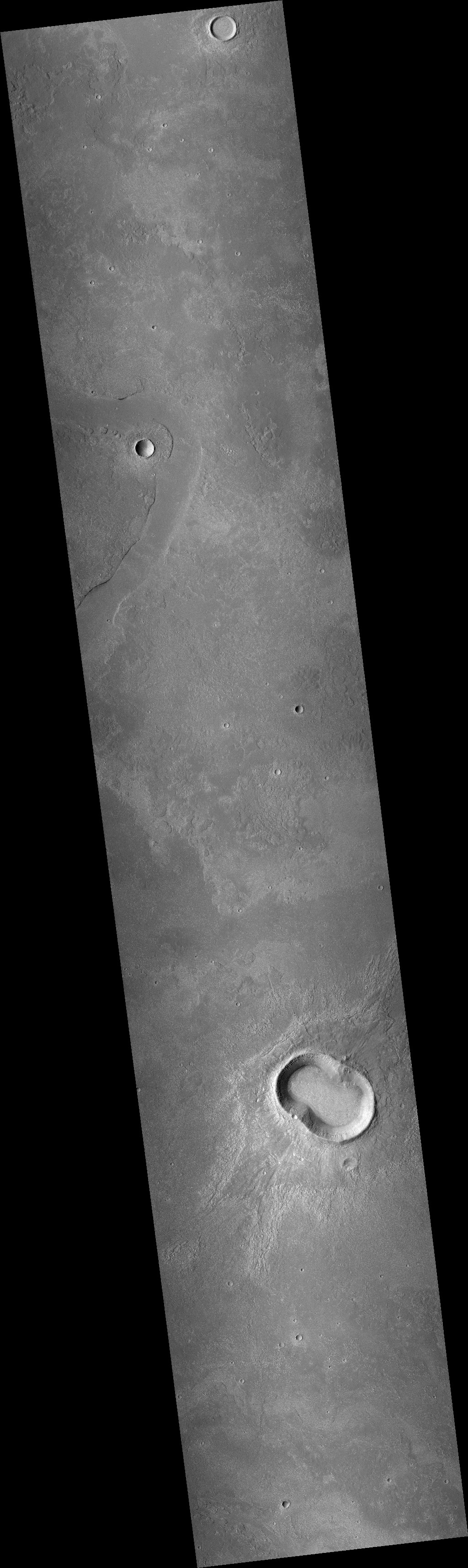
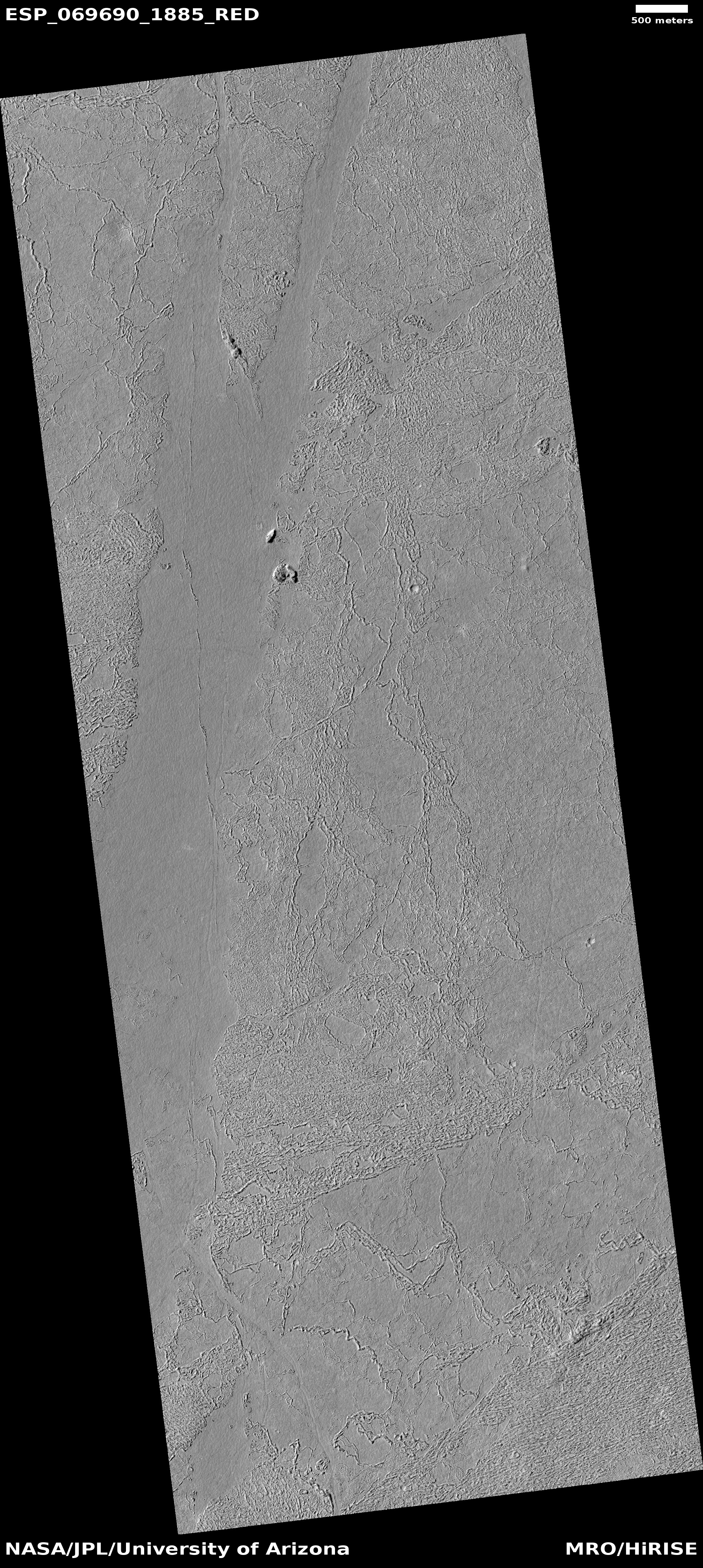
Cool image time! The picture to the right, rotated, cropped, and reduced to post here, was taken on March 25, 2023 by the high resolution camera on Mars Reconnaissance Orbiter (MRO). The science team labeled this image “Cross-Section of Glacier-Like Form,” probably because the mesa in the center of the picture clearly shows numerous layers as you descend from its peak to the surrounding plains, an elevation difference of about 200 feet.

The white dot about 250 miles due south of Lyot Crater on the overview map above marks the location of this mesa, inside the chaos terrain of Deuteronilus Mensae that is the western section of the 2,000 long strip in the northern mid-latitudes of Mars that I call glacier country, since practically every image, like today’s, suggests the presence of glaciers.

The oblique mosaic below, created using MRO’s context camera images, illustrates this fact even more spectacularly.
» Read more

0 comments

Lightning on Jupiter

Lightning on Jupiter
Click for original image.

Cool image time! The picture to the right, cropped and reduced to post here, was taken on December 30, 2020 by Juno during its 31st close fly-by of Jupiter, and was enhanced and processed by citizen-scientist Kevin Gill.

In this view of a vortex near Jupiter’s north pole, NASA’s Juno mission observed the glow from a bolt of lightning. On Earth, lightning bolts originate from water clouds, and happen most frequently near the equator, while on Jupiter lightning likely also occurs in clouds containing an ammonia-water solution, and can be seen most often near the poles.

Juno was about 20,000 miles above Jupiter’s clouds when it took this picture, located at about 78 degrees north latitude.

4 comments

Rocket Lab about to launch a secret mission

Rocket Lab is gearing up to launch a rocket from Wallops sometime between June 15th and June 20th but it will provide no live stream and no press access.

The article at the link then speculates that this launch might be the first military hypersonic test flight using a suborbital version of Rocket Lab’s Electron rocket.

That launcher is called HASTE, short for “Hypersonic Accelerator Suborbital Test Electron.” As that name suggests, HASTE is derived from the workhorse Electron and is designed to help test technologies for hypersonic craft โ€” highly maneuverable vehicles capable of flying at least five times the speed of sound.

HASTE can haul up to 1,540 pounds (700 kilograms) of payload aloft, whereas Electron can deliver a maximum of 660 pounds (300 kg) to low Earth orbit. The suborbital rocket also features a modified version of Electron’s “kick stage” specialized for the deployment of hypersonic payloads, Rocket Lab said in an April 17 statement that announced HASTE’s existence.

The suborbital rocket is scheduled to make its debut right about now, on a mission whose details are hard to come by, according to that statement.

If so, we will only find out some limited details after launch, based on what the military decides to release publicly.

Regardless, the HASTE project demonstrates the ability of Rocket Lab to quickly improvise in order to find new ways to make money from its existing assets. For its stockholders, it is another piece of evidence that the company is a good investment.

1 comment

ESA transfers its Artemis-2 Orion service module to NASA

The European Space Agency (ESA) yesterday officially handed over to NASA its second completed Orion service module, to be used in 2024 on the first manned Artemis mission, dubbed Artemis-2, that will carry four astronauts on a mission around the Moon.

The European Service Module-2 will power the Orion spacecraft on the Artemis II mission that will see NASA astronauts commander Reid Wiseman, pilot Victor Glover, and mission specialists Christina Koch with Canadian Space Agency astronaut Jeremy Hansen complete flyby of the Moon and return to Earth.

The crew will fly Orion to 8889 km beyond the Moon before completing a lunar flyby and returning to Earth. The mission will take a minimum of eight days and will collect valuable flight test data, in the first time for over 50 years that humans have voyaged to our natural satellite.

The odds of this launching in 2024 are relatively slim. It will also be the first time NASA will be flying Orion’s environmental systems (the systems that keep the astronauts alive). We all hope those system work perfectly this first time, since people will be on board.

0 comments

Axiom delays launch of first space station module to ’26

Buried in a Space.com article today about Axiom was the important revelation that the company has now officially delayed the launch of its first space station module that will be attached to ISS from 2024 to 2026, with the rest of its follow-up modules delayed as well.

In January 2020, Axiom won NASA’s contract to construct the first commercially manufactured module for the ISS. “Our first module is going to be in 2026,” David Zuniga, senior director of in-space solutions at Axiom, told Space.com. This is an update to the company’s previously stated target of 2024.

Axiom’s first station component will attach to the forward port of the ISS’ Harmony module and serve as the springboard for the remaining pieces of the company’s planned space station architecture. Axiom is planning to attach a second module in 2027 and a third module a year later. Finally, a thermal power module, scheduled for sometime before 2030, will allow Axiom’s space station to detach from the ISS and become a free-flying, commercially run low Earth orbit (LEO) destination.

This schedule puts Axiom at some risk. ISS is likely going to be retired in 2030. Axiom has to therefore be able to detach its space station before that happens. It seems however with this new schedule that it might not be ready. And if it can’t, it will then need to arrange some deal with NASA and ISS’s international partners to either take over operations of ISS temporarily or convince these nations to operate it a little longer.

8 comments

A private Russian rocket?

According to two short stories in the Russian state-run press (here and here), a private Russian company, dubbed SR Space, is developing a private orbital rocket, and has already completed two launches of a test rocket, though neither launch reached suborbital space.

It is now assembling its first suborbital rocket intended to reach space.

As the SR Space press office specified for TASS, the new sub-orbital rocket is set for its launch at the end of the year. “The launch is scheduled for the end of the current year to deliver a signal transmitter payload,” the press office said. The transmitterโ€™s signal sent to Earth is expected to be received by drones engineered by the company. “This is necessary to test interaction with remotely piloted aircraft systems and the technology of their remote control and flight control of a swarm in automatic mode,” it explained.

This will be the first launch of a private sub-orbital rocket in Russia to an altitude of over 100 km (the altitude where outer space begins). The carrier rocket will measure 5.17 meters in length and 0.45 meters in diameter and weigh 253 kg.

SR Space appears to be the same kind of pseudo-company that China allows. It has obtained private funding, and is operating with some independence hoping to win contracts from the Russian government in order to earn a profit. At the same time, it without doubt does nothing without that government’s permission and approval, and can be taken over at any time by that government, as happened to Russia’s last commercial rocket company S7 that wanted to use the Sea Launch ocean platform to fly commercial launches.

0 comments

June 15, 2023 Quick space links

Courtesy of BtB’s stringer Jay.


  • Kuiper official urges governments to regulate the methods used by satellite makers to maneuver their satellites
  • I like Jay’s comment: “How many satellites does Kuiper have again? Zero. Damn arm-chair satellite companies!” The timing of this statement, a day after the WEF issued its proposed government guidelines for de-orbiting satellites, suggests Amazon supports that effort, but has a different approach as to how those rules should be implemented.

    In other words, Amazon wants to dictate how others build their satellites. Or make it illegal for them to do so as they wish. Seems a great plan for eliminating one’s competition.

5 comments
1 447 448 449 450 451 2,413